The Pearl Cluster (NGC 3766, Caldwell 97), in Centaurus, from my backyard, 15 km North from Sydney’s city center, on 4th June 2020.
This image compiles 30 x 180s images (1.5 hours total integration time) obtained with my Skywatcher Black Diamond 80, an Orion X0.8 focal reducer (f/6), the ZWO ASI178MC camera and an OPTOLONG L-Pro filter.
I used the ZWO ASIAir to control the camera, the mount (Skywatcher AZ-EQ6) and the guiding system (ASI120MM + Orion 50mm finderscope).
Flats and darks included. Data processed with Siril software. Color / saturation / levels / contrast / smart sharpen with Photoshop.
“The Lighthouse” is the online Macquarie University‘s Newsletter that aims to showcase of world-changing research news, expert comment and data-backed opinion.
I want to thank Virginia Tressider for preparing this beautiful article in a very short time. I hope that many of these articles will come in the nearby feature.
Nate Byrnetalking about my astronomical images in today’s ABC Breakfast News. You can see the high-resolution image Nate is showing on my webpage and on my Flickr.
I’m extremely excited about all of this, and I really want to thank Nate for showing my images.
Unfortunately, though, I couldn’t watch the show, and it is not available on iView. I’m trying to get the screenshots of the other images that Nate shared today to include them here.
My “SpaceNews” for the episode of “The Skyentists” that Kirsten and me released yesterday was to talk about the citizen science project that is running this Sunday, 21st June (Winter Solstice in the Southern Hemisphere) with the aims of measure the light pollution in Australia and New Zealand.
This citizen science project is also part of the Guinness World Records ™ Official Attempt for Most users to take an online environmental sustainability lesson in 24 hours.
As you know, I’ve been fighting the big problem of the light pollution for decades, and not only because it negatively affects us, astronomers, but also because of the huge environmental impact that the light pollution is, with plenty of negative effects in flora, fauna and our health, and on top of that it is a stupid way of wasting our resources (and MONEY) and contribute to CO2 emission.
Hence, I’m helping as much as I can to promote this citizen science project and make the people aware of what we are missing because we are not illuminating properly our cities.
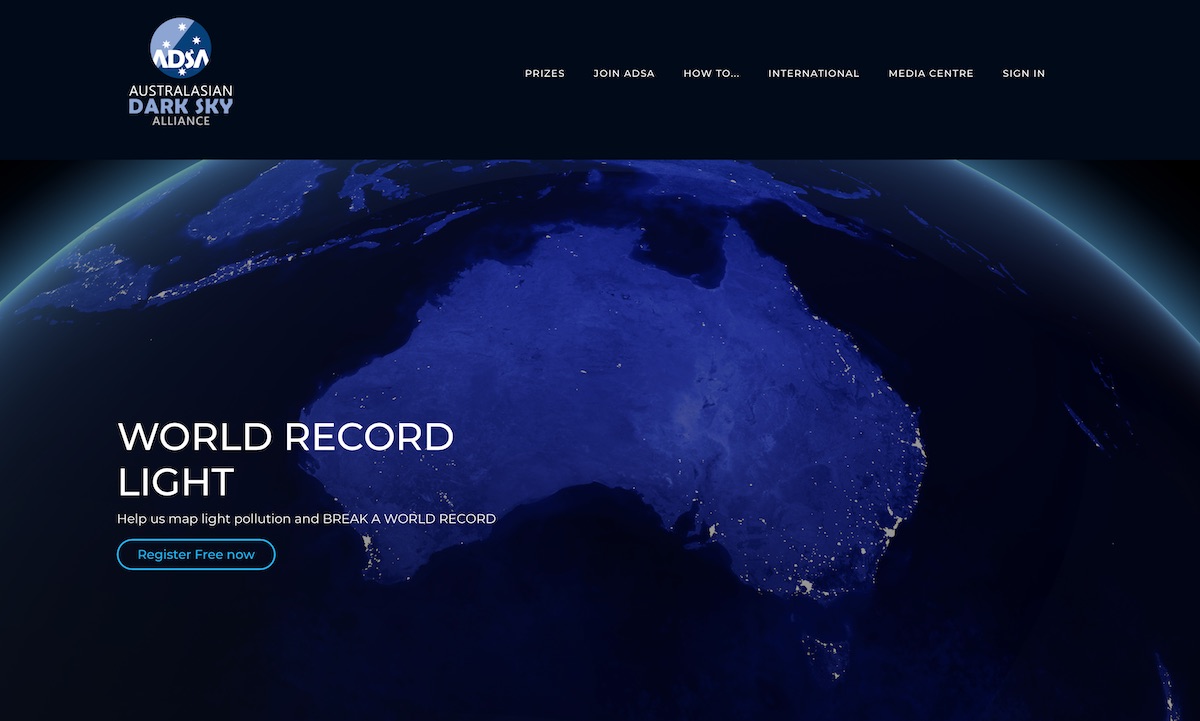
This morning, Marnie Ogg, CEO of the Australasian Dark Sky Alliance, has been interviewed by the famous weather presenter, meteorologist and science communicator Nate Byrne in the public Australian TV channel, ABC, about it.
The Australian night sky is amazing, but light pollution can ruin the view.
This Sunday, citizen scientists are being urged to measure how light is affecting how we see the stars.@SciNate gets the lowdown from @DarkSkyAlliance.
And I’m very happy because, for some few seconds, I was on TV!!!
I’m very grateful to Niall Byrne (Science in Public), Tanya Ha, Nate Byrne and Marnie Ogg for using my images and videos for all of this, but also for crediting them.
So, now you know, this Sunday evening don’t stay inside your house: get your kids, your friends, your family, your parents, your boyfriend or your girlfriend and look at the sky to help us measuring the light pollution in Australia, and perhaps even beating a World Guinness Record!
Update: Below I compile the links to articles in the media that have used my images for talking about all of this.
Help measure who has the darkest skies in Australia, The Rural, 21 June 2020. (The same article has been published in a total of 33 newspapers!!! I’m not going to list all of those here, some of them are: Illawarra, Central Western Daily, Mudgee Guardian, Hunter Valley News, Bendigo, Glen Innes Examiner, Wauchope Gazette, Moree, Barossa Herald, Margaret River Mail, Walcha News, South Coast Register, Sunshine Coast Daily, Busselton Mail…)
In today’s episode of The Skyentists, astronomers Kirsten Banks and Ángel López-Sánchez talk about Australian Aboriginal Astronomy. Kirsten provides a general overview of the importance that Astronomy has always had on Earth’s longest-living culture: Australian Aboriginal people. In particular, she discusses how Aboriginal Australians draw constellations in the sky: connecting stars (as usually done in Western civilisations), using just single, bright stars like Arcturus, but also considering the “dark areas” of the Milky Way for creating “dark constellations”, such as the “Emu in the Sky”. Precisely the long, dark, Australian Aboriginal constellation “Emu in the Sky” (that crosses from the Coal Sack dark nebula in the Southern Cross to the Galactic Center in Sagittarius) is our “What’s Up!” for this episode. For Space News, Ángel talks again about the problem of the light pollution, this time not only from the perspective of Astronomy, but also environmental, our health, the impact in flora and fauna, and its useless waste of energy (=money). For this, The Skyentists invite everybody to participate in the citizen science project lead by The Australasian Dark Sky Alliance aiming to measure the light pollution of our cities and towns this Sunday, 21st June 2020. Kirsten brings a very interesting new result combining two independent works about Titan in Saturn. They also answer some questions and provide some extra feedback about the previous episode. More in two weeks!








 A/Prof. Ángel R. López-Sánchez