Category Archives: Astrophotography

Feeding, Feedback and Fireworks in galaxies

During this week (23 – 28 June 2013), I’m participating in the international astrophysics conference “Feeding, Feedback, and Fireworks: Celebrating Our Cosmic Landscape”, which is hosted in the tropical paradise of Hamilton Island, one of the most important islands of the Whitsundays (Queensland, Australia). The conference is jointly supported by the Australian Astronomical Observatory (AAO) and the CSIRO Astronomy and Space Science (CASS) and it is the 6th of the Southern Cross Conference Series.

Poster of the “Feeding, Feedback, and Fireworks: Celebrating Our Cosmic Landscape”, jointly supported by the Australian Astronomical Observatory (AAO) and the CSIRO Astronomy and Space Science (CASS), being the 6th of the Southern Cross Conference Series. The Heart Reef near Hamilton Island appears in the foreground, while the Hubble Ultra-Deep Field image is the background image.
Credit: Heart Reef Photo and Fireworks: Ángel R. López-Sánchez (Australian Astronomical Observatory / Macquarie University); Hubble Ultra-Deep Field: NASA, ESA and R. Thompson (Univ. Arizona).

It has been a very intense and fruitful conference, with almost 100 participants (the majority coming from Australia, but many others from America, Europe, Asia and Africa), and we are discussing hot topics about how the diffuse gas is moved inside the galaxies (Feeding), how stars form in galaxies (Fireworks) and how these newborn stars alter the properties of their host galaxies and their surroundings (Feedback). We are also investigating the role of the Active Galactic Nuclei (AGN) in galaxy evolution: how are they triggered (Feeding) and how they affect their host galaxies and even the galaxy cluster their host galaxies reside (Feedback). All in the context of the cosmological evolution of the Universe, constraining theoretical models using observations, and trying to put all the pieces together to understand the evolution of the galaxies.

In my case I presented part of my multi-wavelength work in Blue Compact Dwarf Galaxies, which are small galaxies (smaller than 1/100 times the size and mass of the Milky Way) which are experiencing a very intense star-formation event. Hence, it seems all the dwarf galaxy is a giant nebula! I’ll describe these interesting objects in a future post.

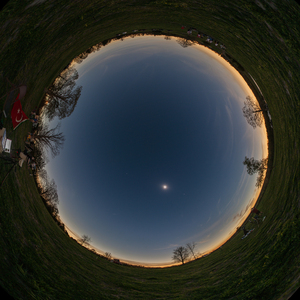
I’m part of the “LOC”, the Local Organizing Committee, which is chaired by Amanda Bauer (AAO), aka @astropixie, and hence in the last months I have actively participate to get the conference smoothly running (conference booklet, schedule of the talks, helping in registration and photos). One of my tasks during this week was to get the “Conference Photo” which, as Amanda suggested, includes not only the beach and palm trees of the beautiful beach at Hamilton Island but also a nice night-sky photo showing the Southern Cross. The result is this:

Conference Photo of the “Feeding, Feedback, and Fireworks: Celebrating Our Cosmic Landscape” conference.
Photo Credit and composition: Ángel R. López-Sánchez (Australian Astronomical Observatory / Macquarie University).

The talks and more information about this exciting conference will be posted in the conference webpage soon.

Partial solar eclipse from Sydney

Today, 10th May 2013, the combined movements of the Sun, Earth and Moon gave us a very nice Annular Solar Eclipse. Following a similar path to the Total Solar Eclipse we enjoyed last November, the shadow of the Moon over the Earth moved from North Australia to the Pacific. However, today the Moon was close to its maximum distance to the Earth (planets and satellites move following elliptical orbits) and hence its apparent size on the sky was not big enough to completely cover the disc of the Sun. This is indeed the reason the eclipse was an annular solar eclipse.

In this occasion I couldn’t travel to North Australia to enjoy the annular eclipse (actually, I have seen 2 of these in the past, the most recent one was on 3rd October 2005 from Madrid), and even last night I didn’t expect to do anything special about this today. But this morning, while watching it from my backyard using my solar glasses, I decided just to take some few shots using not the telescope but only the tele lens. This is the result:

Partial Solar Eclipse from Sydney. Data obtained using a CANON EOS 600D, a 250mm Tele Lens and a Solar filter (which I hold by hand). I stacked 12 individual frames obtained at ISO 100, f10, 1/80 s using the Lynkeos software. The final processing was achieved using Photoshop. 10 May 2013 @ 09: 10 AEST ( 00:10 UT ), Sydney, Australia.
Credit: Ángel R. López-Sánchez (Australian Astronomical Observatory / Macquarie University, Agrupación Astronómica de Córdoba / Red Andaluza de Astronomía)

I hope you like it.

Timelapse video: The Sky over the Anglo-Australian Telescope

A dark winter night, with the Milky Way crossing the firmament while its center in located near the zenith, is one of the most astonishing views we can enjoy. This vision is only obtained from the Southern Hemisphere and it is really inspiring. In particular, the Milky Way shines over the Siding Spring Observatory, near Coonabarabran (NSW), where the famous Anglo-Australian Telescope (AAT) is located. With the idea of sharing the beauty of the night sky to everybody, in May 2011 I decided to start taking timelapse photography while I was working as support astronomer at the AAT. This technique consists on taking many images and then adding all to get a movie with a very high resolution. The best shots I obtained by September 2011 were included in the video The Sky over the Anglo-Australian Telescope, which is available both in YouTube and in several MOV/MP4 files (HD, iPad, iPhone) in my personal AAO webpage.


“The Sky over the Anglo-Australian Telescope” was my first public timelapse video, released in November 2011.
Credit: Ángel R. López-Sánchez (AAO/MQ), the credit of the music is Echoes from the past, by Dj Fab.

The video, which lasts for 2.7 minutes, is the results of combining around 3800 different frames obtained using a CANON EOS 600D between June and September 2011. Except for those frames used for the sunset in the first scene, all frames have a 30 seconds exposure time, with a ISO speed of 1600. As the videos were created at 24 fps (frames per second), each second in the movie corresponds to 12 minutes in real time. I used several lens to take the images (standard 50 mm, 50mm x 0.65 focal reducer and a 10 mm wide-angle lens). The focal chosen was 5.6 (for the 50 mm lens) or 4.5 (10 mm wide-angle lens). Processing each sequence of the movie took five to six hours of computer time, and usually I had to repeat this at least once for each sequence, to improve the quality. The soundtrack I chose is an extract of the music Echoes from the past, by the french composer Dj Fab, which gives energy to the timelapse.

The Milky Way is setting at Siding Spring Observatory on 21 Sep 2011.
Click here to get the full resolution frame.
Credit: Á.R. L-S.

As my main job while I’m at the AAT is providing instrumental and scientific support to the astronomers who are observing in this telescope, I always set the camera up at the beginning of the night, let it run, and check on its progress occasionally. Sometimes this was not easy: wind knocked the camera over on a couple of times, often the battery ran out, and even once I had an encounter with some intransigent kangaroos. However, finally I got this material, which does not only show the magnificent Milky Way rising and setting above the dome of the AAT, but also stars circling the South Celestial Pole, the Magellanic Clouds over the AAT, satellites and airplanes crossing the sky, the Moon rising and setting, and the most famous constellations as Orion, Carina and the Southern Cross.

Circumpolar star traces (2.7 hours) over the Anglo-Australian Telescope on 20 Sep 2011.
Click here to get the full resolution frame.
Credit: Á.R. L-S.

I hope you enjoy the result. More timelapse videos to come soon!

Moon, Jupiter, Jewel Box and Comet Lemmon

Besides being an astrophysicist I’m an active amateur astronomer. After 6 years living in Australia, finally in May 2012 I bought my own, small amateur telescope: Skywatcher Black Diamond Refractor Telescope, with an aperture of 80 mm and a focal distance of 600 mm. It provides beautiful images of the sky. However, besides once while stayed at Siding Spring Observatory and the two “great astronomical events” of 2012 (and the final reason I got the telescope), the Transit of Venus in June and the Total Solar Eclipse in November, I have not had too much time to play with this toy.

Last Monday 18th February it was clear in Sydney and I tried to get some shots of the conjunction between the Moon and Jupiter (actually, from South Australia the Moon occulted Jupiter!). This is the vision I got from my telescope:


Conjunction between the Moon and Jupiter observed from Sydney on 18th February 2013. I used my Skywatcher Black Diamond Telescope D = 80 mm, f = 600 mm and my CANON EOS 600D at primary focus, at 200 ISO. It is a composition of two images: one taken at speed 1/60 and another at 1/10. I did what I could to get a nice balance between them. Credit: Angel R. López-Sánchez.

After this, I decided to try to find the bright comet Lemmon 2012 F6, that was located near the Small Magellanic Cloud. It was actually easier I thought and, besides the light pollution, I got it. So on Tuesday 19th, again clear, I prepared the telescope but this time including the motors and performing an alignment of the mount to the South Celestial Pole. This task is not easy when there is too much light in the sky, as the stars used to do it are faint. At the end I got this view of the comet. I was not able to detect the tail with my eyes, however it does appear when combining several frames, as I did for this image.

My vision of the comet Lemmon 2012 F6 from Sydney on Tuesday 19th February 2012, at 21:20 AEST (10:20 UT). I combined 7 frames of 6 seconds exposure each (42 seconds total exposition time), at 1600 ISO using Skywatcher Black Diamond Telescope D = 80 mm, f = 600 mm and my CANON EOS 600D at primary focus. Note the faint tail moving towards the upper-left. Credit: Angel R. López-Sánchez.


An annotated version of this image can be found here:


Annotated version of my vision of the comet Lemmon 2012 F6 from Sydney on Tuesday 19th February 2012, at 21:20 AEST (10:20 UT). I combined 7 frames of 6 seconds exposure each (42 seconds total exposition time), at 1600 ISO using Skywatcher Black Diamond Telescope D = 80 mm, f = 600 mm and my CANON EOS 600D at primary focus. I have included an arrow folowing the faint tail, the orientation, and the position of the star &epsilon Tucanae. Credit: Angel R. López-Sánchez.

To get a good focus I decided to use the famous Jewel Box star cluster, very close to Mimosa (β Crucis).


Image of the “Jewel Box” star cluster (NGC 4755 or Kappa Crucis) in the Southern Cross from Sydney (actually, 4 km from the city center) on Tuesday 19th February 2013, 20:50 AEST (09:50 UT). It combines 6 images with 5 seconds exposure each ( 30 seconds total time) at 400 ISO, using a Skywatcher Black Diamond Telescope D = 80 mm, f = 600 mm and my CANON EOS 600D at primary focus. The bright star at the left is Mimosa, β Crucis, one of the brightest stars of the Southern Cross. Credit: Angel R. López-Sánchez.


Any of these images are very spectacular but considering that they have been taken just 4 km from the center of Sydney, with all the light pollution, plus the extra “fight” with the mozzies, I’m happy to share them with you.

Timelapse of the Total Solar Eclipse

Last week I shared some of the images I obtained during the Total Solar Eclipse on 13 / 14 November 2012. It was observed from the Mulligan Highway, 44 km south of Lakeland, Queensland Australia. After spending a weekend playing with the raw frames, I ended up with this timelapse video, which shows all the sequence of the eclipse.

Timelapse video of the Total Solar Eclipse on 13 / 14 Nov 2012. The direct link to YouTube is here. Credit: Ángel R. López-Sánchez (Australian Astronomical Observatory / Macquarie University, Agrupación Astronómica de Córdoba / Red Andaluza de Astronomía).

The video combines 1203 individual frames obtained while the eclipse was happening. As before, I used my refractor Skywatcher telescope, 80 mm aperture and 600 mm focal, and my digital camera CANON EOS 600D at primary focus. For all partial phases but the totality I used a solar filter which blocks the 99.9997% of the incident light. The approximate field of view of the video is 2ºx1º. I usually took a frame each 6 seconds, but sometimes I triggered many consecutive images to improve the quality of the final photo of that moment. The music is the theme “WorldBuilder” written by Fran Solo and included in Epic Soul Factory Xpansion Edition.