During this week I’m curator of the @astrotweep, a Twitter account that each week features an astronomer or planetary scientist taking about their research, science and life. I’m having a lot of fun with it, although I have to recognize it is extra work.
I chose to do it this week because there are some few things happening. In particular, I’m supporting observations at the Anglo-Australian Telescope (Siding Spring Observatory, NSW, Australia) using the 2dF / HERMES instruments. I thought it would be nice to be tweeting life how observations are doing. And that is precisely what I’ve doing today.
On top of that, “this morning” I had an idea. As we always have some “free time” at the AAT after completing the “2dF first night setup” (1) I decided to observe a nice bright deep sky object and get a nice image with the AAT. I was starting to search for a suitable target, but then I though, why don’t I ask the public what do they want to observe?
After consulting with my supervisors and getting the OK to do this, I initiated a poll in both @astrotweeps and @AAOastro asking the public to vote for one of the four following astro objects:
- The elliptical galaxy NGC 2865.
- The planetary nebula NGC 4361.
- The warped and almost edge-on spiral galaxy ESO 510-G13.
- The barred spiral galaxy NGC 4027.
For around 8 hours people were casting their vote, we received 153 unique votes in total combining the @AAOastro and the @astrotweets accounts.
And the winner (2) was… the barred spiral galaxy NGC 4027!
But surprises didn’t end here. In the afternoon, when I was starting to prepare the instruments for the night (I’m conducting observations remotely from Sydney), I explained to astronomers and technicians at the AAT what we were doing. Rob Paterson, our afternoon technician, then told me “Do you know we already have the new CCD camera installed in 2dF and just waiting for testing it?”
Let me explain why I was so excited when I heard this. For years the 2dF instrument has had an auxiliary camera, the FPI camera, that we use for properly positioning 2dF in the requested field. Rarely it has been used for science, as it is just a 516×516 pixels camera without filters. Occasionally I have also used it for getting some images of deep sky objects. But, as it has no filters, I had to get the color of the images elsewhere, usually taking archive data taken with other telescopes. But the new CCD camera in 2dF does have filters!
Rob phoned Steve Lee, the head of the Night Assistants at the AAT, and with Bob Dean the three of them managed to prepare CACTI (that is the name of the new camera) to have it ready for us.
Although there is still a lot to be done and tests to be conducted, the very first images I got this evening are quite promising. Here is the final result:
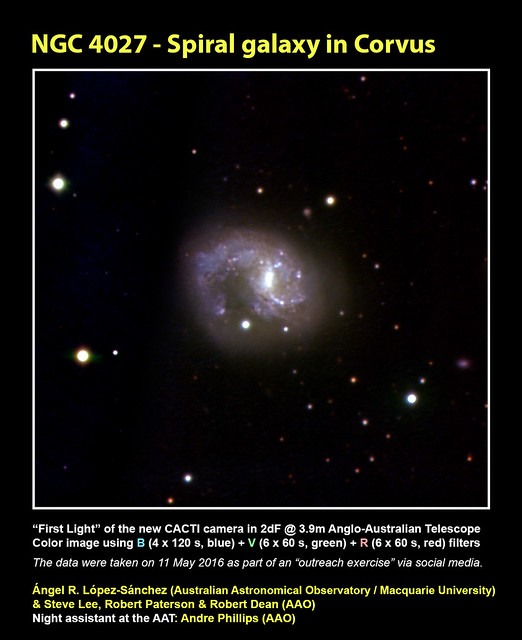
Spiral galaxy NGC 4027 located at around 75 million light years in Corvus (The Crow). This barred spiral galaxy, also identified as Arp 22, is identified as a peculiar galaxy by the extended arm, thought to be the result of a collision with another galaxy millions of years ago. This image is the “First Light” of the new CACTI camera in 2dF @ 3.9m Anglo-Australian Telescope. Color image using B (4 x 120 s, blue) + V (6 x 60 s, green) + R (6 x 60 s, red) filters. The data were taken on 11 May 2016 as part of an “outreach exercise” via social media. Click here to get a higher resolution image. Credit: Ángel R. López-Sánchez (AAO/MQ) & Steve Lee, Robert Paterson & Robert Dean (AAO). Night assistant at the AAT: Andre Phillips (AAO).
Note that this image, that actually is the “first light” of the CACTI camera, only combines 6 minutes in V and R and 8 minutes in B, that is, it is not deep at all. Furthermore not extra calibrations were taken (some flatfield images would have been nice). The deep image obtained by the 3.6m NTT telescope (ESO La Silla Observatory, Chile) provides many more details and resolution… but of course they were using the EFOSC instrument, which was specifically designed for deep imaging in optical filters. And the image of NGC 4027 obtained by David Malin (AAO) using photographic plates at the AAT in 1982 is much more colorful.
But I still think it is a pretty result, particularly as this new image of NGC 4027 was obtained as a completely improvised “outreach exercise” using social media, in which 153 people voted for their favorite object to be observed at the 3.9m Anglo-Australian Telescope.
I really hope to repeat this exercise soon.
(1) A 2dF Plate must be configured with a scientific field, that is, allocating ~350 optical fibres to different objects in the sky. This takes ~ 20-30 minutes.
(2) Just to provide the details of the votes, see table below:
OBJECT @Astrotweeps @AAOastro COMBINED
NGC 2865 5 4 9 ( 6% )
NGC 4361 36 9 45 (29%)
ESO 510-G13 36 7 43 (28%)
NGC 4027 36 20 56 (37%)
TOTAL 113 40 153






 A/Prof. Ángel R. López-Sánchez