Category Archives: Astrophysics

Starburst spiral galaxy NGC 3310 with Gemini North

Last Tuesday 1st of March the famous NASA webpage Astronomy Picture of the Day (APOD) released a very nice image of the galaxy NGC 3310 obtained with the 8.2m Gemini North Telescope in Hawaii (U.S.A.).

Nice image of the starburst spiral galaxy NGC 3310 in the Ursa Major obtained with the 8.2m Gemini North Telescope in Hawaii (U.S.A.). This image was obtained for the “Cosmic Poll” contest organized by the International Telescopes Support Office at the Australian Astronomical Observatory (AAO) and appeared as APOD on 1st March 2016. Colours codify the light received in blue (B, blue) and red (R, green) filters, plus the emission of the ionized gas (Hα filter) coded in red.AAO ITSO Office, Gemini Obs./AURA & T. A. Rector (U. Alaska Anchorage).

NGC 3310 lies at a distance of around 50 million years from us, within stars of the Northern constellation of the Ursa Mayor (meaning we cannot see it here from Australia, well, it has a maximum elevation of ~5 degrees from Siding Spring Observatory). The spiral structure in NGC 3310 looks like what we expect for our own Milky Way galaxy, with plenty of star-forming regions (in red-pink colours tracing the Hα emission). However in the case of NGC 3310, the star-formation activity seems to be more extreme.

It seems that NGC 3310 started experiencing an interaction with a dwarf galaxy around 100 million years ago. This interaction has triggered a very strong star-formation event (that is why NGC 3310 is defined as a starburst galaxy), and has “broken” the external areas of the galaxy as consequence of the intense tidal forces. In the image, all regions showing red-pink colours (tracing Hα emission) are nebulae. These regions are found almost everywhere within NGC 3310, sometimes even forming some peculiar alignments of red-pink-ish regions as that “ray” that goes from the centre of the galaxy till the upper left corner. It is interesting to note that, although the interaction with the dwarf galaxy happened ~100 million years ago, the fact of finding this large amount of Hα emission informs that the star-formation activity is still important today. The colliding dwarf galaxy was probably engulfed by NGC 3310, its remaining debris could be that diffuse arc-like structure we observed in the outskirts of the galaxy in the upper part of the image.

These are the kind of objects (starburst galaxies) and the kind of features (enhanced Hα activity, tidal distortions of the stellar component of the galaxy, tails, rays…) I studied in a sample of dwarf galaxies for my PhD Thesis (I still have to tell all of that here…).

Beside tracing the nebular (Hα) emission, the image also allows to distinguish that the majority of the stars in NGC 3310 have blue colours, even in its external areas. Again, this fact informs that the dominant stellar populations in this galaxy are relatively young, as only young stars emit a lot of light in blue and ultraviolet colours.

Although it was not said in the APOD I would like to remark that the idea of observing this galaxy in the 8.2m Gemini North Telescope came from the International Telescopes Support Office at the Australian Astronomical Observatory (AAO). In particular, mi colleagues Elaina Hyde, Richard McDermid, Caroline Foster-Guanzon and Stuart Ryder (AAO) organized a very interesting outreach initiative, the Cosmic Poll, asking the people to emit a vote for which kind of object would they like to be observed at the 8.2m Gemini Telescope. The winning entry was “an individual galaxy”, and later they decided to observe NGC 3310. Furthermore they organised an on-line event,a live-stream with the Gemini North Telescope (is available on YouTube) explaining how the telescope works and giving details of the observatory. The Gemini Observatory website also included this in its blog. After processing and cleaning the images, the final result is that you see in APOD.

I couldn’t help myself, though, and decided to play a bit with the colours, levels, contrast and lights of the image to try to get an enhanced image of this very nice object. In my opinion, the central part of the galaxy is a bit too bright (it should be, of course, the real difference in brightness between the central part of NGC 3310 and the diffuse stellar streams in its outskirts is several orders of magnitude, but for illustration purposes I have found that it is a good idea to minimize that) and the outskirts of the galaxy are not that easy to see. So here it goes my enhanced image of NGC 3310 with Gemini North:
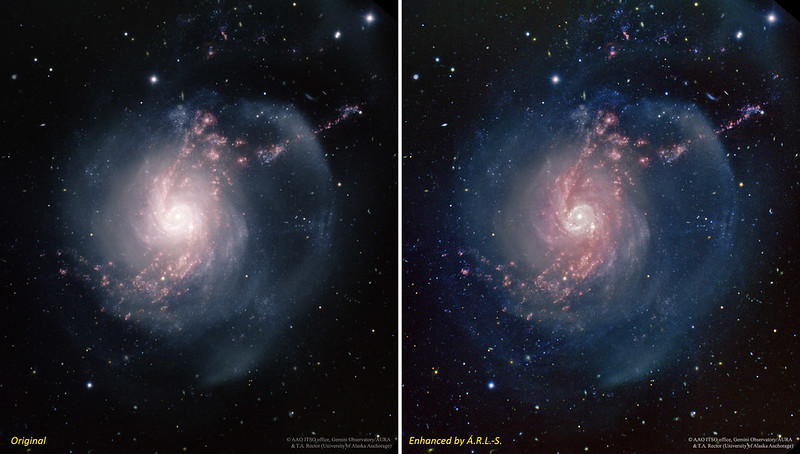
Comparison between the image of the starburst spiral galaxy NGC 3310 obtained by the 8.2m Gemini North Telescope and published in APOD on 1st March 2016 (left) and the same image enhanced by myself (right). Credit: AAO ITSO Office, Gemini Obs./AURA & T. A. Rector (U. Alaska Anchorage), Enhancement: Ángel R. López-Sánchez (AAO/MQ)

What do you think? What image do you like more?
Video: Space is just totally big and amazing

Last November some friends of the new Sydney on-line magazine A-star, Ryan Wittingslow and Harry Simpson, visited Siding Spring Observatory (Coonabarabran, NSW) to prepare a documentary about Astronomy and the telescopes at site. This is the nice video they have released, entitled Space is just totally big and amazing:

Documentary Space is just totally big and amazing prepared by A-star after their visit to the telescopes at Siding Spring Observatory. Credit: A-star.

As it happened while I was supporting astronomical observations at the Anglo-Australian Telescope (AAT), I was interviewed as part of the video. Although I talked about some few things (my research, my job at the AAO and my times as a young amateur astronomer in Spain), they only used my comments about astrophotography. Indeed, they asked me to include some scenes of my astronomical time-lapses on the documentary, and I think the result is great. I really love to see my astro photos and videos so well used. Thanks Ryan and Harry for this report!

CALIFA: City of Light

DP ESPAÑOL: Esta historia entra en la categoría “Doble Post” donde indico artículos que han sido escritos tanto en español en El Lobo Rayado como en inglés en The Lined Wolf.

DP ENGLISH: This story belongs to the series “Double Post” which indicates posts that have been written both in English in The Lined Wolf and in Spanish in El Lobo Rayado.

Next April 2016 the Calar Alto Legacy Integral Field spectroscopy Area (CALIFA) survey will make public to the international astronomical community the datacubes belonging to 600 galaxies observed by this survey using the PMAS (Potsdam Multi Aperture Spectrophotometer) spectrograph, that is installed at the 3.5m Telescope at Calar Alto Observatory (Almería, Spain). The release of the CALIFA DR3 (“Data Release 3”) will be coincident with this interesting Conference in Cozumel (Mexico).

My friend Rubén García-Benito (IAA-CSIC) has prepared the following “teaser” of the CALIFA DR3, which uses a 3D movie he has prepared using the CALIFA data. The teaser, entitled “CALIFA: City of Light”, is available in Youtube and in YouKu (for Chinese astronomers):

“CALIFA: City of Light”, teaser announcing the release of CALIFA DR3 in April 2016, that will make publish the 3D data of 600 galaxies observed for this survey. Credit: Rubén García-Benito (IAA-CSIC)

I think it is a quite original idea for giving a bit of extra publicity to the CALIFA DR3, don’t you think so?

Related Posts

Dissecting galaxies of the Local Universe with the CALIFA survey, 1 October 2014.

The oldest stars of the Galaxy

DP ENGLISH: This story belongs to the series “Double Post” which indicates posts that have been written both in English in The Lined Wolf and in Spanish in El Lobo Rayado.

DP ESPAÑOL: Esta historia entra en la categoría “Doble Post” donde indico artículos que han sido escritos tanto en español en El Lobo Rayado como en inglés en The Lined Wolf.

Last month the prestigious journal Nature published a letter led by PhD student (and friend) Louise Howes (@Lousie, ANU/RSAA, Australia). This scientific paper, with title Extremely metal-poor stars from the cosmic dawn in the bulge of the Milky Way, uses data from the 1.2m Skymapper Telescope, the 3.9m Anglo-Australian Telescope (both at Siding Spring Observatory, NSW, Australia) and the 6.5m Magellan Clay telescope (Las Campanas Observatory, Chile) to study very old stars in the Milky Way bulge.

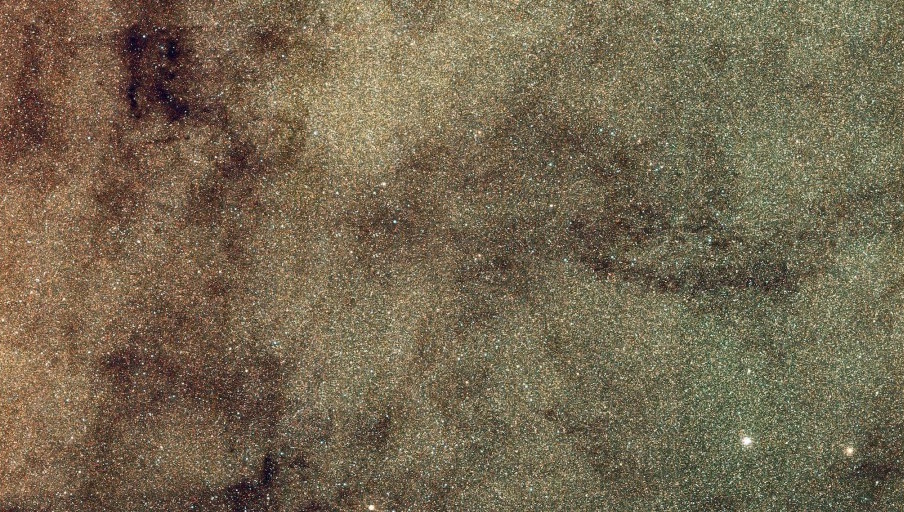
Image of the Galactic centre obtained using Skymapper data. Credit: Chris Owen (ANU/RSAA).

Image of the Galactic centre obtained using Skymapper data. Credit: Chris Owen (ANU/RSAA).

The aim of the research was to look for signatures of really old stars: stars that old that perhaps the Milky Was was not even born when they were created! How do astronomers know that? Just studying the chemical composition of the stars via deep spectral analysis. Only hydrogen and helium (and just a bit of litium) were formed in the Big Bang: the rest of elements have been created or inside the stars (oxygen, carbon, nitrogen, iron) or because of processes happening to the stars (e.g., supernova explosions, that create heavy elements such as gold, silver, copper or uranium). As time goes by and new generations of stars are born, the amount of metals (for astronomers, metals are all elements which are not hydrogen and helium) increases. Therefore if we discover a star with very few amount of metals, we will quite sure we are observing a very old object.

Loiuse has been using the 2dF instrument at the Anglo-Australian Telescope and the MIKE spectrograph at the Magellan Clay Telescope (Chile) to get deep, high-resolution spectra of candidate old stars in the Galactic bulge. The candidate stars were identified using optical images provided by the 1.2m Skymapper Telescope. With these observations, Louise Howes and collaborators have detected 23 stars that are extremely metal-poor. These stars have surprisingly low levels of carbon, iron and other heavy elements. Indeed, they report the discovery of a star that has an abundance of iron which is 10,000 times lower than that found in the Sun! These stars were formed at redshift greater than 15, that is, we are observing in our own Milky Way stars that were formed just ~300 million years after the Big Bang!

On top of that, the study suggests that these first stars didn’t explode as normal supernova but as hypernova: poorly understood explosions of probably rapidly rotating stars producing 10 times as much energy as normal supernovae. The high-resolution spectroscopic data have been also used to study the kinematics of these very old stars, that are found on tight orbits around the Galactic centre rather that being halo stars passing through the bulge. This is also characteristic of stars that were formed at redshifts greater than 15.

Short 3 minutes video discussing the results found in this study. Credit: ANU.

I’m happy to say here that I’ve been the support astronomer for many of her nights at the AAT the last couple of years. And I’m extremely happy to see that, even because of the bad weather we have had sometimes, they managed to get these observations published in Nature! Well done, Louise!

More details:

Scientific paper in Nature: Howes et al. 2015, Extremely metal-poor stars from the cosmic dawn in the bulge of the Milky Way, 11 November 2015.

Scientific paper in arXiv

ANU Press Release

Bright meteor over the AAT

This week I’m back at the Anglo-Australian Telescope (AAT, Siding Spring Observatory) as support astronomer. As the same time I’m helping visitors astronomer to get the best data using the 2dF instrument, I’m taking time-lapse sequences of the night sky using 2 CANON EOS 5D Mark III cameras. This afternoon, when checking the “preliminary” sequences of the previous night, I discovered a bright meteor in one of the frames. I was excited because at the beginning I thought it was a Leonid, but I checked and it seems to be a sporadic meteor or, perhaps, a meteor from the South Taurids shower.


The circumpolar Southern Sky, with the Magellanic Clouds, the Southern Cross and the Pointers (Alpha and Beta Centauri) over the Anglo-Australian Telescope (AAT), at Siding Spring Observatory (NSW, Australia). A bright meteor crosses the sky. Although it could have been a meteor of the Leonids meteor shower, the radiant (point in the sky from where the meteors of a meteor shower come from) was not in the sky. However it could be a meteor from the South Taurids shower. Photo taken at 2am AEST (UT+11) of the 17 Nov 2015 with a CANON EOS5D using a 16 mm lens at f2.8, 3200 ISO, 30 seconds exposure. Click here to get a higher resolution image. Credit: Ángel R. López-Sánchez (AAO/MQ).

A reddish-greenish sky glow is also seen in the image. This glow has been also observed from the observatories in Chile as is consequence of chemical reactions involving oxygen (green colours, usually forming ozone) and nitrogen (red colours) molecules in our atmosphere. These chemical reactions are induced by ultraviolet emission from the Sun, which is much more intense when the solar cycle is in maximum, as it has been in the last few years.