Category Archives: Astrophysics

Time-lapse: The Sky over Siding Spring Observatory

DP ENGLISH: This story belongs to the series “Double Post” which indicates posts that have been written both in English in The Lined Wolf and in Spanish in El Lobo Rayado.

DP ESPAÑOL: Esta historia entra en la categoría “Doble Post” donde indico artículos que han sido escritos tanto en español en El Lobo Rayado como en inglés en The Lined Wolf.

I’ve been waiting year and a half to finally see this happening. One of the displays I prepared for the Stories from Siding Spring Observatory Photo Exhibition (that was organized by staff of the Australian Astronomical Observatory (AAO) and originally released on 17th April 2013 at the Sydney Observatory), was a new time-lapse video compiling scenes showing all the telescopes at the Siding Spring Observatory (Coonabarabran, NSW, Australia) before the terrible bushfires that destroyed the Warrumbungle National Park and seriously affected the very same Observatory on 13th January 2013. However I couldn’t do this time-lapse video public until today, as it is the very first video to be included in the AAO Youtube channel. So here it is the time-lapse video “The Sky over Siding Spring Observatory:

Video time-lapse The Sky over Siding Spring Observatory. To enjoy it as its best, I strongly recommend you to see it at its highest resolution (FullHD) and full screen in a dark room. Credit: Video Credit: Ángel R. López-Sanchez (AAO/MQ), Music: Point of no return (Rogert Subirana).

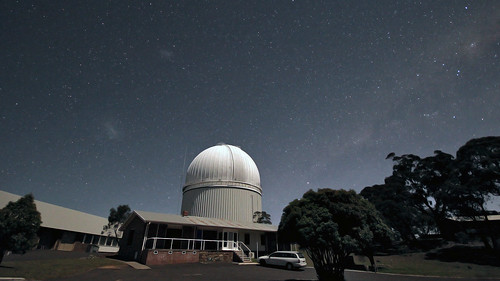
I think this is the best time-lapse video I have created so far. It last 4:30 minutes and it compiles the best time-lapse sequences I obtained at Siding Spring Observatory between August 2011 and March 2013, during my support astronomer duties for the 4-metre Anglo-Australian Telescope (AAT). Telescopes at Siding Spring Observatory featured include the Uppsala Near Earth Object Survey Telescope, the UNSW Automated Patrol Telescope, the 2.3m ANU Telescope, 1.2m Skymapper ANU, the 1.2m UK Schmidt Telescope (AAO) and the very own Anglo-Australian Telescope (AAT).

Throughout the video, watch for several astronomical objects: our Milky Way Galaxy, the Large and Small Magellanic Clouds, the Moon rising and setting, the planets Venus, Mars, Jupiter and Saturn, Zodiacal Light, Earth-orbiting satellites, airplanes crossing the sky, the Pleiades and Hyades star clusters, the Coalsack and the Carina nebulae, and famous constellations like the Southern Cross, Taurus, Orion, and Scorpio.

The time-lapse technique consists of taking many images and then adding all to get a movie with a very high resolution. In particular, the camera CANON EOS 600D and two lenses (a 10-20 mm wide-angle lens and a standard 35-80 mm lens) were used to get the frames of this time-lapse video. Except for those frames taken during the sunset in the first scene, frames usually have a 30 seconds exposure time, with a ISO speed of 1600. Some few scenes were shot using 15 or 20 seconds exposure time. All sequences were created at 24 fps (frames per second), and hence a second in the movie corresponds to 12 minutes in real time for the majority of the scenes. In total, the video combines around 5800 individual frames. Processing each 10 – 20 seconds sequence took between five and six hours of computer time. Care was taken to remove artifacts and hot pixels from individual frames, minimize background noise, and get an appropriate colour/contrast balance.

I hope you like it. Comments and posting about it in social media are very welcome.

More information and previous time-lapses

Video in the AAO YouTube Channel.

AAO Webpage: Timelapse Video: The Sky Over Siding Spring Observatory (25th Sep 2014)

Timelapse video: The Sky over the Anglo-Australian Telescope (3rd May 2013).

Timelapse video: A 2dF night at the Anglo-Australian Telescope (7th May 2014).
Seasons: Astronomy vs. Australia

Something that really shocked me when I started to live in Australia ~7 years ago was to hear everywhere that seasons start at the beginning of the corresponding month. That is, as today is Sep 1st, everyone in the radio / advertisements / news is welcoming Spring. And this, being an astronomer, believe me, hurts. Why? Because astronomically we are still in winter. Seasons are defined by Astronomy in a very accurate and precise way. This year Spring starts on September 23rd, 11:29 AEST (02:29 Universal Time). That is when that the Autumn Equinox happens, and the real moment Spring starts in the Southern Hemisphere (and Autumn/Fall starts in the Northern Hemisphere).

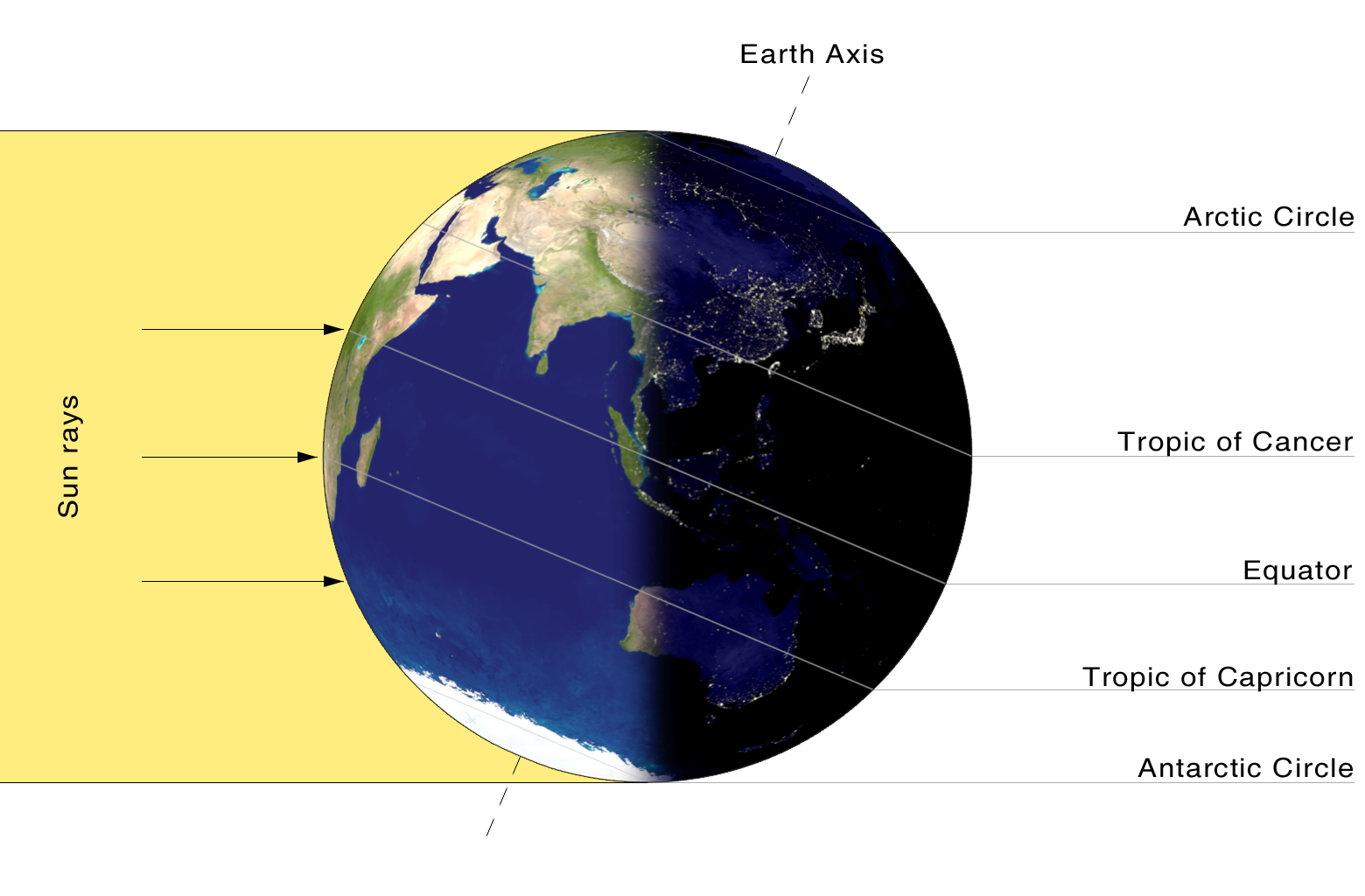
The seasons are caused by the combination of three astronomical factors: the Earth’s is a (almost perfect) sphere, the Earth’s orbit around the Sun, and the Earth’s axial tilt. As a consequence of these the Earth’s atmosphere is unequally heated by the Sun around the year at a given position. Therefore, the seasons are marked by the movement of the Earth around the Sun and, hence, which way the Earth is tilted with respect to the Sun. When the South hemisphere is tilted towards the Sun, the Sun’s rays strike the Earth at a steeper angle compared to a similar latitude in the North hemisphere. As a result, the radiation is distributed over an area which is less in the South hemisphere than in the North hemisphere. This means that there is more radiation per area to be absorbed in the South hemisphere, and therefore it is winter in the North hemisphere and summer in the South hemisphere.

Illumination of Earth by Sun at the southern solstice. Credit: Wikipedia


By astronomical definition, the precise timing of the seasons is determined by the exact times of transit of the Sun over the tropics of Cancer and Capricorn for the solstices and the times of the Sun’s transit over the Equator for the equinoxes, as specified in this figure:

Movement of the Earth around the Sun following an orbital ellipse (with eccentricity exaggerated for effect) and seasons. Equinoxes (20 or 21st March and 22nd or 23rd September) happen when the tilt of Earth’s axis neither inclines away from nor towards the Sun (green dotted line), and hence two points a the same latitude but a different hemispheres receive the same amount of energy from the Sun. In an equinox, the Sun is found at the zenith at the midday at the Equator. A solstice (20th or 21st June and 21st or 22nd December) happens when the tilt of the Earth’s axis has maximum effect (23.44º, red dotted line). At the June solstice the Sun is found at the zenith at the midday (just over our head!) at latitude 23.44º North, defining the Tropic of Cancer. Similarly at the December solstice this happens at 23.44º South, known as the Tropic of Capricorn. The periapsis (perihelion) and the apoapsis (aphelion) mark the nearest and the farthest points from the Sun, respectively (blue dotted line). Credit: Wikipedia


Therefore, in the South hemisphere, Spring starts with the Autumn Equinox, Summer with the Winter Solstice, Autumn with the Spring Equinox and Winter with the Summer Solstice. Of course, the names were given as correct for the North hemisphere.

Well, at least all of this is what Astronomy says. However, Governments and societies quite often decide to use their own definitions. Just checking this webpage of the Australian Bureau of Meteorology:

In Australia, the seasons are defined by grouping the calendar months in the following way:

1. Spring – the three transition months September, October and November.
2. Summer – the three hottest months December, January and February.
3. Autumn – the transition months March, April and May.
4. Winter – the three coldest months June, July and August.

These definitions reflect the lag in heating and cooling as the sun appears to move southward and northward across the equator. They are also useful for compiling and presenting climate-based statistics on time scales such as months and seasons.

Following these assumptions, Australia indeed enters in Spring today, which is funny because the majority of the countries (if not all) of the North hemisphere are still in Summer. In any case, for me it is Winter, and it will be winter till next on September 23rd, 11:29 AEST, when Spring, according to Astronomy, really starts.

Sequence of the occultation of Saturn by the Moon

DP ENGLISH: This story belongs to the series “Double Post” which indicates posts that have been written both in English in The Lined Wolf and in Spanish in El Lobo Rayado.

DP ESPAÑOL: Esta historia entra en la categoría “Doble Post” donde indico artículos que han sido escritos tanto en español en El Lobo Rayado como en inglés en The Lined Wolf.

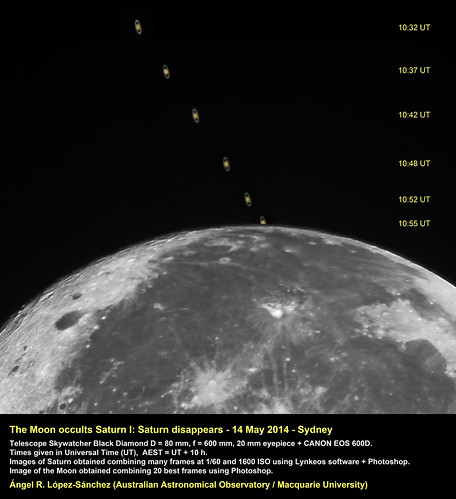
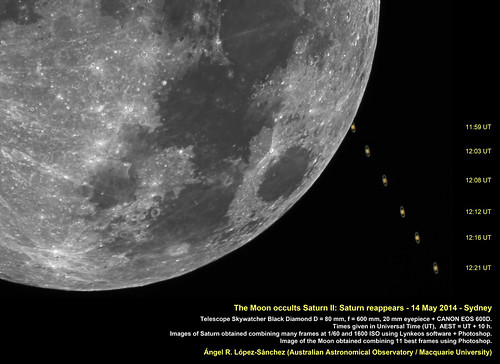
Today Sunday I’ve used some of my free time to process the images I took last Wednesday, when Saturn was occulted by an almost full Moon. These are my two final images showing how Saturn first disappears behind the Moon and it reappears an hour later.

The Moon occults Saturn I: Saturn disappears.
14 May 2014 from Sydney. Data obtained using Telescope Skywatcher Black Diamond D = 80 mm, f = 600 mm, 20 mm eyepiece + CANON EOS 600D. All times are given in Universal Time, add 10 hours to get the local time in Sydney (AEST) that date. Images of Saturn obtained combining many frames at 1/60 and 1600 ISO using Lynkeos software + Photoshop. Image of the Moon obtained combining 20 best frames using Photoshop. Credit: Á.R.L-S. (AAO/MQ)


The Moon occults Saturn I: Saturn disappears.
14 May 2014 from Sydney. Data obtained using Telescope Skywatcher Black Diamond D = 80 mm, f = 600 mm, 20 mm eyepiece + CANON EOS 600D. All times are given in Universal Time, add 10 hours to get the local time in Sydney (AEST) that date. Images of Saturn obtained combining many frames at 1/100 and 1600 ISO using Lynkeos software + Photoshop. Image of the Moon obtained combining 11 best frames using Photoshop. Credit: Á.R.L-S. (AAO/MQ)

Getting nice images of Saturn was much trickier than I expected: the setup I used the other night it is not the best to observe Saturn, as more magnification and a good tracking are needed. On the other hand, the Moon was very bright so I had to use short exposition times, and hence Saturn appeared very dim. At the end I manage to get a kind of “master Saturn” combining the best frames I took during the night and later combine it with the data of each position to get the final view of Saturn at each time. For the Moon it was much easier, although you’ll perhaps realize that the second image is somewhat better than the first. The reason is that some parts of the Moon were actually saturated with the 1/60 seconds exposures, and that is why I later used 1/100 seconds for getting Saturn reappearing. In any case, I hope you like them.

Occultation of Saturn by the Moon

Today, 14th May 2014, Saturn is occulted by the Moon, although this can only be seen from most Australia and New Zealand. I’ve set up my telescope in the backyard and now I’m taking some photos of the event. Although I’ll try to get better images later, let me show you what I’m obtaining now.

These three images show how Saturn is moving closer to the Moon:

Occultation of Saturn by the Moon, as observed from my backyard in Sydney. I used my Skywatcher Black Diamond Telescope D = 80 mm, f = 600 mm and my CANON EOS 600D, and a 20mm eyepiece projection, at 1600 ISO and speed 1/60. This is just a single frame obtained at 20:44 AEST (10:44 UT). I also used Photoshop to play with the levels/colours/saturation. Credit: Angel R. López-Sánchez.

Occultation of Saturn by the Moon, as observed from my backyard in Sydney. I used my Skywatcher Black Diamond Telescope D = 80 mm, f = 600 mm and my CANON EOS 600D, and a 20mm eyepiece projection, at 1600 ISO and speed 1/60. This is just a single frame obtained at 21:12 AEST (11:12 UT). I also used Photoshop to play with the levels/colours/saturation. Credit: Angel R. López-Sánchez.

Occultation of Saturn by the Moon, as observed from my backyard in Sydney. I used my Skywatcher Black Diamond Telescope D = 80 mm, f = 600 mm and my CANON EOS 600D, and a 20mm eyepiece projection, at 1600 ISO and speed 1/60. This is just a single frame obtained at 21:18 AEST (11:18 UT), the planet is “touching” the disc of the Moon. I also used Photoshop to play with the levels/colours/saturation. Credit: Angel R. López-Sánchez.

After that, I waited for 40 minutes to see Saturn reappears behind the Moon, as it is shown is the next three photos:

Occultation of Saturn by the Moon, as observed from my backyard in Sydney. I used my Skywatcher Black Diamond Telescope D = 80 mm, f = 600 mm and my CANON EOS 600D, and a 20mm eyepiece projection, at 1600 ISO and speed 1/100. This is just a single frame obtained at 21:59 AEST (11:59 UT). I also used Photoshop to play with the levels/colours/saturation. Credit: Angel R. López-Sánchez.

Occultation of Saturn by the Moon, as observed from my backyard in Sydney. I used my Skywatcher Black Diamond Telescope D = 80 mm, f = 600 mm and my CANON EOS 600D, and a 20mm eyepiece projection, at 1600 ISO and speed 1/100. This is just a single frame obtained at 22:05 AEST (12:05 UT). I also used Photoshop to play with the levels/colours/saturation. Credit: Angel R. López-Sánchez.

Occultation of Saturn by the Moon, as observed from my backyard in Sydney. I used my Skywatcher Black Diamond Telescope D = 80 mm, f = 600 mm and my CANON EOS 600D, and a 20mm eyepiece projection, at 1600 ISO and speed 1/100. This is just a single frame obtained at 22:15 AEST (12:15 UT). I also used Photoshop to play with the levels/colours/saturation. Credit: Angel R. López-Sánchez.

In the next few days I’ll prepare some few better (processed) images. Stay tuned!

A 2dF night at the Anglo-Australian Telescope

One of the most complex astronomical instruments nowadays available is the Two Degree Field (2dF) system at the Anglo-Australian Telescope (AAT, Siding Spring Observatory, NSW, Australia). The main part of 2dF is a robot gantry which allows to position up to 400 optical fibers in any object anywhere within a “two degree field” of the sky.

The 2dF instrument attached to the primary focus of the AAT. Note that the mirror of the telescope is opened. This image was chosen to be part of the Stories from Siding Spring Observatory Photo Exhibition the AAO organized last year.
Credit: Á.R.L-S.

392 optical fibers are fed to the AAOmega spectrograph, which allows to obtain the full optical spectrum of every object targeted by an optical fiber. The remaining 8 optical fibers are actually fibre-bundles and are used to get an accurate tracking of the telescope while astronomers are observing that field, which may last up to 3 hours. 2dF possesses two field plates: one located at the primary focus of the telescope and another at the position of the robot gantry. While a field is being observed in one plate, 2dF configures the next field on the other plate. A tumbling mechanism is used to exchange the plates. 2dF was designed at the AAO in the late 90s and, since then, it has been used by a large number of international astrophysicists. In a clear night, 2dF can obtain high-quality optical spectroscopic data of more than 2,800 objects.

Indeed, this sophisticated instrument has conducted observations for hundreds of astronomical projects, including galaxy surveys such as the 2dF Galaxy Redshift Survey, the WiggleZ Dark Energy Survey, and the Galaxy And Mass Assembly (GAMA), survey which is still on going and in which I actively participate. The optical fibers of 2dF can be also fed the new HERMES spectrograph, which is now starting the ambitious Galactic Archaeology with HERMES (GALAH) survey at the AAT. GALAH aims to observe around 1 million galactic stars to measure elemental abundances and measure stellar kinematics.

Frame of the time-lapse video “A 2dF night at the Anglo-Australian Telescope”. The 2dF robot gantry moving and positioning the optical fibers. Credit: Á.R.L-S.

How does 2dF move and position the optical fibers? A very nice way of explain it is using the time-lapse technique, that is, taking many images and then adding all to get a movie of the robot while moving and positioning the fibers. That is why in 2012 I decided to create the video, A 2dF night at the AAT, which assembles 14 time-lapse sequences taken at the AAT during September and November 2011 while I was working at the AAT as support astronomer of the 2dF instrument. Actually, this time-lapse video shows not only how 2dF works but also how the AAT and the dome move and the beauty of the Southern Sky in spring and summer. The time-lapse lasts for 2.9 minutes and combines more than 4000 frames obtained using a CANON EOS 600D provided with a 10-20mm wide-angle lens.

Time-lapse video “A 2dF night at the AAT”. I recommend to follow the link to YouTube and watch it at HD and full screen in a dark room. Credit: Á.R.L-S.

The video consists in three kinds of sequences created at 24 frames per second (fps). The first 3 sequences show how the 2dF robot gantry moves the optical fibers over a plate located at the primary focus of the telescope. Although in real life 2dF needs around 40-45 minutes to configure a full field with 400 fibers, the time-lapse technique allows to speed this process. The first 2 sequences have been assembled taking 1 exposure per second, therefore 1 second of the video corresponds to 24 seconds in real life. The third sequence considers an exposure each 3 seconds, and hence it shows the robot moving very quickly. The next four sequences show the movement of the telescope and the dome. All of them were obtained taking 2 images per second (a second in the movie corresponds to 12 seconds in real life). The long black tube located at the primary focus of the telescope is 2dF. The remaining sequences, all obtained during the night, were created taking exposures of 30 seconds, and hence each second in the video corresponds to 12 minutes in real life.

Frame of the time-lapse video “A 2dF night at the Anglo-Australian Telescope”. The AAT telescope, with 2dF (the long, black tube) attached at its primary focus, is prepared to start observing. Credit: Á.R.L-S.

Astronomical time-lapse videos allow to see the movement of the Moon, planets and stars in a particular position in the Earth, something that conventional videos cannot achieve. In particular, dim stars and faint sky features, such as the Milky Way with its bright and dark clouds and the Magellanic Clouds, can be now easily recorded. As in my first time-lapse video, The Sky over the AAT, I set the camera up at the beginning of the night, let it run, and check on its progress occasionally. I used at focal of f5.6 and an ISO speed of 1600 ISO for the night sequences.

Frame of the time-lapse video “A 2dF night at the Anglo-Australian Telescope”. The Magellanic Cloud rise while the Milky Way sets over the Anglo-Australian Telescope at Siding Spring Observatory on 3 Nov 2011. Some kangaroos can be seen in the ground. Credit: Á.R.L-S.

However, the procedure that took more time was processing the hundreds of individual photographies included in each sequence. In many cases, I needed more than 12 hours of computer time, including 3 or 4 iterations per sequence, to get a good combination of low noise and details of the sky, plus “cleaning” bad pixels or cosmic rays. In particular, for this video I tried hard to show the colours of the stars, a detail which is usually lost when increasing the contrast to reveal the faintest stars. In the last sequence of the video, Aldebaran and Betelgeuse appear clearly red, while the stars in the Pleiades and Rigel have a blue color.

Frame of the time-lapse video “A 2dF night at the Anglo-Australian Telescope”. A dark night at The Anglo-Australian Telescope (23 Sep 2011). Orion constellation is seen over the AAT dome. The red colour of Alderaban and Betelgeuse and blue colours of Pleiades and Rigel are clearly distinguished. Credit: Á.R.L-S.

As I did for my previous time-lapse, here I also included a sequence which shows the trails created by the stars as they move in the sky as a consequence of the rotation of the Earth. This sequence shows the Celestial Equator and stars at the South (top) and North (bottom) Celestial Hemisphere. Note that star trails have indeed many different colours. Other details that appear in this time-lapse video are clouds moving over the AAT, satellites and airplanes crossing the sky, the nebular emission of the Orion and Carina nebulae, the moonlight entering in the AAT dome, and kangaroos “jumping” in the ground.

Frame of the time-lapse video “A 2dF night at the Anglo-Australian Telescope”. Startrails over the Anglo-Australian Telescope on 23 Sep 2011. The colours of the stars are clearly seen in this image, which stacks 1h 6min of observing time. Credit: Á.R.L-S.

Finally, I chose an energetic soundtrack which moves with both 2dF and the sky. It is the theme Blue Raider of the group Epic Soul Factory, by the composer Cesc Villà. Actually, all sequences were created to fit the changes in the music, something that also gave me some headaches. But I think the result was worth all the effort.