Category Archives: Astrophysics

The Betelgeuse hype

Although we are “enjoying” the Christmas break, today I’ve been contacted (thanks to Rami Mandow @CosmicRami) by Kelsie Iorio, an ABC News Digital journalist who was preparing an article about the situation of the red supergiant Betelgeuse.

The article published in ABC News, entitled “Is Betelgeuse, the red giant star in the constellation Orion, going to explode?“, can be found in this link. It includes comments from Rami Mandow, Associate Professor Michael Brown from Monash University’s School of Physics and Astronomy and myself, with some other tweets from several astrophysicists who are talking about the “mysterious dimming of Betelgeuse“.

The red supergiant star Betelgeuse in Orion was the very first star after the Sun we got a direct image of its surface. That is because it is a huge star: if it were where the Sun is its outer layers will reach the orbit of Jupiter! This image was taken with the Hubble Space Telescope in 1995. More info in the APOD (Astronomy Picture of the Day) on April 19th, 1998. Credit: A. Dupree (CfA), R. Gilliland (STScI), FOC, HST, NASA.

But I want to share with you my full interview here, and keep it for my records, so here it goes.

The Betelgeuse hype

Interviewer: Kelsie Iorio  (ABC News Digital )

Interviewee: Ángel R. López-Sánchez (AAO-MQ)

Q: For those who don’t know, what is Betelgeuse and what is it doing at the moment that’s out of the ordinary?

Betelgeuse is a bright star in the famous constellation of Orion the Hunter. It is a red supergiant star, meaning that it is star that is much more massive than our Sun (10 – 15 times) and that is already in the latest stages of its live. The star will eventually explode as a (type II) supernova. We astrophysicists know this will happen “soon”, but “soon” in Astronomy means 100 thousands years or perhaps even more.

During the last month observers worldwide have measured a dimming in the brightness of Betelgeuse.

This is actually completely ordinary, as it is well known and documented that Betelgeuse is a variable star (that means that it’s periodically changing its brightness).

Social media has again played a role here with the “hype” of the brightness of Betelgeuse: it is a normal situation that is happening at the moment and we can explain the dimming of Betelgeuse in many ways (a small shrinking of its huge size, solar spots, magnetic activity, a combination of factors) without the need of thinking that is going to explode now.

But people have been talking about that and many of them would love to see Betelgeuse explode! (I do not).


Q: Why is the astronomy world so excited about what’s happening?

If Betelgeuse really explodes as a supernova this would be a great opportunity for use to study how massive stars explode and get a better understanding of stellar evolution and stellar interiors. It will create a point-like object as bright as the Moon that would be visible even during the day, that will be fading during months till disappear.

However I must insist: the dimming of the brightness is the typical behaviour of the star. It is periodically changing its brightness and it has had this “low” brightness in the past. Even Aboriginal Australian knew this star changed brightness!


Q: Can we see Betelgeuse from Australia? For people who haven’t seen it or don’t know how to look for it, what does it look like from earth?

Of course! This is a star located very close to the celestial equator, meaning it can be seen essentially from everywhere (just not from the very same South Pole and around). Right now it is clearly visible to the North-East at the beginning of the night. The constellation of Orion is one of the most famous constellations of the sky and can be very easily recognised even by non-experts. Just use a stellar map (there are plenty free in internet, I recommend http://skymaps.com, and also plenty of apps) and you’ll see it. Despite it has noticeable dimmed in the last month, Betelgeuse still is one of the brightests stars in the night sky.

As any other star Betelgeuse is just a point of light, even when using a powerful telescope: stars are very, very, very far away from us to see them like a little disk. Betelgeuse is at a distance of around 700 light years.


Q: What do you think will happen to Betelgeuse next? Is it likely to explode?

No, it is very unlikely we see it exploding. The latest astrophysical research conducted about Betelgeuse clearly shows that it should still have a life of around 100 thousand years. Again, that is almost NOTHING in the cosmic scale, but a lot for us.

As it has done plenty of times in the past, Betelgeuse will eventually gain brightness again and all will be back to usual, continuing being sometimes a bit brighter sometimes a bit dimmer during the rest of all our own lifetimes.


Q: Is what’s happening with Betelgeuse a rare event?

No, it is not a rare event.

There are PLENTY of variable stars in the sky. A nice example is the star Mira in the constellation of Cetus (the Whale). This star sometimes can be easily seen with the naked eye and sometimes it is imposible to see, needing binoculars or telescopes to detect it. And it is not going to explode as supernova!


Q: Do you believe it’s important for the wider public to have a basic knowledge of astronomy and understand what’s happening in situations like this? Why?

I think it is important because everyone loves Astronomy but nowadays it is very easy to be confused because of the mixed bag of content found in social media and the internet.

I could tell the story about why supermoon are NOT a thing, but that is for another time (or read it here: https://angelrls.wordpress.com/2016/11/11/supermoons/)


Article in ABC News: “Is Betelgeuse, the red giant star in the constellation Orion, going to explode?“, Kelsie Iorio, 28th December 2020.

The only Earth

This is the English adaptation of the article I published in Diario Córdoba newsletter last Sunday, 15th December 2019, which I have also compiled in my personal blog in the Naukas science communication network. It has some references to the situation of the light pollution in Spain but unfortunately this also applies to the majority of the countries of the developed world.

A couple of weeks ago my six-year-old son had to make his first speech in front of his classmates. It is a very common practice in Australia and in other English countries: from a very young age students are encouraged to briefly and concisely discuss their thoughts regarding a particular topic in public. My son chose the topic “how can we care about the environment?”, that we developed together (obviously, you can’t ask to a six-year-old child to do something like this on his own the very first time). He rehearsed during days. In his speech my son wanted to emphasize “the 3 Rs“: “reduce, reuse and recycle.” It was evident that at some point during the course they had talked about it in class, and certainly sometimes during this year he had returned from school asking for “containers and cartons to reuse them in toys or ornaments”. Ecological and environmental awareness does exist in our society, and it is indeed encouraging to see young people very committed to that. But is it enough?

Brainstorming session compiling key topics to prepare my child’s speech “What can we do to take care of the environment?”

The environmental issues are widely complex and touch on social, economic, political, scientific and even religious aspects. The World Climate Summit that has been held in Madrid these weeks demonstrates the complicated interrelationship of interests that exist when we try to really take care of our planet. Many people think that they are doing something useful but at the end of the day these are just patches to clear their conscience about their lack of actions to attack the real problem. Now, during Christmas, we all live another example of these contradictions.

Christmas has always been my favorite time of the year. As a child I waited excitedly for the gifts of the Three Wise Kings on January 6th (that is the real moment kids get their Christmas presents in Spain, as the tradition is that they are brought by the Three Wise Kings, we imported Papá Noel – Santa Clauss just recently). This day was always a great party in our house, with lots of papers and boxes to be unwrapped. Despite living now in another continent, with a slightly different culture, I try to maintain this tradition and the illusion of Christmas for my son, like so many people sure does around the world. But this year the confluence of many factors (the World Climate Summit, the rise of climate change deniers, the disastrous fires that are plaguing Australia and making Sydney the most polluted city in the world on Tuesday Dec 10th, my outrage at others environmental factors that are not taken seriously, and my son’s speech) have made me rethink everything. How much garbage do we generate in a few days? Where is this consumer society taking us?

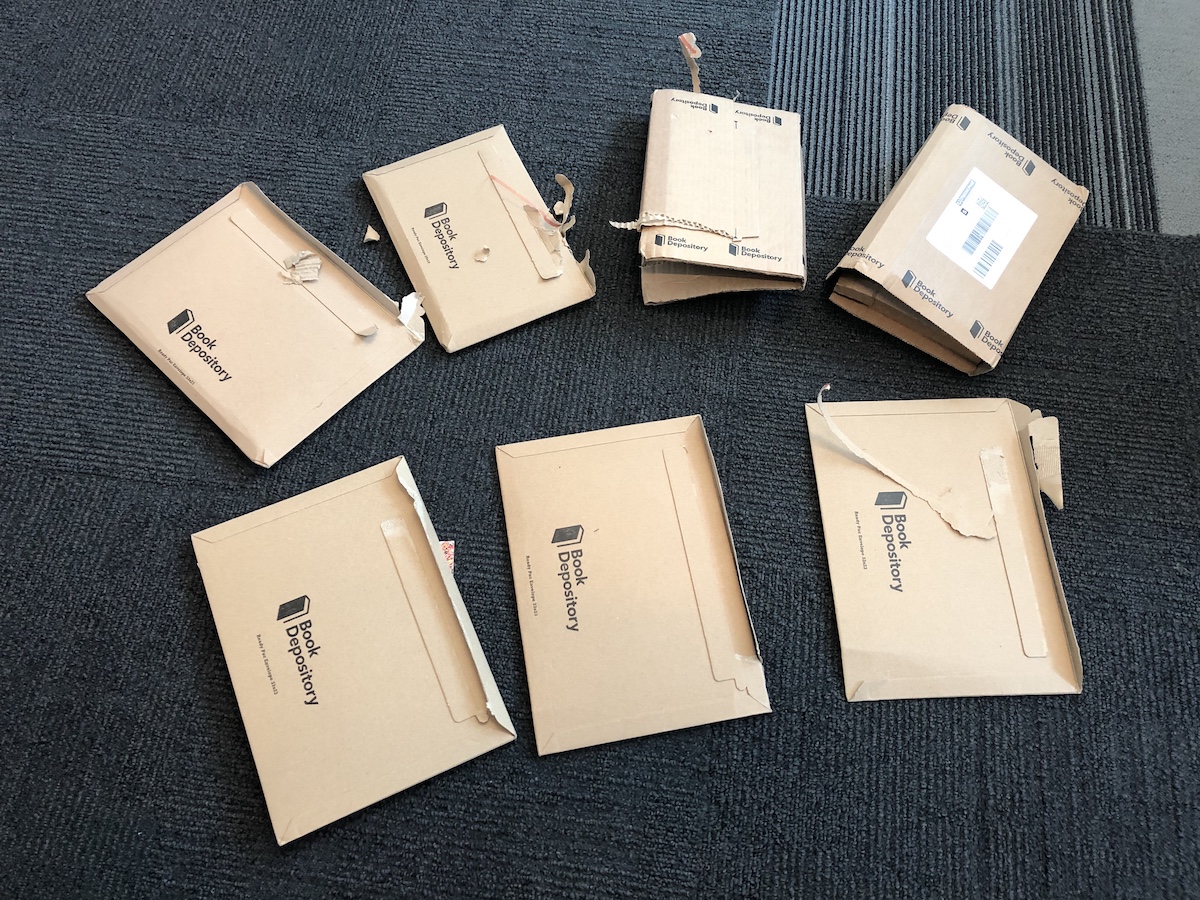
As I couldn’t travel to Spain in 2019 I bought online several books and notebooks in Spanish for Christmas. I placed the entire order together but each book or notebook (the three packages at the bottom are thin homework notebooks in Spanish for my son, all of the same course) has come in an individual cardboard box and with a lot of extra, unwanted advertising and papers inside ? How much extra crap are we generating? By the way, 3 more packages that had not yet arrived are missing in the photo.

Indeed, Christmas has become a time of waste. You have to buy more and more things, frantically decorating houses and cities, attending large banquets (business, family, friends) in a few days. What used to be a short period of one or two weeks has now extended over two months. The shopping centers are decorated before Halloween. And the “Black Friday” is now a common practice worldwide, with people buying plenty of things online that they don’t need (and that will delivered to their homes by workers who usually are in precarious working conditions, in a cardboard box that includes plenty of unwanted publicity and other papers). Here it is the first “R” my son pointed out: we must reduce the huge amount of waste that we create.

Of course, for years now many scientists including me have been pointing out that there is an increasing huge waste of resources (of money) in Christmas lighting. Light pollution is growing  and, sponsored by the rise of LEDs, more and more Christmas lights are installed every year in our cities. I am the first one to enjoy a beautiful holiday lighting and I know that it attracts people to the streets for Christmas shopping, but aren’t they too much now? 

During the last months we have seen some politicians of Spanish major cities boasting about “my Christmas lighting is the best”. The facilities began to be installed in September, with millions of LEDs everywhere. It has been estimated that about 10% of the annual electricity bill of a large city in Spain is going into Christmas lighting. Apart from the most correct use that money could be given, this means a great contribution of greenhouse gases to the atmosphere. And it is more: the scientific studies are demonstrating that LEDs (which are replacing the low-pressure sodium lights, the most energy efficient and the least polluting of lights) are substantially impacting the fauna, flora and ourselves. An increasing of cancers are being detected in places with excessive lighting. Blue light (the dominant one in most LEDs that are being installed in cities around the world) inhibits the creation of melatonin, which is the hormone that controls our sleep and circadian rhythm. Light pollution is another major environmental problem, perhaps not publicly known as other types of pollution, but that must be taken into account and mitigated with appropriate laws and regulations. On this point it is interesting to note that the Spanish Network of Studies of Light Pollution has requested this month the total paralysis and reconstruction of the Royal Decree in which the Regulation of energy efficiency of outdoor lighting installations is approved, as it contains fundamental errors and the complete absence of scientific criteria in its elaboration.

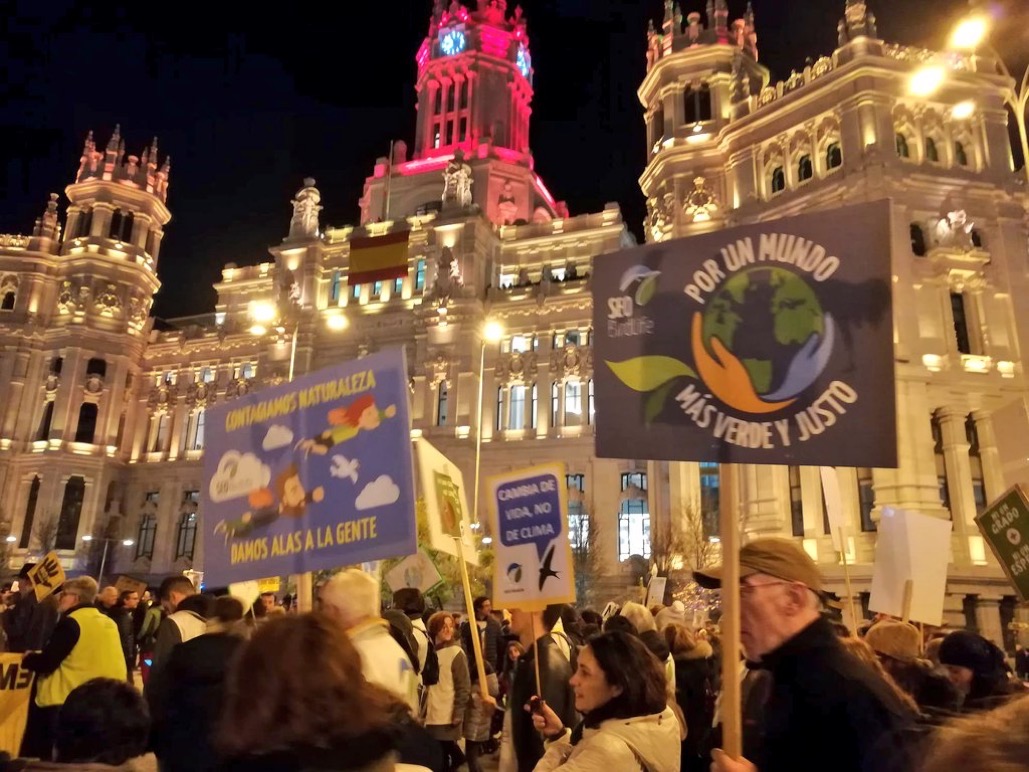
Protesters in Madrid during the UN Climate Summit COP 25, on Friday, December 6, 2019, with the contrast of the exaggerated lighting of Madrid’s buildings, even more for Christmas. I have not found the credit of the image, a thousand apologies to the author, although I asked on Twitter and tried.

As a scientist I don’t believe in climate change. I don’t believe in it because the verb to believe means “to have something for sure without knowing it directly or without it being proven or proven” (definition of the “Real Academia Española”, the “Royal Spanish Academy”). As a scientist who has read and contrasted the observations and studies that have been done on the effect of the emission of greenhouse gases in the Earth’s atmosphere by burning fossil fuels in human activities during the past 200 years, I do have the absolute knowledge that climate change is real. Scientists have been warning the society for decades, and we have clearly known that global warming is not due to external factors, such as changing the brightness of the Sun, the Earth’s orbit, or even the movement of the Sun around the Milky Way. Global warming and its consequences, climate change, is undoubtedly the product of human activity.

Comparison of solar irradiance on the Earth (yellow) with the average temperature of the planet (in red) since 1880. The thick lines show the average in periods of 11 years. Variations (maximum 0.15%) of the total irradiance of the Sun on Earth show the small oscillations of 11 years due to the solar cycle. The change in the brightness of the Sun does not explain the increase of around 1 degree Celsius of the average temperature of the Earth’s atmosphere from the beginning of the 20th Century to the present. Credit: NASA.

Our society is not environmentally sustainable. Crossed interests and our own daily habits make extremely difficult to solve the environmental problems. Maybe first we all have to become aware of them. During the World Climate Summit in Madrid the last weeks some absurd things have been proposed (such as removing the emoji of plastic bottles of non-reusable cups with plastic straws), interesting ideas have been discussed (such as green bus stops, investigations of bacteria that consume carbon dioxide, the most common greenhouse gas, or ecological bags) and very contradictory images have been seen (such as the large mass demonstration of young people with banners for a green and sustainable world in a Madrid absolutely overflowed with lights, and not just Christmas lights).

But the only way to really deal with the problem is to change our energy model. We must really invest in renewable energy (especially solar) and also in nuclear energy (which has been scientifically proven safe) and ban coal, gas, petrol and oil. Some politicians and governments (Germany, New Zealand) are taking the problem of climate change seriously and are proposing good measures. Other countries like Spain are there there. And some countries including the United States and Australia try to ignore it.

We are not going to destroy the Earth. Climate change affects us as a global civilization, but not the planet itself. Certainly, we are killing the Earth’s enormous biodiversity, but we, the human beings, will be the most affected because of climate change, with hundreds of millions, perhaps billions, of people who will have to escape from their homes, becoming refugees elsewhere. Wars will happen, water will be a luxury product, and our descendants will look at us without believing that we had in our hands to stop this madness and we did nothing to stop it. 

There are many important problems in the world, and many others local problems that seem to be important but they may not be. But, with total certainty, the most important challenge that Humanity is currently facing is stopping, and I’m not saying inverting, global warming. Only the combination of the personal effort of every citizen by changing our exaggerated consumption habits and the institutional effort strongly promoting a change in the energy model of our societies can achieve this.

The Earth seen by Apollo 17 in the last crewed mission to the Moon. The photo was taken 5 hours after takeoff, on December 7, 1972. This image is known as “The Blue Marble” (Credit: NASA / Apollo 17).

I conclude with the same reflections that my six-year-old son left at the end of his speech. “No other planet in the Solar System, not even Mars, and none of the more than 4000 planets that astronomers have discovered around other stars are like Earth. We have to take care of our home world. It is the only Earth we will ever know.

Pocket guide to the Moon

It’s 50 years! since Humans first put our feet on the Moon. For celebrating this achievement, ABC released a special “Stargazing ABC” show, Moon and Beyond. Hosted by Professor Brian Cox and Julia Zemiro, and with the participation of Greg Quicke and Prof. Tamara Davis, the show revisited what the Apollo mission meant, imagine future space exploration, checked what takes to become an astronaut, and investigated Australia’s space agency.

I was invited to be part of the live audience for this show, that was recorded on the 24th of June. It has been my very first time attending a TV show recording… that was quite interesting. If you watch the show you’ll see me from time to time sit in the very first row 🙂

In parallel to all of this, ABC has also released a “Pocket guide to the Moon“. Narrated by my friend and colleague Prof. Fred Watson, it is a guided tour of the Apollo sites, stunning lava plains and craters that dot the lunar surface.

Both my son and me have participated in the “Pocket guide to the Moon” providing some of the Moon images that are included there, as during this year we have been compiling many shots of the Moon in different phases with my telescope. And we both are in the credits, of course!

Luke was very excited about it, and so was I!


The threat of Starlink

This is the English adaptation of the article I published in the Spanish science communication website Naukas.com yesterday, Tuesday 4th June 2019, which was an extended version of the article I wrote for my weekly section “Zoco de Astronomía” in Diario Córdoba last Sunday, 2nd June 2019.

If the light reflected by satellites is not limited, the new “satellite constellations” such as Starlink may not only be a problem for the scientific observations of professional astrophysicists and amateur astronomers but they will also induce a loss for our society, as we could have more satellites than stars visible to the naked eye anywhere in the world during several hours during the night.

For generations and generations we human beings have looked to the heavens and left in them our illusions, hopes, aspirations, goals, even searched for our own origins. The contemplation of a completely starry sky awakens all kinds of feelings in the human being, has defined us as people, as cultures and as societies. Being under a sky full of stars on a moonless night is really one of nature’s greatest spectacles we can enjoy. An unique show that, little by little, we are losing.

First it was the light pollution. As cities grew and technology was able to produce electricity cheaply, we began to shine irresponsibly. It is incredible how little aware we are of the problem of light pollution: billions of euros are lost every year around the world illuminating the sky, something that has as ominous consequences the impact on the environment and human health, in addition to erasing at a stroke until 95% of all the stars we could see in the sky. This generation, the one that is growing now, is the first one in all history that has not been able to enjoy a dark starry sky. Sadly, in many large cities of the civilized world children believe that the true color of the night is orange (or blue, after the introduction of the terrible lighting using LEDs).

These days we are starting to be aware of a new threat to enjoy the starry sky. This thread is global, and not local as the light pollution is. After all one “can  escape” from the light pollution, even for a few days, taking refuge in dark places in the middle of the countryside, on the tops of mountains, in the middle of the ocean, on deserted islands or in the middle of the desert. But we could not escape this new threat if it materializes.

On Thursday, May 23, 2019, the US private space company SpaceX , led by the famous Elon Musk , launched a group of 60 satellites in low Earth orbit . This group of satellites is the first of a super satellite complex (also referred to as a “constellation“) known as Starlink . In the next few years, SpaceX has planned many more launches of these individual satellites, perhaps even surpassing 12,000 units in a decade. The goal of Starlink is to get internet service to everyone at a low cost. But these satellites, which have solar panels and metal surfaces, are visible to the naked eye. Since the launch of these 60 Starlink satellites have been seen by hundreds of thousands of people. These sightings have unleashed the controversy: the satellites are much brighter than expected.

(a) Coverage of the Starlink constellation. (b) Starlink satellites. (c) Starlink satellites prior to being released by the second stage of Falcon 9. (d) Image of the group of galaxies NGC 5353 with the diagonal traces of the Starlink satellite group crossing the field of view, as observed on Saturday 25 of May. Credits: (a) Mark Handley, (b, c) Space X (d) Victoria Girgis, Lowell Observatory.

How bright? It depends on the specific moment, but on some occasions they can equal the brightness of the brightest stars, with flashes that exceed the brightness of Sirius, the brightest star in the night sky. There are internet pages and apps that let you know what artificial satellites can be seen from a particular place on a particular night. Searching for the passage of the International Space Station (ISS) is quite common, for example, and usually like everyone. But the problem here is that there would be 12,000 satellites up there: although the space around the Earth is large, it is not so large, and there will always be tens or hundreds of satellites visible at a particular moment of the night. So much that the worst estimations indicate that there might be more satellites moving through the sky than fixed stars that we can see with the naked eye in urban areas.

Some astronomers have tried to make calculations to account for the problem. For example, the Dutch astrophysicist Cees Bassa accounted for only 1,600 satellites (the first phase of the Starlink constellation), estimating that in places with latitudes equal to that of London (52 degrees north) there would always be 84 satellites visible at any time, of which 15 would be easily visible, especially in the summer months when the sun does not fall much over the horizon. The visibility of satellites is worse in the hours close to sunset or sunrise. With 12 thousand satellites he estimated that between 70 and 100 satellites would be visible from any point of the sky for much of the night. Of course, the exact brightness of these satellites once they are in their final orbit is still unknown, but right now it is feared that many of them can be really as bright as the stars that are seen from places with high light pollution.

Graph showing the number of Starlink satellites visible in latitudes of 52º (London). It assumes 7500 satellites at 340 km altitude, with 75 orbital planes, each with 100 satellites. Only satellites that have a height greater than 30º above the horizon are included. The horizontal axis collects the time of day and the vertical axis the day of the year. The green and red stripes show the sunrise and sunset, respectively. The color yellow corresponds to 40 satellites, the color black to 0 satellites. Following this figure there would be an average of 40 satellites illuminated at any time in the hours around twilight, and all night in the months near the summer solstice (June and July). Credit: Cees Bassa.

Amateur astronomers are screaming blue murder. And many professional astrophysicists too. Some have had curious interactions with Elon Musk, who in this case does not seem to be setting a good example because he has helped spread bad information. For example, in a tweet he said that “the ISS looks very bright because they turn on the lights“, something that is completely false because it simply reflects the light of the Sun, just as Starlink’s satellites do.

In addition to the loss of the starry sky to the general public, the large increase in artificial satellites in low Earth orbit is a huge problem no longer to amateur astronomers (they are used to occasionally have “traces” of artificial satellites in their photos, but this is corrected by obtaining many photos and averaging when stacking) but to professional astrophysicists. Astrophysical images are often “deep ” (exposures of many minutes, sometimes an hour) but few (2 – 5 images per target), so the “clean” data would be much more complicated. And to this we have to add that the many calibration images (for example, “flatfields“), that are fundamental for the correct scientific use of the data, would also be affected, and it is necessary to invest more time than is currently used in these shots. calibration to make sure they are valid.

In the coming years new telescopic installations will be inaugurated. Some of them are costing a lot of money and are thought to take images in very large fields of the sky. For example, the Large Synoptic Survey Telescope (LSST) will be capable of mapping the entire sky in only 3 nights. Nonetheless, this early morning LSST has issued a statement notifying that, after a preliminary study, the impact of the satellites of the Starlink constellation would be very small for LSST. That is because the algorithm that combines individual frames (3 of them) into a final scientific image should be able to eliminate the satellite traces.

But it is not only the large telescopes: there are dozens of “modest” professional telescopes (say, between half a meter and 4 meters in size) that perform fundamental scientific work, for example, the hunting of asteroids and comets or the search for supernovas. All these scientific observations would also be affected by satellite traces.

Another problem added: the radio-interference that the satellites would cause in radio telescopes . This is something well known by professionals and difficult to quantify until the satellites are actually there. One of the most ambitious international projects is precisely the SKASquare Kilometer Array“, a network with thousands of radio telescopes that will be installed between South Africa and Australia. If constellations of satellites like Starlink are not careful in limiting the frequencies in which they emit and receive they could greatly limit the huge investment in technical and human capital that is being used in SKA. Several professional radio astronomy organizations, including the NRAO ( National Radio Astronomy Observatory, USA ), have issued statements insisting that SpaceX has been in contact with them to minimize the impact of radio interference on scientific observation, delimiting “exclusion zones“. These are frequency ranges that should not be used in satellites, to minimize the impact on astrophysical tasks from the ground. But this does not have to be the case in constellations of satellites launched by other companies or other countries.

Here we also have to insist on something else: we do not need to go into space for doing astronomy (as indeed Elon Musk himself suggested): many of these installations (telescopes of class 30 meters and radio interferometers such as the SKA) are only possible on Earth, at least with the current means and budgets. In addition, satellites in low orbit also interfere with the work of space telescopes such as the HST ( Hubble Space Telescope )! It is not common yet, but it is detected in some shots of the HST the passage of artificial satellites as “defocused strokes” .

Early this week, the International Astronomical Union (IAU) issued a statement precisely warning of this problem, notifying that “we still do not understand well the impact of thousands of these satellites visible throughout the night sky and, despite their good intentions, these constellations of satellites can threaten [astronomical observations in optical and radio] In the same statement, the IAU asks all the companies involved and legislators to work together with the astronomical community to understand the real impact that satellite constellations may have and thus eliminate or at least mitigate their impact on scientific work and exploration. space.

Indeed, many of us do not expect to suspend these space projects, but we hope that satellite companies take this problem into account, in order to minimize the reflectivity of the satellites and the frequencies in which they operate, and to legislate correctly so that this actually happens. It is no longer just SpaceX: several international companies want to launch their own satellite constellations in the near future, reaching more than 50,000 in just a couple of decades.

In 20 years or so, the children of our world will might see the sky as an orange glow where hundreds of bright spots are continuously moving, losing forever the real beauty of the night sky. And they will not be able to escape from this pollution: it does not matter where you are on Earth, far or near cities, if you’re lost in a desert, in the middle of the ocean or in an astronomical observatory:  there could be dozens or hundreds of satellites moving through the sky almost at any moment. Goodbye to the romanticism of Astronomy and identifying the constellations in the sky. Goodbye to a society and young people marveling at the beauty of a dark sky full of stars. They might get the best internet connection, but they will be losing what once it made us dream with the stars.

Links:

Image

The Galaxy and me

The Galaxy and me

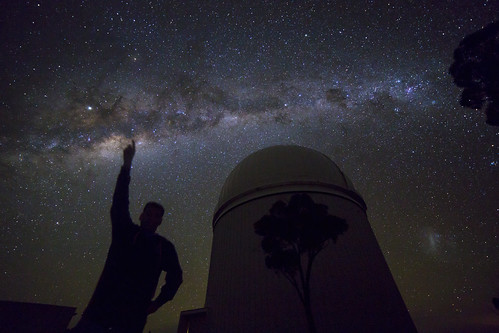
The Anglo-Australian Telescope, The Emu in the Sky (The Milky Way), the Southern Cross, Carina Nebula, Large Magellanic Cloud, Jupiter, Saturn… and me! Single 15s shot using a CANON 5D Mark III with a 14mm lens at f2.8, 1600ISO. Photo taken at 1.15am AEST, Saturday 6th April 2019.

Full resolution image in my Flickr.

Credit: Ángel R. López-Sánchez (Australian Astronomical Optics, Macquarie University).