Category Archives: Solar System

My son and the “Story of the Planets”

I spend a lot of time with my son, Luke. He turned 3 last January and, after the terrible “terrible twos” phase he is a very different and charming little person now. He has been always obsessed with letters and numbers. Indeed he does not only know his ABC’s in Spanish and in English but he also identifies Greek letters (*). He has been doing these for around a year (the Greeks letters since Christmas). Lately he’s even writing letters by himself in his (several) blackboards or in the sand at the beach. And with numbers he’s always counting everything: pieces of food, toys, steps… I think he is starting to understand what additions and subtractions are. Yes, I do have a lot of fun playing with him (not that much when it is 10pm and he refuses to go to bed, but, ey, we’re Spanish, going to bed at 10pm is not bad seen in our native country… it must be on the genes…).

Of course I also talk about Astronomy to him. Using “glowing in the dark stars” we drew constellations in his bedroom. He now knows what “the Southern Cross“, “Orion” and “Scorpius” are, even the Pleiades (not a constellation, just a a star cluster or an asterism). A couple of weeks ago I got a small book about Astronomy for him. In only 50 pages it compiles planets, constellations, star clusters, nebulae and galaxies. It is not a book for a 3 years old, but I wanted to show him the photos of the planets. And he was fascinated about that!

Since then, every night, I have to take him to bed (as said, that usually happens later than 10pm) and read him “the story of the planets“. The book has too much text, so I just tell him funny things and curiosities about the planets. He loves it!

Yesterday, as every Sunday, it was he and me alone (and Luci, our little dog), as mum works on the weekends. It was another sunny day in Sydney, and I really wanted to go to the beach (some friends were actually meeting in Manly). But Luke didn’t want to go anywhere, he wanted to stay at home playing with the many toys and books he has. Eventually he went to his bedroom and came back to the living room bringing the book with “the story of the planets”. He wanted to play with it. Then I asked him: “do you want we make planets to put in your bedroom?“. A second after that he was just jumping and laughing, excited as crazy, “¡sí, sí, sí, papi!”.

And that was it, we took white paper and color pen markers and, following the images of the planets in the book, made our own “Solar System”:
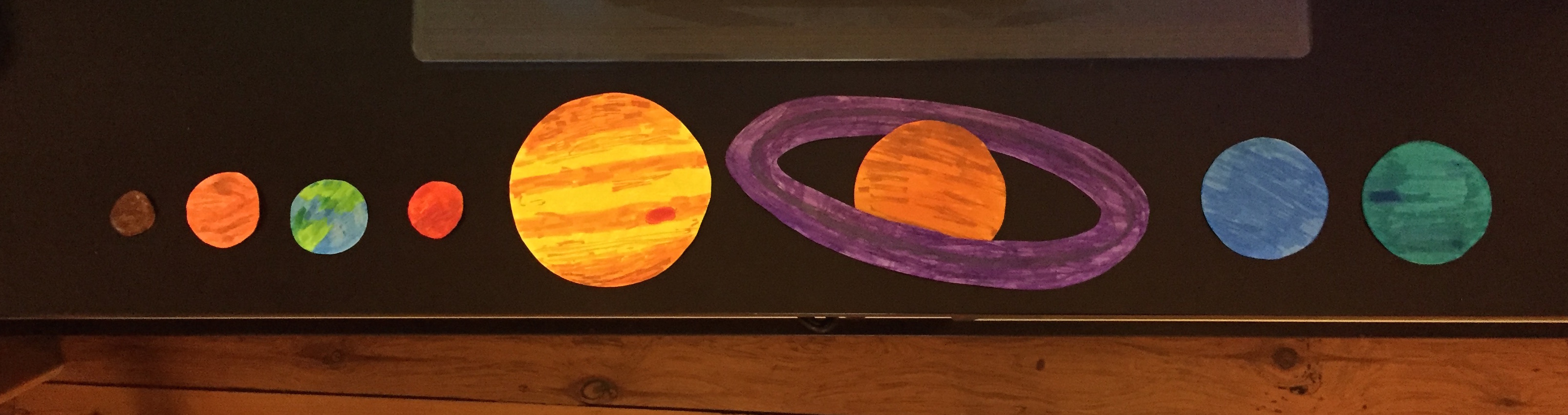
The planets that my son & me make yesteday

The planets that my son & me make yesterday. Sizes are NOT in scale.

Mercury was easy. For Venus and the Earth we used a glass and just painted with oranges-brown (Venus) or green-blue (Earth) colors. Mars was also easy just painting using red colors. I tried to add the details of the polar caps (the same that the clouds on the Earth) but our white crayon didn’t work well with the pen markers. Jupiter was fun, we used the empty box of a large yogurt (actually, that is where he has his pen markers, pencils and crayons) and just did stripes in orange colors over a yellow background to follow the Jovian bands. We added the detail of the Giant Red Spot with a red pen maker. We used a similar trick to draw Saturn (of course, this is Luke’s favorite planet) and then added the rings using a new piece of white A4 paper. Saturn’s rings were indeed the most difficult part to get, and I’m still not convinced of the result. In reality the are not that dark, and its shape is funny. We then just finished with the ice giants Uranus (pale blue with not many details on the disk) and Neptune (green-blue including some details in the clouds, and the “Great Dark Spot”).

Once this was done, Luke was really happy with “his planets”, and was counting them and naming them all the day. But I waited to the night to put them on his bedroom.

My son's bedroom wall with stars and planets

My son’s bedroom wall with stars and planets (and the X-Wing, of course).

At 9pm I said “let’s go to put your planets in your bedroom, and I’ll read you the story of the planets” and he went happily to bed. We used bluetag to do this. The result is really nice, and he is so exciting about all of this!

And, yes, we didn’t make Pluto because it is not a planet. But, don’t worry, he already knows there are other things in the Solar System: the Sun, asteroids, comets and five dwarf planets (Ceres, Pluto, Eris, Haumea and Makemake), as well as many planets have also moons! We’ll eventually make many of them.

I’ll need a bigger wall…

(*) Why teaching Luke Greek letters? Well, stars are named with Greek letters (e.g., Alpha Centauri) , and I remember it took me a while to memorize that when I was a teenager. But, more importantly, Physics and Math equations are written with Greek letters. And I write many of these in his blackboards. Yes, I know, he is little, but he is absorbing everything and I’m sure it will not hurt for him to be familiar to, let say, the Newton Equations, although some times I’ve written Einstein General Relativity, Maxwell’s Equations, or Schrodinger Equation. Luke does not pay too much attention to all of that, but he loves reading the Euler Equation “e i π plus 1 equal zero”.

Bright meteor over the AAT

This week I’m back at the Anglo-Australian Telescope (AAT, Siding Spring Observatory) as support astronomer. As the same time I’m helping visitors astronomer to get the best data using the 2dF instrument, I’m taking time-lapse sequences of the night sky using 2 CANON EOS 5D Mark III cameras. This afternoon, when checking the “preliminary” sequences of the previous night, I discovered a bright meteor in one of the frames. I was excited because at the beginning I thought it was a Leonid, but I checked and it seems to be a sporadic meteor or, perhaps, a meteor from the South Taurids shower.


The circumpolar Southern Sky, with the Magellanic Clouds, the Southern Cross and the Pointers (Alpha and Beta Centauri) over the Anglo-Australian Telescope (AAT), at Siding Spring Observatory (NSW, Australia). A bright meteor crosses the sky. Although it could have been a meteor of the Leonids meteor shower, the radiant (point in the sky from where the meteors of a meteor shower come from) was not in the sky. However it could be a meteor from the South Taurids shower. Photo taken at 2am AEST (UT+11) of the 17 Nov 2015 with a CANON EOS5D using a 16 mm lens at f2.8, 3200 ISO, 30 seconds exposure. Click here to get a higher resolution image. Credit: Ángel R. López-Sánchez (AAO/MQ).

A reddish-greenish sky glow is also seen in the image. This glow has been also observed from the observatories in Chile as is consequence of chemical reactions involving oxygen (green colours, usually forming ozone) and nitrogen (red colours) molecules in our atmosphere. These chemical reactions are induced by ultraviolet emission from the Sun, which is much more intense when the solar cycle is in maximum, as it has been in the last few years.

Visions of a Total Lunar Eclipse within clouds

DP ENGLISH: This story belongs to the series “Double Post” which indicates posts that have been written both in English in The Lined Wolf and in Spanish in El Lobo Rayado.

DP ESPAÑOL: Esta historia entra en la categoría “Doble Post” donde indico artículos que han sido escritos tanto en español en El Lobo Rayado como en inglés en The Lined Wolf.

Last night half of the world (Eastern Asia, Australasia, Pacific and the Americas) enjoyed a total lunar eclipse. Again clouds were moving around over Sydney during all the day, I actually see the moon rising in the evening and in just few minutes moving into the clouds. The sky was almost completely covered when the eclipse started, at around 20:15 local time. I was fearing that, as it happened with the partial solar eclipse visible in Sydney last 29th April, I would not be able to get any useful image of the eclipse.

In any case, as I did for the occultation of Saturn by the Moon last May, I set up my telescope in the backyard and prepared everything for taking some photos of the event. Although I followed the eclipse almost completely, the clouds only allowed me to get good images in three occasions. These are the results:

Visions of a Total Lunar Eclipse within clouds.
8 October 2014 from Sydney. Data obtained using Telescope Skywatcher Black Diamond D = 80 mm, f = 600 mm, with a CANON EOS 600D at primary focus. The Red Moon compiles 40 frames taken at 1/3 s & ISO 800. Stacking using Lynkeos software, final processing with Photoshop. Credit: Á.R.L-S. (AAO/MQ)


It is not too much but I hope you like it. I will wait for the next total lunar eclipse to try to get the time-lapse sequence of all the event.

Seasons: Astronomy vs. Australia

Something that really shocked me when I started to live in Australia ~7 years ago was to hear everywhere that seasons start at the beginning of the corresponding month. That is, as today is Sep 1st, everyone in the radio / advertisements / news is welcoming Spring. And this, being an astronomer, believe me, hurts. Why? Because astronomically we are still in winter. Seasons are defined by Astronomy in a very accurate and precise way. This year Spring starts on September 23rd, 11:29 AEST (02:29 Universal Time). That is when that the Autumn Equinox happens, and the real moment Spring starts in the Southern Hemisphere (and Autumn/Fall starts in the Northern Hemisphere).

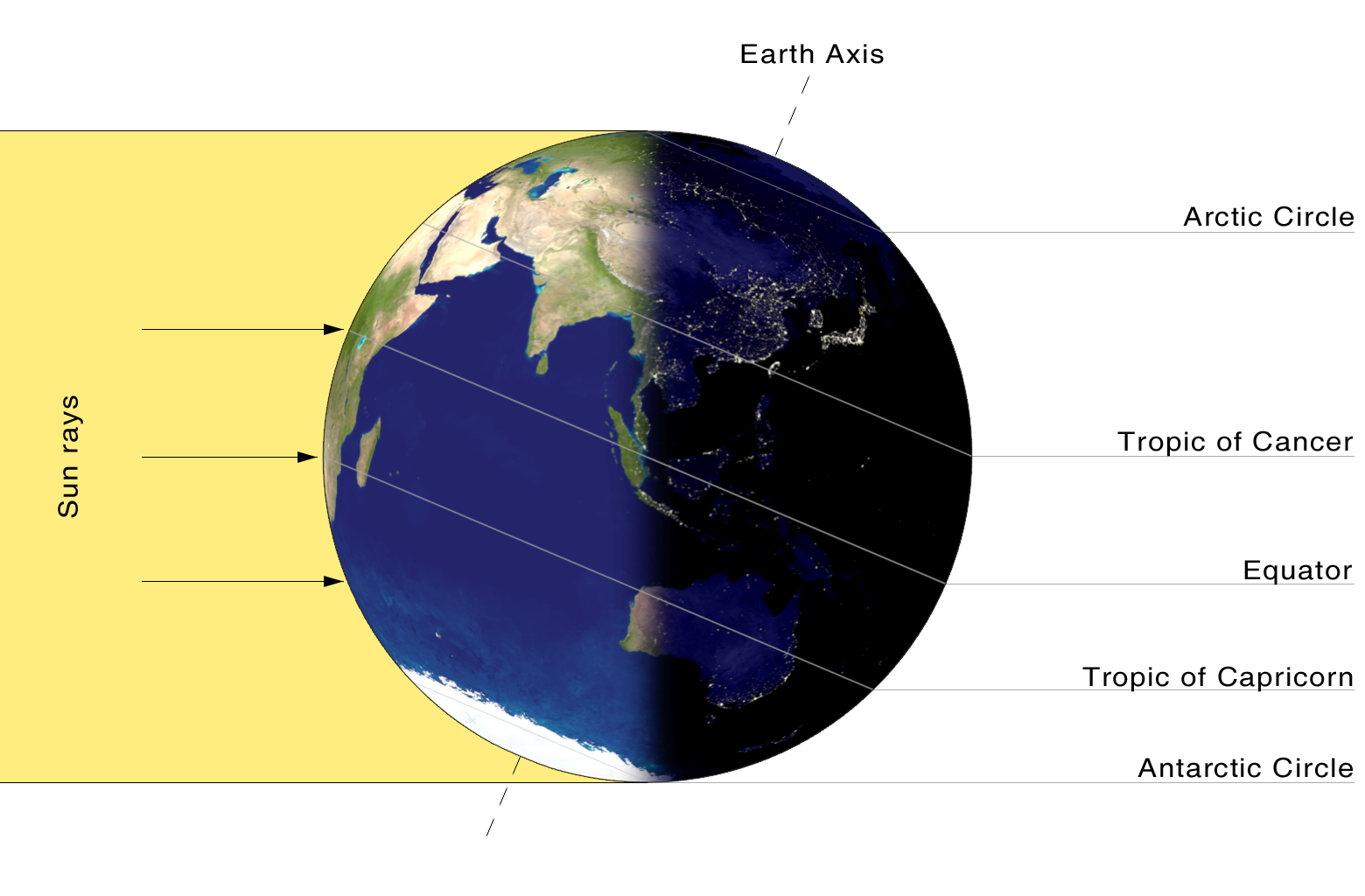
The seasons are caused by the combination of three astronomical factors: the Earth’s is a (almost perfect) sphere, the Earth’s orbit around the Sun, and the Earth’s axial tilt. As a consequence of these the Earth’s atmosphere is unequally heated by the Sun around the year at a given position. Therefore, the seasons are marked by the movement of the Earth around the Sun and, hence, which way the Earth is tilted with respect to the Sun. When the South hemisphere is tilted towards the Sun, the Sun’s rays strike the Earth at a steeper angle compared to a similar latitude in the North hemisphere. As a result, the radiation is distributed over an area which is less in the South hemisphere than in the North hemisphere. This means that there is more radiation per area to be absorbed in the South hemisphere, and therefore it is winter in the North hemisphere and summer in the South hemisphere.

Illumination of Earth by Sun at the southern solstice. Credit: Wikipedia


By astronomical definition, the precise timing of the seasons is determined by the exact times of transit of the Sun over the tropics of Cancer and Capricorn for the solstices and the times of the Sun’s transit over the Equator for the equinoxes, as specified in this figure:

Movement of the Earth around the Sun following an orbital ellipse (with eccentricity exaggerated for effect) and seasons. Equinoxes (20 or 21st March and 22nd or 23rd September) happen when the tilt of Earth’s axis neither inclines away from nor towards the Sun (green dotted line), and hence two points a the same latitude but a different hemispheres receive the same amount of energy from the Sun. In an equinox, the Sun is found at the zenith at the midday at the Equator. A solstice (20th or 21st June and 21st or 22nd December) happens when the tilt of the Earth’s axis has maximum effect (23.44º, red dotted line). At the June solstice the Sun is found at the zenith at the midday (just over our head!) at latitude 23.44º North, defining the Tropic of Cancer. Similarly at the December solstice this happens at 23.44º South, known as the Tropic of Capricorn. The periapsis (perihelion) and the apoapsis (aphelion) mark the nearest and the farthest points from the Sun, respectively (blue dotted line). Credit: Wikipedia


Therefore, in the South hemisphere, Spring starts with the Autumn Equinox, Summer with the Winter Solstice, Autumn with the Spring Equinox and Winter with the Summer Solstice. Of course, the names were given as correct for the North hemisphere.

Well, at least all of this is what Astronomy says. However, Governments and societies quite often decide to use their own definitions. Just checking this webpage of the Australian Bureau of Meteorology:

In Australia, the seasons are defined by grouping the calendar months in the following way:

1. Spring – the three transition months September, October and November.
2. Summer – the three hottest months December, January and February.
3. Autumn – the transition months March, April and May.
4. Winter – the three coldest months June, July and August.

These definitions reflect the lag in heating and cooling as the sun appears to move southward and northward across the equator. They are also useful for compiling and presenting climate-based statistics on time scales such as months and seasons.

Following these assumptions, Australia indeed enters in Spring today, which is funny because the majority of the countries (if not all) of the North hemisphere are still in Summer. In any case, for me it is Winter, and it will be winter till next on September 23rd, 11:29 AEST, when Spring, according to Astronomy, really starts.

Sequence of the occultation of Saturn by the Moon

DP ENGLISH: This story belongs to the series “Double Post” which indicates posts that have been written both in English in The Lined Wolf and in Spanish in El Lobo Rayado.

DP ESPAÑOL: Esta historia entra en la categoría “Doble Post” donde indico artículos que han sido escritos tanto en español en El Lobo Rayado como en inglés en The Lined Wolf.

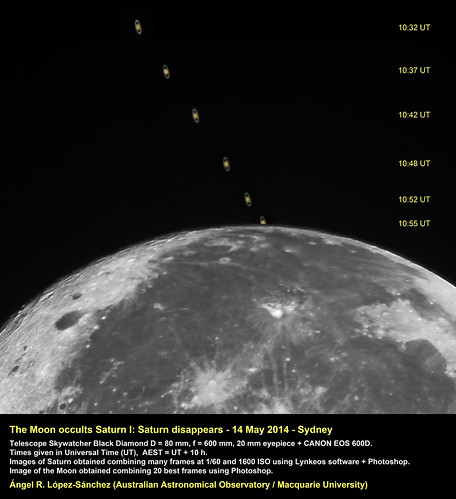
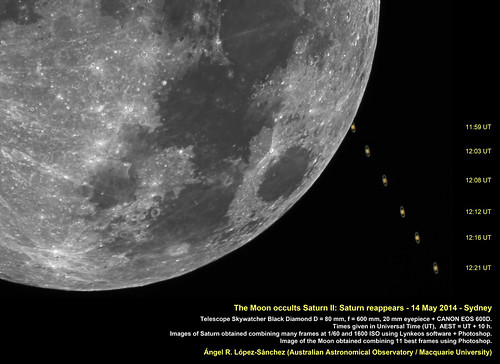
Today Sunday I’ve used some of my free time to process the images I took last Wednesday, when Saturn was occulted by an almost full Moon. These are my two final images showing how Saturn first disappears behind the Moon and it reappears an hour later.

The Moon occults Saturn I: Saturn disappears.
14 May 2014 from Sydney. Data obtained using Telescope Skywatcher Black Diamond D = 80 mm, f = 600 mm, 20 mm eyepiece + CANON EOS 600D. All times are given in Universal Time, add 10 hours to get the local time in Sydney (AEST) that date. Images of Saturn obtained combining many frames at 1/60 and 1600 ISO using Lynkeos software + Photoshop. Image of the Moon obtained combining 20 best frames using Photoshop. Credit: Á.R.L-S. (AAO/MQ)


The Moon occults Saturn I: Saturn disappears.
14 May 2014 from Sydney. Data obtained using Telescope Skywatcher Black Diamond D = 80 mm, f = 600 mm, 20 mm eyepiece + CANON EOS 600D. All times are given in Universal Time, add 10 hours to get the local time in Sydney (AEST) that date. Images of Saturn obtained combining many frames at 1/100 and 1600 ISO using Lynkeos software + Photoshop. Image of the Moon obtained combining 11 best frames using Photoshop. Credit: Á.R.L-S. (AAO/MQ)

Getting nice images of Saturn was much trickier than I expected: the setup I used the other night it is not the best to observe Saturn, as more magnification and a good tracking are needed. On the other hand, the Moon was very bright so I had to use short exposition times, and hence Saturn appeared very dim. At the end I manage to get a kind of “master Saturn” combining the best frames I took during the night and later combine it with the data of each position to get the final view of Saturn at each time. For the Moon it was much easier, although you’ll perhaps realize that the second image is somewhat better than the first. The reason is that some parts of the Moon were actually saturated with the 1/60 seconds exposures, and that is why I later used 1/100 seconds for getting Saturn reappearing. In any case, I hope you like them.