Today, 14th May 2014, Saturn is occulted by the Moon, although this can only be seen from most Australia and New Zealand. I’ve set up my telescope in the backyard and now I’m taking some photos of the event. Although I’ll try to get better images later, let me show you what I’m obtaining now.
These three images show how Saturn is moving closer to the Moon:
Occultation of Saturn by the Moon, as observed from my backyard in Sydney. I used my Skywatcher Black Diamond Telescope D = 80 mm, f = 600 mm and my CANON EOS 600D, and a 20mm eyepiece projection, at 1600 ISO and speed 1/60. This is just a single frame obtained at 20:44 AEST (10:44 UT). I also used Photoshop to play with the levels/colours/saturation. Credit: Angel R. López-Sánchez.
Occultation of Saturn by the Moon, as observed from my backyard in Sydney. I used my Skywatcher Black Diamond Telescope D = 80 mm, f = 600 mm and my CANON EOS 600D, and a 20mm eyepiece projection, at 1600 ISO and speed 1/60. This is just a single frame obtained at 21:12 AEST (11:12 UT). I also used Photoshop to play with the levels/colours/saturation. Credit: Angel R. López-Sánchez.
Occultation of Saturn by the Moon, as observed from my backyard in Sydney. I used my Skywatcher Black Diamond Telescope D = 80 mm, f = 600 mm and my CANON EOS 600D, and a 20mm eyepiece projection, at 1600 ISO and speed 1/60. This is just a single frame obtained at 21:18 AEST (11:18 UT), the planet is “touching” the disc of the Moon. I also used Photoshop to play with the levels/colours/saturation. Credit: Angel R. López-Sánchez.
After that, I waited for 40 minutes to see Saturn reappears behind the Moon, as it is shown is the next three photos:
Occultation of Saturn by the Moon, as observed from my backyard in Sydney. I used my Skywatcher Black Diamond Telescope D = 80 mm, f = 600 mm and my CANON EOS 600D, and a 20mm eyepiece projection, at 1600 ISO and speed 1/100. This is just a single frame obtained at 21:59 AEST (11:59 UT). I also used Photoshop to play with the levels/colours/saturation. Credit: Angel R. López-Sánchez.
Occultation of Saturn by the Moon, as observed from my backyard in Sydney. I used my Skywatcher Black Diamond Telescope D = 80 mm, f = 600 mm and my CANON EOS 600D, and a 20mm eyepiece projection, at 1600 ISO and speed 1/100. This is just a single frame obtained at 22:05 AEST (12:05 UT). I also used Photoshop to play with the levels/colours/saturation. Credit: Angel R. López-Sánchez.
Occultation of Saturn by the Moon, as observed from my backyard in Sydney. I used my Skywatcher Black Diamond Telescope D = 80 mm, f = 600 mm and my CANON EOS 600D, and a 20mm eyepiece projection, at 1600 ISO and speed 1/100. This is just a single frame obtained at 22:15 AEST (12:15 UT). I also used Photoshop to play with the levels/colours/saturation. Credit: Angel R. López-Sánchez.
In the next few days I’ll prepare some few better (processed) images. Stay tuned!
Last Tuesday 29th April the Earth, the Moon, and the Sun aligned to produce one of the most spectacular astronomical phenomena we can see: a solar eclipse. The 29th April solar eclipse was actually not a total eclipse (i.e., the disc of the Moon didn’t cover all the disc of the Sun) but an Annular eclipse. The annular phase could be only visible in Antarctica, but a partial solar eclipse was seen throughout Australia in the late afternoon. More information about this solar eclipse can be found in the NASA Eclipse Website managed by the astrophysicist Fred Espenak.
The Sun would be eclipsed by the Moon during the sunset, it was then a perfect opportunity to get some nice photos of the eclipsed Sun with some famous buildings such the Sydney Opera House or Sydney Harbour Bridge. With this excuse, but also with the idea of showing the wonders of Nature to the public, a group of astrophysicists working at Australian Astronomical Observatory (AAO) decided use this solar eclipse to organize our first “Guerrilla Astronomy” event (*). The aim of these activities is to set up amateur telescopes in a public area (a park or a shopping center) and explain to the public who is around what Astronomy is, what astronomers do, and what the “Australian Astronomical Observatory” is. More of these events are coming in the future, but this was our first “test” to see how we can organize and manage the activity.
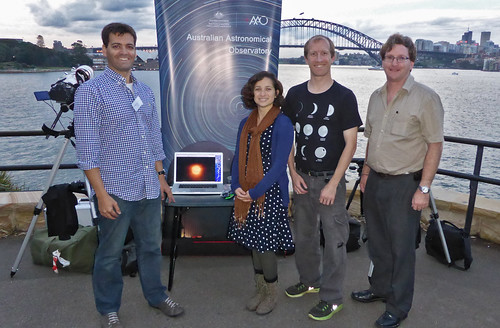
Participants to the first AAO “Guerrilla Astronomy” Event. From right to left, Stuart Ryder (AAO/AusGO), Kyler Kuehn (AAO), Paola Oliva-Altamiro (Swinburne/AAO) and Ángel R. López-Sánchez (AAO/MQ). The laptop shows the only good image we could get of the eclipse using my telescope. Mrs Macquarie Chair, Sydney Botanic Gardens / Domain, 29 Apr 2014. Photo Credit: Stuart Ryder (AAO/AusGO).
Given the time and position of the Sun during the eclipse, we decided that a really nice spot to prepare our telescopes would be Mrs Macquarie Chair point, in the Domain, Sydney Botanic Gardens. From there a very dramatic view of the Sydney Opera House and the Sydney Harbour Bridge is seen. We first requested permission to do this to the authorities of the Domain, who were really nice and even allowed us to park by free. Actually, they also came along to see the eclipse and they liked our idea of organizing more “Guerrilla Astronomy” events there in the nearby future.
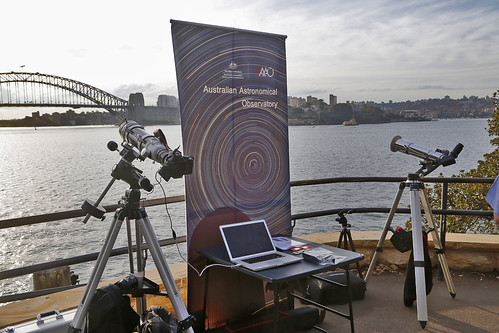
All set up for eclipse: two telescopes (Stuart’s at the right, mine at the left), the AAO banner, my laptop and camera to take photos through the telescope, the eclipse glasses and extra information about the eclipse to give to the visitors. Mrs Macquarie Chair, Sydney Botanic Gardens / Domain, 29 Apr 2014. Photo Credit: Ángel R. López-Sánchez (AAO/MQ).
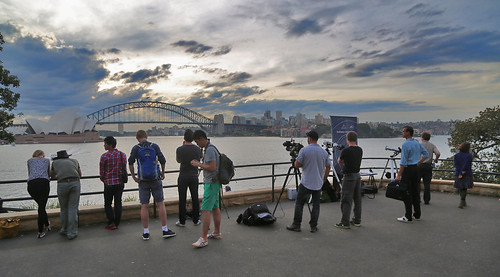
It was four of us, Stuart Ryder (AAO/AusGO), Kyler Kuehn (AAO), Paola Oliva-Altamiro (Swinburne/AAO) and myself, who participated in this first “Guerrilla Astronomy” event. Just to have everything ready on time, we were setting up telescopes, AAO banner and laptop around an hour before the beginning of the eclipse. The weather seemed very clear in the morning, but in the afternoon, as we feared, some clouds started to arrive from the west. We already knew this would be a killer… but we had to try!
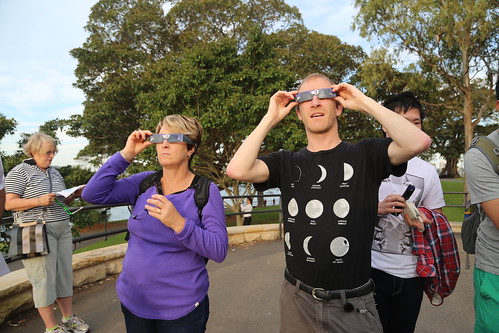
Kyler and visitor using the solar glasses. First AAO “Guerrilla Astronomy” Event: partial solar eclipse on 29 April 2014 over Sydney Harbour. Mrs Macquarie Chair, Sydney Botanic Gardens / Domain. Photo Credit: Paola Oliva-Altamiro (Swinburne/AAO).
Little girl using the eclipse glasses. First AAO “Guerrilla Astronomy” Event: partial solar eclipse on 29 April 2014 over Sydney Harbour. Mrs Macquarie Chair, Sydney Botanic Gardens / Domain. Photo Credit: Paola Oliva-Altamiro (Swinburne/AAO).
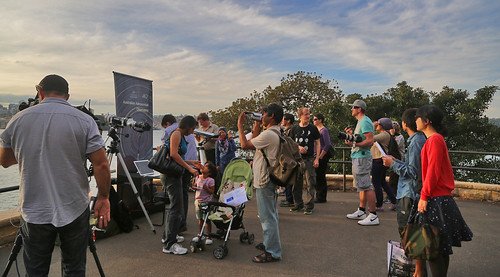
Visitors, but clouds please go away! First AAO “Guerrilla Astronomy” Event: partial solar eclipse on 29 April 2014 over Sydney Harbour. Mrs Macquarie Chair, Sydney Botanic Gardens / Domain. Photo Credit: Paola Oliva-Altamiro (Swinburne/AAO).
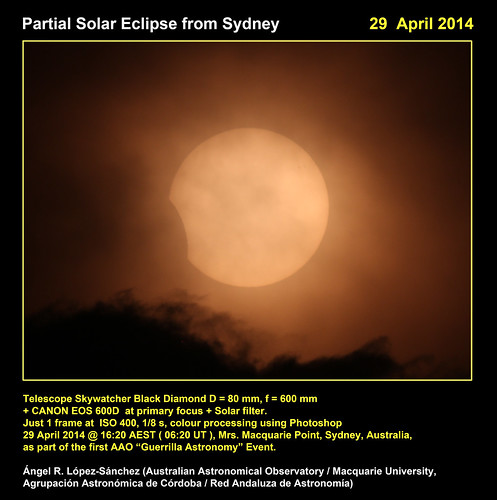
We actually were a bit lucky at the beginning, and hence we could see the Sun within thin clouds and follow the eclipse for 10 minutes. I even could take a nice image:
Partial Solar Eclipse from Sydney on 29 Apr 2014. Telescope Skywatcher Black Diamond D = 80 mm, f = 600 mm + CANON EOS 600D at primary focus + Solar filter. Just 1 frame at ISO 400, 1/8 s, colour processing using Photoshop. 29 April 2014 @ 16:20 AEST ( 06:20 UT ). First AAO “Guerrilla Astronomy” Event: partial solar eclipse on 29 April 2014 over Sydney Harbour. Mrs Macquarie Chair, Sydney Botanic Gardens / Domain. Photo Credit: Ángel R. López-Sánchez (AAO/MQ).
After that, thick clouds arrived and this happened:
5-seconds timelapse video obtained combining 25 images taken with Telescope Skywatcher Black Diamond D = 80 mm, f = 600 mm + CANON EOS 600D at primary focus + Solar filter, at ISO 400, 1/8 s, showing how the clouds completly cover the eclipsed sun. 29 April 2014 @ 16:20 AEST ( 06:20 UT ). The direct link to the YouTube video is here. Credit: Ángel R. López-Sánchez (AAO/MQ).
Once the Sun was completely covered by thick clouds we just waited and hoped for a little gap, but unfortunately this never happened and we didn’t see the Sun again that day.
Stuart and his telescope, Kyler and visitors, all hoping the clouds go away. First AAO “Guerrilla Astronomy” Event: partial solar eclipse on 29 April 2014 over Sydney Harbour. Mrs Macquarie Chair, Sydney Botanic Gardens / Domain. Photo Credit: Paola Oliva-Altamiro (Swinburne/AAO).
The eclipsed sun is setting behind those think clouds. First AAO “Guerrilla Astronomy” Event: partial solar eclipse on 29 April 2014 over Sydney Harbour. Mrs Macquarie Chair, Sydney Botanic Gardens / Domain. Photo Credit: Ángel R. López-Sánchez (AAO/MQ).
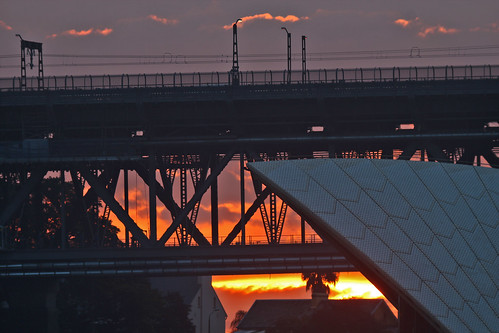
Well, it would have been really nice to see the eclipsed sun setting over the Sydney Harbour Bridge and sinking later close to the Sydney Opera House, I’m sure the images and time-lapse video would have been quite spectacular, but the best I got was this image:
An eclipsed sun should be setting around there… Imagen taken using a Telescope Skywatcher Black Diamond D = 80 mm, f = 600 mm + CANON EOS 600D at primary focus. First AAO “Guerrilla Astronomy” Event: partial solar eclipse on 29 April 2014 over Sydney Harbour. Mrs Macquarie Chair, Sydney Botanic Gardens / Domain. Photo Credit: Ángel R. López-Sánchez (AAO/MQ).
In any case, all four AAO participants were very happy about how the event was and, as I said, we are expecting to repeat these “Guerrilla Astronomy” activities in the nearby future.
Next solar eclipse to touch Australia will be on 9 March 2016, but it will also be a partial eclipse only visible on the northern and western parts of the continent. The next total eclipse to be seen from Australia will happen on 20 April 2023 and it will just touch the coast of Western Australia. We have to wait until 22 July 2028 to see a total solar eclipse in Sydney. Actually, Sydney is almost exactly in the center of the totality.
(*) Note that the word “Guerrilla” comes from Spanish, however the name didn’t come from me but from an idea my colleague Amanda Bauer (AAO Outreach Officer) had some months ago. As a native Spanish speaker I have to confess it is really hard to hear the pronunciation of “Guerrilla” following English phonemes as “Guerrilla Astronomy” sounds almost identical to “Gorilla Astronomy“. I would encourage to try to pronounce “Guerrilla” as it is said in Spanish (geˈri.ʝa) to be released of this confusion, but of course that is only my modest suggestion than can be completely ignored…
Today, 10th May 2013, the combined movements of the Sun, Earth and Moon gave us a very nice Annular Solar Eclipse. Following a similar path to the Total Solar Eclipse we enjoyed last November, the shadow of the Moon over the Earth moved from North Australia to the Pacific. However, today the Moon was close to its maximum distance to the Earth (planets and satellites move following elliptical orbits) and hence its apparent size on the sky was not big enough to completely cover the disc of the Sun. This is indeed the reason the eclipse was an annular solar eclipse.
In this occasion I couldn’t travel to North Australia to enjoy the annular eclipse (actually, I have seen 2 of these in the past, the most recent one was on 3rd October 2005 from Madrid), and even last night I didn’t expect to do anything special about this today. But this morning, while watching it from my backyard using my solar glasses, I decided just to take some few shots using not the telescope but only the tele lens. This is the result:
Partial Solar Eclipse from Sydney. Data obtained using a CANON EOS 600D, a 250mm Tele Lens and a Solar filter (which I hold by hand). I stacked 12 individual frames obtained at ISO 100, f10, 1/80 s using the Lynkeos software. The final processing was achieved using Photoshop. 10 May 2013 @ 09: 10 AEST ( 00:10 UT ), Sydney, Australia. Credit: Ángel R. López-Sánchez (Australian Astronomical Observatory / Macquarie University, Agrupación Astronómica de Córdoba / Red Andaluza de Astronomía)
Besides being an astrophysicist I’m an active amateur astronomer. After 6 years living in Australia, finally in May 2012 I bought my own, small amateur telescope: Skywatcher Black Diamond Refractor Telescope, with an aperture of 80 mm and a focal distance of 600 mm. It provides beautiful images of the sky. However, besides once while stayed at Siding Spring Observatory and the two “great astronomical events” of 2012 (and the final reason I got the telescope), the Transit of Venus in June and the Total Solar Eclipse in November, I have not had too much time to play with this toy.
Last Monday 18th February it was clear in Sydney and I tried to get some shots of the conjunction between the Moon and Jupiter (actually, from South Australia the Moon occulted Jupiter!). This is the vision I got from my telescope:
Conjunction between the Moon and Jupiter observed from Sydney on 18th February 2013. I used my Skywatcher Black Diamond Telescope D = 80 mm, f = 600 mm and my CANON EOS 600D at primary focus, at 200 ISO. It is a composition of two images: one taken at speed 1/60 and another at 1/10. I did what I could to get a nice balance between them. Credit: Angel R. López-Sánchez.
After this, I decided to try to find the bright comet Lemmon 2012 F6, that was located near the Small Magellanic Cloud. It was actually easier I thought and, besides the light pollution, I got it. So on Tuesday 19th, again clear, I prepared the telescope but this time including the motors and performing an alignment of the mount to the South Celestial Pole. This task is not easy when there is too much light in the sky, as the stars used to do it are faint. At the end I got this view of the comet. I was not able to detect the tail with my eyes, however it does appear when combining several frames, as I did for this image.
My vision of the comet Lemmon 2012 F6 from Sydney on Tuesday 19th February 2012, at 21:20 AEST (10:20 UT). I combined 7 frames of 6 seconds exposure each (42 seconds total exposition time), at 1600 ISO using Skywatcher Black Diamond Telescope D = 80 mm, f = 600 mm and my CANON EOS 600D at primary focus. Note the faint tail moving towards the upper-left. Credit: Angel R. López-Sánchez.
An annotated version of this image can be found here:
Annotated version of my vision of the comet Lemmon 2012 F6 from Sydney on Tuesday 19th February 2012, at 21:20 AEST (10:20 UT). I combined 7 frames of 6 seconds exposure each (42 seconds total exposition time), at 1600 ISO using Skywatcher Black Diamond Telescope D = 80 mm, f = 600 mm and my CANON EOS 600D at primary focus. I have included an arrow folowing the faint tail, the orientation, and the position of the star &epsilon Tucanae. Credit: Angel R. López-Sánchez.
To get a good focus I decided to use the famous Jewel Box star cluster, very close to Mimosa (β Crucis).
Image of the “Jewel Box” star cluster (NGC 4755 or Kappa Crucis) in the Southern Cross from Sydney (actually, 4 km from the city center) on Tuesday 19th February 2013, 20:50 AEST (09:50 UT). It combines 6 images with 5 seconds exposure each ( 30 seconds total time) at 400 ISO, using a Skywatcher Black Diamond Telescope D = 80 mm, f = 600 mm and my CANON EOS 600D at primary focus. The bright star at the left is Mimosa, β Crucis, one of the brightest stars of the Southern Cross. Credit: Angel R. López-Sánchez.
Any of these images are very spectacular but considering that they have been taken just 4 km from the center of Sydney, with all the light pollution, plus the extra “fight” with the mozzies, I’m happy to share them with you.
Yesterday I explained we are resuming the scientific observations at Siding Spring Observatory (NSW, Australia) since the recent bushfires on 13 January 2013. Today we have used this telescope to observe the Near Earth Asteroid (NEA) 2012 DA14, which is getting its closest encounter to our planet today (it will be at only 27000 km from the surface of the Earth). Here you have the details:
The path of the NEA 2012 DA14 from the AAT. Observed during the evening twilight on the 15 February 2013 using the FPI camera of the 2dF instrument at the 3.9m Anglo-Australian Telescope located at Siding Spring Observatory (NSW, Australia). 25 frames, 2 seconds exposure each, 5 seconds between frames. First frame obtained at 09:53:54 UT, last one at 09:56:22. Support Astronomers: Lee Spitler (MQ/AAO) & Andy Green (AAO). Night Assistant at the AAT: Steve Chapman (AAO). Edition of the data and movie: Ángel R. López-Sánchez (AAO/MQ). Link to the video in my Flick.
The data were obtained by Lee Spitler (MQ/AAO), Andy Green (AAO) and Steve Chapman (AAO) during the evening twilight while waiting the sky was dark enough to start the scheduled scientific observations. We will try to get more data of this object during the morning twilight. More to come soon!
Update at 14:45 AEST, 16th Feb 2013
I’ve checked there are some problems to watch the video using smartphones and tablets such iPhones and iPad. Just try this link and it should work, although you may get a low resolution version of it. I’m creating a new video to be uploaded to YouTube. At the same time, I’ve just finished this image showing a mosaic with 13 of the frames obtained for the video.
Mosaic with the path of the NEA 2012 DA14 from the AAT. Observed during the evening twilight on the 15 February 2013 using the FPI camera of the 2dF instrument at the 3.9m Anglo-Australian Telescope located at Siding Spring Observatory (NSW, Australia). Each frame has an exposition time of 2 seconds.Times are shown in Universal Time (UT), add +11 hours to get the local time in NSW. Support Astronomers: Lee Spitler (MQ/AAO) & Andy Green (AAO). Night Assistant at the AAT: Steve Chapman (AAO). Edition of the data and movie: Ángel R. López-Sánchez (AAO/MQ).
Finally, I confirm we also observed the NEA at the AAT during the morning twilight.
The path of the NEA 2012 DA14 from the AAT. Observed during the evening twilight on the 15 February 2013 using the FPI camera of the 2dF instrument at the 3.9m Anglo-Australian Telescope located at Siding Spring Observatory (NSW, Australia). 25 frames, 2 seconds exposure each, 5 seconds between frames. First frame obtained at 09:53:54 UT, last one at 09:56:22. Support Astronomers: Lee Spitler (MQ/AAO) & Andy Green (AAO). Night Assistant at the AAT: Steve Chapman (AAO). Edition of the data and movie: Ángel R. López-Sánchez (AAO/MQ).










 A/Prof. Ángel R. López-Sánchez