Category Archives: Earth

The only Earth

This is the English adaptation of the article I published in Diario Córdoba newsletter last Sunday, 15th December 2019, which I have also compiled in my personal blog in the Naukas science communication network. It has some references to the situation of the light pollution in Spain but unfortunately this also applies to the majority of the countries of the developed world.

A couple of weeks ago my six-year-old son had to make his first speech in front of his classmates. It is a very common practice in Australia and in other English countries: from a very young age students are encouraged to briefly and concisely discuss their thoughts regarding a particular topic in public. My son chose the topic “how can we care about the environment?”, that we developed together (obviously, you can’t ask to a six-year-old child to do something like this on his own the very first time). He rehearsed during days. In his speech my son wanted to emphasize “the 3 Rs“: “reduce, reuse and recycle.” It was evident that at some point during the course they had talked about it in class, and certainly sometimes during this year he had returned from school asking for “containers and cartons to reuse them in toys or ornaments”. Ecological and environmental awareness does exist in our society, and it is indeed encouraging to see young people very committed to that. But is it enough?

Brainstorming session compiling key topics to prepare my child’s speech “What can we do to take care of the environment?”

The environmental issues are widely complex and touch on social, economic, political, scientific and even religious aspects. The World Climate Summit that has been held in Madrid these weeks demonstrates the complicated interrelationship of interests that exist when we try to really take care of our planet. Many people think that they are doing something useful but at the end of the day these are just patches to clear their conscience about their lack of actions to attack the real problem. Now, during Christmas, we all live another example of these contradictions.

Christmas has always been my favorite time of the year. As a child I waited excitedly for the gifts of the Three Wise Kings on January 6th (that is the real moment kids get their Christmas presents in Spain, as the tradition is that they are brought by the Three Wise Kings, we imported Papá Noel – Santa Clauss just recently). This day was always a great party in our house, with lots of papers and boxes to be unwrapped. Despite living now in another continent, with a slightly different culture, I try to maintain this tradition and the illusion of Christmas for my son, like so many people sure does around the world. But this year the confluence of many factors (the World Climate Summit, the rise of climate change deniers, the disastrous fires that are plaguing Australia and making Sydney the most polluted city in the world on Tuesday Dec 10th, my outrage at others environmental factors that are not taken seriously, and my son’s speech) have made me rethink everything. How much garbage do we generate in a few days? Where is this consumer society taking us?
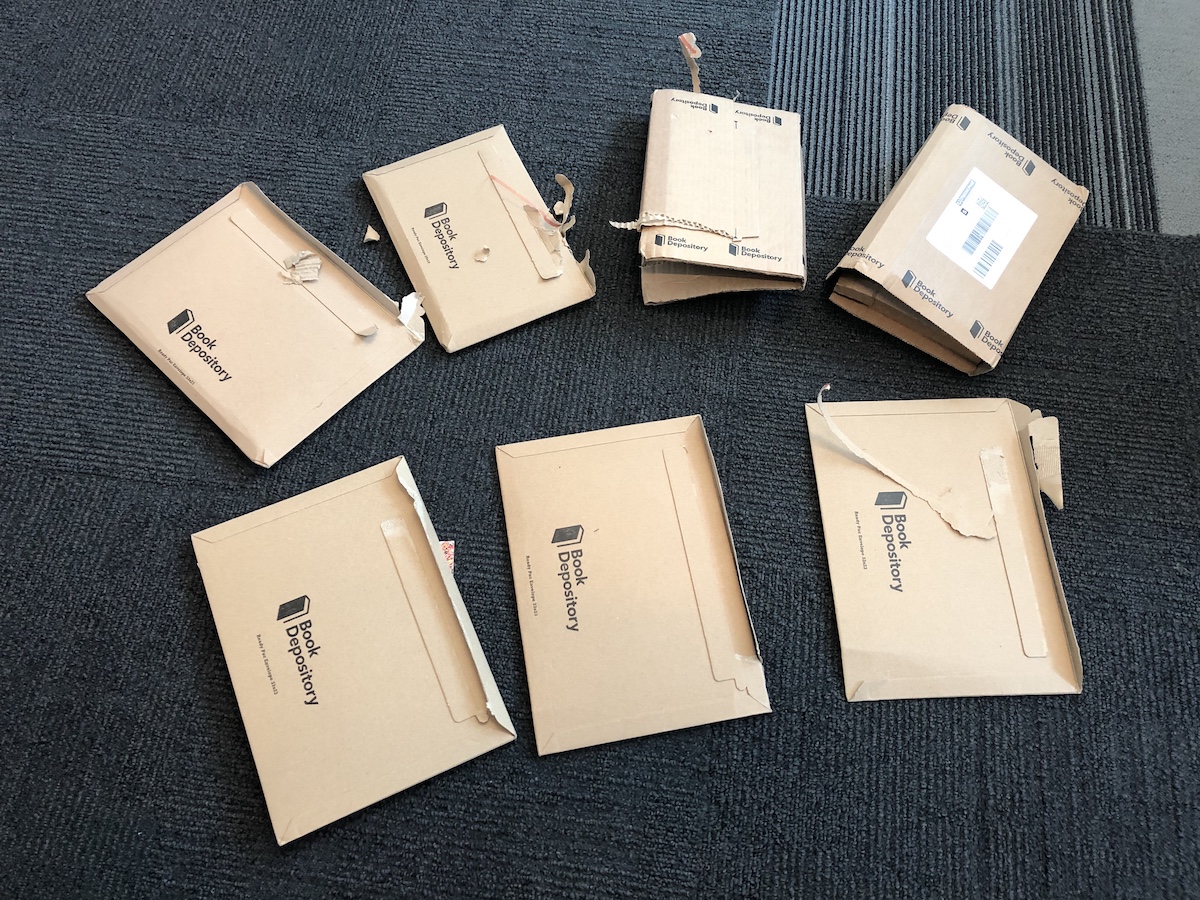
As I couldn’t travel to Spain in 2019 I bought online several books and notebooks in Spanish for Christmas. I placed the entire order together but each book or notebook (the three packages at the bottom are thin homework notebooks in Spanish for my son, all of the same course) has come in an individual cardboard box and with a lot of extra, unwanted advertising and papers inside ? How much extra crap are we generating? By the way, 3 more packages that had not yet arrived are missing in the photo.

Indeed, Christmas has become a time of waste. You have to buy more and more things, frantically decorating houses and cities, attending large banquets (business, family, friends) in a few days. What used to be a short period of one or two weeks has now extended over two months. The shopping centers are decorated before Halloween. And the “Black Friday” is now a common practice worldwide, with people buying plenty of things online that they don’t need (and that will delivered to their homes by workers who usually are in precarious working conditions, in a cardboard box that includes plenty of unwanted publicity and other papers). Here it is the first “R” my son pointed out: we must reduce the huge amount of waste that we create.

Of course, for years now many scientists including me have been pointing out that there is an increasing huge waste of resources (of money) in Christmas lighting. Light pollution is growing  and, sponsored by the rise of LEDs, more and more Christmas lights are installed every year in our cities. I am the first one to enjoy a beautiful holiday lighting and I know that it attracts people to the streets for Christmas shopping, but aren’t they too much now? 

During the last months we have seen some politicians of Spanish major cities boasting about “my Christmas lighting is the best”. The facilities began to be installed in September, with millions of LEDs everywhere. It has been estimated that about 10% of the annual electricity bill of a large city in Spain is going into Christmas lighting. Apart from the most correct use that money could be given, this means a great contribution of greenhouse gases to the atmosphere. And it is more: the scientific studies are demonstrating that LEDs (which are replacing the low-pressure sodium lights, the most energy efficient and the least polluting of lights) are substantially impacting the fauna, flora and ourselves. An increasing of cancers are being detected in places with excessive lighting. Blue light (the dominant one in most LEDs that are being installed in cities around the world) inhibits the creation of melatonin, which is the hormone that controls our sleep and circadian rhythm. Light pollution is another major environmental problem, perhaps not publicly known as other types of pollution, but that must be taken into account and mitigated with appropriate laws and regulations. On this point it is interesting to note that the Spanish Network of Studies of Light Pollution has requested this month the total paralysis and reconstruction of the Royal Decree in which the Regulation of energy efficiency of outdoor lighting installations is approved, as it contains fundamental errors and the complete absence of scientific criteria in its elaboration.
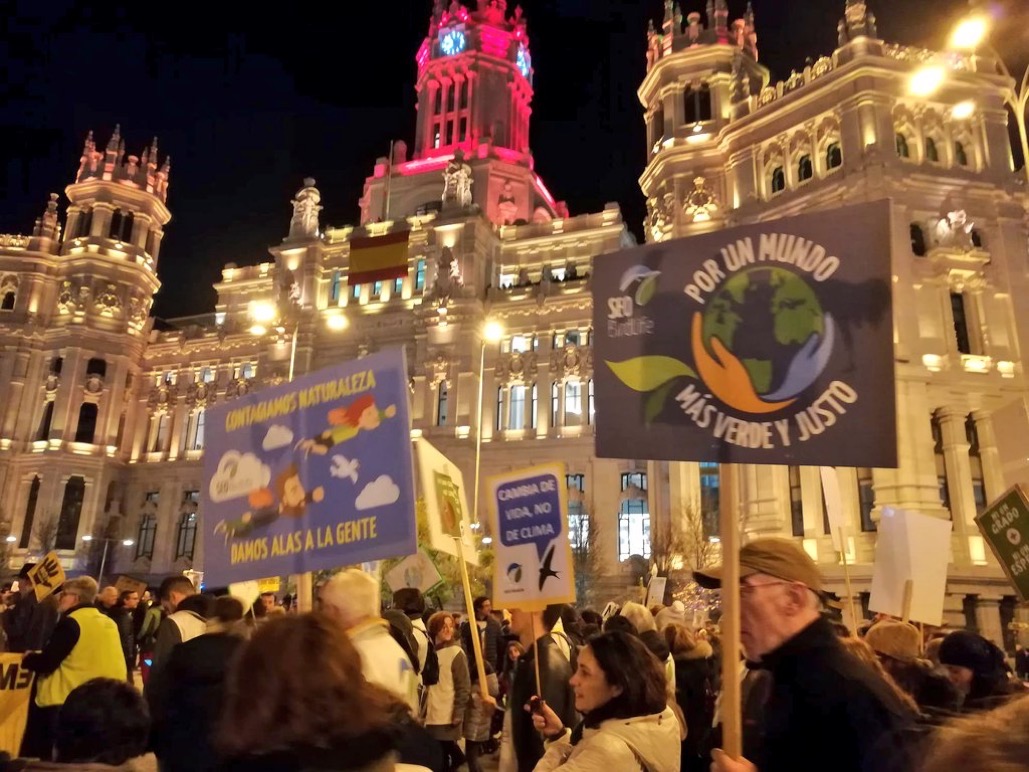
Protesters in Madrid during the UN Climate Summit COP 25, on Friday, December 6, 2019, with the contrast of the exaggerated lighting of Madrid’s buildings, even more for Christmas. I have not found the credit of the image, a thousand apologies to the author, although I asked on Twitter and tried.

As a scientist I don’t believe in climate change. I don’t believe in it because the verb to believe means “to have something for sure without knowing it directly or without it being proven or proven” (definition of the “Real Academia Española”, the “Royal Spanish Academy”). As a scientist who has read and contrasted the observations and studies that have been done on the effect of the emission of greenhouse gases in the Earth’s atmosphere by burning fossil fuels in human activities during the past 200 years, I do have the absolute knowledge that climate change is real. Scientists have been warning the society for decades, and we have clearly known that global warming is not due to external factors, such as changing the brightness of the Sun, the Earth’s orbit, or even the movement of the Sun around the Milky Way. Global warming and its consequences, climate change, is undoubtedly the product of human activity.

Comparison of solar irradiance on the Earth (yellow) with the average temperature of the planet (in red) since 1880. The thick lines show the average in periods of 11 years. Variations (maximum 0.15%) of the total irradiance of the Sun on Earth show the small oscillations of 11 years due to the solar cycle. The change in the brightness of the Sun does not explain the increase of around 1 degree Celsius of the average temperature of the Earth’s atmosphere from the beginning of the 20th Century to the present. Credit: NASA.

Our society is not environmentally sustainable. Crossed interests and our own daily habits make extremely difficult to solve the environmental problems. Maybe first we all have to become aware of them. During the World Climate Summit in Madrid the last weeks some absurd things have been proposed (such as removing the emoji of plastic bottles of non-reusable cups with plastic straws), interesting ideas have been discussed (such as green bus stops, investigations of bacteria that consume carbon dioxide, the most common greenhouse gas, or ecological bags) and very contradictory images have been seen (such as the large mass demonstration of young people with banners for a green and sustainable world in a Madrid absolutely overflowed with lights, and not just Christmas lights).

But the only way to really deal with the problem is to change our energy model. We must really invest in renewable energy (especially solar) and also in nuclear energy (which has been scientifically proven safe) and ban coal, gas, petrol and oil. Some politicians and governments (Germany, New Zealand) are taking the problem of climate change seriously and are proposing good measures. Other countries like Spain are there there. And some countries including the United States and Australia try to ignore it.

We are not going to destroy the Earth. Climate change affects us as a global civilization, but not the planet itself. Certainly, we are killing the Earth’s enormous biodiversity, but we, the human beings, will be the most affected because of climate change, with hundreds of millions, perhaps billions, of people who will have to escape from their homes, becoming refugees elsewhere. Wars will happen, water will be a luxury product, and our descendants will look at us without believing that we had in our hands to stop this madness and we did nothing to stop it. 

There are many important problems in the world, and many others local problems that seem to be important but they may not be. But, with total certainty, the most important challenge that Humanity is currently facing is stopping, and I’m not saying inverting, global warming. Only the combination of the personal effort of every citizen by changing our exaggerated consumption habits and the institutional effort strongly promoting a change in the energy model of our societies can achieve this.

The Earth seen by Apollo 17 in the last crewed mission to the Moon. The photo was taken 5 hours after takeoff, on December 7, 1972. This image is known as “The Blue Marble” (Credit: NASA / Apollo 17).

I conclude with the same reflections that my six-year-old son left at the end of his speech. “No other planet in the Solar System, not even Mars, and none of the more than 4000 planets that astronomers have discovered around other stars are like Earth. We have to take care of our home world. It is the only Earth we will ever know.

Supermoons

During the last few days the news are talking about the “Supermoon” happening on Monday 14th November. The reports (some examples here, here and here) say that “it will be the brightest Full Moon in years“. Even we at the Australian Astronomical Observatory have been asked about this “very rare phenomenon“. But how much is true about all of this?

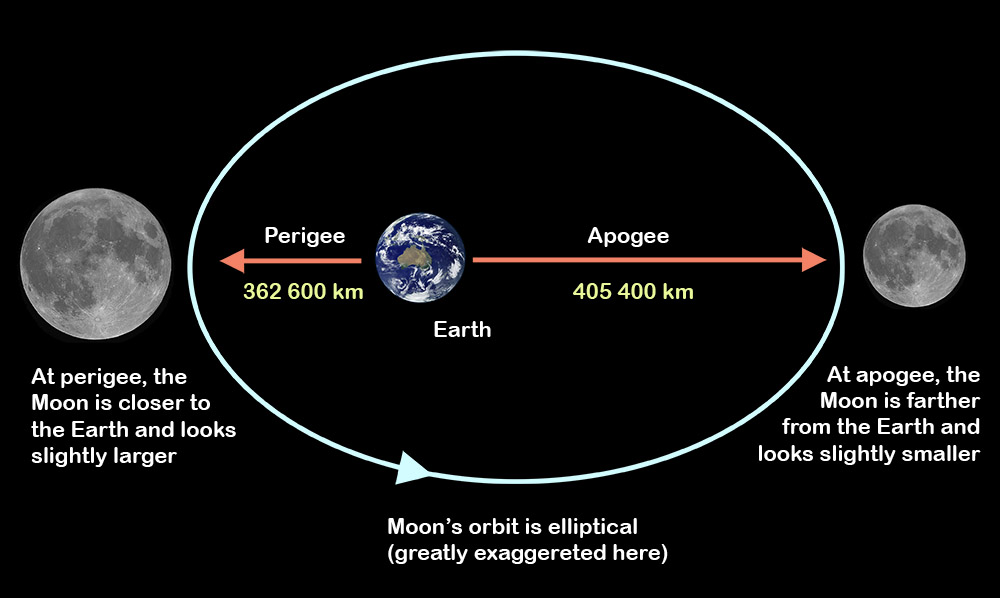
Let’s take a look. First of all we should have clear that the Moon, as any other small body moving around a larger body, has an elliptical orbit.

Diagram explaining the movement of the Moon around the Earth. Not in scale. Credit: Ángel R. López-Sánchez. Moon image: Paco Bellido.

Diagram explaining the movement of the Moon around the Earth following an elliptical orbit and defining the perigee and the apogee. Not in scale. Credit: Ángel R. López-Sánchez. Moon image: Paco Bellido.

Planets also move around the Sun following elliptical orbits, as it was discovered by the great astronomer (and the first real astrophysicist in History, although he also had to work as an astrologer to get a salary) Johannes Kepler at the beginning of the 17th century.

This means that sometimes the Moon is closer to the Earth and sometimes it is farther from the Earth, just depending on where it is located within its orbit. The point on the Moon’s orbit closest to Earth is called the perigee (at an average distance of 362 600 km) and the point farthest away is the apogee (at an average distance of 405 400 km). On average the Moon-Earth distance is about 382 900 kilometers.

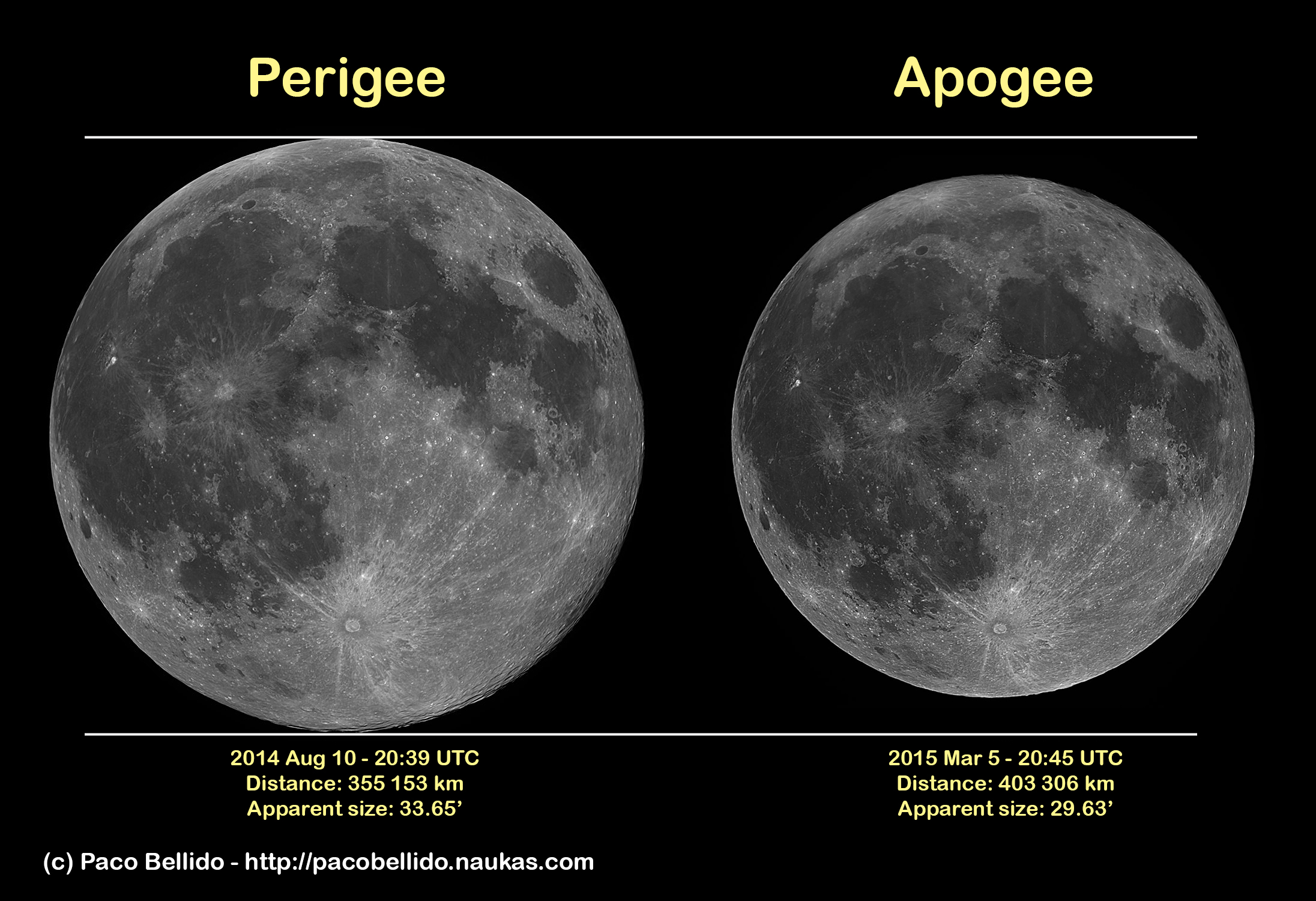
Therefore, just because of its distance, the apparent size of the Moon is a bit larger than usual when it is at the perigee, while it seems a bit smaller than usual when the Moon is at the apogee. An image can explain this much better than words:

Comparison of the apparent size of the Moon when it is located at the perigee (left) and when it is at the apogee (right). Credit: Paco Bellido.

Comparison of the apparent size of the Moon when it is located at the perigee (left) and when it is at the apogee (right). Credit: Paco Bellido.

These photos were taken by the Spanish astrophotographer and friend Paco Bellido in 2014 and 2015 from Córdoba (Spain), my natal city, and clearly show the different apparent size that the Moon has at the perigee (left) when compared to where it is at the apogee (right).

What does happen when the full moon coincides with the perigee? Well, that is a supermoon! The next time this will occur is next Tuesday, 15th November, 12:52am Sydney time. In that moment the Moon will be ~13% larger and ~30% brighter than a full moon happening in the apogee (a “micromoon“). From Sydney (and Australia) the best moment to see it will be on the evening of Monday 14th November, and actually many people are planning to enjoy watching the “supermoon” appearing over the Pacific Ocean at the dusk from Sydney’s famous beaches and clifts.

Regarding this, it is important to say that our brain tricks us when observing the Moon or the Sun close to the horizon: they do appear to be larger than they do higher up in the sky. This is called the Moon illusion, some studies suggest that the perception is that the Moon is almost 3 times larger near the horizon that when located near the zenith.

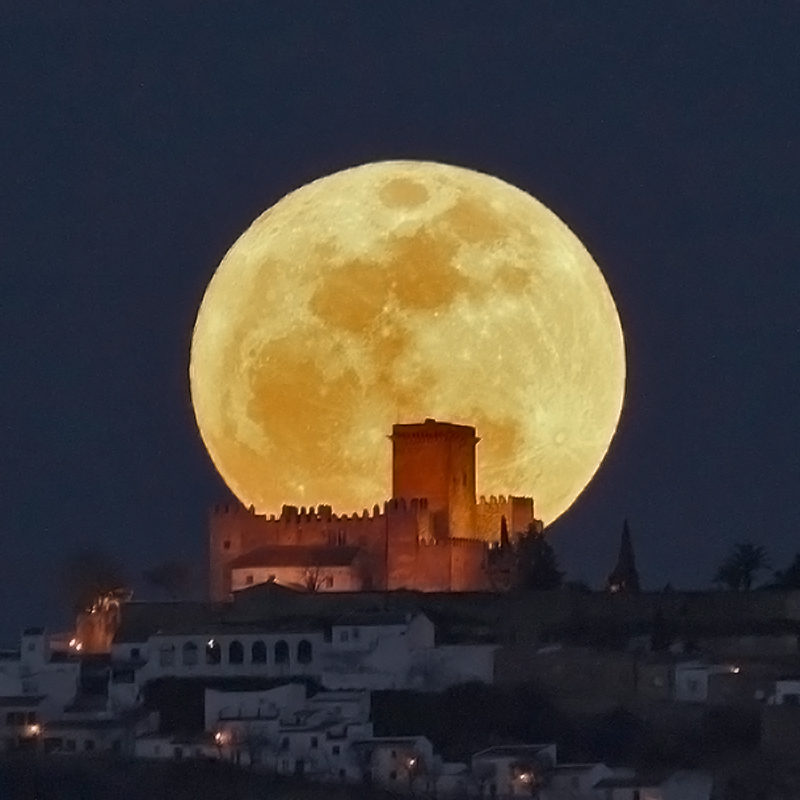
Supermoon over Espejo's Castle (Córdoba, Spain) on 20th March 2011. This photo, taken by Paco Bellido, has been widely used in many places since then. Now people still try to get it too with their cameras... More info (in Spanish) in "El beso en la luna". Credit: Paco Bellido.

Supermoon over Espejo’s Castle (Córdoba, Spain) on 20th March 2011. This photo, taken by Paco Bellido, has been widely used in many places since then. Now people still try to reproduce this photo with their cameras when full moon… More info (in Spanish) in Paco’s blog “El beso en la luna“. Credit: Paco Bellido.

However, I must insist that the term “supermoon” does not come from Astronomy but from the pseudoscience of astrology. Perhaps that is one of the reasons why many people are talking about this. The term “supermoon” was coined by the US astrologer Richard Nolle in 1979, who defined it as ‘a New or a Full Moon that occurs when the Moon is at or near (within 90% of) its closest approach to Earth in its orbit’.

Nolle, who associated supermoons to catastrophes without any scientific evidence that this was true, didn’t know that we astronomers already had a scientific term to describe this alignment: the perigee-syzygy of the Earth-Moon-Sun system. The word “syzygy” means a perfect alignment between three bodies, that are in a perfect straight line. The most famous examples of syzygies are the lunar and solar eclipses, when the alignment of the Sun, Earth and Moon happens on the lunar nodes (the two points where the plane of the orbit of the Moon around the Earth and the plane of orbit of the Earth around the Sun intercept).

As other “expressions”, such as “blood moon” (a lunar eclipse) or “blue moon” (the second full moon within the same calendar month), the term “supermoon” has become very popular lately, perhaps also because all the action in social media. But these definitions are not official astronomical terms. Indeed, a “blue moon” does not have a proper astronomical definition, and may happen or not depending on the time zone the observer is located.

In any case all the excitement about the supermoon happening on Tuesday 15th (for us in Sydney, but for the majority of the world on Monday 14th) it that the exact moment of the full moon (12:52 am Sydney time) is really close to the perigee, happening at a distance of only 356 536 km from us. The supermoon was not that close since 26th January 1948, when it was at 356 460 km, and it will not be that close till 26 November 2034, when it happens at 356 472 km.

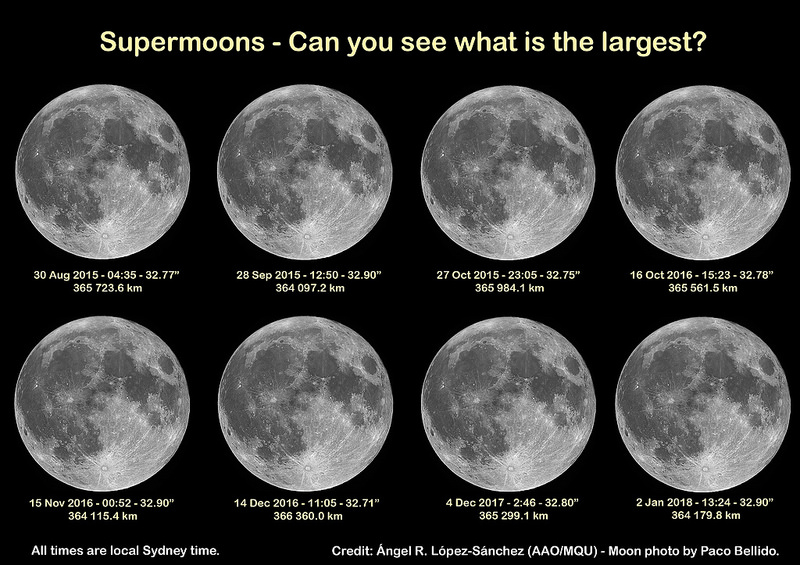
Check the numbers, please. 356 532 km, 356 460 km, 356 472 km… they all just differ in tens of kilometers! That is only a difference of a 0.02% ! Even considering the distances happening on other supermoons (I forgot to say we typically have 2-3 supermoons per year, last 17th October and next 13 Dec will be also supermoons), the differences are just within around 500 km, what is translated into a difference of only 0.14%.

Illustration: Supermoons: can you see what is the largest? Eight supermoons between 2015 and 2018, images have been scaled to the apparent size of the Moon considering its distance from Sydney when the full moon is happening. The dates are times indicated are the moment of the Full Moon. The sizes and distances are computed assuming the observer is located in Sydney, Australia. This is an illustration, not real photos taken from Sydney (I can't travel to the future!). The original Moon image is the photo of the "micromoon" that Spanish astrophotographer Paco Pellido took on 5 March 2015 from Córdoba, Spain, which is the image I use in this post. An image without labels can be found here. The high resolution image is available here. Credit: Ángel R. López-Sánchez, Moon Photo Credit: Paco Bellido.

Illustration: Supermoons: can you see what is the largest? Eight supermoons between 2015 and 2018, images have been scaled to the apparent size of the Moon considering its distance from Sydney when the full moon is happening. The dates are times indicated are the moment of the Full Moon. The sizes and distances are computed assuming the observer is located in Sydney, Australia.
This is an illustration, not real photos taken from Sydney (I can’t travel to the future!). The original Moon image is the photo of the “micromoon” that Spanish astrophotographer Paco Pellido took on 5 March 2015 from Córdoba, Spain, which is the image I use in this post. An image without labels can be found here. The high resolution image is available here. Credit: Ángel R. López-Sánchez, Moon Photo Credit: Paco Bellido.

Let me say it again: the difference of the distance between the Earth and the Moon during a “supermoon”, with these happening typically 2-3 times per year (for full moon, 4-5 times per year in total including new moon), is only the 0.14%. Do you think you’ll be able to notice this with your naked eye?

However, giving numbers (talking quantitatively) the media can say “it is a rare event, the closest supermoon in almost 70 years“. But in practice you’ll not notice a thing. It will be a supermoon essentially similar to all of those we have every year.

Distance from the observer to the Moon depending on when rising or setting (top) or when it is near the zenith (bottom). Credit: Ángel R. López-Sánchez. Moon image: Paco Bellido.

Distance from the observer to the Moon depending on when rising or setting (top) or when it is near the zenith (bottom). Credit: Ángel R. López-Sánchez. Moon image: Paco Bellido.

There is more. Besides the lunar illusion, the moon is actually a bit further away from us when it is rising or setting than when it is near the zenith, as the image above clearly shows. The difference on the distance between the observer and the Moon may vary between few thousand an twelve thousand kilometers. This is called “diurnal effect” as it is, indeed,  larger than the difference of few hundreds of kilometers found for supermoons. In both cases, I insist, the differences on the apparent size of the Moon can’t be noted with the naked eye.

Here again it is important to have a bit of critical thought about what all of this means. In any case this “supermoon” is a great excuse to forget about our domestic problems, look at the sky and be amazed by all the beautiful things that are hiding among the stars.

More info:

PS: Ah, yes, a curiosity:  it is me who will be observing at the Anglo-Australian Telescope (AAT) the night of Monday 14th till Tuesday 15th… That is, quantitatively talking this will be the worst night since the AAT was built to be observing there…

Update 17 November:

I’ve included the illustration comparing the size of the Moon for 8 supermoons, as seen from Sydney. This started as a game in social media on Monday. I also prepared this illustration showing the sizes of the 12 full moons in 2016, as seen from Sydney. Do you identify the micromoon and the 3 supermoons?

Illustration: Full Moons in 2016 as seen from Sydney. All the full moons in 2016, scaled in size following the Moon's apparent size as seen from Sydney. The micromoon corresponds to 22nd Apr (top right) and the thre supermoons are 16 Oct, 14 Nov (15 Nov Sydney time) and 14 Dec. This is an illustration, not real photos taken from Sydney (I can't travel to the future!). The original Moon image is the photo of the "micromoon" that Spanish astrophotographer Paco Pellido took on 5 March 2015 from Córdoba, Spain, which is the image I use in this post. The image without labels is here. A high resolution image is available in my Flickr. Credit: Ángel R. López-Sánchez. Moon photo credit: Paco Bellido.

Illustration: Full Moons in 2016 as seen from Sydney. All the full moons in 2016, scaled in size following the Moon’s apparent size as seen from Sydney. The micromoon corresponds to 22nd Apr (top right) and the thre supermoons are 16 Oct, 14 Nov (15 Nov Sydney time) and 14 Dec. This is an illustration, not real photos taken from Sydney (I can’t travel to the future!). The original Moon image is the photo of the “micromoon” that Spanish astrophotographer Paco Pellido took on 5 March 2015 from Córdoba, Spain, which is the image I use in this post. The image without labels is here. A high resolution image is available in my Flickr. Credit: Ángel R. López-Sánchez. Moon photo credit: Paco Bellido.

Seasons: Astronomy vs. Australia

Something that really shocked me when I started to live in Australia ~7 years ago was to hear everywhere that seasons start at the beginning of the corresponding month. That is, as today is Sep 1st, everyone in the radio / advertisements / news is welcoming Spring. And this, being an astronomer, believe me, hurts. Why? Because astronomically we are still in winter. Seasons are defined by Astronomy in a very accurate and precise way. This year Spring starts on September 23rd, 11:29 AEST (02:29 Universal Time). That is when that the Autumn Equinox happens, and the real moment Spring starts in the Southern Hemisphere (and Autumn/Fall starts in the Northern Hemisphere).

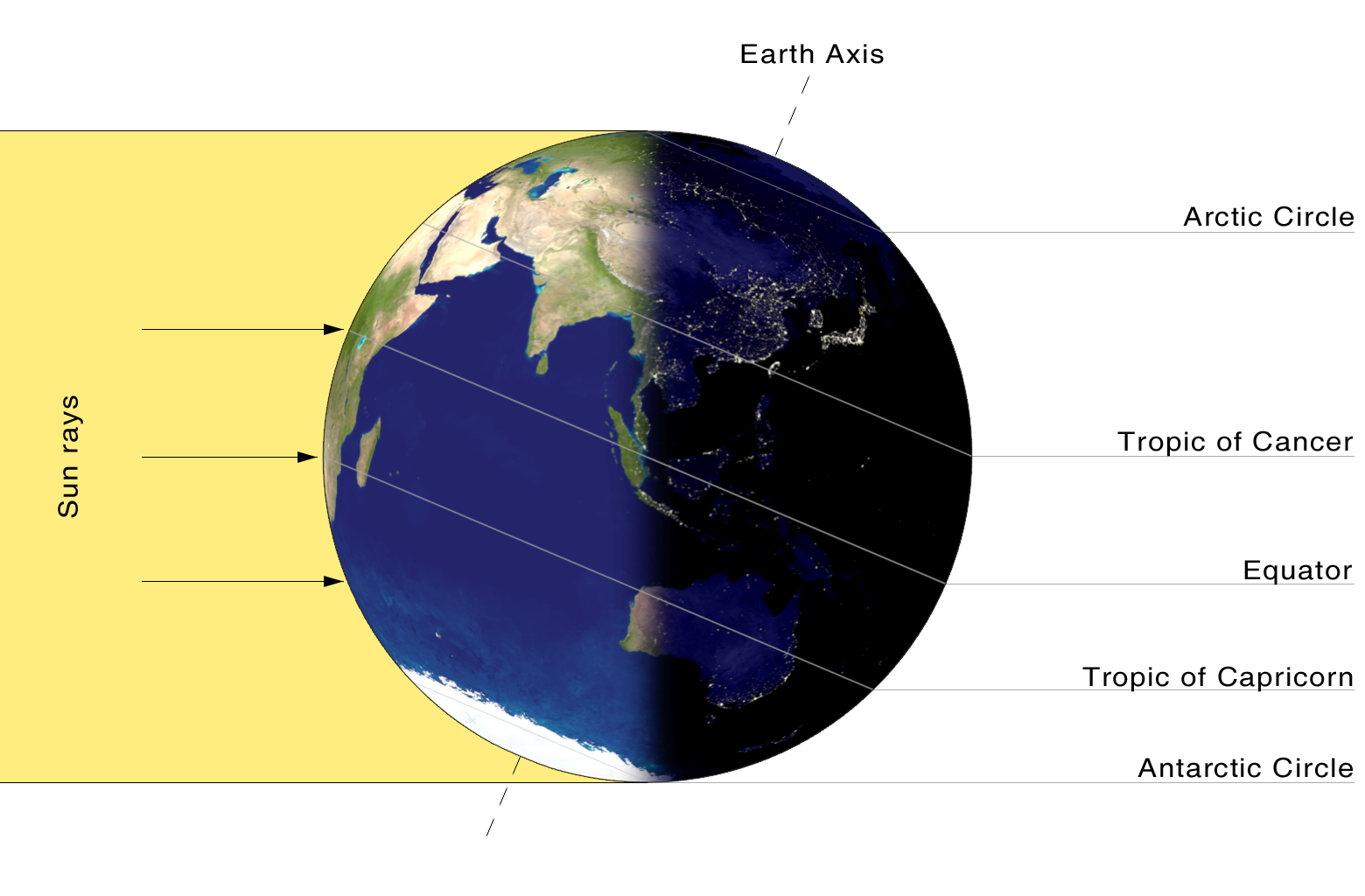
The seasons are caused by the combination of three astronomical factors: the Earth’s is a (almost perfect) sphere, the Earth’s orbit around the Sun, and the Earth’s axial tilt. As a consequence of these the Earth’s atmosphere is unequally heated by the Sun around the year at a given position. Therefore, the seasons are marked by the movement of the Earth around the Sun and, hence, which way the Earth is tilted with respect to the Sun. When the South hemisphere is tilted towards the Sun, the Sun’s rays strike the Earth at a steeper angle compared to a similar latitude in the North hemisphere. As a result, the radiation is distributed over an area which is less in the South hemisphere than in the North hemisphere. This means that there is more radiation per area to be absorbed in the South hemisphere, and therefore it is winter in the North hemisphere and summer in the South hemisphere.

Illumination of Earth by Sun at the southern solstice. Credit: Wikipedia


By astronomical definition, the precise timing of the seasons is determined by the exact times of transit of the Sun over the tropics of Cancer and Capricorn for the solstices and the times of the Sun’s transit over the Equator for the equinoxes, as specified in this figure:

Movement of the Earth around the Sun following an orbital ellipse (with eccentricity exaggerated for effect) and seasons. Equinoxes (20 or 21st March and 22nd or 23rd September) happen when the tilt of Earth’s axis neither inclines away from nor towards the Sun (green dotted line), and hence two points a the same latitude but a different hemispheres receive the same amount of energy from the Sun. In an equinox, the Sun is found at the zenith at the midday at the Equator. A solstice (20th or 21st June and 21st or 22nd December) happens when the tilt of the Earth’s axis has maximum effect (23.44º, red dotted line). At the June solstice the Sun is found at the zenith at the midday (just over our head!) at latitude 23.44º North, defining the Tropic of Cancer. Similarly at the December solstice this happens at 23.44º South, known as the Tropic of Capricorn. The periapsis (perihelion) and the apoapsis (aphelion) mark the nearest and the farthest points from the Sun, respectively (blue dotted line). Credit: Wikipedia


Therefore, in the South hemisphere, Spring starts with the Autumn Equinox, Summer with the Winter Solstice, Autumn with the Spring Equinox and Winter with the Summer Solstice. Of course, the names were given as correct for the North hemisphere.

Well, at least all of this is what Astronomy says. However, Governments and societies quite often decide to use their own definitions. Just checking this webpage of the Australian Bureau of Meteorology:

In Australia, the seasons are defined by grouping the calendar months in the following way:

1. Spring – the three transition months September, October and November.
2. Summer – the three hottest months December, January and February.
3. Autumn – the transition months March, April and May.
4. Winter – the three coldest months June, July and August.

These definitions reflect the lag in heating and cooling as the sun appears to move southward and northward across the equator. They are also useful for compiling and presenting climate-based statistics on time scales such as months and seasons.

Following these assumptions, Australia indeed enters in Spring today, which is funny because the majority of the countries (if not all) of the North hemisphere are still in Summer. In any case, for me it is Winter, and it will be winter till next on September 23rd, 11:29 AEST, when Spring, according to Astronomy, really starts.