Very happy to see my images and time-lapses videos taken at Siding Spring Observatory in the ABC News segment about the GALAH DR4 (Data Release 4) that was broadcasted in Australia national TV on Wednesday 2nd October 2024. Funny enough, this week I’m attending the Conference for the 50th Anniversary of the Anglo-Australian Telescope (AAT) at Siding Spring Observatory (Coonabarabran), where I gave an invited talk about my research with KOALA+AAOmega, although at that particular time I was attending an online meeting about the exciting BlueMUSE instrument.
I want first to congratulate the GALAH team for the success of this impressive star survey conducted at the AAT with the amazing 2dF + HERMES instruments (they have compiled the spectra of almost a million stars in Milky Way. But I also but to thank GALAH for using my photos and videos, as well as Tom Carruthers (Science in Public) for contacting me for this and very kindly providing the recording of the ABC News segment.
The Pearl Cluster (NGC 3766, Caldwell 97), in Centaurus, from my backyard, 15 km North from Sydney’s city center, on 4th June 2020.
This image compiles 30 x 180s images (1.5 hours total integration time) obtained with my Skywatcher Black Diamond 80, an Orion X0.8 focal reducer (f/6), the ZWO ASI178MC camera and an OPTOLONG L-Pro filter.
I used the ZWO ASIAir to control the camera, the mount (Skywatcher AZ-EQ6) and the guiding system (ASI120MM + Orion 50mm finderscope).
Flats and darks included. Data processed with Siril software. Color / saturation / levels / contrast / smart sharpen with Photoshop.
Although we are “enjoying” the Christmas break, today I’ve been contacted (thanks toRami Mandow @CosmicRami) by Kelsie Iorio, an ABC News Digital journalist who was preparing an article about the situation of the red supergiant Betelgeuse.
The article published in ABC News, entitled “Is Betelgeuse, the red giant star in the constellation Orion, going to explode?“, can be found in this link. It includes comments from Rami Mandow, Associate Professor Michael Brown from Monash University’s School of Physics and Astronomy and myself, with some other tweets from several astrophysicists who are talking about the “mysterious dimming of Betelgeuse“.
The red supergiant star Betelgeuse in Orion was the very first star after the Sun we got a direct image of its surface. That is because it is a huge star: if it were where the Sun is its outer layers will reach the orbit of Jupiter! This image was taken with the Hubble Space Telescope in 1995. More info in the APOD (Astronomy Picture of the Day) on April 19th, 1998. Credit: A. Dupree (CfA), R. Gilliland (STScI), FOC, HST, NASA.
But I want to share with you my full interview here, and keep it for my records, so here it goes.
The Betelgeuse hype
Interviewer: Kelsie Iorio (ABC News Digital )
Interviewee: Ángel R. López-Sánchez (AAO-MQ)
Q: For those who don’t know, what is Betelgeuse and what is it doing at the moment that’s out of the ordinary?
Betelgeuse is a bright star in the famous constellation of Orion the Hunter. It is a red supergiant star, meaning that it is star that is much more massive than our Sun (10 – 15 times) and that is already in the latest stages of its live. The star will eventually explode as a (type II) supernova. We astrophysicists know this will happen “soon”, but “soon” in Astronomy means 100 thousands years or perhaps even more.
During the last month observers worldwide have measured a dimming in the brightness of Betelgeuse.
This is actually completely ordinary, as it is well known and documented that Betelgeuse is a variable star (that means that it’s periodically changing its brightness).
Social media has again played a role here with the “hype” of the brightness of Betelgeuse: it is a normal situation that is happening at the moment and we can explain the dimming of Betelgeuse in many ways (a small shrinking of its huge size, solar spots, magnetic activity, a combination of factors) without the need of thinking that is going to explode now.
But people have been talking about that and many of them would love to see Betelgeuse explode! (I do not).
Q: Why is the astronomy world so excited about what’s happening?
If Betelgeuse really explodes as a supernova this would be a great opportunity for use to study how massive stars explode and get a better understanding of stellar evolution and stellar interiors. It will create a point-like object as bright as the Moon that would be visible even during the day, that will be fading during months till disappear.
However I must insist: the dimming of the brightness is the typical behaviour of the star. It is periodically changing its brightness and it has had this “low” brightness in the past. Even Aboriginal Australian knew this star changed brightness!
Q: Can we see Betelgeuse from Australia? For people who haven’t seen it or don’t know how to look for it, what does it look like from earth?
Of course! This is a star located very close to the celestial equator, meaning it can be seen essentially from everywhere (just not from the very same South Pole and around). Right now it is clearly visible to the North-East at the beginning of the night. The constellation of Orion is one of the most famous constellations of the sky and can be very easily recognised even by non-experts. Just use a stellar map (there are plenty free in internet, I recommend http://skymaps.com, and also plenty of apps) and you’ll see it. Despite it has noticeable dimmed in the last month, Betelgeuse still is one of the brightests stars in the night sky.
As any other star Betelgeuse is just a point of light, even when using a powerful telescope: stars are very, very, very far away from us to see them like a little disk. Betelgeuse is at a distance of around 700 light years.
Q: What do you think will happen to Betelgeuse next? Is it likely to explode?
No, it is very unlikely we see it exploding. The latest astrophysical research conducted about Betelgeuse clearly shows that it should still have a life of around 100 thousand years. Again, that is almost NOTHING in the cosmic scale, but a lot for us.
As it has done plenty of times in the past, Betelgeuse will eventually gain brightness again and all will be back to usual, continuing being sometimes a bit brighter sometimes a bit dimmer during the rest of all our own lifetimes.
Q: Is what’s happening with Betelgeuse a rare event?
No, it is not a rare event.
There are PLENTY of variable stars in the sky. A nice example is the star Mira in the constellation of Cetus (the Whale). This star sometimes can be easily seen with the naked eye and sometimes it is imposible to see, needing binoculars or telescopes to detect it. And it is not going to explode as supernova!
Q: Do you believe it’s important for the wider public to have a basic knowledge of astronomy and understand what’s happening in situations like this? Why?
I think it is important because everyone loves Astronomy but nowadays it is very easy to be confused because of the mixed bag of content found in social media and the internet.
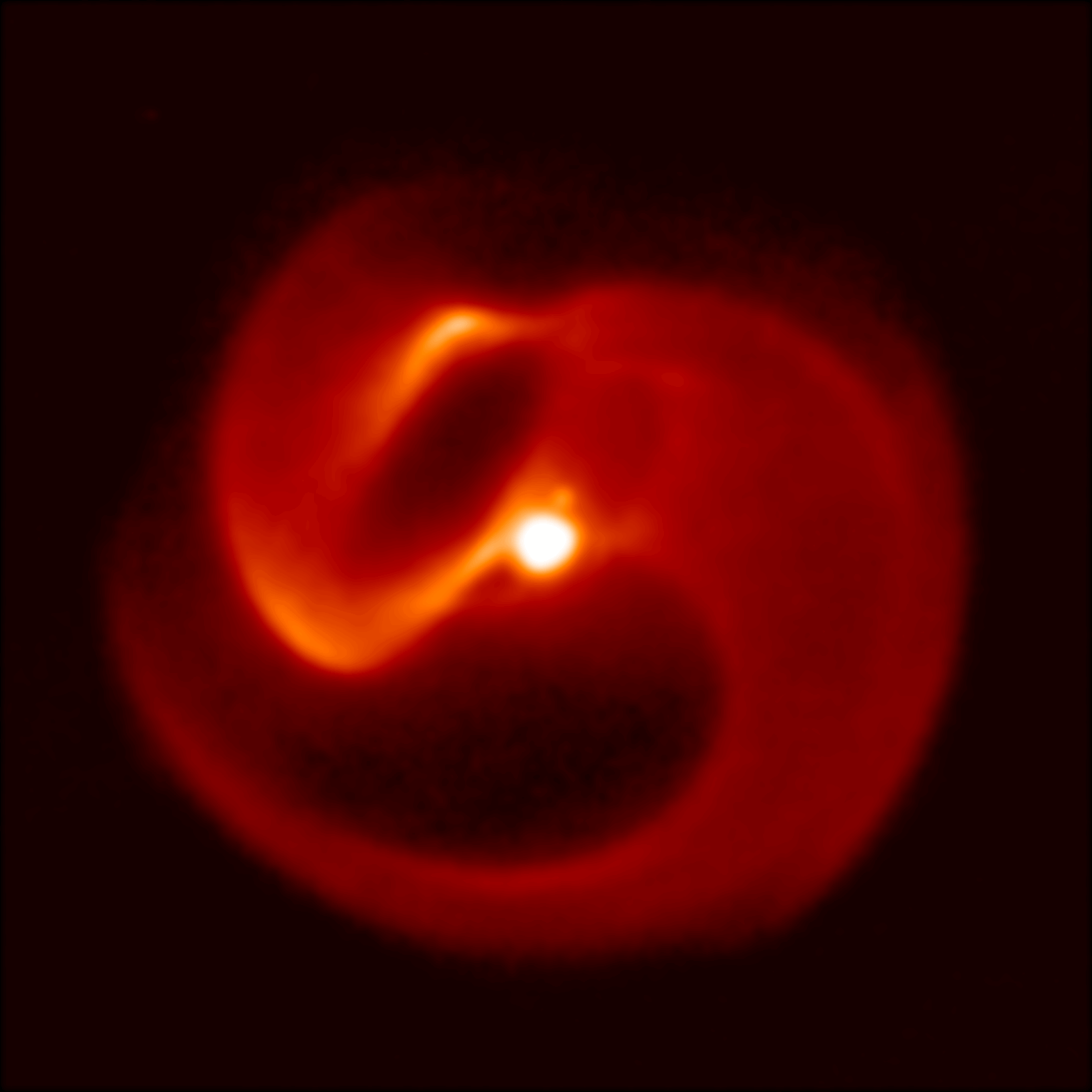
A new, very intriguing Wolf-Rayet star has been discovered in the Milky Way. Actually it is a massive triple star system. It has been nicknamed Apep after an ancient Egyptian deity, this may be the first ever gamma-ray burst progenitor found.
Image of Apep captured in the thermal infrared with the VISIR camera on the European Southern Observatory’s VLT telescope in Chile. Credit: Professor Peter Tuthill/ESO.
Earlier this week I was contacted from a journalist from The Age, Liam Mannix, who wanted to talk to me as “expert of Wolf-Rayet stars who has not participated in this research”. He called me and I spent 20 minutes to half an hour explaining what Wolf-Rayet stars are, the few of these stars known in our Galaxy (~600s) as they are the descendant of the most massive stars (and these are quite rare), and more. Of course, this conversation was latter summarized in a line in the article that he prepared:
Systems like this are very, very rare,” says Angel Lopez-Sanchez, an astrophysicist at Macquarie University who studies Wolf-Rayets and was not involved in the research. “It is a very exciting finding.”
But in any case I’m very happy I had this conversation with Liam and that I could contribute at least to the dissemination of this nice work.
Full AAO Media Release, published at 01:00am Sydney time, 17 October 2017, that I coordinated.
For the first time, astronomers have observed the afterglow of an event that was also detected in gravitational waves. The object, dubbed AT2017gfo, was a pair of in-spiralling neutron stars in a galaxy 130 million light years away. The death spiral was detected in gravitational waves, and the resulting explosion was followed by over 50 observatories world wide, including the AAO and other observatories here in Australia.
On August 17, the Advanced Laser Interferometer Gravitational-Wave Observatory (LIGO), based in the United States, detected a new gravitational wave event, called GW170817.
GW170817 is the fifth source of gravitational waves ever recorded. The first one was discovered in September 2015, for which three founding members of the LIGO collaboration were awarded the 2017 Nobel Prize in Physics.
The GW170817 data are consistent with the merging of two neutron stars and are unlike the four previous events, which were merging black holes.
Artist’s illustration of two merging neutron stars. The narrow beams represent the gamma-ray burst while the rippling space-time grid indicates the gravitational waves that characterize the merger. Swirling clouds of material ejected from the merging stars are a possible source of the light that was seen at lower energies. Credit: National Science Foundation/LIGO/Sonoma State University/A. Simonnet.
The Advanced-Virgo interferometer, based in Italy, was online at the time of the discovery and contributed to the localization of the new gravitational wave burst.
Based on information from LIGO and VIRGO, numerous telescopes immediately sprang into action to determine if an electromagnetic counterpart to the gravitational waves could be detected.
Meanwhile, NASA’s Fermi satellite independently reported a short burst of gamma-rays within 2 seconds of the merger event associated with GW170817, consistent with the area of sky from which LIGO and VIRGO detected their gravitational waves.
This gamma-ray detection at the same time and place triggered even greater interest from the astronomical community and resulted in more intense follow up observations in optical, infrared and radio wavelengths.
A team of scientists within the Dark Energy Survey (DES) collaboration, which includes researchers from the Australian Astronomical Observatory and other Australian institutions, working with astronomers at the Harvard-Smithsonian Center for Astrophysics (CfA) in the U.S., were among the first astronomers to observe the electromagnetic counterpart of GW170817 in optical wavelengths.
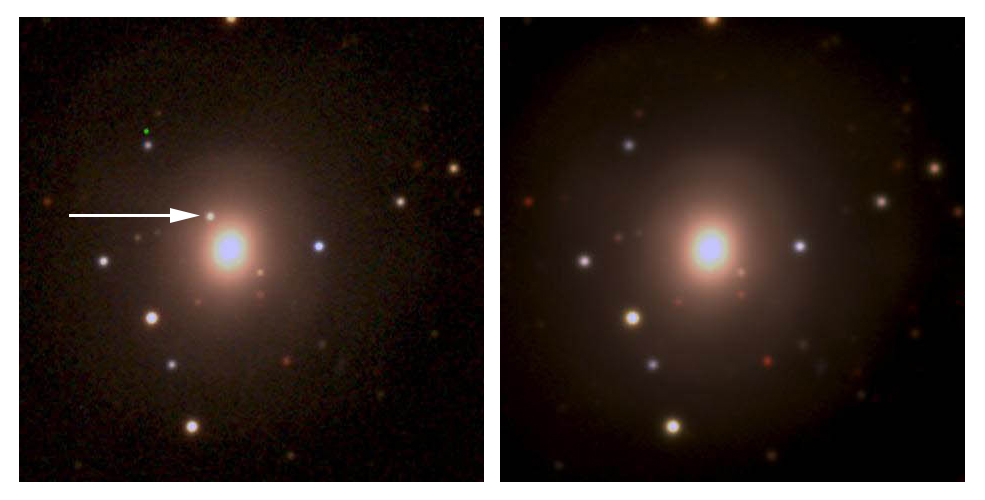
Using the 570-megapixel Dark Energy Camera (DECam) mounted at the 4m Blanco Telescope at Cerro Tololo Inter-American Observatory in Chile, DES identified the kilonova AT2017gfo in the nearby galaxy NGC 4993, located only 130 million light years from us, as the optical counterpart of GW170817.
Composite of detection images, including the discovery z image taken on August 18th and the g and r images taken 1 day later. Right: The same area two weeks later. Credit: Soares-Santos et al. and DES Collaboration.
“Because of its large field of view, the Dark Energy Camera was able to search almost the entire region where LIGO/VIRGO expected the gravitational wave source to be, and its exquisite sensitivity allowed us to make detailed measurements of the kilonova – the extremely energetic outburst created by the merging neutron stars,” AAO Instrument Scientist and DES Collaboration member Dr Kyler Kuehn stated.
A kilonova is similar to a supernova in some aspects, but it is different in others. It occurs when two neutron stars crash into each other. These events are thought to be the mechanism by which many of the elements heavier than iron, such as gold, are formed.
“But as impressive as it is, the Dark Energy Camera is only one of many instruments with a front row seat to this celestial spectacle. A lot of effort has gone into preparing dozens of telescopes around the world to search for electromagnetic counterparts to gravitational waves”, Dr Kuehn added.
Simultaneously to the DES study, a large group of Australian astronomers obtained follow up observations of the kilonova AT2017gfo at optical, infrared and radio wavelengths, using 14 Australian telescopes as part of the ARC Centre of Excellence for Gravitational Wave Discovery (OzGrav) and other Australian programs.
Their data are consistent with the expected outburst and subsequent merger of two neutron stars, in agreement with the results derived for GW170817 by the LIGO/Virgo collaboration.
“Before this event, it was like we were sitting in an IMAX theatre with blindfolds on. The gravitational wave detectors let us ‘hear’ the movies of black hole collisions, but we couldn’t see anything. This event lifted the blindfolds and, wow, what an amazing show!!”, A/Professor Jeff Cooke, astronomer at Swinburne University who led many of the observations said.
The Australia team also conducted observations at the 3.9m Anglo-Australian Telescope (AAT), that is managed by the Australian Astronomical Observatory (AAO). Additional archive data from the 6dF survey obtained at the AAO’s 1.2m UK Schmidt Telescope were also used.
“The observations undertaken at the AAT place important constraints on the nature of the environment in which the kilonova occurred”, AAO astronomer Dr Chris Lidman said.
The follow up observations were not scheduled, but the excitement that this event generated in the astronomical community was so large that regular programs were placed on hold.
“Many astronomers dropped any other planned observation and used all the available resources to study this rare event”, said PhD candidate Igor Andreoni (Swinburne University and Australian Astronomical Observatory), first author of the scientific paper that will be published in the science journal “Publications of the Astronomical Society of Australia” (PASA).
The study also reveals that the host galaxy has not experienced significant star-formation during the last billion years. However, there is some evidence that indicates that NGC 4993 experienced a collision with a smaller galaxy not long time ago.
The position of the kilonova AT2017gfo, found in the external parts of NGC 4993, may suggest that the binary neutron star could have been part of the smaller galaxy.
Australian astronomers were thrilled to contribute to both the detection and the ongoing observations of the kilonova AT2017gfo, the electromagnetic counterpart to the gravitational wave event GW170817.
“We have been waiting and preparing for an event like this, but didn’t think it would happen so soon and in a galaxy that is so near to us. Once we were alerted of the gravitational wave detection, we immediately contacted a dozen telescopes and joined the worldwide effort to study this historic event. It didn’t let us down!”, A/Professor Jeff Cooke said.
“It was crucial to have telescopes placed in every continent, including Australia, to keep this rare event continuously monitored”, PhD candidate Igor Andreoni said.
“To me, this gravitational + electromagnetic wave combined detection is even more important than the initial detection that resulted in the Nobel Prize. This has changed the way the entire astronomical community operates”, AAO Instrument Scientist Dr Kyler Kuehn stated.
The first identification of the electromagnetic counterpart to a gravitational wave event is a milestone in the history of modern Astronomy, and opens a new era of multi-messenger astronomy.








 A/Prof. Ángel R. López-Sánchez