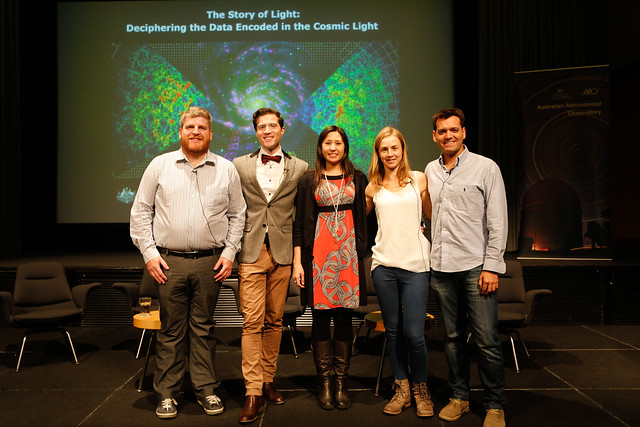
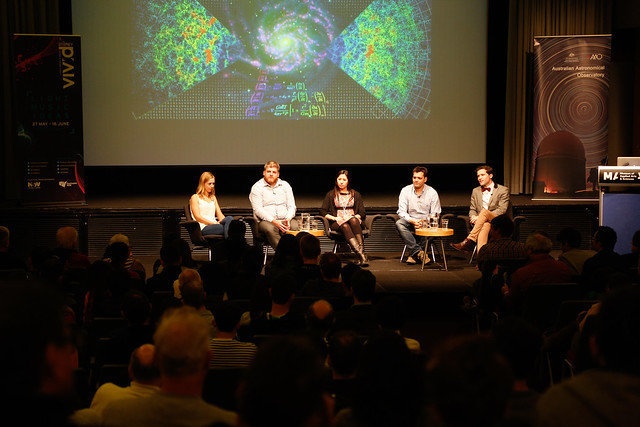
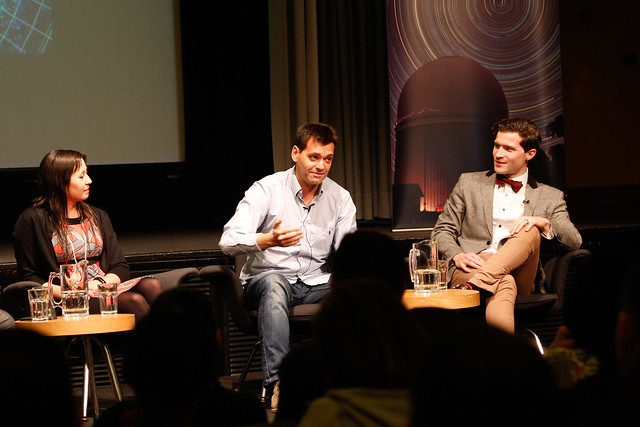
The five astronomers speaking during our “Sydney Vivid Ideas: The Story of Light” started at the Powerhouse Museum, Sydney, 29th May 2016. From left to right: Luke Barnes, Alan Duffy, Vanessa Moss, Liz Mannering and Ángel López-Sánchez. Photo credit: Jenny Ghabache (AAO).
The event was held at the PowerHouse Museum in Sydney on Sunday 29th May 2016. More than 160 people attended this special event. Five young astronomers (me included) talked about Astronomy and Big Data: the light and light-based technologies developed in Australian astronomy for both optical and radio telescopes; the tools, platforms, and techniques used for data analysis and visualization; how astronomers create simulation data; how some of these techniques are being used in other research areas; and the major scientific contributions toward our understanding of the Universe. Indeed, astronomers have been pioneers in developing “Data Science” techniques to make sense of this huge data deluge, many of which are now used in other areas.
We recorded all the event in video, and it is now publicly available in the AAO YouTube channel. Some photos of the event are also compiled below. I want to thank AAO/ITSO Research Astronomer Caroline Foster for helping recording and editing the video and Jenny Ghabache (AAO) for taking the photos of the event.
Full recording of the event “The Story of Light 2016: Deciphering the data encoded on the cosmic light” organised by the AAO for Vivid Sydney Ideas 2016. Credit: AAO. Acknowledgment: Caroline Foster (AAO).
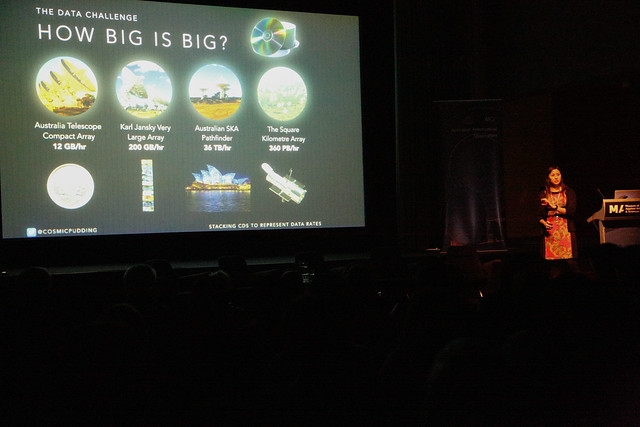
The event was hosted by Alan Duffy (Swinburne University). I was in charge of explaining optical astronomy, the AAO, optical surveys and big data. Then my colleagues Vanessa Moss (Univ of Sydney/CAASTRO), Luke Barnes (Univ. of Sydney) and Liz Mannering (AAO/ICRAR) discussed radio astronomy, the ASKAP and big data (Vanessa), simulating, analysing and visualizing astronomy data (Luke) and astronomy data archive, the All-Sky Virtual Observatory (ASVO) and other virtual observatories (Liz ). After the short 12-15 minutes talks (well, as usual I took a bit more time), the panel welcomed questions from the audience (and even from Twitter using #SoLSydneyIdeas) for a discussion session about Light and Astronomy and the Australian contribution to the improvement of our understanding of the Universe.
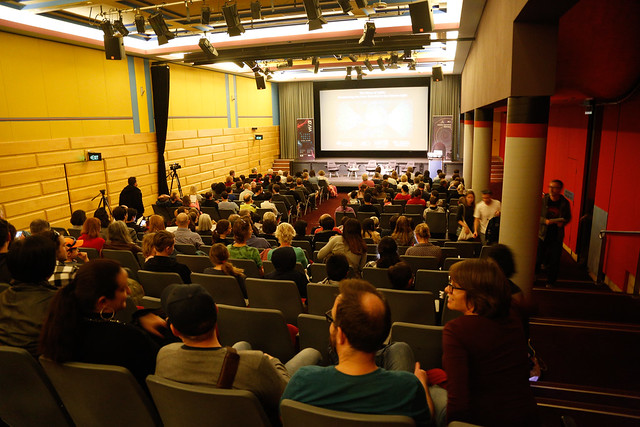
The Lecture Theatre a few minutes before our “Sydney Vivid Ideas: The Story of Light” started at the Powerhouse Museum, Sydney, 29th May 2016. Photo credit: Jenny Ghabache (AAO).
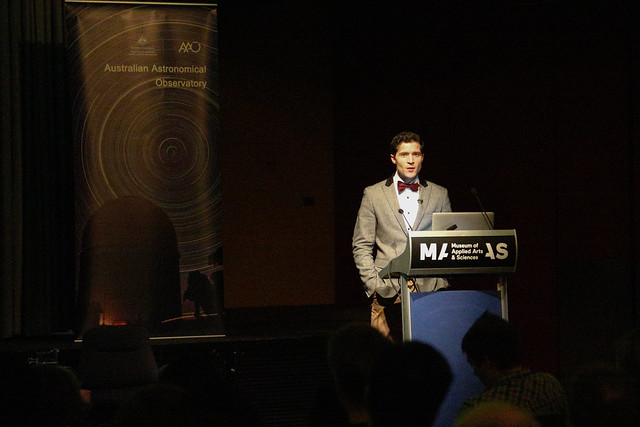
Our host, Alan Duffy, introducing the event. Photo credit: Jenny Ghabache (AAO).
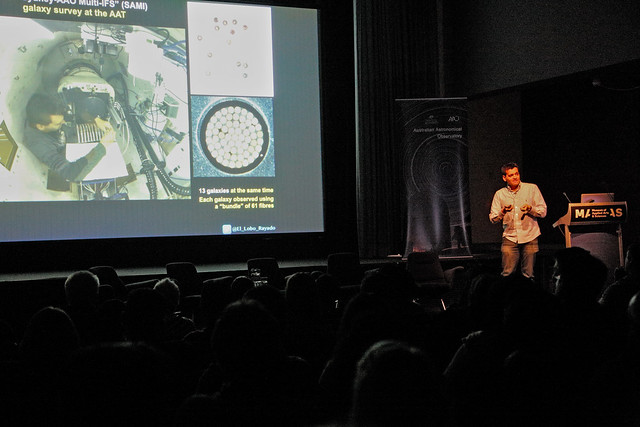
AAO/MQU Research Astronomer Ángel R. López-Sánchez talking about optical astronomy, the AAO and big data. Photo credit: Jenny Ghabache (AAO).
Vanessa Moss (Univ. of Sydney/CAASTRO) talking about radioastronomy, the ASKAP and big data. Photo credit: Jenny Ghabache (AAO).
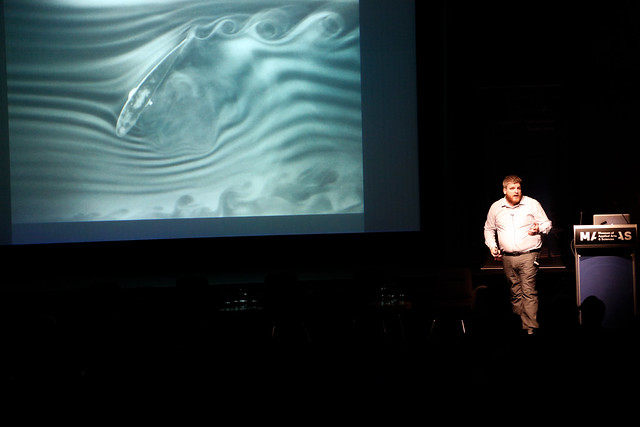
Luke Barnes (Univ. of Sydney) talking about simulating, analysing and visualizing astronomy data. Photo credit: Jenny Ghabache (AAO).
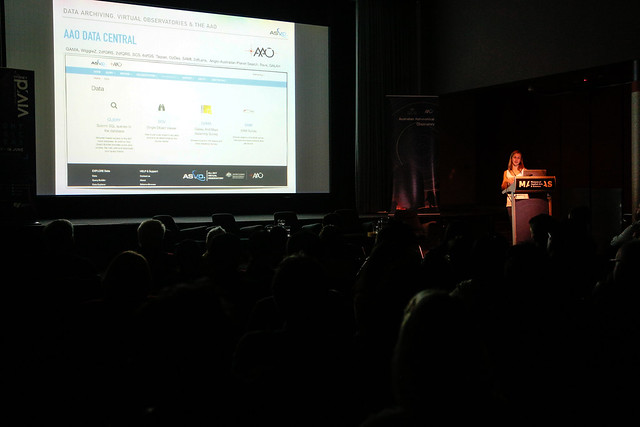
Liz Mannering (Univ. of Sydney) discussed astronomy data archive, the All-Sky Virtual Observatory (ASVO) and other virtual observatories. Photo credit: Jenny Ghabache (AAO).
Panel discussion with all participants answering questions from the audience. Photo credit: Jenny Ghabache (AAO).
Angel Lopez-Sanchez answering a question from the audience. Photo credit: Jenny Ghabache (AAO).
And last… Well, if you want to see only my talk, here it is:
I cannot believe a FULL YEAR has already gone since the “Multiwavelength Dissection of Galaxies” Conference happened. And I have never found the time to just describe how much work this was for me, and at the success of this meeting. At least let me share today the article I wrote for “The Observer”, the AAO Newsletter.
The Southern Cross Astrophysics Conferences, which are jointly supported by the Australian Astronomical Observatory (AAO) and the CSIRO Astronomy and Space Science (CASS), are held annually around Australia with the aim of attracting international experts with wide ranging skills to discuss a particular astrophysical topic. The conference “Multiwavelength dissection of galaxies”, which was held at the Crown Plaza Hotel in Coogee Beach, Sydney between 24th – 29th May 2015, was the 8th of the Southern Cross Conference Series. This Conference focused on galaxy evolution, combining resolved optical/near-infrared integral field spectroscopy data with other multiwavelength properties (from X-ray to radio) of nearby galaxies plus giving the view of what is known in our Milky Way.
Poster of the Conference “Multiwavelength Dissection of Galaxies”.
Indeed, the number of studies of galaxies using integral field spectroscopy (IFS) is rapidly increasing as a consequence of surveys such as ATLAS-3D, CALIFA, SAMI (that is conducted at the AAT), or MANGA. IFS techniques allow to spatially resolve internal properties of galaxies with unprecedented detail, and therefore they are providing key clues for understanding the structural components of galaxies, their star-formation activity, kinematics, stellar populations, metal distribution, and nuclear activity, as well as how galaxies evolve with time. Nevertheless, for a complete picture of how galaxies work it is crucial to use other multi-wavelength results, targeting galaxies in X-ray, ultraviolet, infrared, and radio frequencies. In particular, HI radio-surveys such as HIPASS, LVHIS, THINGS, Little-THINGS, ALFALFA, HALOGAS or WALLABY are essential to trace the neutral gas content of galaxies, as the 21 cm HI radio data provide key information about how the cold gas in converted into stars and galaxy dynamics. At the same time we are notably increasing our knowledge of the structure and composition of the Milky Way. This is possible thanks to the combination of very detailed observations of individual stars (such those coming from the RAVE survey conducted at the 1.2m UKST or the on-going GALAH survey at the AAT using the new high-resolution HERMES spectrograph), detailed analyses of Galactic nebulae, large field studies of the interstellar medium, and surveys searching for the diffuse gas with and around our Galaxy.
Hence, the aim of the “Multiwavelength dissection of galaxies” Conference was to bring together international experts in both Galactic and extragalactic astronomy to discuss the different components of a galaxy: stars, gas, dust, and dark matter, and where these components are found within and around galaxies, from both an observational (from radio to X-rays, but with a fundamental optical IFS component) and a theoretical point of view (from the most recent simulations of galaxy assembly to models reproducing the chemical evolution of galaxies), with the final objective of getting a better understanding on the processes that rule the evolution of the galaxies.
Conference Photo with the majority of the participants to the “Multiwavelength Dissection of Galaxies” meeting, 24th – 29th May 2015. The background is an image of the Southern sky showing the Southern Cross and the Pointers. Credit: Conference Photo: Andy Green (AAO), Background image & composition: Ángel R. López-Sánchez.
Around 120 astronomers all around the globe attended to this Conference. In five days we had 94 talks, including 27 invited talks and a Summary talk, and 26 poster contributions. Highlight invited talks were given by Rosemary Wyse (The Structure of the Milky Way), Naomi McClure-Griffiths (Neutral gas in and around the Milky Way), Baerbel Koribalski (Diffuse gas in and around galaxies), Christy Tremonti (Measuring Gas Accretion and Outflow Signatures with MaNGA), César Esteban (Ionized gas in the Milky Way), Evan Skillman (The Chemical Properties of the ISM of Nearby Galaxies), Sarah Martell (Introduction to the GALAH Survey), Geraint Lewis (Galactic Archeology in the Local Group), Alessandro Boselli (The dust emission properties of nearby galaxies after Herschel), Jakob Walcher (News about the interstellar medium in galaxies from the CALIFA survey), Stas Shabala (Resolving the mysteries of AGN feedback:radio jets, galaxies and citizen science), Joss Bland-Hawthorn (Near Field Cosmology), Martin Asplund (The Gaia-ESO survey), Richard Bower (The EAGLE Universe), Lisa Kewley (SAMI Science) and Molly Peeples (A Multiwavelength View of the Circumgalactic Medium).
We also organised a “Poster Contest”: participants were asked to vote for their 2 favourite posters, and they got a short (10 minutes) talk during the last session of the Conference. The winners were two PhD students: Christina Baldwin (Macquarie University, Australia, with the poster “Early-Type Galaxy Stellar Populations in the Near-Infrared”) and Manuel Emilio Moreno-Raya (Universidad Complutense Madrid and CIEMAT, Spain, with the poster “Dependence of SNe Ia absolute magnitudes on the host galaxies elemental gas-phase abundances”).
We have compiled all scientific presentations at the Conference Webpage:
Furthermore, participants were very active in Twitter, that followed the hashtag of the Conference #MDGal15, allowing a wider diffusion of the main results speakers were presenting. We have also compiled all tweets in a Storify for each day, they are available in our website.
Besides the scientific talks, participants enjoyed the social events we organised for the Conference, including a Welcome Cocktail Cruise on Sunday 24th May (delegates enjoyed not only the great views of Sydney Harbour but also a starry sky and the famous ViVID Lights Sydney Festival), a Wine Tasting event on Tuesday 26th, an outdoors barbecue and a visit to Sydney Observatory and Stargazing on Wednesday 27th May, and the Conference Dinner on Thursday 28th May, which was held at the Spanish restaurant “Postales” in famous Martin Place, Sydney. Furthermore, the AAO organised the Public Event “The Story of Light: The Astronomer’s Perspective” on Sunday 24th May at the Powerhouse Museum (Sydney). This event, which was fully booked, was included as part of the ViVID Festival and connected the International Year of Light 2015 with our Conference.
Overall, we considered it was a great Conference and some important and controversial research topics were actually discussed during those five days, generating new ideas and projects, and many new collaborations between participants (even between Galactic and extragalactic astronomers) started there.
Finally, I would like to thank the impeccable organisation of the staff at Crown Plaza Hotel, as everything worked very smoothly and we didn’t have any problems at all during our Conference. In particular, coffee breaks and lunches were very well attended, and we really enjoyed a great quality food. Of course, I also must thank all the members of the LOC and the SOC committees for their invaluable help organising this Conference. In particular, I would like to thank Helen Woods (AAO) for her enormous effort and Andrew Hopkins and AAO’s Director, Warrick Couch, for their strong support to this meeting.
DPENGLISH: This story belongs to the series “Double Post” which indicates posts that have been written both in English in The Lined Wolf and in Spanish in El Lobo Rayado.
DPESPAÑOL: Esta historia entra en la categoría “Doble Post” donde indico artículos que han sido escritos tanto en español en El Lobo Rayado como en inglés en The Lined Wolf.
Last month the prestigious journal Nature published a letter led by PhD student (and friend) Louise Howes (@Lousie, ANU/RSAA, Australia). This scientific paper, with title Extremely metal-poor stars from the cosmic dawn in the bulge of the Milky Way, uses data from the 1.2m Skymapper Telescope, the 3.9m Anglo-Australian Telescope (both at Siding Spring Observatory, NSW, Australia) and the 6.5m Magellan Clay telescope (Las Campanas Observatory, Chile) to study very old stars in the Milky Way bulge.
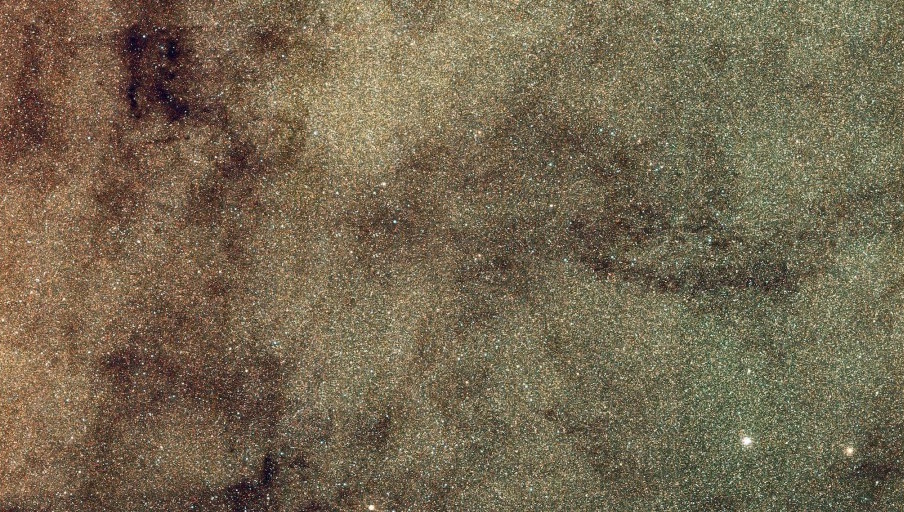
Image of the Galactic centre obtained using Skymapper data. Credit: Chris Owen (ANU/RSAA).
The aim of the research was to look for signatures of really old stars: stars that old that perhaps the Milky Was was not even born when they were created! How do astronomers know that? Just studying the chemical composition of the stars via deep spectral analysis. Only hydrogen and helium (and just a bit of litium) were formed in the Big Bang: the rest of elements have been created or inside the stars (oxygen, carbon, nitrogen, iron) or because of processes happening to the stars (e.g., supernova explosions, that create heavy elements such as gold, silver, copper or uranium). As time goes by and new generations of stars are born, the amount of metals (for astronomers, metals are all elements which are not hydrogen and helium) increases. Therefore if we discover a star with very few amount of metals, we will quite sure we are observing a very old object.
Loiuse has been using the 2dF instrument at the Anglo-Australian Telescope and the MIKE spectrograph at the Magellan Clay Telescope (Chile) to get deep, high-resolution spectra of candidate old stars in the Galactic bulge. The candidate stars were identified using optical images provided by the 1.2m Skymapper Telescope. With these observations, Louise Howes and collaborators have detected 23 stars that are extremely metal-poor. These stars have surprisingly low levels of carbon, iron and other heavy elements. Indeed, they report the discovery of a star that has an abundance of iron which is 10,000 times lower than that found in the Sun! These stars were formed at redshift greater than 15, that is, we are observing in our own Milky Way stars that were formed just ~300 million years after the Big Bang!
On top of that, the study suggests that these first stars didn’t explode as normal supernova but as hypernova: poorly understood explosions of probably rapidly rotating stars producing 10 times as much energy as normal supernovae. The high-resolution spectroscopic data have been also used to study the kinematics of these very old stars, that are found on tight orbits around the Galactic centre rather that being halo stars passing through the bulge. This is also characteristic of stars that were formed at redshifts greater than 15.
Short 3 minutes video discussing the results found in this study. Credit: ANU.
I’m happy to say here that I’ve been the support astronomer for many of her nights at the AAT the last couple of years. And I’m extremely happy to see that, even because of the bad weather we have had sometimes, they managed to get these observations published in Nature! Well done, Louise!
How many words are out there? To date, we know the existence of 1958 planets orbiting around stars different to our Sun. These objects are defined as “exoplanets”: astrophysicists estimate that our Galaxy, the Milky Way, would host trillions of planets.
How do we name the exoplanets? Almost the 100% of these names are not proper names but a designation given by letters and numbers coming from star catalogs, such as Kepler 88b or OGLE 2015 BLG 0966b. Following the convention adopted by the International Astronomical Union (IAU), an exoplanet’s name is normally formed by taking the name of its parent star and adding a lowercase letter. The first planet discovered in a system is given the designation “b” and later planets are given subsequent letters. For example, the second planet discovered around star HD 7924 was named HD 7924c. Indeed, these names might be convenient… but they are not easy to remember by the non-astronomers.
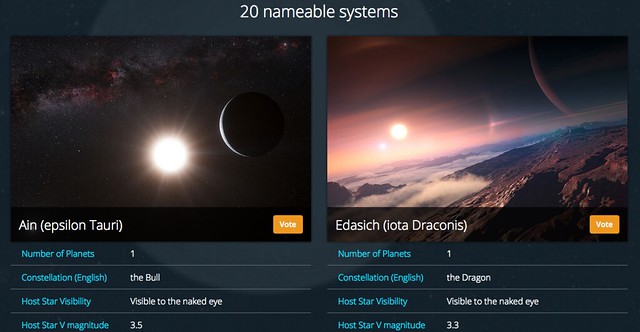
Screenshot from the #NameExoWorlds website. Credit: NameExoWorlds, IAU.
In 2014, following a recommendation of its Working Group “Exoplanets for the Public”, the IAU decided to put real names to a few of these exoplanets and their parent stars. By April 2015 a 20 ExoWorlds list is published in the NameExoWorlds website. The IAU proposes astronomical clubs and non-profit organisations to send proposals to put proper names to the 15 stars and 32 exoplanets which are located in these 20 planetary systems (some stars already have proper names, such as Fomalhaut or Pollux). These organisations only have to follow some easy IAU’s rules to name stars and planets. In August 2015, during the IAU XXIX General Assembly in Honolulu (USA), a massive press release at a special public ceremony announced that the general public can vote to rank the proposed names to these 20 planetary systems following the internet address:
The hashtag is #NameExoWorlds and the deadline for this is next 31st October. The IAU is expecting a million votes or more worldwide. You can cast your vote just visiting that website, reading the name proposals for each planetary system, and clicking in “Vote” in your favorite option. Only a vote per device and per planetary system in allowed however you can emit your vote using different devices (i.e., laptops, tablets and smartphones).
One of the planetary systems that the IAU proposes to give proper name is that located around the star mu Arae (μ Arae). Mu Arae is a star similar to the Sun, located at around 50 light years from us, in the Ara (the Altar) constellation. Mu Arae is slightly older than the Sun (astronomers estimate it has an age of 6.3 billion years), it around 10% more massive than the Sun but around 90% more luminous that the star of the Solar System. We have know for many years that Mu Arae has four planets: mu Arae b, c, d and e. The Sociedad Española de Astronomía (Spanish Astronomical Society, SEA) is promoting the proposal of names given to the star mu Arae and its planets by the Planetarium of Pamplona (Spain). They proposed to name mu Arae as Cervantes, and its planets with the names of the main characters of the Quixote: Quijote (mu Arae b), Dulcinea (mu Arae c), Rocinante (mu Arae d) and Sancho (mu Arae e). This proposal, with the hashtag #YoEstrellaCervantes, is also supported by the prestigious Instituto Cervantes, the public Spanish institution that promotes the Spanish language and culture around the world. The “Instituto Cervantes” has headquarters in 90 cities of 43 countries, Sydney included.
Artistic representation of star mu (μ) Arae and its planetary system. The #YoEstrellaCervantes initiative proposes to name this star as Cervantes and its planets Dulcinea, Rocinante, Quijote and Sancho, following the main characters of Don Quixote (“Don Quijote” in Spanish). Credit: http://estrellacervantes.es.
If you like the #YoEstrellaCervantes initiative, please vote for it going to this webpage:
and clicking in the “vote” button for Cervantes. You can also ask your friends and relatives to vote #YoEstrellaCervantes and help put names to these 20 planetary systems. You can cast an unique vote per system per device (laptop, computer, tablet, smartphone). Remember the deadline is next 31st Oct.
The website http://estrellacervantes.es/ compiles, in Spanish, all the information about #YoEstrellaCervantes, including news and related activities. One of my favorite initiatives was created by Laura Morrón in collaboration with comic illustrator Jordi Bayarri and teacher Juan Carlos García-Bayonas. They developed a comic and great didactic material to promote #YoEstrellaCervantes in the classroom. Their material put together Science and Literature with the aim of approaching the #NameExoWorlds and #YoEstrellaCervantes initiatives to young students (and their parents).
Comic promoting the #YoEstrellaCervantes proposal for star mu Arae. Credit: Text: Laura Morrón, Drawings: Jordi Bayarri..
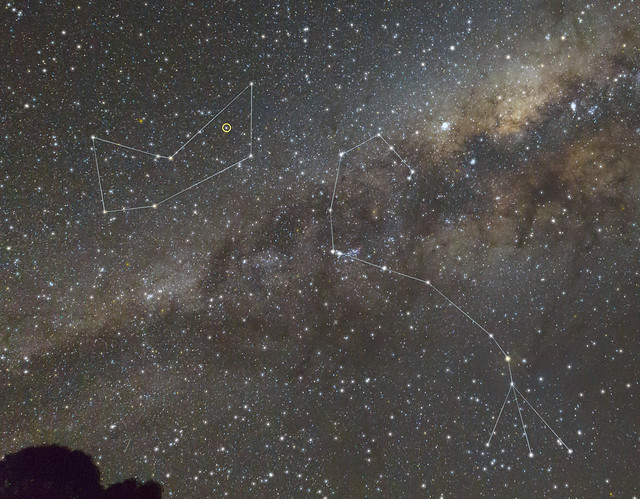
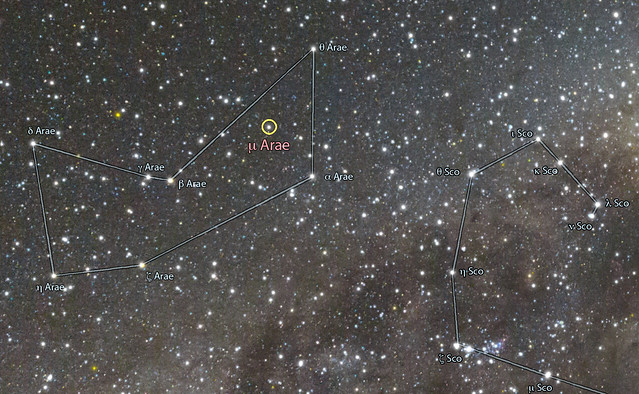
Where is mu (μ) Arae located in the sky? This star belongs to Ara constellation (the Altar), a region of the Southern Sky between Scorpius (the Scorpion) and the Triangulum Australe (the Southern Triangle). Hence, this constellation cannot be seen in the majority of the Northern Hemisphere (although it was already described by the 2nd century astronomer Ptolomey as one of the 48 Greek constellations). Seen from the Southern Hemisphere, this region of the sky is spectacular. Mu Arae has a visual magnitude of 5.2, therefore, although being a faint star, it can be seen with the naked eye from dark place. However, because of the huge number of faint stars found within these constellations (which are located very close to the Galactic Plane), it can be a bit hard to accurately identify mu Arae under a very dark place, far from the light pollution.
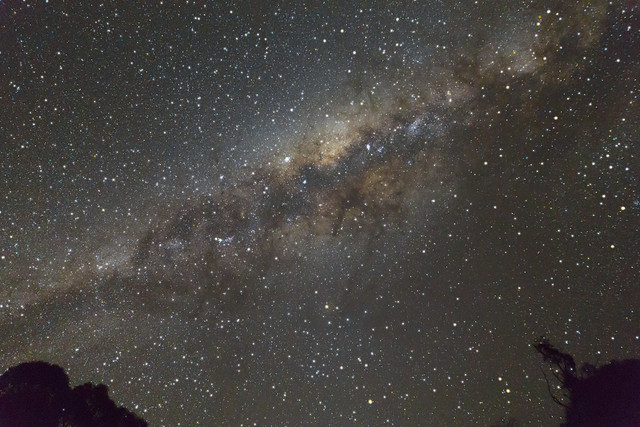
The Milky Way as seen from Siding Spring Observatory (NSW, Australia). This image was the very first astrophoto I took with my new camera, a CANON EOS 5D Mark III, last 7th September. I used a 24mm lens, F2.8, with 30 seconds exposure. Credit: Ángel R. López-Sánchez.
A zoom-in of the previous image shows the location in the sky of the constellations of Scorpius (Right) and Ara (left). Star mu Arae is identified by a yellow open circle. Credit: Ángel R. López-Sánchez.
Another zoom-in of the image now only shows the details of the Ara constellation and mu Arae surroundings. The brightest stars in Ara and in the tail of Scorpius are also identified. Credit: Ángel R. López-Sánchez.
Today, September 29th, is the (assumed) anniversary of the birth of Don Miguel de Cervantes Saavedra. Using this as a driver, the SEA has released the campaign ¿Te atreves a regalarle una estrella a Cervantes? (Why don’t you give a star to Cervantes?), that aims to promote the #YoEstrellaCervantes proposal for star mu Arae. We are asking citizens around the world (and not only Spanish-speakers, but of course mainly orientated to them, as the majority it is in Spanish) to help us to get the hashtag #YoEstrellaCervantes trending topic in social media today. Besides casting your vote, please share #YoEstrellaCervantes in your social network to reach more people.
Logo of the #YoEstrellaCervantes initiative. Credit: Almudena M. Castro.
The book “The Ingenious Gentleman Don Quixote of La Mancha” (“El ingenioso hidalgo don Quijote de la Mancha”), or just Don Quixote (“Don Quijote” in Spanish) was published in two parts in 1605 and 1615. Hence 2015 marks the 400th Anniversary of Don Quixote, which has been considered one of the most influential works of literature, one of the best works of fiction ever written, a classic of the Western literature, and to be the first modern European novel. The initiative #YoEstrellaCervantes is a beautiful project that puts together Science and Art (Literature) and a tribute to Don Miguel de Cervantes and his work. If Shakespeare already has his works in the heavens (the majority of the Moons of Uranus are named after characters from the works of William Shakespeare), why hasn’t Cervantes?
DPENGLISH: This story belongs to the series “Double Post” which indicates posts that have been written both in English in The Lined Wolf and in Spanish in El Lobo Rayado.
DPESPAÑOL: Esta historia entra en la categoría “Doble Post” donde indico artículos que han sido escritos tanto en español en El Lobo Rayado como en inglés en The Lined Wolf.
Unlike the rest of sciences, Astrophysics is not based on carefully experiments designed in a laboratory but in the direct observation of the Universe. Astrophysicists get their data via the analysis of the light we receive from the Cosmos. For achieving this we use extremely sensitive instruments that collect the light emitted by planets, stars, nebulae and galaxies. Certainly, there are some alternative ways to study the Universe besides using the light, as analyzing meteorites or moon rocks, detecting energetic particles such as cosmic rays and neutrinos, or perhaps even using gravitational waves if they actually exist. But the main tool astrophysicists have today to investigate the Cosmos is the study of the radiation we receive from the outer space. Light is the key piece of the Astrophysics we make today.
As the aim is to observe the very faint light coming from objects located even billions of light years away, astronomical observatories are built in relatively isolated places, which are typically located high over the sea level. To observe the Universe, we astrophysicists need dark skies that are not affected by the nasty light pollution created by our society. The inadequate use of the artificial light emitted by streetlight of the cities induces an increasing of the brightness of the night sky. This happens as a consequence of the reflection and diffusion of the artificial light in the gases and particles of dust of the atmosphere. Besides the huge economic waste that it means, light pollution also has a very negative impact on the ecosystem, increases the amount of greenhouse gases in the atmosphere, and drastically diminishes the visibility of the celestial bodies. Unfortunately the light pollution is the reason that a large part of the mankind cannot enjoy a dark starry sky. How is the firmament when we observe it from a dark place? This time-lapse video shows as an example the sky over Siding Spring Observatory (Australia), where the Anglo-Australian Telescope (AAT), managed by the Australian Astronomical Observatory (AAO) and where I work, is located. The darkness of the sky in this observatory allows us to clearly see with our own eyes the Milky Way (the diffuse band of stars that crosses the sky) and many other celestial bodies such as the Magellanic Clouds, the Orion and Carina nebulae, or the Pleiades and Hyades star clusters.
Movie: Time-lapse video “The Sky over the Siding Spring Observatory”. More information about this video in this post in the blog. Credit: Ángel R. López-Sánchez (AAO/MQ).
On the other hand, after traveling during hundreds, millions, or billions of years throughout the deep space, the information codified in the light that reaches us is disrupted by the atmosphere of the Earth in the last millionth of a second of its trip. Hence professional telescopes are built on the top of the mountains, where the atmosphere is more stable than a sea level. Even though, many times this is not enough: our atmosphere distorts the light coming from space and prevents the identification of objects located very close in the sky. New techniques have been developed for compensating the effect of the atmosphere in the quality of the light we receive from the Cosmos. In particular, the adaptive optics technique induces in real time slight modifications to the shape of the primary mirror of the telescope, and therefore they counteract the distortion created by the atmosphere. In any case, astrophysicists need to direct the light received by the telescope to a detector, which transforms light energy into electric energy. This has been the purpose of the CCD (Charge-Couple Device) chips, firstly used by astronomers, and later popularized in smartphones and digital cameras. Very sophisticated optical systems are built to direct the light from the telescope to the detectors. Some of the systems created to manipulate our collection and processing of light are based on optical fibres. This new technology has created the branch of Astrophotonic. Indeed, the AAO, together with the University of Sydney and Macquarie University (Australia), are pioneers in the field of Astrophotonic. The next video shows how the light from the Cosmos is studied at the AAT. First it is collected using the primary mirror of the telescope, which has a diameter of 4 meters, and then it is sent using optical fibres to a dark room where the AAOmega spectrograph is located. This spectrograph, which is a series of special optics, separates the light into its rainbow spectrum, in a similar way a prism separates white light into a rainbow. The separated light is later focussed onto the CCD detector.
Movie: Rainbow Fingerprints, showing how the light of distant galaxies in collected by the Anglo-Australian Telescope and directed to the AAOmega spectrograph using optical fibres. More information: at the AAO webpages. Credit: Australian Astronomical Observatory (AAO), Movie produced by Amanda Bauer (AAO).
Specifically, this video shows how astrophysicists analyse the light coming from distant galaxies to understand their nature and properties. In particular, the video reveals the final science quality spectra for two different types of galaxies, one spiral (top panel) and one elliptical (bottom panel), using actual data obtained with the AAT and the AAOmega spectrograph. The information codified in the rainbow fingerprint identifies each galaxy unambiguously: distance, star formation history, chemical composition, age, physical properties as the temperature or the density of the diffuse gas, and many more. All this information has been captured within a single ray of light that has travelled hundred of millions of years to reach us. Similarly, the properties of stars (luminosity, mass, temperature, chemical composition, kinematics, …), nebulae, and any other celestial body (planets, comets, asteroids, quasars, …) are analyzed through its light. And studying tiny changes in the amount of light we receive from nearby stars we are now finding thousands of exoplanets in the Milky Way.
The “rainbow fingerprints” video shown before includes only the observations of two galaxies, but actually the AAT is able to observe around 350 objects at the same time. This is achieved using the 2dF robot, which can configure 400 optical fibres within a circular field of view with a diameter of 4 full moons. The majority of the optical fibres are allocated to observe galaxies (or stars), but some few optical fibres are used to get an accurate guiding of the telescope or to obtain important calibration data. With this technology the AAT is a survey machine, and indeed it is a pioneer of galaxy surveys. Around 1/3 of all the galaxy distances known today have been obtained using the AAT. The most recent galaxy survey completed at the AAT is the “Galaxy And Mass Assembly” (GAMA) survey, that has collected the light of more than 300 thousand galaxies located in some particular areas of the sky. The next movie shows the 3D distribution of galaxies in one of the sky areas observed by GAMA. This simulated fly through shows the real positions and images of the galaxies that have been mapped by GAMA. Distances are to scale, but the galaxy images have been enlarged for a viewing pleasure.
Movie: “Fly through of the GAMA Galaxy Catalogue”, showing a detailed map of the Universe where galaxies are in 3D. More information in the Vimeo webpage of the video. Crédito: Made by Will Parr, Dr. Mark Swinbank and Dr. Peder Norberg (Durham University) using data from the SDSS (Sloan Digital Sky Survey) and the GAMA (Galaxy And Mass Assembly) surveys.
However, to really understand what happens in the Universe, astrophysicists use not only the light that our eyes can see (the optical range) but all the other “lights” that make up the electromagnetic spectrum, from the very energetic gamma rays to the radio waves. The light codified in the radio waves is studied using radiotelescopes, many of them located in the surface of the Earth. The study of the light in radio frequencies allows us to detect the diffuse, cold gas existing in and around galaxies, the coldest regions of the interstellar medium and where the stars are formed, and energetic phenomena associated to galaxy nuclei hosting an active super-massive black hole in its centre. Many technological achievements, including the invention of the Wi-Fi, come from Radioastronomy. The study of the infrared, ultraviolet, X ray and gamma ray lights must be done using space telescopes, as the atmosphere of the Earth completely blocks these kinds of radiation. As an example, the next image shows how the nearby spiral galaxy M 101 is seen when we use all the lights of the electromagnetic spectrum. Light in X rays traces the most violent phenomena in the galaxy, which are regions associated to supernova remnants and black holes. The ultraviolet (UV) light marks where the youngest stars (those born less than 100 million years ago) are located. Optical (R band) and near-infrared (H band) lights indicate where the sun-like and the old stars are found. The emission coming from ionized hydrogen (H-alpha) reveals the star-forming regions, that is, the nebulae, in M 101. Mid-infrared (MIR) light comes from the thermal emission of the dust, which has been heated up by the young stars. Finally, the image in radio light (neutral atomic hydrogen, HI, at 21 cm) maps the diffuse, cold, gas in the galaxy.
Imagen: Mosaic showing six different views of the galaxy M 101, each one using a different wavelength. Images credit: X ray data (Chandra): NASA/CXC/JHU/K.Kuntz et al,; UV data(GALEX): Gil de Paz et al. 2007, ApJS, 173, 185; R and Hα data (KPNO): Hoopes et al. 2001, ApJ, 559, 878; Near-Infrared data (2MASS): Jarrett et al. 2003, AJ, 125, 525, 8 microns data (Spitzer): Dale et al. 2009, ApJ, 703, 517; 21cm HI data (VLA): Walter et al. 2008, AJ, 136, 2563, ”The H I Nearby Galaxy Survey”. Credit of the composition: Ángel R. López-Sánchez (AAO/MQ).
In any case, today Astrophysics does not only use observations of the light we collect from the Cosmos, but also includes a prominent theoretical framework. “Experiments” in Astrophysics are somewhat performed using computer simulations, where the laws of Physics, together with some initial conditions, are taken into account. When the computer runs, the simulated system evolves and from there general or particular trends are obtained. These predictions must be later compared with the real data obtained using telescopes. Just to name some few cases, stellar interiors, supernova explosions, and galaxy evolution are modeled through careful and sometimes expensive computer simulations. As an example, the next movie shows a cosmological simulation that follows the development of a spiral galaxy similar to the Milky Way from shortly after the Big Bang to the present time. This computer simulation, that required about 1 million CPU hours to be completed, assumes that the Universe is dominated by dark energy and dark matter. The simulation distinguishes old stars (red colour), young stars (blue colour) and the diffuse gas available to form new stars (pale blue), which is the gas we observe using radiotelescopes. This kind of cosmological simulations are later compared with observations obtained using professional telescopes to progress in our understanding of the Cosmos.
Movie: Computer simulation showing the evolution of a spiral galaxy over about 13.5 billion years, from shortly after the Big Bang to the present time. Colors indicate old stars (red), young stars (white and bright blue) and the distribution of gas density (pale blue); the view is 300,000 light-years across. The simulation ran on the Pleiades supercomputer at NASA’s Ames Research Center in Moffett Field, Calif., and required about 1 million CPU hours. It assumes a universe dominated by dark energy and dark matter. More information about this animation in this NASA website. Credit: F. Governato and T. Quinn (Univ. of Washington), A. Brooks (Univ. of Wisconsin, Madison), and J. Wadsley (McMaster Univ.).
In summary, thanks to the analysis of the light we know where stars, galaxies, and all the other celestial bodies are, what are they made of, how do the move, and more. Actually, much of the research that we astrophysicists do today combines observing and analyzing light coming from very different spectral ranges, X rays, ultraviolet, optical, infrared and radio waves. In many cases, we are using techniques that have been known for only few decades and that are still waiting to be fully exploited. The detailed study of the light coming from the Cosmos will provide new important astronomical discoveries in the nearby future and, at the same time, will impulse new technologies; many of them will be applied in medicine and communications. The light techniques we are developing for Astrophysics will have a direct application to our everyday life and will improve the welfare state of our society, besides deepens the understanding of the vast Universe we all live in.












 A/Prof. Ángel R. López-Sánchez