Category Archives: Stars

A 2dF night at the Anglo-Australian Telescope

One of the most complex astronomical instruments nowadays available is the Two Degree Field (2dF) system at the Anglo-Australian Telescope (AAT, Siding Spring Observatory, NSW, Australia). The main part of 2dF is a robot gantry which allows to position up to 400 optical fibers in any object anywhere within a “two degree field” of the sky.

The 2dF instrument attached to the primary focus of the AAT. Note that the mirror of the telescope is opened. This image was chosen to be part of the Stories from Siding Spring Observatory Photo Exhibition the AAO organized last year.
Credit: Á.R.L-S.

392 optical fibers are fed to the AAOmega spectrograph, which allows to obtain the full optical spectrum of every object targeted by an optical fiber. The remaining 8 optical fibers are actually fibre-bundles and are used to get an accurate tracking of the telescope while astronomers are observing that field, which may last up to 3 hours. 2dF possesses two field plates: one located at the primary focus of the telescope and another at the position of the robot gantry. While a field is being observed in one plate, 2dF configures the next field on the other plate. A tumbling mechanism is used to exchange the plates. 2dF was designed at the AAO in the late 90s and, since then, it has been used by a large number of international astrophysicists. In a clear night, 2dF can obtain high-quality optical spectroscopic data of more than 2,800 objects.

Indeed, this sophisticated instrument has conducted observations for hundreds of astronomical projects, including galaxy surveys such as the 2dF Galaxy Redshift Survey, the WiggleZ Dark Energy Survey, and the Galaxy And Mass Assembly (GAMA), survey which is still on going and in which I actively participate. The optical fibers of 2dF can be also fed the new HERMES spectrograph, which is now starting the ambitious Galactic Archaeology with HERMES (GALAH) survey at the AAT. GALAH aims to observe around 1 million galactic stars to measure elemental abundances and measure stellar kinematics.

Frame of the time-lapse video “A 2dF night at the Anglo-Australian Telescope”. The 2dF robot gantry moving and positioning the optical fibers. Credit: Á.R.L-S.

How does 2dF move and position the optical fibers? A very nice way of explain it is using the time-lapse technique, that is, taking many images and then adding all to get a movie of the robot while moving and positioning the fibers. That is why in 2012 I decided to create the video, A 2dF night at the AAT, which assembles 14 time-lapse sequences taken at the AAT during September and November 2011 while I was working at the AAT as support astronomer of the 2dF instrument. Actually, this time-lapse video shows not only how 2dF works but also how the AAT and the dome move and the beauty of the Southern Sky in spring and summer. The time-lapse lasts for 2.9 minutes and combines more than 4000 frames obtained using a CANON EOS 600D provided with a 10-20mm wide-angle lens.

Time-lapse video “A 2dF night at the AAT”. I recommend to follow the link to YouTube and watch it at HD and full screen in a dark room. Credit: Á.R.L-S.

The video consists in three kinds of sequences created at 24 frames per second (fps). The first 3 sequences show how the 2dF robot gantry moves the optical fibers over a plate located at the primary focus of the telescope. Although in real life 2dF needs around 40-45 minutes to configure a full field with 400 fibers, the time-lapse technique allows to speed this process. The first 2 sequences have been assembled taking 1 exposure per second, therefore 1 second of the video corresponds to 24 seconds in real life. The third sequence considers an exposure each 3 seconds, and hence it shows the robot moving very quickly. The next four sequences show the movement of the telescope and the dome. All of them were obtained taking 2 images per second (a second in the movie corresponds to 12 seconds in real life). The long black tube located at the primary focus of the telescope is 2dF. The remaining sequences, all obtained during the night, were created taking exposures of 30 seconds, and hence each second in the video corresponds to 12 minutes in real life.

Frame of the time-lapse video “A 2dF night at the Anglo-Australian Telescope”. The AAT telescope, with 2dF (the long, black tube) attached at its primary focus, is prepared to start observing. Credit: Á.R.L-S.

Astronomical time-lapse videos allow to see the movement of the Moon, planets and stars in a particular position in the Earth, something that conventional videos cannot achieve. In particular, dim stars and faint sky features, such as the Milky Way with its bright and dark clouds and the Magellanic Clouds, can be now easily recorded. As in my first time-lapse video, The Sky over the AAT, I set the camera up at the beginning of the night, let it run, and check on its progress occasionally. I used at focal of f5.6 and an ISO speed of 1600 ISO for the night sequences.
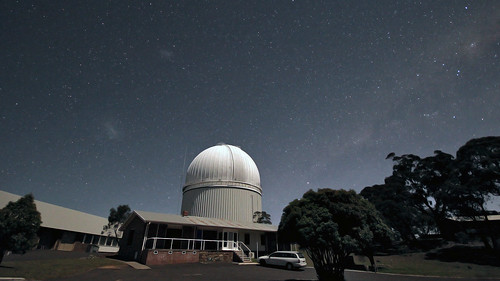
Frame of the time-lapse video “A 2dF night at the Anglo-Australian Telescope”. The Magellanic Cloud rise while the Milky Way sets over the Anglo-Australian Telescope at Siding Spring Observatory on 3 Nov 2011. Some kangaroos can be seen in the ground. Credit: Á.R.L-S.

However, the procedure that took more time was processing the hundreds of individual photographies included in each sequence. In many cases, I needed more than 12 hours of computer time, including 3 or 4 iterations per sequence, to get a good combination of low noise and details of the sky, plus “cleaning” bad pixels or cosmic rays. In particular, for this video I tried hard to show the colours of the stars, a detail which is usually lost when increasing the contrast to reveal the faintest stars. In the last sequence of the video, Aldebaran and Betelgeuse appear clearly red, while the stars in the Pleiades and Rigel have a blue color.

Frame of the time-lapse video “A 2dF night at the Anglo-Australian Telescope”. A dark night at The Anglo-Australian Telescope (23 Sep 2011). Orion constellation is seen over the AAT dome. The red colour of Alderaban and Betelgeuse and blue colours of Pleiades and Rigel are clearly distinguished. Credit: Á.R.L-S.

As I did for my previous time-lapse, here I also included a sequence which shows the trails created by the stars as they move in the sky as a consequence of the rotation of the Earth. This sequence shows the Celestial Equator and stars at the South (top) and North (bottom) Celestial Hemisphere. Note that star trails have indeed many different colours. Other details that appear in this time-lapse video are clouds moving over the AAT, satellites and airplanes crossing the sky, the nebular emission of the Orion and Carina nebulae, the moonlight entering in the AAT dome, and kangaroos “jumping” in the ground.

Frame of the time-lapse video “A 2dF night at the Anglo-Australian Telescope”. Startrails over the Anglo-Australian Telescope on 23 Sep 2011. The colours of the stars are clearly seen in this image, which stacks 1h 6min of observing time. Credit: Á.R.L-S.

Finally, I chose an energetic soundtrack which moves with both 2dF and the sky. It is the theme Blue Raider of the group Epic Soul Factory, by the composer Cesc Villà. Actually, all sequences were created to fit the changes in the music, something that also gave me some headaches. But I think the result was worth all the effort.
SN2014J in M82 observed at the William Herschel Telescope

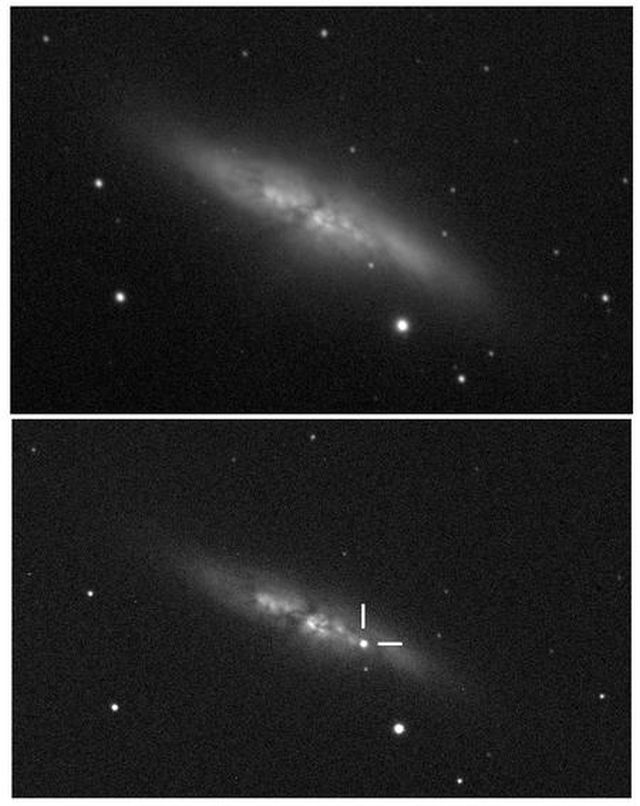
A week ago, on January 21st, the English astrophysicist Steve Fossey gave a telescope workshop for a group of undergraduate students (Ben Cooke, Tom Wright, Matthew Wilde and Guy Pollack) belonging to the University College of London (UCL). As usually happens in the British capital, the sky was practically covered by clouds. However, Fossey and his students used the automatic 35 cm telescope of the University of London Observatory to spot the famous starburst galaxy M 82. Located at 12 million light-years away in the constellation of Ursa Major (The Big Dipper), the galaxy M 82 hosts an intense star-formation burst, being its light dominated by young, hot, massive, blue stars. As consequence of this frenetic activity, M 82 possesses long jets of hot gas that has been expelled from the center of the galaxy. Therefore, it is not casual that the students chose this galaxy as a target for their assignment. While Fossey was centering the galaxy in the field of the telescope he realized that there was a bright star which should not be there. They checked that this new star was real using another telescope of the Observatory. As clouds were approaching, they quickly took some few images in different filters. The first analysis was doubtless: they had just discovered a supernova in the galaxy M 82.

Discovery image of type Ia SN2014J in the starburst galaxy M82 (below) compared with an older image of the galaxy before the supernova exploded (top). The discovery image was obtained at 19:20 UT, 21st January 2014 using the automatic 35 cm telescope of the University of London Observatory. Credit: UCL/University of London Observatory/Steve Fossey/Ben Cooke/Guy Pollack/Matthew Wilde/Thomas Wright.

In just one day, amateur astronomers and professional astrophysicists used their telescopes to study M 82. These observations soon confirmed the discovery made by Fossey and his students. Actually, some astronomers even found that they had taken data of the galaxy and the supernova a week before the official discovery, but the new exploding stars was unnoticed by them. A couple of days after the discovery, a group of astrophysicists led by Yi Cao (Caltech) got the first optical spectrum of the supernova using the 3.5m ARC Telescope at Apache Point Observatory (New Mexico, USA). The analysis of this spectrum showed that the progenitor of the supernova was a white dwarf, and hence the explosion was classified as a type Ia supernova. The official name of this exploding star is SN 2014J. It has not reached its maximum brightness yet: when Fossey and his students discovered the supernova, it was 2 weeks before when we expect this happens. Right now it is so bright (around 10th magnitude) it is very easy to spot using a small amateur telescope. Perhaps even it can be seen using binoculars when the supernova reaches its maximum brightness in a week or so!

Hence, it is not difficult to understand that SN 2014J and M 82 have been the main astronomical news in the last week. Using the 4.2m William Herschel Telescope (WHT), which is part of the Isaac Newton Group, located at the Roque de los Muchachos Observatory in the beautiful island of La Palma (Canary Islands, Spain), the astrophysicists Manuel Moreno-Raya (CIEMAT, Spain) and Lluís Galbany (DAS/UC, Chile) have observed with great detail both the supernova and the galaxy. Between Thursday 23rd and Sunday 26th January they used the ISIS spectrograph, as well as the ACAM instrument (Auxiliary-Port Camera), of the WHT to get images and spectra of the supernova. I was continuously in touch with them as I’m part of their research team (actually, I’m co-supervising the PhD thesis which is conducted by Manu). I originally planned to travel to La Palma to be helping on these observations, however this was colliding with my support activities at the Anglo-Australian Telescope (Siding Spring Observatory, NSW, Australia). Manu and Lluís sent me the data as they were coming from the WHT, and I was reducing, combining, and getting the preliminary images and spectra of this object!

The image below shows the supernova SN 2014J and the galaxy M 82 using the data obtained with ACAM. I tried to get all the important details of this puzzling object: the dust lanes crossing the disc (dark-yellow), the strong star-formating bursts (blue) and even the filamentary structure of the super-galactic wind that M 82 possesses (in red). This feature is hot, ionized gas which has been expelled from the center of the galaxy and here it is seems perpendicular to the galactic disc. SN 2014J very brightly shines at the west (right) of M 82 galactic center.


Colour image of starburst galaxy M 82 with the type Ia supernova SN 2014J. M 82 lies at 12 million light years from us, in the Ursa Major constellation. The supernova is marked with two white lines. The data needed to get this image were taken using the ACAM instrument located at the Cassegrain focus of the 4.2m William Herschel Telescope (WHT) (Roque de los Muchachos Observatory, La Palma, Canary Islands, Spain). We got data in u, g, i, r, and Hα filters. Data coming from the u filter (2 x 200 seconds exposures) are colour-coded in blue; data in the g filter (3 x 100 seconds exposures) are colour-coded in cyan; data in the i filter (3 x 100 seconds exposures) are colour-coded in green; data in r filter (3 x 300 seconds exposures) are colour-coded in red. The majority of the data were obtained last 24th January, at 04:40 UT. Data in r and u filter were taken on 25th January, at around 06:00 UT. The Hα data (4 x 300 seconds exposures), which are colour-coded in red, were taken on 26th January at 06:30 UT. Data coming from the Hα filter clearly reveals the super-galactic wind of M 82. All data were reduced and combined using standard IRAF routines. The colour composition was obtained using Photoshop. The field of view is 8 arcminutes and the resolution 0.25 arcsec/pixels. However, the seeing was not too good, between 2 and 5 arcsec.
Credit: Observers: Manuel E. Moreno-Raya (CIEMAT, Spain) & Lluís Galbany (DAS / UC, Chile). Data processing and color image composition: Ángel R. López-Sánchez (AAO / MQ, Australia). Support astronomer: Chris Benn (ING, UK), Telescope Operator: José Norberto González (ING, UK). Research Team: Manuel E. Moreno-Raya (CIEMAT, Spain), Mercedes Mollá (CIEMAT, Spain), Ángel R. López-Sánchez (AAO / MQ, Australia), Lluís Galbany (DAS / UC, Chile),Aurelio Carnero (ON, Brazil), Inma Domínguez (UGR, Spain), & Pepe Vílchez (CSIC / IAA, Spain).

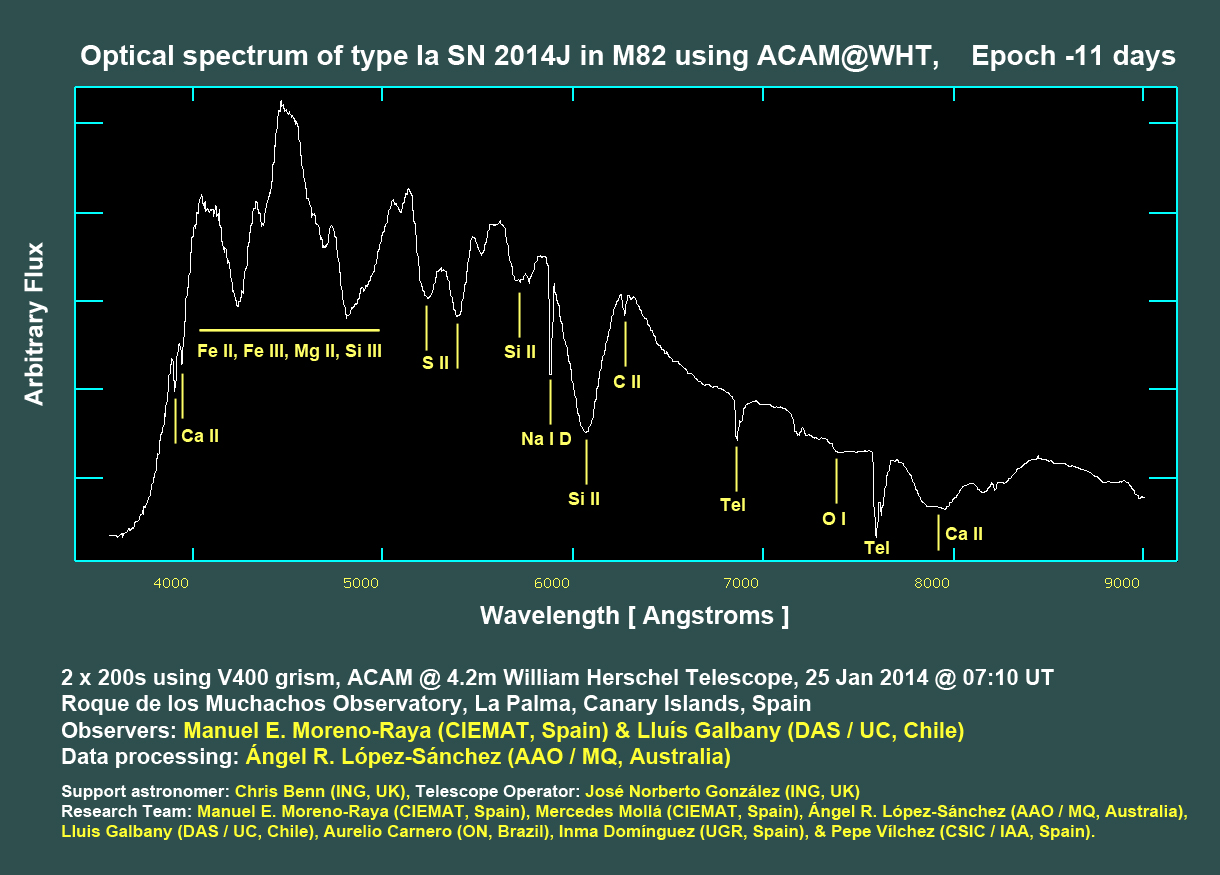
In addition, we have already analyzed the low-resolution spectrum of the SN 2014J obtained using ACAM. This spectrum gets all the optical range, between 3500 and 9500 Angstroms, and clearly identifies the object as a type Ia supernova. The main features are absorption bands of iron (Fe II and Fe III), magnesium (Mg II) and silicon (Si II) between 4000 and 5000 A. These bands actually are blends of absorptions due to these metallic elements. Indeed, astrophysicists expect the intensity of these bands will be changing as the supernova evolves, as the chemical abundances and ionization of each species vary as some elements are converted into others and more material coming from the center of the dead star is observed. Even so, it is a surprise to find these absorption bands almost 10 days before the supernova reaches its maximum brightness. The spectrum also shows absorptions of sulfur (S II) at 5240 and 5450 A, a strong absorption by silicon (Si II) at 6150 A, and absorptions of calcium (Ca II), sodium (Na I) and oxygen (O I). Some features are actually created in the Earth atmosphere and hence they do not belong to the supernova, these are labelled as “Tel” (from “Teluric lines”). However, the feature which interested us most was the carbon absorption (C II) at 6580. This line indicates that the progenitor of the supernova was a white dwarf composed by carbon and oxygen (as it happens in the majority of the white dwarf). However, it is uncommon to observe this line in type Ia spectra. This suggests that the surface of the white dwarf has not been completely burnt during the explosion. All absorption lines are found “blue-shifted”, that is, at shorter wavelengths that those expected. That is a consequence of the high speed at which the material is moving, expanding fast away from the dead star. The measurement of the C II and S II lines observed in our ACAM optical spectrum indicates that this material is moving at around 15 000 km/s!


Low-resolution optical spectrum of the type Ia supernova SN 2014J discovered in the galaxy M 82 obtained using the ACAM instrument at the Cassegrain focus of the 4.2m William Herschel Telescope (WHT) (Roque de los Muchachos Observatory, La Palma, Canary Islands, Spain). The intensity or relative flux (“Arbitrary Flux”, vertical axis) is plotted versus wavelength (“colour”, horizontal axis). The main features, which includes absorption lines of iron, magnesium, silicon, sodium, calcium, oxygen and carbon, are labelled. The spectrum combines two expositions of 200 seconds each using the ACAM V400 grism. The data were obtained last 25th January at 7:10 UT, which approximately corresponds to Epoch -11 days. It is expected the supernova reaches its maximum brightness in that time. The reduction of the data and the wavelength calibration was performed using standard IRAF routines.
Credit: Observers: Manuel E. Moreno-Raya (CIEMAT, Spain) & Lluís Galbany (DAS / UC, Chile). Data processing and color image composition: Ángel R. López-Sánchez (AAO / MQ, Australia). Support astronomer: Chris Benn (ING, UK), Telescope Operator: José Norberto González (ING, UK). Research Team: Manuel E. Moreno-Raya (CIEMAT, Spain), Mercedes Mollá (CIEMAT, Spain), Ángel R. López-Sánchez (AAO / MQ, Australia), Lluís Galbany (DAS / UC, Chile),Aurelio Carnero (ON, Brazil), Inma Domínguez (UGR, Spain), & Pepe Vílchez (CSIC / IAA, Spain).

Interestingly, the project that Manuel Moreno-Raya (CIEMAT, Spain) and his research team, composed by Mercedes Mollá (CIEMAT, Spain), Lluís Galbany (DAS / UC, Chile), Aurelio Carnero (ON, Brazil), Inma Domínguez (UGR, Spain), Pepe Vílchez (CSIC / IAA, Spain) and myself, was observing at the WHT was focused in obtaining deep, high-quality data of galaxies hosting type-Ia supernova. The idea is to quantify the physical and chemical properties of these host galaxies with the final aim of getting a better understanding of the parameters which control the brightness of these supernovae and apply these new measurements to improve the accuracy to very distant galaxies. This research is the main part of the PhD thesis project that Manu is conducting. Besides the observations of M 82 and the SN 2014J, we also got deep intermediate-resolution optical spectroscopy data of around 20 galaxies. These data still have to be analyzed in detail, something that will take months.

SN 2014J is the type-Ia supernova closest to the Earth since that Johannes Kepler observed in 1604. The Kepler’s Supernova actually exploded in our Galaxy, at just 20 thousands light-years from us, and it was so bright it was seen with the naked eye, being the brightest object in the sky after the Sun and the Moon. The type Ia supernova SN 1972e was also very close to us, as it exploded in the dwarf galaxy NGC 5253 (*). NGC 5253, which lies at a distance of 13 million light years, is in some way a similar object to M 82, as it also hosts a very powerful star-formation event. SN 1972e became the prototype object for the development of theoretical understanding of Type Ia supernovae, but this position may change with all the data that are coming from SN 2014J. What surprises will provide this new supernova? Can the new data be used to get a better understanding of the type Ia supernovae as a cosmological distance estimators and help to discover the nature of the mysterious dark energy which induces the expansion of the Universe? This research has just started.

UPDATE: Part of the information included in this post was used to prepare a telegram for ATel, The Astronomer’s Telegram, number 5827, Broad and narrow band imaging and spectroscopic follow up of SN2014J in M82, published on 28 Jan 2014; 18:30 UT.

(*) I should tell you many more things about the dwarf galaxy NGC 5253… It was my nightmare for some few years and after performing a very complete and detailed multi-wavelength analysis of this weird object I’m still not sure what is happening in there!

Timelapse video: The Sky over the Anglo-Australian Telescope

A dark winter night, with the Milky Way crossing the firmament while its center in located near the zenith, is one of the most astonishing views we can enjoy. This vision is only obtained from the Southern Hemisphere and it is really inspiring. In particular, the Milky Way shines over the Siding Spring Observatory, near Coonabarabran (NSW), where the famous Anglo-Australian Telescope (AAT) is located. With the idea of sharing the beauty of the night sky to everybody, in May 2011 I decided to start taking timelapse photography while I was working as support astronomer at the AAT. This technique consists on taking many images and then adding all to get a movie with a very high resolution. The best shots I obtained by September 2011 were included in the video The Sky over the Anglo-Australian Telescope, which is available both in YouTube and in several MOV/MP4 files (HD, iPad, iPhone) in my personal AAO webpage.


“The Sky over the Anglo-Australian Telescope” was my first public timelapse video, released in November 2011.
Credit: Ángel R. López-Sánchez (AAO/MQ), the credit of the music is Echoes from the past, by Dj Fab.

The video, which lasts for 2.7 minutes, is the results of combining around 3800 different frames obtained using a CANON EOS 600D between June and September 2011. Except for those frames used for the sunset in the first scene, all frames have a 30 seconds exposure time, with a ISO speed of 1600. As the videos were created at 24 fps (frames per second), each second in the movie corresponds to 12 minutes in real time. I used several lens to take the images (standard 50 mm, 50mm x 0.65 focal reducer and a 10 mm wide-angle lens). The focal chosen was 5.6 (for the 50 mm lens) or 4.5 (10 mm wide-angle lens). Processing each sequence of the movie took five to six hours of computer time, and usually I had to repeat this at least once for each sequence, to improve the quality. The soundtrack I chose is an extract of the music Echoes from the past, by the french composer Dj Fab, which gives energy to the timelapse.

The Milky Way is setting at Siding Spring Observatory on 21 Sep 2011.
Click here to get the full resolution frame.
Credit: Á.R. L-S.

As my main job while I’m at the AAT is providing instrumental and scientific support to the astronomers who are observing in this telescope, I always set the camera up at the beginning of the night, let it run, and check on its progress occasionally. Sometimes this was not easy: wind knocked the camera over on a couple of times, often the battery ran out, and even once I had an encounter with some intransigent kangaroos. However, finally I got this material, which does not only show the magnificent Milky Way rising and setting above the dome of the AAT, but also stars circling the South Celestial Pole, the Magellanic Clouds over the AAT, satellites and airplanes crossing the sky, the Moon rising and setting, and the most famous constellations as Orion, Carina and the Southern Cross.

Circumpolar star traces (2.7 hours) over the Anglo-Australian Telescope on 20 Sep 2011.
Click here to get the full resolution frame.
Credit: Á.R. L-S.

I hope you enjoy the result. More timelapse videos to come soon!

Moon, Jupiter, Jewel Box and Comet Lemmon

Besides being an astrophysicist I’m an active amateur astronomer. After 6 years living in Australia, finally in May 2012 I bought my own, small amateur telescope: Skywatcher Black Diamond Refractor Telescope, with an aperture of 80 mm and a focal distance of 600 mm. It provides beautiful images of the sky. However, besides once while stayed at Siding Spring Observatory and the two “great astronomical events” of 2012 (and the final reason I got the telescope), the Transit of Venus in June and the Total Solar Eclipse in November, I have not had too much time to play with this toy.

Last Monday 18th February it was clear in Sydney and I tried to get some shots of the conjunction between the Moon and Jupiter (actually, from South Australia the Moon occulted Jupiter!). This is the vision I got from my telescope:


Conjunction between the Moon and Jupiter observed from Sydney on 18th February 2013. I used my Skywatcher Black Diamond Telescope D = 80 mm, f = 600 mm and my CANON EOS 600D at primary focus, at 200 ISO. It is a composition of two images: one taken at speed 1/60 and another at 1/10. I did what I could to get a nice balance between them. Credit: Angel R. López-Sánchez.

After this, I decided to try to find the bright comet Lemmon 2012 F6, that was located near the Small Magellanic Cloud. It was actually easier I thought and, besides the light pollution, I got it. So on Tuesday 19th, again clear, I prepared the telescope but this time including the motors and performing an alignment of the mount to the South Celestial Pole. This task is not easy when there is too much light in the sky, as the stars used to do it are faint. At the end I got this view of the comet. I was not able to detect the tail with my eyes, however it does appear when combining several frames, as I did for this image.

My vision of the comet Lemmon 2012 F6 from Sydney on Tuesday 19th February 2012, at 21:20 AEST (10:20 UT). I combined 7 frames of 6 seconds exposure each (42 seconds total exposition time), at 1600 ISO using Skywatcher Black Diamond Telescope D = 80 mm, f = 600 mm and my CANON EOS 600D at primary focus. Note the faint tail moving towards the upper-left. Credit: Angel R. López-Sánchez.


An annotated version of this image can be found here:


Annotated version of my vision of the comet Lemmon 2012 F6 from Sydney on Tuesday 19th February 2012, at 21:20 AEST (10:20 UT). I combined 7 frames of 6 seconds exposure each (42 seconds total exposition time), at 1600 ISO using Skywatcher Black Diamond Telescope D = 80 mm, f = 600 mm and my CANON EOS 600D at primary focus. I have included an arrow folowing the faint tail, the orientation, and the position of the star &epsilon Tucanae. Credit: Angel R. López-Sánchez.

To get a good focus I decided to use the famous Jewel Box star cluster, very close to Mimosa (β Crucis).


Image of the “Jewel Box” star cluster (NGC 4755 or Kappa Crucis) in the Southern Cross from Sydney (actually, 4 km from the city center) on Tuesday 19th February 2013, 20:50 AEST (09:50 UT). It combines 6 images with 5 seconds exposure each ( 30 seconds total time) at 400 ISO, using a Skywatcher Black Diamond Telescope D = 80 mm, f = 600 mm and my CANON EOS 600D at primary focus. The bright star at the left is Mimosa, β Crucis, one of the brightest stars of the Southern Cross. Credit: Angel R. López-Sánchez.


Any of these images are very spectacular but considering that they have been taken just 4 km from the center of Sydney, with all the light pollution, plus the extra “fight” with the mozzies, I’m happy to share them with you.

The importance of massive stars

The mass range of stars drawing their energy supply from nuclear fusion covers about three orders of magnitude. The least massive stars known have masses around 0.1 solar masses (M) and the most massive examples are around 100 M, although stars with masses of ~150M may also exist.

Massive stars are defined as those stars with masses higher than around 8 M. However, this lower limit is not completely fixed, as the definition of massive star actually comes from those stars that ignite helium and afterwards carbon in non-degenerated stellar cores (i.e., the hydrostatic equilibrium is reached because the inward gravitational force is balanced with the outward force due to the pressure gradient of the gas). Depending on the evolutionary scenario, this happens between 7 and 9 M.

Massive stars consume their fuel faster than low and intermediate mass stars: a solar-mass star has a life ~125 times longer than a 10 M star. Massive stars also are very luminous: a 100M star shines with a luminosity similar to ~1600 Suns. Hence, except for stars of transient brightness, like novae and supernovae, hot, massive stars are the most luminous stellar objects in the Universe.

STScI-01EVT9Y2MZMV5XAMN6ATWKA46C

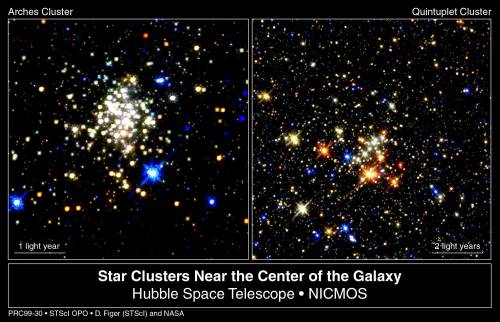
Young, massive star clusters near the center of the Milky Way, at ~25,000 light-years from Earth: the Arches cluster (left) and the Quintuplet Cluster (right). Both pictures were taken using infrared filters by the NICMOS camera of the Hubble Space Telescope in September 1997. The galactic center stars are white, the red stars are enshrouded in dust or behind dust, and the blue stars are foreground stars between us and the Milky Way’s center. The clusters are hidden from direct view behind black dust clouds in the constellation Sagittarius. Credit: Don Figer (STScI) and NASA.

Massive stars are, however, extremely rare. Following the very famous results obtained by the Austrian-Australian-American astrophysicist Edwin Ernest Salpeter in 1955, the number of stars formed per unit mass interval is roughly proportional to M -2.35. Therefore we expect to find only very few massive stars in comparison with solar-type stars: for each 20M star in the Milky Way there are roughly a hundred thousand solar-type stars; for each 100M star there should be over a million solar-type stars.

However, despite their relative low number, massive stars have a fundamental influence over the interstellar medium and galactic evolution because they are the responsible of the ionization of the surrounding gas and they deposit mechanical energy first via strong stellar winds and later as supernovae, enriching the interstellar medium by returning unprocessed and nuclear processed material during their whole life. Massive stars therefore condition their environment and supply it with new material available for the birth of new generations of stars, being even the triggering mechanism of star formation. They also generate most of the ultraviolet ionization radiation in galaxies, and power the far-infrared luminosities through the heating of dust. The combined action of stellar winds and supernovae explosions in massive young stellar clusters leads to the formation of super-bubbles that may derive in galactic super-winds. Furthermore, massive stars are the progenitors of the most energetic phenomenon nowadays found, the gamma-ray bursts (GRBs), as they collapse as supernova explotions into black holes. Particularly, the interest in hot luminous stars has increased in the last decade because of the massive star formation at high redshift and the results of numerical simulations regarding the formation of the firts stars at zero metallicity (Population III stars), that are thought to be very massive stars with masses around 100M.

The descents of the most massive, extremely hot (temperatures up to 200,000 K) and very luminous (105  to 106 solar luminosities, L) O stars are Wolf-Rayet stars, which have typical masses of 25 – 30 M for solar metallicity.