Category Archives: Conferences

ESOz2020 Conference

Between 17 and 21 February 2020 I participated in the international conference “2ND AUSTRALIA-ESO JOINT CONFERENCE: The build-up of galaxies through multiple tracers and facilities” ESOz2020, hosted by ICRAR at University of Western Australia in Perth.


As usual I got my notes using tweets. Well, here you have the links to the compilation of those tweets for each of the days.


My talk was on Tuesday afternoon, in case you’re interested.


From here I want to congratulate the LOC of this conference as it was very well organised and they did a great job. I particularly want to thank Claudia Lagos (ICRAR-UWA) for her hard work on this as chair of both the SOC and the LOC.


Twitter helping in a busy week

You might or might not know that I’ve been trying to be very active in my favorite social media network, Twitter, for the last years. I joined Twitter in 2011 just to promote my Spanish blog “El Lobo Rayado“, that is why my username still is @El_Lobo_Rayado (*)

In some way, micro-posting in Twitter has had a huge impact on the way I do science communication. For example, I used to write long posts in my Spanish blog explaining or discussing astronomy news, but now I do that in Twitter, and almost everything in English. Twitter drastically changed my presence in the web, also helping me to promote science communication events, and at the same time contacting very interesting people.

Social media and science communication have evolved A LOT between 2011 and 2019, that’s for sure.

Twitter has been increasingly popular for researchers, astronomers in particular, and a bit of “networking” is also done there. Conferences usually have a hashtag to follow, sometimes even a full twitter account, and that has been my way of capturing and summarizing the talks, sometimes providing comments or discussions to the topics that were discussed. And even, I must confess, writing Twitter posts including some photos of the talk is now the way I’m taking notes during the Conference.

I’m doing that using threads, that is, connecting all my tweets one after the other. Some people of Twitter use threads to tell a story as if it was a post in a conventional blog… but breaking the post in many (10-50 or even more) independent tweets. I don’t like that. In my personal opinion, if you want to tell that much, just write a post in a blog and provide the link in a single tweet! But that is my humble opinion, I can understand that other people DO LOVE to write threads (and even they first prepare them in a separate document to know how many tweets are needed and/or schedule the individual tweets seeking the highest impact).

What was missing? Compiling all those tweets in an easy way! If you are familiar to Twitter you know that, after some few days (it depends on how active you are) it is not that easy to find a particular tweet. In the past we had Storify to collect tweets, not necessarily from the same account. It was quite good, although it involved a bit of extra work compiling tweets and sorting them. But Storify was closed a year ago (and with that some of us lost plenty of useful information, as the tens of #AskAAO sessions we used to have in the old “Australian Astronomical Observatory”).

Luckily recently a new tool came into play to help us with that. It is the Thread Reader App, that allows the user to get a full post compiling all the tweets in a thread. How to do it? Easy: just send a tweet to @threadreaderapp at the end of your Twitter thread including the word “unroll“… and magic happens!

And that is what I’ve done today to compile my tweets of Monday and Tuesday… busy as I’m both attending the “ASTRO-3D Science Meeting 2019#A3Dscimeet19 AND helping in the international science communication festival “Pint of Science#PintAU19 #Pint19AU in the evenings…

Here they are the posts with all my tweets during the week:

I have to say… I should be at the #A3Dscimeet19 right now but I had some few “urgent” things to do at the university, and later I got some few emails and… well… here I am in my office writing this.

But I’ll update it later with today’s thread. Done!

(*) I say “still” because I’m seriously considering changing it to a “more English-speakers friendly” username…

A year since the “Multiwavelength Dissection of Galaxies” Conference

I cannot believe a FULL YEAR has already gone since the “Multiwavelength Dissection of Galaxies” Conference happened. And I have never found the time to just describe how much work this was for me, and at the success of this meeting. At least let me share today the article I wrote for “The Observer”, the AAO Newsletter.

 
The Southern Cross Astrophysics Conferences, which are jointly supported by the Australian Astronomical Observatory (AAO) and the CSIRO Astronomy and Space Science (CASS), are held annually around Australia with the aim of attracting international experts with wide ranging skills to discuss a particular astrophysical topic. The conference “Multiwavelength dissection of galaxies”, which was held at the Crown Plaza Hotel in  Coogee Beach, Sydney between 24th – 29th May 2015, was the 8th of the Southern Cross Conference Series. This Conference focused on galaxy evolution, combining resolved optical/near-infrared integral field spectroscopy data with other multiwavelength properties (from X-ray to radio) of nearby galaxies plus giving the view of what is known in our Milky Way.
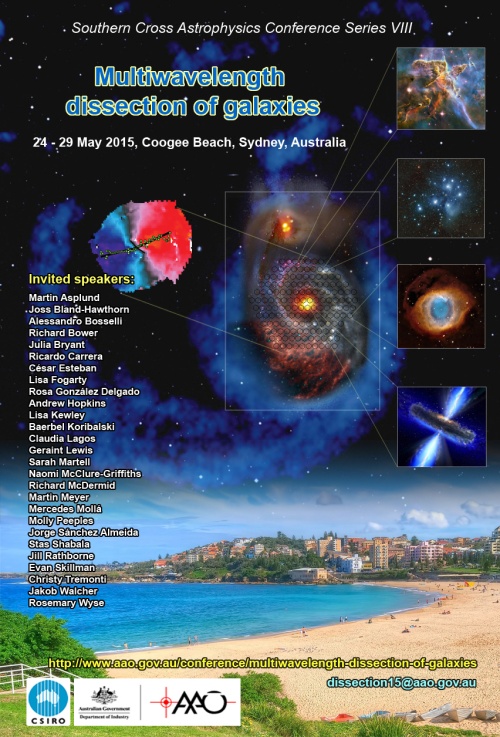
Poster of the Conference "Multiwavelength Dissection of Galaxies".

Poster of the Conference “Multiwavelength Dissection of Galaxies”.

Indeed, the number of studies of galaxies using integral field spectroscopy (IFS) is rapidly increasing as a consequence of surveys such as ATLAS-3D, CALIFA, SAMI (that is conducted at the AAT), or MANGA. IFS techniques allow to spatially resolve internal properties of galaxies with unprecedented detail, and therefore they are providing key clues for understanding the structural components of galaxies, their star-formation activity, kinematics, stellar populations, metal distribution, and nuclear activity, as well as how galaxies evolve with time. Nevertheless, for a complete picture of how galaxies work it is crucial to use other multi-wavelength results, targeting galaxies in X-ray, ultraviolet, infrared, and radio frequencies. In particular, HI radio-surveys such as HIPASS, LVHIS, THINGS, Little-THINGS, ALFALFA, HALOGAS or WALLABY are essential to trace the neutral gas content of galaxies, as the 21 cm HI radio data provide key information about how the cold gas in converted into stars and galaxy dynamics. At the same time we are notably increasing our knowledge of the structure and composition of the Milky Way. This is possible thanks to the combination of very detailed observations of individual stars (such those coming from the RAVE survey conducted at the 1.2m UKST or the on-going GALAH survey at the AAT using the new high-resolution HERMES spectrograph), detailed analyses of Galactic nebulae, large field studies of the interstellar medium, and surveys searching for the diffuse gas with and around our Galaxy.

Hence, the aim of the “Multiwavelength dissection of galaxies” Conference was to bring together international experts in both Galactic and extragalactic astronomy to discuss the different components of a galaxy: stars, gas, dust, and dark matter, and where these components are found within and around galaxies, from both an observational (from radio to X-rays, but with a fundamental optical IFS component) and a theoretical point of view (from the most recent simulations of galaxy assembly to models reproducing the chemical evolution of galaxies), with the final objective of getting a better understanding on the processes that rule the evolution of the galaxies.
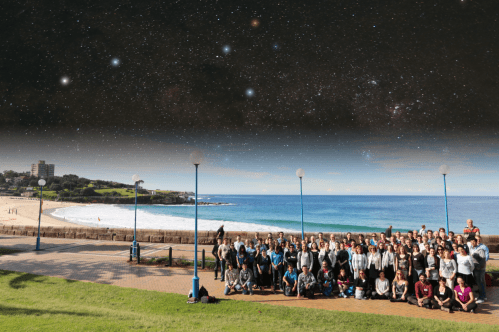
Conference Photo with the majority of the participants to the “Multiwavelength Dissection of Galaxies” meeting, 24th - 29th  May 2015. The background is an image of the Southern sky showing the Southern Cross and the Pointers. Credit: Conference Photo: Andy Green (AAO), Background image & composition: Ángel R. López-Sánchez.

Conference Photo with the majority of the participants to the “Multiwavelength Dissection of Galaxies” meeting, 24th – 29th May 2015. The background is an image of the Southern sky showing the Southern Cross and the Pointers. Credit: Conference Photo: Andy Green (AAO), Background image & composition: Ángel R. López-Sánchez.

Around 120 astronomers all around the globe attended to this Conference. In five days we had 94 talks, including 27 invited talks and a Summary talk, and 26 poster contributions. Highlight invited talks were given by Rosemary Wyse (The Structure of the Milky Way), Naomi McClure-Griffiths (Neutral gas in and around the Milky Way), Baerbel Koribalski (Diffuse gas in and around galaxies), Christy Tremonti (Measuring Gas Accretion and Outflow Signatures with MaNGA), César Esteban (Ionized gas in the Milky Way), Evan Skillman (The Chemical Properties of the ISM of Nearby Galaxies), Sarah Martell (Introduction to the GALAH Survey), Geraint Lewis (Galactic Archeology in the Local Group), Alessandro Boselli (The dust emission properties of nearby galaxies after Herschel), Jakob Walcher (News about the interstellar medium in galaxies from the CALIFA survey), Stas Shabala (Resolving the mysteries of AGN feedback:radio jets, galaxies and citizen science), Joss Bland-Hawthorn (Near Field Cosmology), Martin Asplund (The Gaia-ESO survey), Richard Bower (The EAGLE Universe), Lisa Kewley (SAMI Science) and Molly Peeples (A Multiwavelength View of the Circumgalactic Medium).

We also organised a “Poster Contest”: participants were asked to vote for their 2 favourite posters, and they got a short (10 minutes) talk during the last session of the Conference. The winners were two PhD students: Christina Baldwin (Macquarie University, Australia, with the poster “Early-Type Galaxy Stellar Populations in the Near-Infrared”) and Manuel Emilio Moreno-Raya (Universidad Complutense Madrid and CIEMAT, Spain, with the poster “Dependence of SNe Ia absolute magnitudes on the host galaxies elemental gas-phase abundances”).

We have compiled all scientific presentations at the Conference Webpage:

http://www.aao.gov.au/conference/multiwavelength-dissection-of-galaxies

Furthermore, participants were very active in Twitter, that followed the hashtag of the Conference #MDGal15, allowing a wider diffusion of the main results speakers were presenting. We have also compiled all tweets in a Storify for each day, they are available in our website.

Besides the scientific talks, participants enjoyed the social events we organised for the Conference, including a Welcome Cocktail Cruise on Sunday 24th May (delegates enjoyed not only the great views of Sydney Harbour but also a starry sky and the famous ViVID Lights Sydney Festival), a Wine Tasting event on Tuesday 26th, an outdoors barbecue and a visit to Sydney Observatory and Stargazing on Wednesday 27th May, and the Conference Dinner on Thursday 28th May, which was held at the Spanish restaurant “Postales” in famous Martin Place, Sydney. Furthermore, the AAO organised the Public Event “The Story of Light: The Astronomer’s Perspective” on Sunday 24th May at the Powerhouse Museum (Sydney). This event, which was fully booked, was included as part of the ViVID Festival and connected the International Year of Light 2015 with our Conference.

Overall, we considered it was a great Conference and some important and controversial research topics were actually discussed during those five days, generating new ideas and projects, and many new collaborations between participants (even between Galactic and extragalactic astronomers) started there.

Finally, I would like to thank the impeccable organisation of the staff at Crown Plaza Hotel, as everything worked very smoothly and we didn’t have any problems at all during our Conference. In particular, coffee breaks and lunches were very well attended, and we really enjoyed a great quality food. Of course, I also must thank all the members of the LOC and the SOC committees for their invaluable help organising this Conference. In particular, I would like to thank Helen Woods (AAO) for her enormous effort and Andrew Hopkins and AAO’s Director, Warrick Couch, for their strong support to this meeting.

Feeding, Feedback and Fireworks in galaxies

During this week (23 – 28 June 2013), I’m participating in the international astrophysics conference “Feeding, Feedback, and Fireworks: Celebrating Our Cosmic Landscape”, which is hosted in the tropical paradise of Hamilton Island, one of the most important islands of the Whitsundays (Queensland, Australia). The conference is jointly supported by the Australian Astronomical Observatory (AAO) and the CSIRO Astronomy and Space Science (CASS) and it is the 6th of the Southern Cross Conference Series.

Poster of the “Feeding, Feedback, and Fireworks: Celebrating Our Cosmic Landscape”, jointly supported by the Australian Astronomical Observatory (AAO) and the CSIRO Astronomy and Space Science (CASS), being the 6th of the Southern Cross Conference Series. The Heart Reef near Hamilton Island appears in the foreground, while the Hubble Ultra-Deep Field image is the background image.
Credit: Heart Reef Photo and Fireworks: Ángel R. López-Sánchez (Australian Astronomical Observatory / Macquarie University); Hubble Ultra-Deep Field: NASA, ESA and R. Thompson (Univ. Arizona).

It has been a very intense and fruitful conference, with almost 100 participants (the majority coming from Australia, but many others from America, Europe, Asia and Africa), and we are discussing hot topics about how the diffuse gas is moved inside the galaxies (Feeding), how stars form in galaxies (Fireworks) and how these newborn stars alter the properties of their host galaxies and their surroundings (Feedback). We are also investigating the role of the Active Galactic Nuclei (AGN) in galaxy evolution: how are they triggered (Feeding) and how they affect their host galaxies and even the galaxy cluster their host galaxies reside (Feedback). All in the context of the cosmological evolution of the Universe, constraining theoretical models using observations, and trying to put all the pieces together to understand the evolution of the galaxies.

In my case I presented part of my multi-wavelength work in Blue Compact Dwarf Galaxies, which are small galaxies (smaller than 1/100 times the size and mass of the Milky Way) which are experiencing a very intense star-formation event. Hence, it seems all the dwarf galaxy is a giant nebula! I’ll describe these interesting objects in a future post.

I’m part of the “LOC”, the Local Organizing Committee, which is chaired by Amanda Bauer (AAO), aka @astropixie, and hence in the last months I have actively participate to get the conference smoothly running (conference booklet, schedule of the talks, helping in registration and photos). One of my tasks during this week was to get the “Conference Photo” which, as Amanda suggested, includes not only the beach and palm trees of the beautiful beach at Hamilton Island but also a nice night-sky photo showing the Southern Cross. The result is this:

Conference Photo of the “Feeding, Feedback, and Fireworks: Celebrating Our Cosmic Landscape” conference.
Photo Credit and composition: Ángel R. López-Sánchez (Australian Astronomical Observatory / Macquarie University).

The talks and more information about this exciting conference will be posted in the conference webpage soon.