I cannot believe a FULL YEAR has already gone since the “Multiwavelength Dissection of Galaxies” Conference happened. And I have never found the time to just describe how much work this was for me, and at the success of this meeting. At least let me share today the article I wrote for “The Observer”, the AAO Newsletter.
The Southern Cross Astrophysics Conferences, which are jointly supported by the Australian Astronomical Observatory (AAO) and the CSIRO Astronomy and Space Science (CASS), are held annually around Australia with the aim of attracting international experts with wide ranging skills to discuss a particular astrophysical topic. The conference “Multiwavelength dissection of galaxies”, which was held at the Crown Plaza Hotel in Coogee Beach, Sydney between 24th – 29th May 2015, was the 8th of the Southern Cross Conference Series. This Conference focused on galaxy evolution, combining resolved optical/near-infrared integral field spectroscopy data with other multiwavelength properties (from X-ray to radio) of nearby galaxies plus giving the view of what is known in our Milky Way.
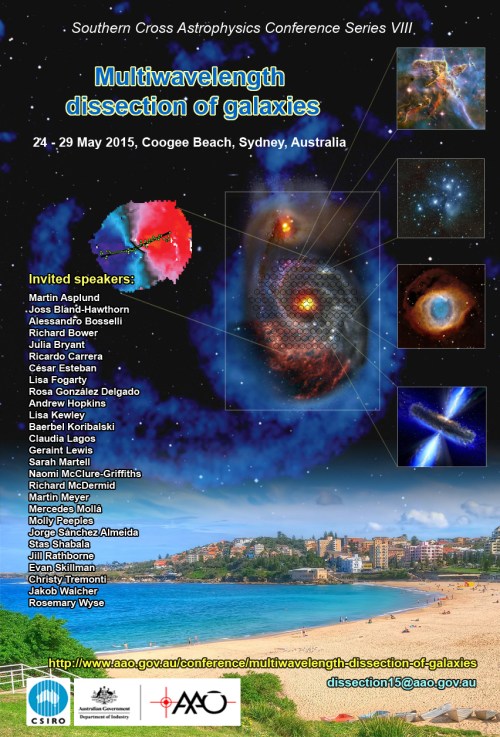
Poster of the Conference “Multiwavelength Dissection of Galaxies”.
Indeed, the number of studies of galaxies using integral field spectroscopy (IFS) is rapidly increasing as a consequence of surveys such as ATLAS-3D, CALIFA, SAMI (that is conducted at the AAT), or MANGA. IFS techniques allow to spatially resolve internal properties of galaxies with unprecedented detail, and therefore they are providing key clues for understanding the structural components of galaxies, their star-formation activity, kinematics, stellar populations, metal distribution, and nuclear activity, as well as how galaxies evolve with time. Nevertheless, for a complete picture of how galaxies work it is crucial to use other multi-wavelength results, targeting galaxies in X-ray, ultraviolet, infrared, and radio frequencies. In particular, HI radio-surveys such as HIPASS, LVHIS, THINGS, Little-THINGS, ALFALFA, HALOGAS or WALLABY are essential to trace the neutral gas content of galaxies, as the 21 cm HI radio data provide key information about how the cold gas in converted into stars and galaxy dynamics. At the same time we are notably increasing our knowledge of the structure and composition of the Milky Way. This is possible thanks to the combination of very detailed observations of individual stars (such those coming from the RAVE survey conducted at the 1.2m UKST or the on-going GALAH survey at the AAT using the new high-resolution HERMES spectrograph), detailed analyses of Galactic nebulae, large field studies of the interstellar medium, and surveys searching for the diffuse gas with and around our Galaxy.
Hence, the aim of the “Multiwavelength dissection of galaxies” Conference was to bring together international experts in both Galactic and extragalactic astronomy to discuss the different components of a galaxy: stars, gas, dust, and dark matter, and where these components are found within and around galaxies, from both an observational (from radio to X-rays, but with a fundamental optical IFS component) and a theoretical point of view (from the most recent simulations of galaxy assembly to models reproducing the chemical evolution of galaxies), with the final objective of getting a better understanding on the processes that rule the evolution of the galaxies.
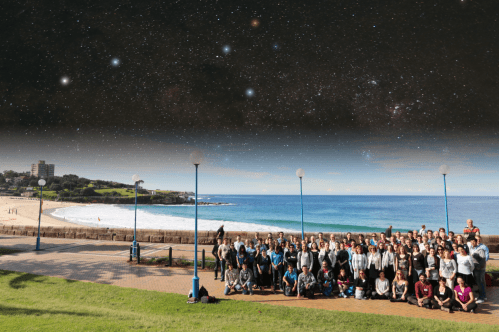
Conference Photo with the majority of the participants to the “Multiwavelength Dissection of Galaxies” meeting, 24th – 29th May 2015. The background is an image of the Southern sky showing the Southern Cross and the Pointers. Credit: Conference Photo: Andy Green (AAO), Background image & composition: Ángel R. López-Sánchez.
Around 120 astronomers all around the globe attended to this Conference. In five days we had 94 talks, including 27 invited talks and a Summary talk, and 26 poster contributions. Highlight invited talks were given by Rosemary Wyse (The Structure of the Milky Way), Naomi McClure-Griffiths (Neutral gas in and around the Milky Way), Baerbel Koribalski (Diffuse gas in and around galaxies), Christy Tremonti (Measuring Gas Accretion and Outflow Signatures with MaNGA), César Esteban (Ionized gas in the Milky Way), Evan Skillman (The Chemical Properties of the ISM of Nearby Galaxies), Sarah Martell (Introduction to the GALAH Survey), Geraint Lewis (Galactic Archeology in the Local Group), Alessandro Boselli (The dust emission properties of nearby galaxies after Herschel), Jakob Walcher (News about the interstellar medium in galaxies from the CALIFA survey), Stas Shabala (Resolving the mysteries of AGN feedback:radio jets, galaxies and citizen science), Joss Bland-Hawthorn (Near Field Cosmology), Martin Asplund (The Gaia-ESO survey), Richard Bower (The EAGLE Universe), Lisa Kewley (SAMI Science) and Molly Peeples (A Multiwavelength View of the Circumgalactic Medium).
We also organised a “Poster Contest”: participants were asked to vote for their 2 favourite posters, and they got a short (10 minutes) talk during the last session of the Conference. The winners were two PhD students: Christina Baldwin (Macquarie University, Australia, with the poster “Early-Type Galaxy Stellar Populations in the Near-Infrared”) and Manuel Emilio Moreno-Raya (Universidad Complutense Madrid and CIEMAT, Spain, with the poster “Dependence of SNe Ia absolute magnitudes on the host galaxies elemental gas-phase abundances”).
We have compiled all scientific presentations at the Conference Webpage:
http://www.aao.gov.au/conference/multiwavelength-dissection-of-galaxies
Furthermore, participants were very active in Twitter, that followed the hashtag of the Conference #MDGal15, allowing a wider diffusion of the main results speakers were presenting. We have also compiled all tweets in a Storify for each day, they are available in our website.
Besides the scientific talks, participants enjoyed the social events we organised for the Conference, including a Welcome Cocktail Cruise on Sunday 24th May (delegates enjoyed not only the great views of Sydney Harbour but also a starry sky and the famous ViVID Lights Sydney Festival), a Wine Tasting event on Tuesday 26th, an outdoors barbecue and a visit to Sydney Observatory and Stargazing on Wednesday 27th May, and the Conference Dinner on Thursday 28th May, which was held at the Spanish restaurant “Postales” in famous Martin Place, Sydney. Furthermore, the AAO organised the Public Event “The Story of Light: The Astronomer’s Perspective” on Sunday 24th May at the Powerhouse Museum (Sydney). This event, which was fully booked, was included as part of the ViVID Festival and connected the International Year of Light 2015 with our Conference.
Overall, we considered it was a great Conference and some important and controversial research topics were actually discussed during those five days, generating new ideas and projects, and many new collaborations between participants (even between Galactic and extragalactic astronomers) started there.
Finally, I would like to thank the impeccable organisation of the staff at Crown Plaza Hotel, as everything worked very smoothly and we didn’t have any problems at all during our Conference. In particular, coffee breaks and lunches were very well attended, and we really enjoyed a great quality food. Of course, I also must thank all the members of the LOC and the SOC committees for their invaluable help organising this Conference. In particular, I would like to thank Helen Woods (AAO) for her enormous effort and Andrew Hopkins and AAO’s Director, Warrick Couch, for their strong support to this meeting.








 A/Prof. Ángel R. López-Sánchez