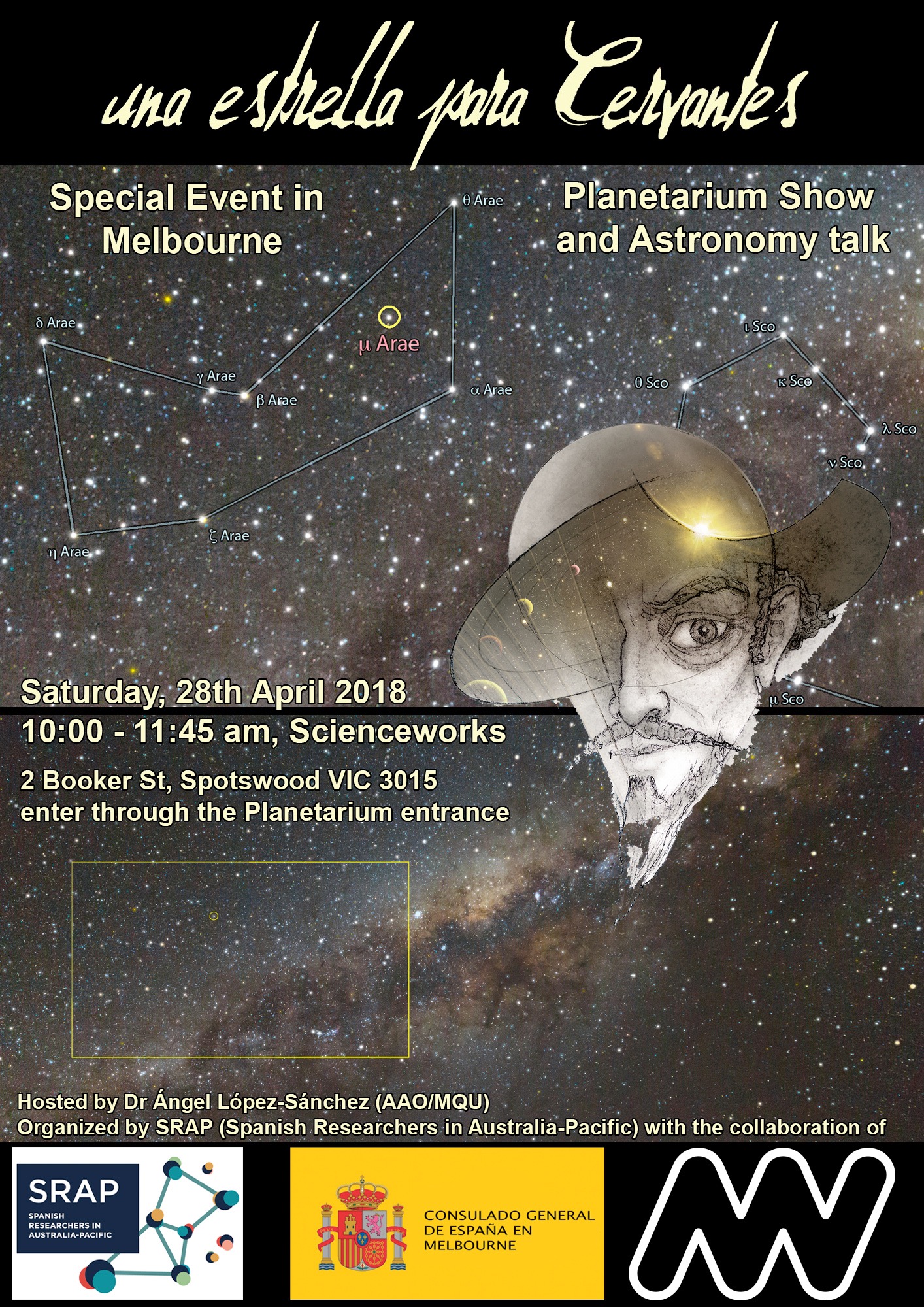
Last Saturday 28th April we had a very special event at Scienceworks (Melbourne, Victoria): a Astronomy talk and a special projection of the planetary show “Una estrella para Cervantes” (A star for Cervantes). The event was hosted by astrophysicist and science communicator Ángel R. López-Sánchez (AAO/MQU), who was in charge of giving a talk about the techniques that astronomers use for detecting planets around other stars and how they survey the sky. Our Chair, Sergio León-Saval (University of Sydney) also provided an overview of our association. The event was organized by Elena López Varela, Ángel R. López-Sánchez and Kate Bernard.
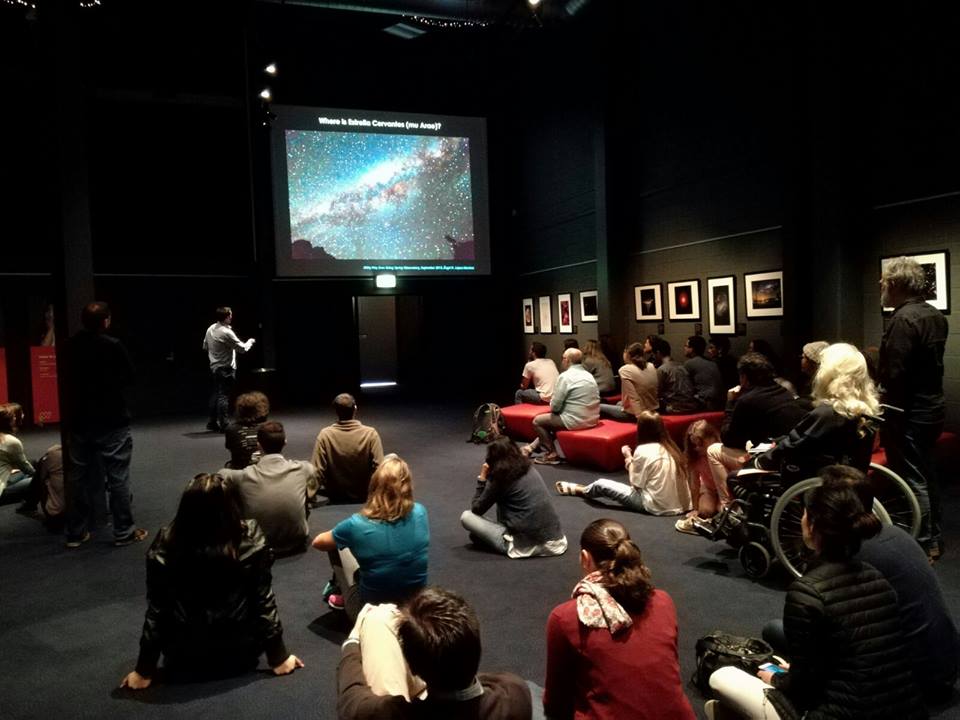
Astronomer Ángel López-Sánchez during his talk. Credit: SRAP-IEAP.
Sergio León-Saval (left) and Ángel López-Sánchez (second left) with the Kate Bernard, director of Sciencework (second right) and Elena López Varela (righe). Credit: SRAP.-IEAP
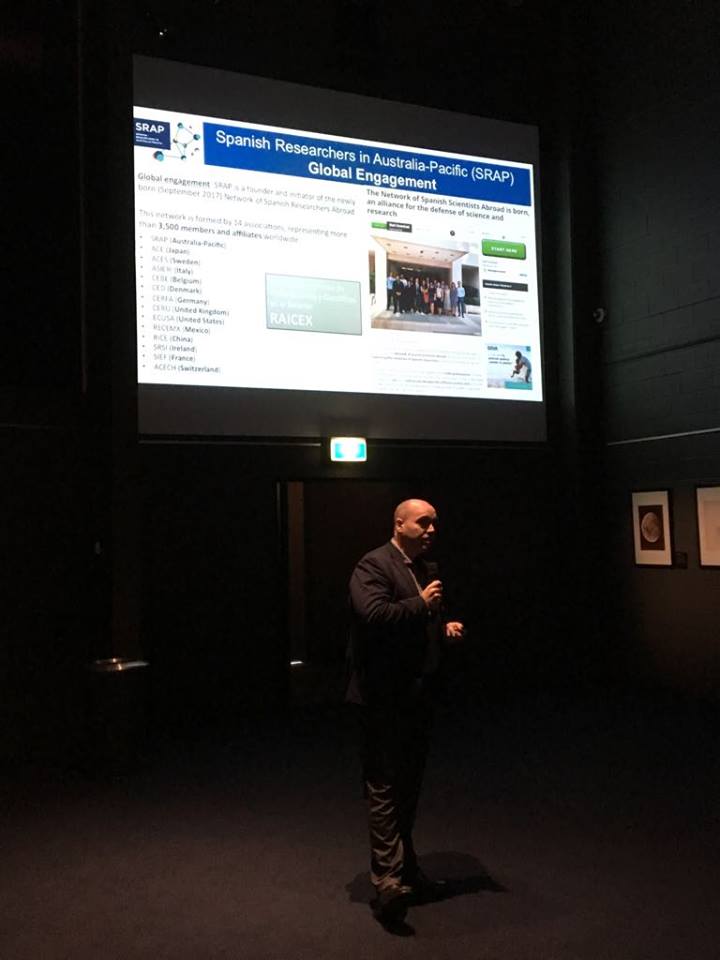
Sergio León-Saval during his talk about SRAP-IEAP. Credit: SRAP-IEAP.
We really thank the very friendly staff of Sciencework, who really helped to get this event happening, and to the support of the Consulado General de España en Melbourne. We also thank staff at the Planetarium of Pamplona, specially to Javier Armentia, for their help providing on time the high-resolution files of the movie.
As I expected the news about the Lunar Eclipse happening on the 31st of January 2018 was in the media and social media all around the world… even though in many countries (Europe, South America) the Lunar Eclipse was not visible.
In my humble opinion, many of the articles in general outlets and media were not very well written and actually very hype, which created that people were actually confused about what was happening.
Of course, I complained a lot about how the news were presented in the media. I’m a huge defender of inviting people to look at the sky (I’m continuously doing it!) but not exaggerating what people should expect to see. In this sense I’m an “old-schooler” as I really consider facts and naming things properly are important.
After having some discussions with friends in social media about all of this, I decided to create a poll in Twitter to explore this more (thanks @DarkSapiens and @vrruiz).
Furthermore, following the “noise” in Twitter, I had the feeling that young people care less about the actual name of the phenomenon than older people. That is, young people didn’t dislike naming the event as a Super Blue Blood Moon.
And that was the beginning. As a scientist I wanted to test if my hypothesis was right.
Hypothesis:At least in Twitter, as I see in my timeline, young astronomers/science communicators seem to prefer or at least are less molest with the term #SuperBlueBloodMoon than old astronomers/science communicators.
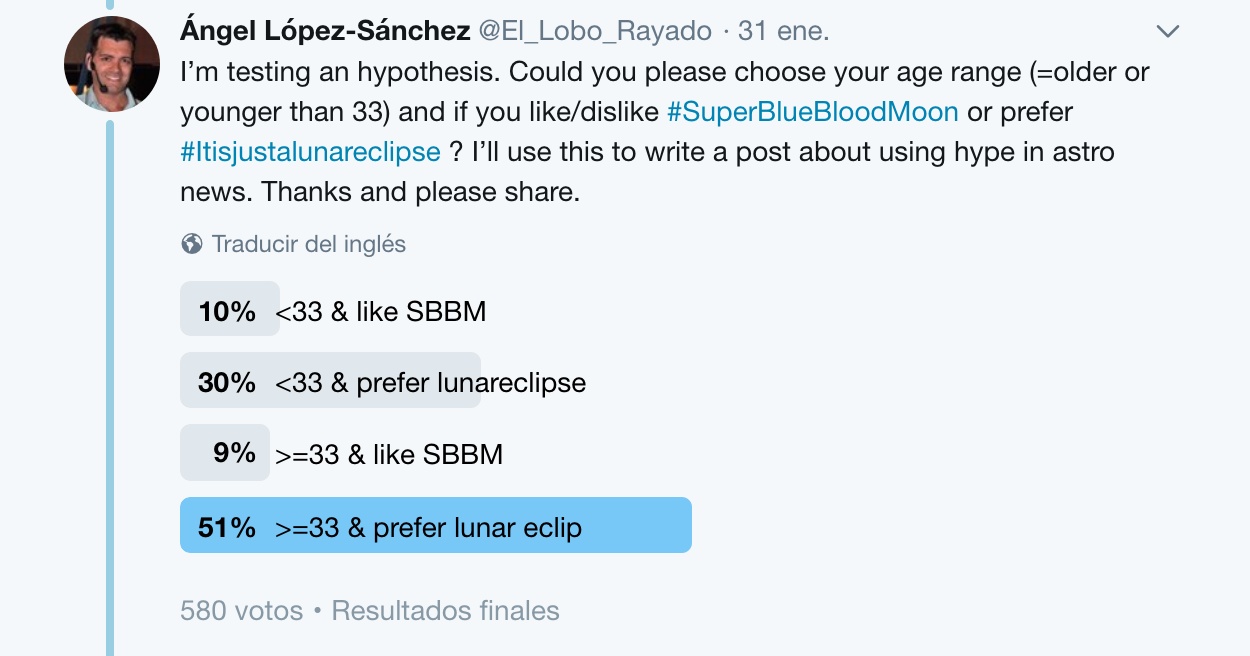
Experiment in Tweet: I’m testing an hypothesis. Could you please choose your age range (=older or younger than 33) and if you like/dislike #SuperBlueBloodMoon or prefer #Itisjustalunareclipse ? I’ll use this to write a post about using hype in astro news. Thanks and please share.
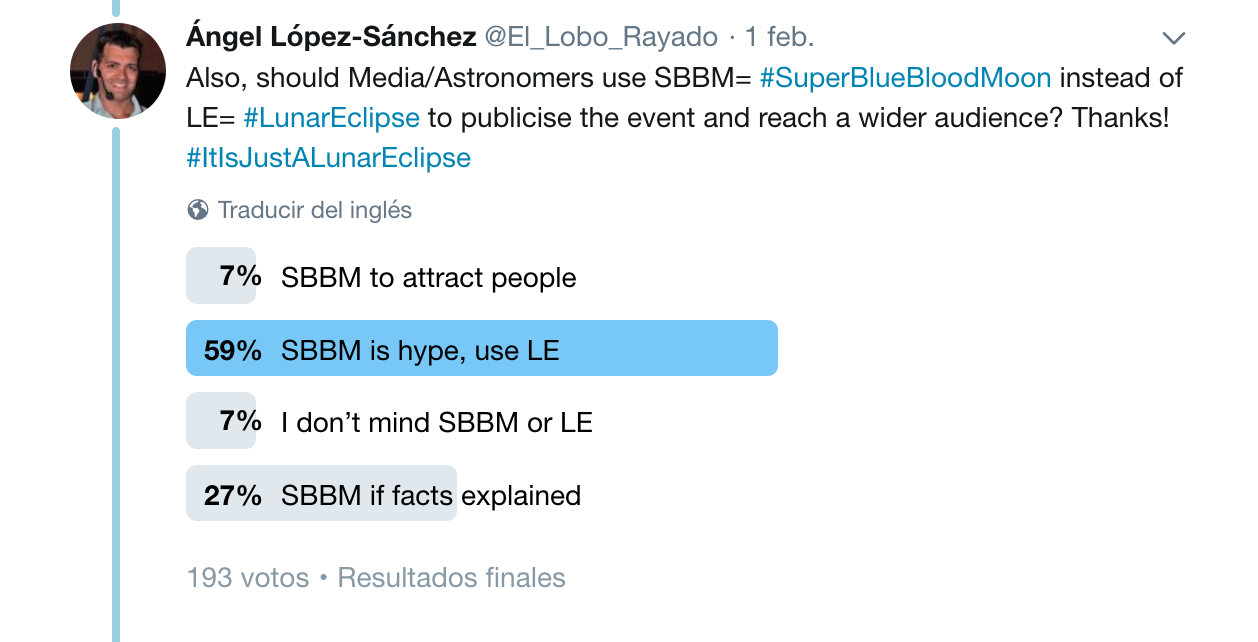
Below is the screenshot with the question and the results. Huge thanks to the 580 people who contributed in this poll (11% of my followers).
The conclusions that we can get from these results, that as I’ve said apply for my vision in Twitter, which is biased for the people who I follow or follow me, are the following.
First, the majority of my followers/people who answered this question are older than 32 years (60%). Fair enough.
Second, combined, only 19% of the answers agree with “I like SBBM”. I’m happy about this. And this was actually expected, because there should be a huge bias in the people that follow me in Twitter.
But the interesting thing for me is that, attending to these results, younger people like SBBM more than older people. The ratio between YES/NO is 25% for <33 years and only 15% for >=33 years.
Without any additional statistical analysis including uncertainties, this result seems to support my hypothesis and the reason of this experiment: young astronomers/science communicators seem to prefer or at least are less molest with the term #SuperBlueBloodMoon than old astronomers/science communicators.
The results here are also interesting. 3 people in 5 agree that using SBBM is hype (yes!). I was expecting this answer would have been around 2/3, but it is still a good proportion.
In any case, I also got some feedback about this:
27% of the answers (a bit more than 1 in 4 people) support using SBBM in the title of the news as long as the facts are explained in the text (which was rarely the case).
Very few people (7%) support using SBBM to attract people. And attending to the results provided by the experiment above, the majority of the answers are coming from young astronomers, as example my AAO colleague and friend Becky Brown:
My conclusion here: although some people think than using SBBM is a good thing to attract people to the news or observing the sky (but see next question), the majority of the people consider that SBBM is hype and should not be used, unless the facts are well explained in the text of the news.
Well, here 61% of the answers agree that “it is not that good to do that” as science/pseudoscience mix and people were confused. And indeed people were confused! During the last week I’ve been giving some virtual talks in Spain with students, and I received the question “what was the SBBM?”. They didn’t know it was a lunar eclipse, and they show some connections with astrology (!!!).
A couple of extra examples in the UK and Australia were provided as comments by two astrophysicists:
Still, 27% (more than 1 in 4) of the answers agree on using SBBM for getting the extra attention by Media (I assume that considering facts are explained, something that didn’t happen very often).
Only 12% of the answers agree that using SBBM instead of Lunar Eclipse encourage people to look the sky.
My conclusion to this question: although it might help to encourage people to look at the sky and for sure will attract the attention of the media, we should refrain to use SBBM as it confuses people at the same time that mixes science and pseudoscience.
In the last few days I’ve already answered some few emails and questions in social media about the Super Blood Blue Moon happening on the night from 31st January to 1st February 2018. What is this? Is this really important?
Short answer: No, it is not! This is just a lunar eclipse. The rest is hype to sell the story.
Visions of a Total Lunar Eclipse within clouds – 8 October 2014 – Sydney. More information and high resolution images in my Flickr. Credit: Ángel R. López-Sánchez.
Long answer: Let me use an email I wrote yesterday replying the questions asked by a journalist about this astronomical event.
1. Can you please define “super moon” “blood moon” and “blue” moon as they occur individually?
—> Supermoon: this is a term that many astronomers (me included) don’t like, as it was introduced by an astrologer (not an astronomer) but it is now very popular. It is just the moment the full moon is happening near the perigee (the Moon in its closest point to Earth). But, that is the important thing, the difference in size of a “supermoon” with respect an average moon is that a supermoon is ~5-6% larger than the average moon. That is almost nothing!!! Many people are confused with the “14% difference” between the supermoon and the micromoon (when the moon is near the apogee, the farthest point to the Earth).
I insist: it is VERY difficult for our naked eye to distinguish a supermoon from an “average” moon.
—> Blood moon: If we astronomers don’t like the term “supermoon”, we really hate the name of “blood moon”. This is just a lunar eclipse!!
—> Blue moon: the now “standard” definition of a blue moon is when a second full moon is happening within the same calendar month. That is, it was full moon on Jan 2nd, the second full moon this month in Jan 31st is a blue moon.
HOWEVER, strictly talking THIS IS NOT TRUE FOR EASTERN AUSTRALIA (NSW, Tasmania, Victoria) and New Zealand, as the moment of the full moon is actually at 00:26am Feb 1st (Sydney/Melbourne time). It is true for Queensland (at 11:26pm Jan 31st), Alice Spring (at 10:56pm Jan 31st) and Perth (9:56pm Jan 31st).
In any case, the ONLY IMPORTANT real astronomical event is that this is a lunar eclipse (the rest is added to create some hype).
2. Is this the first time a super blue blood moon has occurred in 150 years?
Probably not, I don’t know, we actually don’t care about this much… It is just a lunar eclipse!!!!
3. How significant is this lunar event?
As I said, it is just a lunar eclipse. That is the point. The rest is added.
4. We are in north-west Victoria. What can people expect to see?
It does not matter where you are in Australia (or in the world, as long as it is night) to see this event. The only differences will be the local weather conditions… if the weather is good, you’ll see a very nice lunar eclipse. It is a perfect opportunity to enjoy the sky!!
5. Are there any tips to getting the best view of the eclipse, or what would be the best times to see it?
The best moment to see the eclipse is when the moon is completely covered by the Earth’s shadow. This happens between 11:52pm and 1:08pm, with the maximum eclipse at 12:30am. You’ll see a red-orange moon in the sky, pretty spectacular.
Addendum 31st Jan: I’ve been using the hashtag #itisjustalunareclipse in social media to say that, at the end… it is just a lunar eclipse!
Full AAO Media Release, published at 01:00am Sydney time, 17 October 2017, that I coordinated.
For the first time, astronomers have observed the afterglow of an event that was also detected in gravitational waves. The object, dubbed AT2017gfo, was a pair of in-spiralling neutron stars in a galaxy 130 million light years away. The death spiral was detected in gravitational waves, and the resulting explosion was followed by over 50 observatories world wide, including the AAO and other observatories here in Australia.
On August 17, the Advanced Laser Interferometer Gravitational-Wave Observatory (LIGO), based in the United States, detected a new gravitational wave event, called GW170817.
GW170817 is the fifth source of gravitational waves ever recorded. The first one was discovered in September 2015, for which three founding members of the LIGO collaboration were awarded the 2017 Nobel Prize in Physics.
The GW170817 data are consistent with the merging of two neutron stars and are unlike the four previous events, which were merging black holes.
Artist’s illustration of two merging neutron stars. The narrow beams represent the gamma-ray burst while the rippling space-time grid indicates the gravitational waves that characterize the merger. Swirling clouds of material ejected from the merging stars are a possible source of the light that was seen at lower energies. Credit: National Science Foundation/LIGO/Sonoma State University/A. Simonnet.
The Advanced-Virgo interferometer, based in Italy, was online at the time of the discovery and contributed to the localization of the new gravitational wave burst.
Based on information from LIGO and VIRGO, numerous telescopes immediately sprang into action to determine if an electromagnetic counterpart to the gravitational waves could be detected.
Meanwhile, NASA’s Fermi satellite independently reported a short burst of gamma-rays within 2 seconds of the merger event associated with GW170817, consistent with the area of sky from which LIGO and VIRGO detected their gravitational waves.
This gamma-ray detection at the same time and place triggered even greater interest from the astronomical community and resulted in more intense follow up observations in optical, infrared and radio wavelengths.
A team of scientists within the Dark Energy Survey (DES) collaboration, which includes researchers from the Australian Astronomical Observatory and other Australian institutions, working with astronomers at the Harvard-Smithsonian Center for Astrophysics (CfA) in the U.S., were among the first astronomers to observe the electromagnetic counterpart of GW170817 in optical wavelengths.
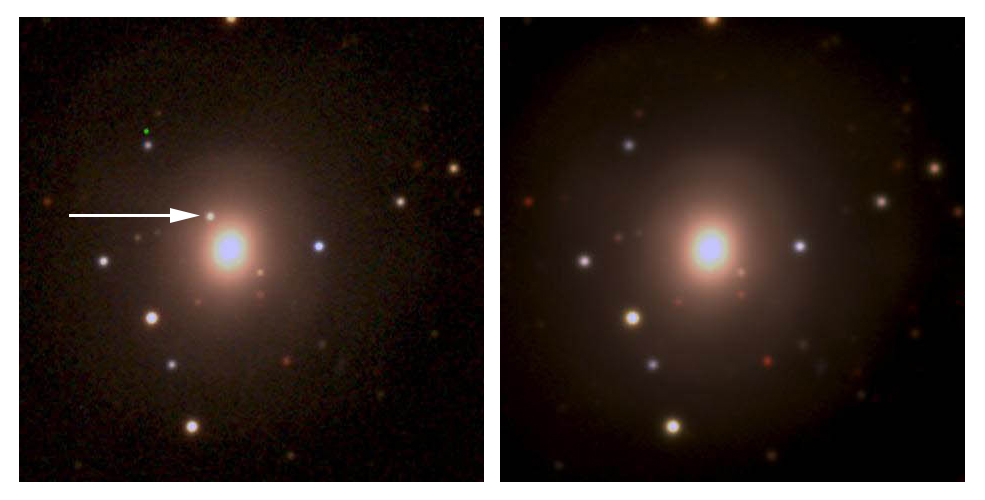
Using the 570-megapixel Dark Energy Camera (DECam) mounted at the 4m Blanco Telescope at Cerro Tololo Inter-American Observatory in Chile, DES identified the kilonova AT2017gfo in the nearby galaxy NGC 4993, located only 130 million light years from us, as the optical counterpart of GW170817.
Composite of detection images, including the discovery z image taken on August 18th and the g and r images taken 1 day later. Right: The same area two weeks later. Credit: Soares-Santos et al. and DES Collaboration.
“Because of its large field of view, the Dark Energy Camera was able to search almost the entire region where LIGO/VIRGO expected the gravitational wave source to be, and its exquisite sensitivity allowed us to make detailed measurements of the kilonova – the extremely energetic outburst created by the merging neutron stars,” AAO Instrument Scientist and DES Collaboration member Dr Kyler Kuehn stated.
A kilonova is similar to a supernova in some aspects, but it is different in others. It occurs when two neutron stars crash into each other. These events are thought to be the mechanism by which many of the elements heavier than iron, such as gold, are formed.
“But as impressive as it is, the Dark Energy Camera is only one of many instruments with a front row seat to this celestial spectacle. A lot of effort has gone into preparing dozens of telescopes around the world to search for electromagnetic counterparts to gravitational waves”, Dr Kuehn added.
Simultaneously to the DES study, a large group of Australian astronomers obtained follow up observations of the kilonova AT2017gfo at optical, infrared and radio wavelengths, using 14 Australian telescopes as part of the ARC Centre of Excellence for Gravitational Wave Discovery (OzGrav) and other Australian programs.
Their data are consistent with the expected outburst and subsequent merger of two neutron stars, in agreement with the results derived for GW170817 by the LIGO/Virgo collaboration.
“Before this event, it was like we were sitting in an IMAX theatre with blindfolds on. The gravitational wave detectors let us ‘hear’ the movies of black hole collisions, but we couldn’t see anything. This event lifted the blindfolds and, wow, what an amazing show!!”, A/Professor Jeff Cooke, astronomer at Swinburne University who led many of the observations said.
The Australia team also conducted observations at the 3.9m Anglo-Australian Telescope (AAT), that is managed by the Australian Astronomical Observatory (AAO). Additional archive data from the 6dF survey obtained at the AAO’s 1.2m UK Schmidt Telescope were also used.
“The observations undertaken at the AAT place important constraints on the nature of the environment in which the kilonova occurred”, AAO astronomer Dr Chris Lidman said.
The follow up observations were not scheduled, but the excitement that this event generated in the astronomical community was so large that regular programs were placed on hold.
“Many astronomers dropped any other planned observation and used all the available resources to study this rare event”, said PhD candidate Igor Andreoni (Swinburne University and Australian Astronomical Observatory), first author of the scientific paper that will be published in the science journal “Publications of the Astronomical Society of Australia” (PASA).
The study also reveals that the host galaxy has not experienced significant star-formation during the last billion years. However, there is some evidence that indicates that NGC 4993 experienced a collision with a smaller galaxy not long time ago.
The position of the kilonova AT2017gfo, found in the external parts of NGC 4993, may suggest that the binary neutron star could have been part of the smaller galaxy.
Australian astronomers were thrilled to contribute to both the detection and the ongoing observations of the kilonova AT2017gfo, the electromagnetic counterpart to the gravitational wave event GW170817.
“We have been waiting and preparing for an event like this, but didn’t think it would happen so soon and in a galaxy that is so near to us. Once we were alerted of the gravitational wave detection, we immediately contacted a dozen telescopes and joined the worldwide effort to study this historic event. It didn’t let us down!”, A/Professor Jeff Cooke said.
“It was crucial to have telescopes placed in every continent, including Australia, to keep this rare event continuously monitored”, PhD candidate Igor Andreoni said.
“To me, this gravitational + electromagnetic wave combined detection is even more important than the initial detection that resulted in the Nobel Prize. This has changed the way the entire astronomical community operates”, AAO Instrument Scientist Dr Kyler Kuehn stated.
The first identification of the electromagnetic counterpart to a gravitational wave event is a milestone in the history of modern Astronomy, and opens a new era of multi-messenger astronomy.
The AAO organized and/or participated in 7 events during Australia’s National Science Week in August 2017, including the very successful and sold-out events “Star Tales of Winter Nights” and “Stargazing in the Park”.
Astronomers at the AAO’s “Star Tales of Winter Nights” event at the Powerhouse Museum during National Science Week 2017. From left to right: Adam Schaefer, Dr Devika Kotachery, Dr. Ángel López-Sánchez (MC), Carlos Bacigalupo and Rebecca Brown. Credit: Ángel López-Sánchez.
The event “Star Tales of Winter Nights”, hosted at Sydney’s Powerhouse Museum had a very similar structure than our ViVID Sydney Ideas events: 5 astronomers talking about science and later answering questions from the audience. The speakers were Rebecca Brown, Adam Schaefer, Dr Devika Kotachery, Carlos Bacigalupo and myself. This event was another big success for the AAO.
Setting up the telescopes for AAO’s “Stargazing in the Park” in Sydney’s Centennial Park. Credit: Ángel R. López-Sánchez.
AAO’s Ángel López-Sánchez, Stuart Ryder and Duncan Wright (from left to right) ready for “Stargazing in the Park” in Sydney’s Centennial Park. Credit: Ángel R. López-Sánchez.
On the other hand, the “Stargazing in the Park” in Sydney’s Centennial Park was another sold-out event, with more than 120 people enjoying first a short lecture about the AAO and introduction to stargazing and later looking at the sky through the telescopes.
AAO’s Stuart Ryder attending visitors at the AAO desk during the “Science and Tech” expo at Chatswood Library on Saturday 12th August. Credit: Ángel López-Sánchez.
During National Science Week 20017 the AAO also participated in two of the events organized by the recently created “North Sydney Science Hub” . First on Saturday 12th August in the “Science and Tech” expo at Chatswood Library, and later in the Public Discussion “Big Data And Visual Analytics – What is it good for?”, on Thursday 17th August, also at Chatswood Library, being myself one of the panelists of the discussion.
Panel for the Public Discussion “Big Data And Visual Analytics – What is it good for?”, on Thursday 17th August, also at Chatswood Library. From left to right: Mark Ballico (NMI), Tomasz Bednarz (Data61 and UNSW Art & Design), Angela (CSIRO) and Ángel R. López-Sánchez (AAO.MQU). Credit: Ángel R. López-Sánchez.













 A/Prof. Ángel R. López-Sánchez