
This is the English adaptation of the article I published in Diario Córdoba newsletter last Sunday, 15th December 2019, which I have also compiled in my personal blog in the Naukas science communication network. It has some references to the situation of the light pollution in Spain but unfortunately this also applies to the majority of the countries of the developed world.
A couple of weeks ago my six-year-old son had to make his first speech in front of his classmates. It is a very common practice in Australia and in other English countries: from a very young age students are encouraged to briefly and concisely discuss their thoughts regarding a particular topic in public. My son chose the topic “how can we care about the environment?”, that we developed together (obviously, you can’t ask to a six-year-old child to do something like this on his own the very first time). He rehearsed during days. In his speech my son wanted to emphasize “the 3 Rs“: “reduce, reuse and recycle.” It was evident that at some point during the course they had talked about it in class, and certainly sometimes during this year he had returned from school asking for “containers and cartons to reuse them in toys or ornaments”. Ecological and environmental awareness does exist in our society, and it is indeed encouraging to see young people very committed to that. But is it enough?

Brainstorming session compiling key topics to prepare my child’s speech “What can we do to take care of the environment?”
The environmental issues are widely complex and touch on social, economic, political, scientific and even religious aspects. The World Climate Summit that has been held in Madrid these weeks demonstrates the complicated interrelationship of interests that exist when we try to really take care of our planet. Many people think that they are doing something useful but at the end of the day these are just patches to clear their conscience about their lack of actions to attack the real problem. Now, during Christmas, we all live another example of these contradictions.
Christmas has always been my favorite time of the year. As a child I waited excitedly for the gifts of the Three Wise Kings on January 6th (that is the real moment kids get their Christmas presents in Spain, as the tradition is that they are brought by the Three Wise Kings, we imported Papá Noel – Santa Clauss just recently). This day was always a great party in our house, with lots of papers and boxes to be unwrapped. Despite living now in another continent, with a slightly different culture, I try to maintain this tradition and the illusion of Christmas for my son, like so many people sure does around the world. But this year the confluence of many factors (the World Climate Summit, the rise of climate change deniers, the disastrous fires that are plaguing Australia and making Sydney the most polluted city in the world on Tuesday Dec 10th, my outrage at others environmental factors that are not taken seriously, and my son’s speech) have made me rethink everything. How much garbage do we generate in a few days? Where is this consumer society taking us?
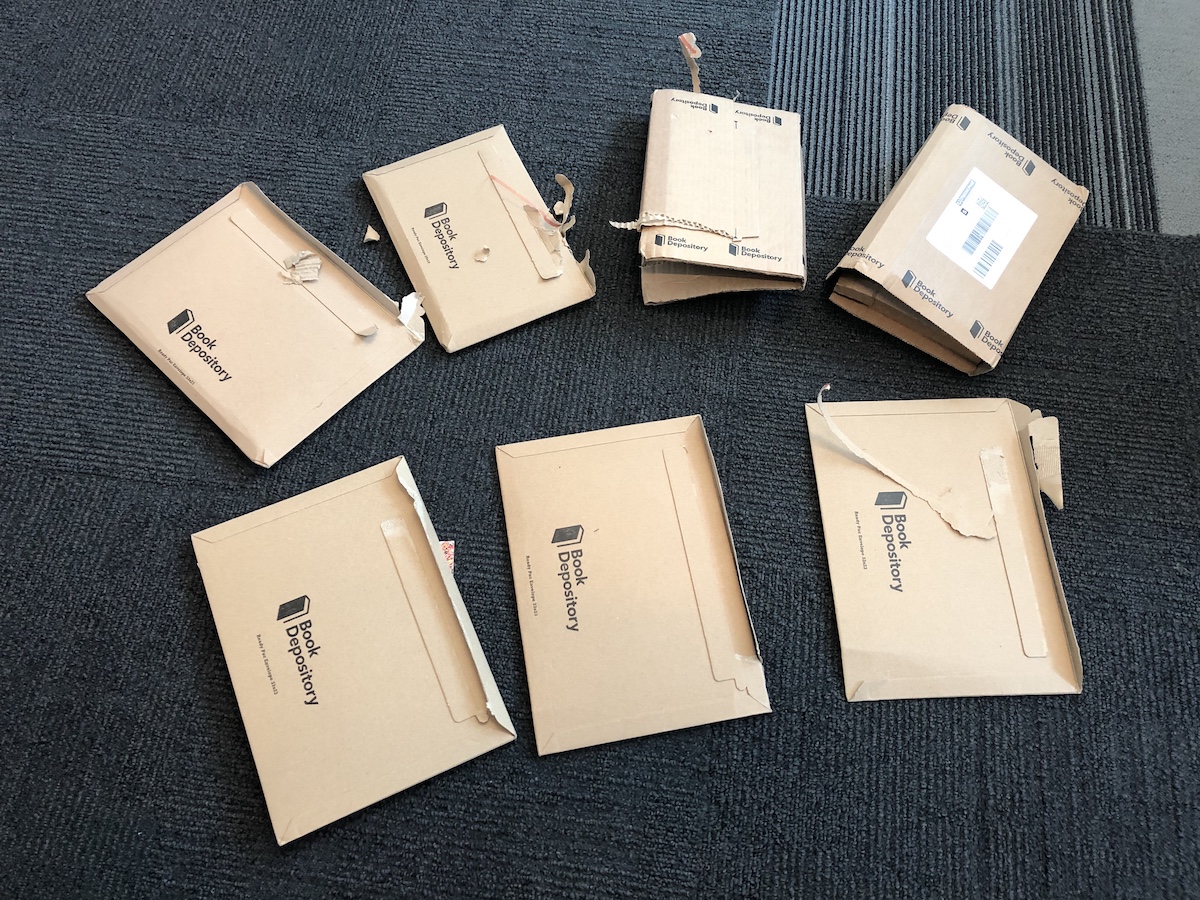
As I couldn’t travel to Spain in 2019 I bought online several books and notebooks in Spanish for Christmas. I placed the entire order together but each book or notebook (the three packages at the bottom are thin homework notebooks in Spanish for my son, all of the same course) has come in an individual cardboard box and with a lot of extra, unwanted advertising and papers inside ? How much extra crap are we generating? By the way, 3 more packages that had not yet arrived are missing in the photo.
Indeed, Christmas has become a time of waste. You have to buy more and more things, frantically decorating houses and cities, attending large banquets (business, family, friends) in a few days. What used to be a short period of one or two weeks has now extended over two months. The shopping centers are decorated before Halloween. And the “Black Friday” is now a common practice worldwide, with people buying plenty of things online that they don’t need (and that will delivered to their homes by workers who usually are in precarious working conditions, in a cardboard box that includes plenty of unwanted publicity and other papers). Here it is the first “R” my son pointed out: we must reduce the huge amount of waste that we create.
Of course, for years now many scientists including me have been pointing out that there is an increasing huge waste of resources (of money) in Christmas lighting. Light pollution is growing and, sponsored by the rise of LEDs, more and more Christmas lights are installed every year in our cities. I am the first one to enjoy a beautiful holiday lighting and I know that it attracts people to the streets for Christmas shopping, but aren’t they too much now?
During the last months we have seen some politicians of Spanish major cities boasting about “my Christmas lighting is the best”. The facilities began to be installed in September, with millions of LEDs everywhere. It has been estimated that about 10% of the annual electricity bill of a large city in Spain is going into Christmas lighting. Apart from the most correct use that money could be given, this means a great contribution of greenhouse gases to the atmosphere. And it is more: the scientific studies are demonstrating that LEDs (which are replacing the low-pressure sodium lights, the most energy efficient and the least polluting of lights) are substantially impacting the fauna, flora and ourselves. An increasing of cancers are being detected in places with excessive lighting. Blue light (the dominant one in most LEDs that are being installed in cities around the world) inhibits the creation of melatonin, which is the hormone that controls our sleep and circadian rhythm. Light pollution is another major environmental problem, perhaps not publicly known as other types of pollution, but that must be taken into account and mitigated with appropriate laws and regulations. On this point it is interesting to note that the Spanish Network of Studies of Light Pollution has requested this month the total paralysis and reconstruction of the Royal Decree in which the Regulation of energy efficiency of outdoor lighting installations is approved, as it contains fundamental errors and the complete absence of scientific criteria in its elaboration.
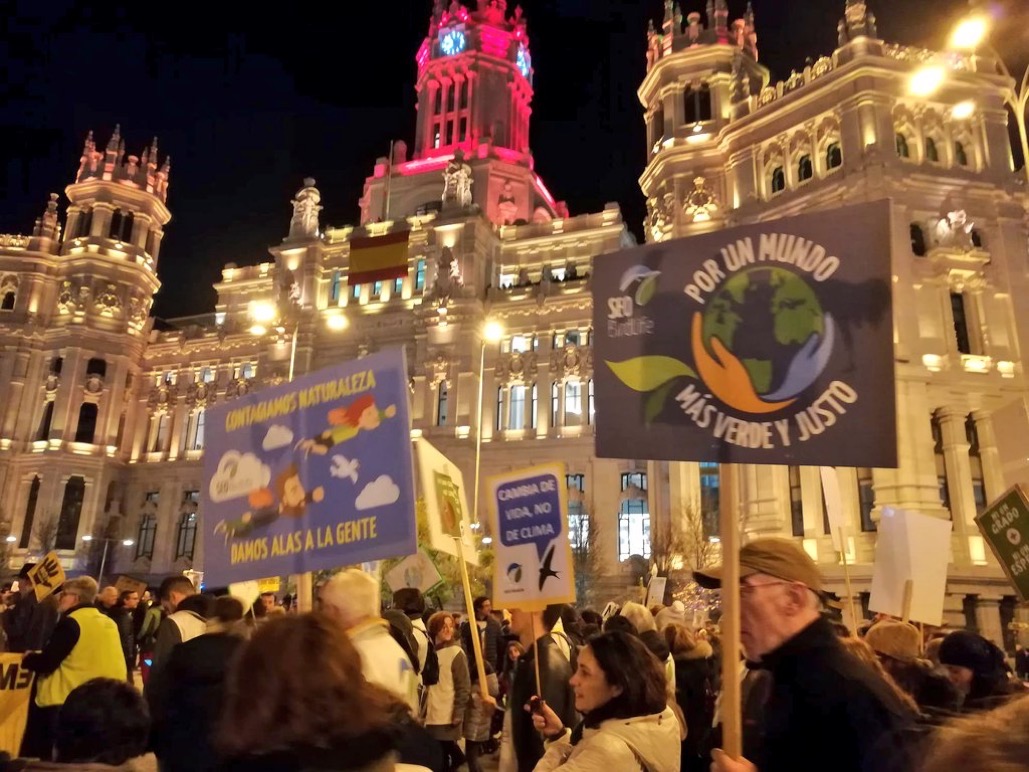
Protesters in Madrid during the UN Climate Summit COP 25, on Friday, December 6, 2019, with the contrast of the exaggerated lighting of Madrid’s buildings, even more for Christmas. I have not found the credit of the image, a thousand apologies to the author, although I asked on Twitter and tried.
As a scientist I don’t believe in climate change. I don’t believe in it because the verb to believe means “to have something for sure without knowing it directly or without it being proven or proven” (definition of the “Real Academia Española”, the “Royal Spanish Academy”). As a scientist who has read and contrasted the observations and studies that have been done on the effect of the emission of greenhouse gases in the Earth’s atmosphere by burning fossil fuels in human activities during the past 200 years, I do have the absolute knowledge that climate change is real. Scientists have been warning the society for decades, and we have clearly known that global warming is not due to external factors, such as changing the brightness of the Sun, the Earth’s orbit, or even the movement of the Sun around the Milky Way. Global warming and its consequences, climate change, is undoubtedly the product of human activity.

Comparison of solar irradiance on the Earth (yellow) with the average temperature of the planet (in red) since 1880. The thick lines show the average in periods of 11 years. Variations (maximum 0.15%) of the total irradiance of the Sun on Earth show the small oscillations of 11 years due to the solar cycle. The change in the brightness of the Sun does not explain the increase of around 1 degree Celsius of the average temperature of the Earth’s atmosphere from the beginning of the 20th Century to the present. Credit: NASA.
Our society is not environmentally sustainable. Crossed interests and our own daily habits make extremely difficult to solve the environmental problems. Maybe first we all have to become aware of them. During the World Climate Summit in Madrid the last weeks some absurd things have been proposed (such as removing the emoji of plastic bottles of non-reusable cups with plastic straws), interesting ideas have been discussed (such as green bus stops, investigations of bacteria that consume carbon dioxide, the most common greenhouse gas, or ecological bags) and very contradictory images have been seen (such as the large mass demonstration of young people with banners for a green and sustainable world in a Madrid absolutely overflowed with lights, and not just Christmas lights).
But the only way to really deal with the problem is to change our energy model. We must really invest in renewable energy (especially solar) and also in nuclear energy (which has been scientifically proven safe) and ban coal, gas, petrol and oil. Some politicians and governments (Germany, New Zealand) are taking the problem of climate change seriously and are proposing good measures. Other countries like Spain are there there. And some countries including the United States and Australia try to ignore it.
We are not going to destroy the Earth. Climate change affects us as a global civilization, but not the planet itself. Certainly, we are killing the Earth’s enormous biodiversity, but we, the human beings, will be the most affected because of climate change, with hundreds of millions, perhaps billions, of people who will have to escape from their homes, becoming refugees elsewhere. Wars will happen, water will be a luxury product, and our descendants will look at us without believing that we had in our hands to stop this madness and we did nothing to stop it.
There are many important problems in the world, and many others local problems that seem to be important but they may not be. But, with total certainty, the most important challenge that Humanity is currently facing is stopping, and I’m not saying inverting, global warming. Only the combination of the personal effort of every citizen by changing our exaggerated consumption habits and the institutional effort strongly promoting a change in the energy model of our societies can achieve this.

The Earth seen by Apollo 17 in the last crewed mission to the Moon. The photo was taken 5 hours after takeoff, on December 7, 1972. This image is known as “The Blue Marble” (Credit: NASA / Apollo 17).
I conclude with the same reflections that my six-year-old son left at the end of his speech. “No other planet in the Solar System, not even Mars, and none of the more than 4000 planets that astronomers have discovered around other stars are like Earth. We have to take care of our home world. It is the only Earth we will ever know. ”






 A/Prof. Ángel R. López-Sánchez