Category Archives: Personal

Eclipse of the body

This is the translation and adaptation to English of my article “Eclipse de cuerpo“, originally published on Sunday, 21st Oct 2018 in the Supplement “El Zoco” of  the newspaper Diario Córdoba. This article summarizes my experience after being diagnosed by the Guillain-Barré Syndrome. I’m still recovering from this, as plenty of rehabilitation and gym are needed. So you are still wandering why I have not answered your email… well, that it is! Thanks a lot for all your support during these hard times.

During the second week of July I was in my natal city, Córdoba (Spain), giving talks at the University of Cordoba within the activities of its Foro Único (which I have the privilege of being part of since its creation) together with the Scientific Culture Unit of the University of Córdoba (“Unidad de Cultura Científica de la Universidad de Córdoba“) and the Astronomical Association of Córdoba. At the same time, I was finishing preparing my contributions (including an invited talk in a plenary session) for the Astronomy Conference and Science Meeting organized every two years by the Spanish Society of Astronomy (“Sociedad Española de Astronomía”) and held in Salamanca (Spain) the following week . These activities promoted not only the dissemination of my scientific work but also the need to inform society about the astronomical discoveries we as researchers are doing.

Without expecting it, and in just four days, from lectures, nice walks, talks, “tapas” and meetings with collaborators, scientists, astronomers and friends in Córdoba, I had to be admitted to the Intense Care Unit (ICU) of the Reina Sofía University Hospital with an induced coma and with the body paralyzed almost entirely. I had been affected by the Guillain-Barré syndrome.

This ill-fated and terrible neurological disease, of which some details are still unknown as to why exactly it does occur, is an autoimmune disorder in which the antibodies generated to attack a virus also attack the nervous system. Consequently the nerves can not send the signals effectively and the muscles lose their ability to respond. This leads to the paralysis of legs, arms, hands and feet, the inability to have sensations such as pain, cold or heat, and even the paralysis of the digestive, excretory and respiratory systems. Although Guillain-Barré syndrome only occurs in 1-2 cases per 100 thousand people per year, its death rate is around 7.5%, usually as a result of respiratory failure induced by paralysis.

Fortunately I was in Córdoba, where one of the best hospitals in Spain (and I would add of Europe or even the whole world) is located. The professionals at the Hospital Universitario de Reina Sofía not only diagnosed the disease quickly, but they did an exhaustive follow-up of everything that was happening to me. The treatment (plasmapheresis, that is, “filtering” the blood to extract the plasma, leaving only the red blood cells, white blood cells and platelets, which did return to the body), the speed of taking me to the ICU to intubate, feed me and make me eliminate my waste, and the rehabilitation from day zero were key to recovery.
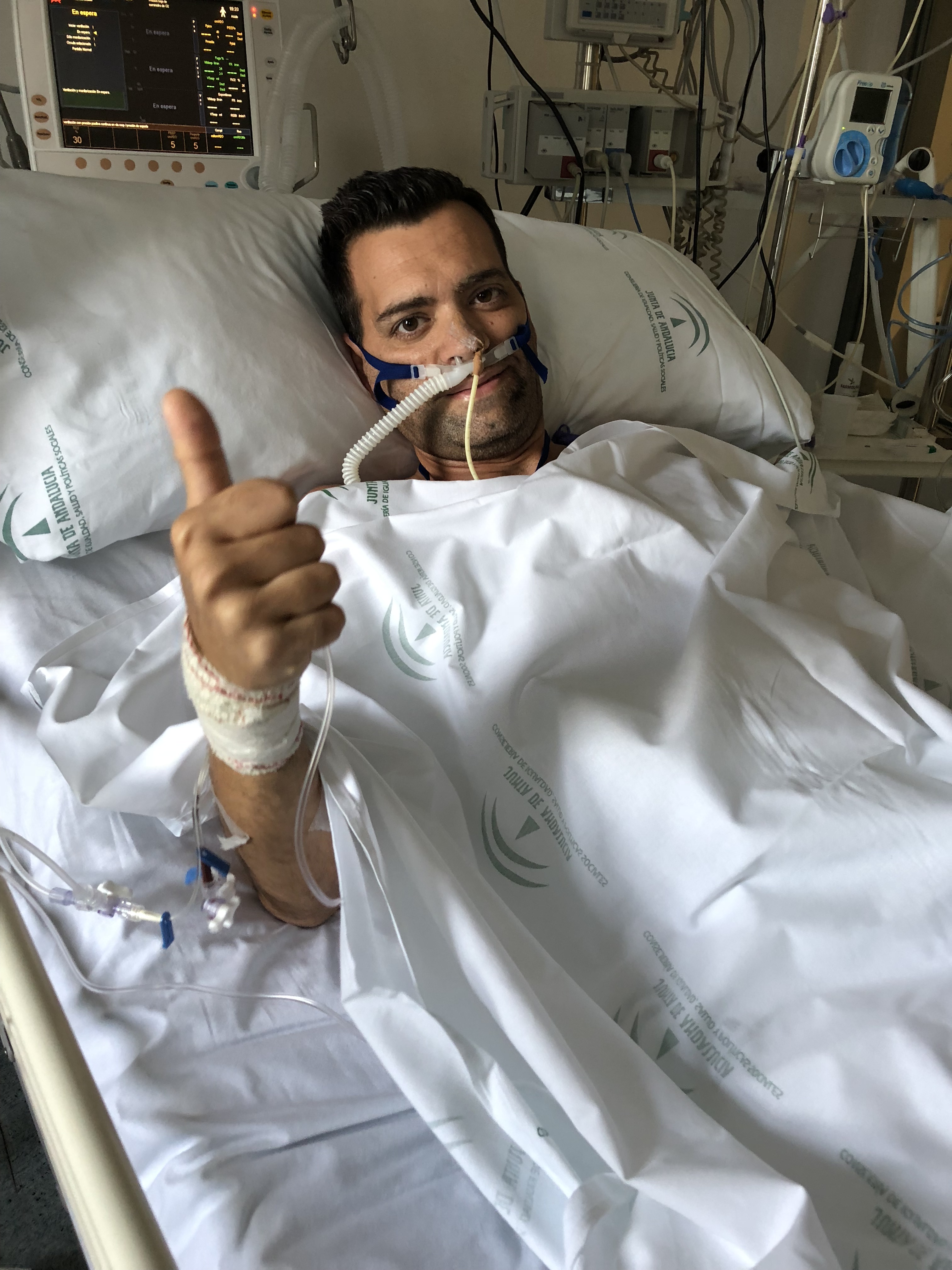
Me at the UCI at Hospital Universitario Reina Sofía on 3rd August 2018, just after the doctors removed the breathing tube.

Me at the UCI at Hospital Universitario Reina Sofía on 3rd August 2018, just after the doctors removed the breathing tube.

In 10 days I was able to breathe again for myself and talk (I do not recommend being fully conscious and not being able to communicate). In 3 weeks I was able to use my mobile phone again, write and feed myself. In just a month and a half I was able to walk again, with help. A month ago, on Sep 19th, at the insistence of the Australian insurance (as I do not quote in the Spanish social security all the hospital expenses were charged to my Australian travel insurance), I returned to Sydney. Three months later I start to see it as a bad dream, I have returned to work and I have a relatively normal life, only that I still have a lot of muscle to recover (I lost almost 15 kilos of weight) and I still get fatigued more than usual, I still need to work part-time and do plenty of rehab every day. In 6 months, I hope to be finally fully recovered.

In total I spent 19 days (three of them unconscious) in the ICU of Reina Sofía and another two weeks more in plant, plus one month going daily to rehabilitation, where day by day the team of doctors, nurses, physiotherapists, assistants, caretakers and others showed excellent treatment both professionally and personally.

Me with some of the doctors, nurses, and specialists at Hospital Universitario Reina Sofía who helped me to recover so fast! This was taken on 6th September 2018, when I was starting to walk a bit (the walking frame I was still using by then is not seen in the photo).

That’s why my first Astronomy article this season, and the first science or outreach article I write after returning to work this third week of October (three months after the start of the illness) is dedicated to the exceptional staff of Reina Sofía. I do not want to give a long list of names for fear of leaving many people behind, but I insist that I do not have enough words of thanks to each and every one of them. It is something that should make us feel very proud to Cordoba, and we should support at all times to continue to make the impressive medical and research work that takes place at the Hospital Universitario de Reina Sofía.

It happened that, being in the phase of improvement at the end of July but still in the ICU, there was a total lunar eclipse visible from Europe and Asia. This lunar eclipse in the middle of summer delighted amateur astronomers and the general public, who enjoyed this beautiful celestial spectacle that does not need a telescope to be observed. A total lunar eclipse  occurs when our satellite enters into the shadow of the Earth. The phantom color between orange, red and black that the Moon acquires is a consequence of the light refracted by the Earth’s atmosphere. The poets can say that we are seeing all the sunsets and sunrises that are happening on Earth at that moment. From Spain the total phase occurred shortly after the departure of the full moon over the eastern horizon, which left beautiful prints of our red satellite next to monuments or mountains. It also proliferated through social networks multitude of “fake photographs” made as assemblies (I was shown one of the Roman Bridge in Córdoba with a full moon eclipsed so big that to have been real our satellite should be 20 or 30 times closer to Earth than it actually is!) .

Total Lunar Eclipse on 27th July 2018 seen from Córdoba, Spain. Credit: Paco Bellido.

Here I compile the wonderful shots that the astrophotographer Paco Bellido took from Córdoba showing the moon completely eclipsed (below left) and two shots of the eclipse when the moon was leaving the Earth’s shadow.

This lunar eclipse occurred on July 27 and I missed it (unfortunately, the window of my ICU room did not have the correct orientation). But for this I had suffered an eclipse of the body myself!

Historic ESO-Australia agreement

This is BIG. Australian astronomers have tried for almost 2 decades to be part of the European Southern Observatory (ESO). Yesterday, 11th July 2017, at a ceremony happening during the Annual Meeting of the Astronomical Society of Australia (ASA) in Canberra, Australia, ESO’s Director General, Tim de Zeeuw, and the Australian Minister for Industry, Innovation and Science, Arthur Sinodinos, signed a 10 years Strategic Partnership between Australia and ESO.

Image composition showing all the ESO observatories and the Headquarters. Credit: ESO/M. Kornmesser.

Following the ESO-Australia Strategic Agreement, Australian astronomers (including me!) will have access to telescope time at La Silla and Paranal Observatories in Chile. The ESO-Australia Strategic Agreement also provides crucial opportunities for Australian influence and technical and scientific input, stimulating international research and industry collaborations.

This is particularly important for the Australian Astronomical Observatory (AAO), as we are developing key instrumentation for ESO (as the ESOP positioner for the VISTA telescope), and that was a key part of the deal, with new opportunities to develop further telescope instrumentation in the nearby future. That also means an important re-arrangement within the AAO, which details are still unknown, but in which we’ll give our best.

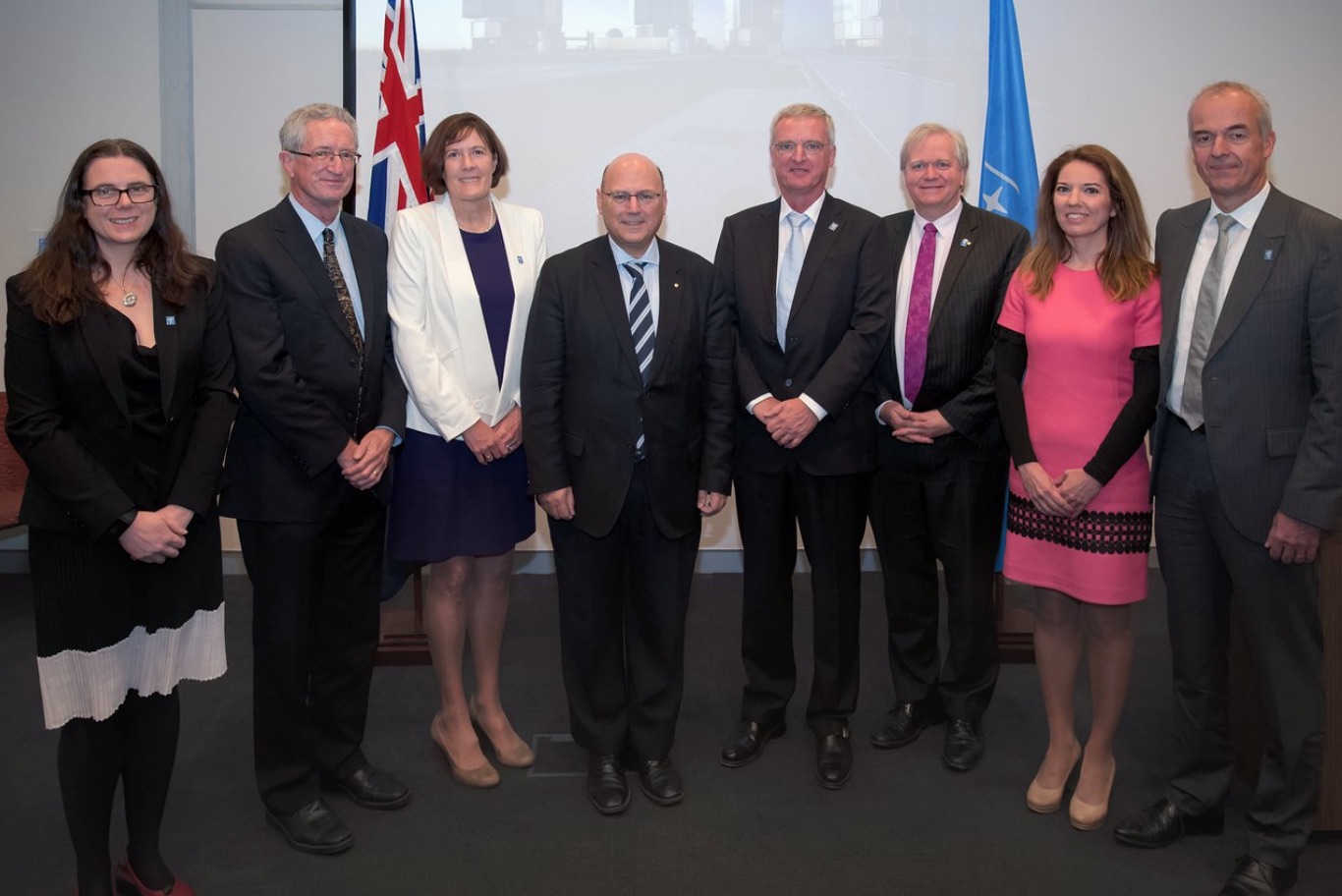
At a ceremony in Canberra, Australia, on 11 July 2017, an arrangement was signed to begin a ten-year strategic partnership between ESO and Australia. The partnership will further strengthen ESO’s programme, both scientifically and technically, and will give Australian astronomers and industry access to the La Silla Paranal Observatory. It may also be the first step towards Australia becoming an ESO Member State.
This picture shows all the signatories of the arrangement. From left to right: Virginia Kilborn, President of the Astronomical Society of Australia, Warrick Couch, Director of the Australian Astronomical Observatory, Sue Weston, Deputy Secretary, Department of Industry, Innovation and Science, Senator the Hon Arthur Sinodinos, Minister for Industry, Innovation and Science, Tim de Zeeuw, ESO Director General, Brian Schmidt, Vice Chancellor of the Australian National University, Laura Comendador, Head of the ESO Cabinet and Patrick Geeraert, ESO Director of Administration. Credit: Australian Government.

The Australian Government will invest $129 million over 10 years in the partnership, including the $26.1 million already announced for 2017-2018 Australian Budget. This may also be the first step towards Australia becoming an ESO Member State.

Exciting times await!

More details:

My son and the “Story of the Planets”

I spend a lot of time with my son, Luke. He turned 3 last January and, after the terrible “terrible twos” phase he is a very different and charming little person now. He has been always obsessed with letters and numbers. Indeed he does not only know his ABC’s in Spanish and in English but he also identifies Greek letters (*). He has been doing these for around a year (the Greeks letters since Christmas). Lately he’s even writing letters by himself in his (several) blackboards or in the sand at the beach. And with numbers he’s always counting everything: pieces of food, toys, steps… I think he is starting to understand what additions and subtractions are. Yes, I do have a lot of fun playing with him (not that much when it is 10pm and he refuses to go to bed, but, ey, we’re Spanish, going to bed at 10pm is not bad seen in our native country… it must be on the genes…).

Of course I also talk about Astronomy to him. Using “glowing in the dark stars” we drew constellations in his bedroom. He now knows what “the Southern Cross“, “Orion” and “Scorpius” are, even the Pleiades (not a constellation, just a a star cluster or an asterism). A couple of weeks ago I got a small book about Astronomy for him. In only 50 pages it compiles planets, constellations, star clusters, nebulae and galaxies. It is not a book for a 3 years old, but I wanted to show him the photos of the planets. And he was fascinated about that!

Since then, every night, I have to take him to bed (as said, that usually happens later than 10pm) and read him “the story of the planets“. The book has too much text, so I just tell him funny things and curiosities about the planets. He loves it!

Yesterday, as every Sunday, it was he and me alone (and Luci, our little dog), as mum works on the weekends. It was another sunny day in Sydney, and I really wanted to go to the beach (some friends were actually meeting in Manly). But Luke didn’t want to go anywhere, he wanted to stay at home playing with the many toys and books he has. Eventually he went to his bedroom and came back to the living room bringing the book with “the story of the planets”. He wanted to play with it. Then I asked him: “do you want we make planets to put in your bedroom?“. A second after that he was just jumping and laughing, excited as crazy, “¡sí, sí, sí, papi!”.

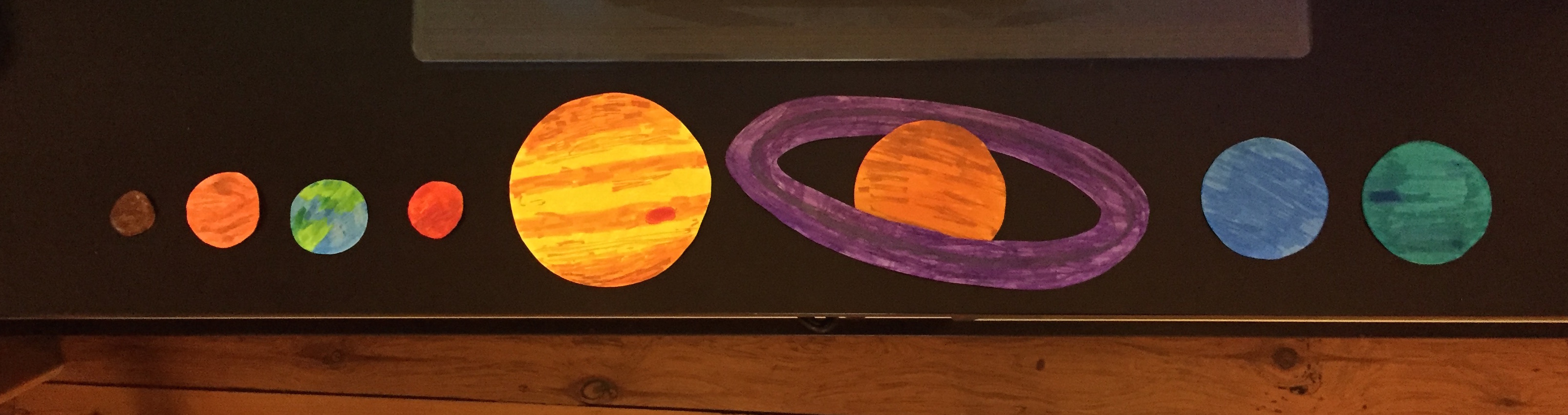
And that was it, we took white paper and color pen markers and, following the images of the planets in the book, made our own “Solar System”:

The planets that my son & me make yesteday

The planets that my son & me make yesterday. Sizes are NOT in scale.

Mercury was easy. For Venus and the Earth we used a glass and just painted with oranges-brown (Venus) or green-blue (Earth) colors. Mars was also easy just painting using red colors. I tried to add the details of the polar caps (the same that the clouds on the Earth) but our white crayon didn’t work well with the pen markers. Jupiter was fun, we used the empty box of a large yogurt (actually, that is where he has his pen markers, pencils and crayons) and just did stripes in orange colors over a yellow background to follow the Jovian bands. We added the detail of the Giant Red Spot with a red pen maker. We used a similar trick to draw Saturn (of course, this is Luke’s favorite planet) and then added the rings using a new piece of white A4 paper. Saturn’s rings were indeed the most difficult part to get, and I’m still not convinced of the result. In reality the are not that dark, and its shape is funny. We then just finished with the ice giants Uranus (pale blue with not many details on the disk) and Neptune (green-blue including some details in the clouds, and the “Great Dark Spot”).

Once this was done, Luke was really happy with “his planets”, and was counting them and naming them all the day. But I waited to the night to put them on his bedroom.

My son's bedroom wall with stars and planets

My son’s bedroom wall with stars and planets (and the X-Wing, of course).

At 9pm I said “let’s go to put your planets in your bedroom, and I’ll read you the story of the planets” and he went happily to bed. We used bluetag to do this. The result is really nice, and he is so exciting about all of this!

And, yes, we didn’t make Pluto because it is not a planet. But, don’t worry, he already knows there are other things in the Solar System: the Sun, asteroids, comets and five dwarf planets (Ceres, Pluto, Eris, Haumea and Makemake), as well as many planets have also moons! We’ll eventually make many of them.

I’ll need a bigger wall…

(*) Why teaching Luke Greek letters? Well, stars are named with Greek letters (e.g., Alpha Centauri) , and I remember it took me a while to memorize that when I was a teenager. But, more importantly, Physics and Math equations are written with Greek letters. And I write many of these in his blackboards. Yes, I know, he is little, but he is absorbing everything and I’m sure it will not hurt for him to be familiar to, let say, the Newton Equations, although some times I’ve written Einstein General Relativity, Maxwell’s Equations, or Schrodinger Equation. Luke does not pay too much attention to all of that, but he loves reading the Euler Equation “e i π plus 1 equal zero”.

“Astronomía para Principiantes”, my new collaboration with radio SBS Australia

Last December I was contacted by journalists from radio SBS Australia in Spanish to be interviewed about my work and my life as a Spanish astronomer in Australia. The interview was prepared by Anna Sagristà, who included it in the section “Latinos en Australia” (Latins in Australia) and released on Sunday 13th December in radio SBS2 97.7 FM. Here is the podcast, in case you want to practice your Spanish:

http://www.sbs.com.au/yourlanguage/api/radio/player/podcast/441762?node=381058

Thanks to this interview I had the chance to talk to them about Astronomy and how scientific research in astronomy works. They were indeed really interested about listening to me talking about stars, planets, galaxies and more, and they liked the way I was answering their questions. Just a couple of days after the interview they phoned me again to talk about a new exoplanets discovery plus the results of the IAU NameExoWorlds contest (yes, we did it! “Estrella Cervantes” is already on the skies!). You can listen to this interview, released on 17th December 2015, here:

http://www.sbs.com.au/yourlanguage/api/radio/player/podcast/442632?node=381786

In early 2016 they asked me to start a collaboration with them. And this way the section “Astronomía para Principiantes” (Astronomy for Beginners) in radio SBS Australia in Spanish was born. This is just a ~monthly 6-8 minutes section talking about an interesting astronomy topic or some recent news about Astronomy. The first podcast was released on Sunday 8th February, we talked about the “predicted IX Planet in the outer parts of the Solar System”. You can listen to it here:

http://www.sbs.com.au/yourlanguage/api/radio/player/podcast/479670?node=408532

Screenshot SBS Australia in Spanish

We still have to work a bit to get it polished, but I’m really happy and excited about this new adventure in Science Communication in Australia.

Additionally last Friday I was also interviewed, of course, about the first observation of gravitational waves, detected by the LIGO experiment in September 2015, but announced in a very expected press conference last Thursday 11th February. The podcast of this interview, which was prepared by Marcia de los Santos, can be found in this podcast:

http://www.sbs.com.au/yourlanguage/api/radio/player/podcast/482376?node=410434

So if you want to practice your Spanish and at the same time know a bit more about Astronomy, you’ll have a chance to listen to me in radio SBS Australia en Español FM 97.7 every month in “Astronomía para Principiantes”. This will be at around 1:15pm on Sundays, but I’ll announce exactly when these are happening via Twitter.

Finally I want to thank journalists at radio SBS Australia in Spanish, and in particular to Anna Sagristà, for the opportunity they are providing me to communicate astronomy to the general public in Australia.


Video: Space is just totally big and amazing

Last November some friends of the new Sydney on-line magazine A-star, Ryan Wittingslow and Harry Simpson, visited Siding Spring Observatory (Coonabarabran, NSW) to prepare a documentary about Astronomy and the telescopes at site. This is the nice video they have released, entitled Space is just totally big and amazing:

Documentary Space is just totally big and amazing prepared by A-star after their visit to the telescopes at Siding Spring Observatory. Credit: A-star.

As it happened while I was supporting astronomical observations at the Anglo-Australian Telescope (AAT), I was interviewed as part of the video. Although I talked about some few things (my research, my job at the AAO and my times as a young amateur astronomer in Spain), they only used my comments about astrophotography. Indeed, they asked me to include some scenes of my astronomical time-lapses on the documentary, and I think the result is great. I really love to see my astro photos and videos so well used. Thanks Ryan and Harry for this report!