Category Archives: Personal

Timelapse video: The Sky over the Anglo-Australian Telescope

A dark winter night, with the Milky Way crossing the firmament while its center in located near the zenith, is one of the most astonishing views we can enjoy. This vision is only obtained from the Southern Hemisphere and it is really inspiring. In particular, the Milky Way shines over the Siding Spring Observatory, near Coonabarabran (NSW), where the famous Anglo-Australian Telescope (AAT) is located. With the idea of sharing the beauty of the night sky to everybody, in May 2011 I decided to start taking timelapse photography while I was working as support astronomer at the AAT. This technique consists on taking many images and then adding all to get a movie with a very high resolution. The best shots I obtained by September 2011 were included in the video The Sky over the Anglo-Australian Telescope, which is available both in YouTube and in several MOV/MP4 files (HD, iPad, iPhone) in my personal AAO webpage.


“The Sky over the Anglo-Australian Telescope” was my first public timelapse video, released in November 2011.
Credit: Ángel R. López-Sánchez (AAO/MQ), the credit of the music is Echoes from the past, by Dj Fab.

The video, which lasts for 2.7 minutes, is the results of combining around 3800 different frames obtained using a CANON EOS 600D between June and September 2011. Except for those frames used for the sunset in the first scene, all frames have a 30 seconds exposure time, with a ISO speed of 1600. As the videos were created at 24 fps (frames per second), each second in the movie corresponds to 12 minutes in real time. I used several lens to take the images (standard 50 mm, 50mm x 0.65 focal reducer and a 10 mm wide-angle lens). The focal chosen was 5.6 (for the 50 mm lens) or 4.5 (10 mm wide-angle lens). Processing each sequence of the movie took five to six hours of computer time, and usually I had to repeat this at least once for each sequence, to improve the quality. The soundtrack I chose is an extract of the music Echoes from the past, by the french composer Dj Fab, which gives energy to the timelapse.

The Milky Way is setting at Siding Spring Observatory on 21 Sep 2011.
Click here to get the full resolution frame.
Credit: Á.R. L-S.

As my main job while I’m at the AAT is providing instrumental and scientific support to the astronomers who are observing in this telescope, I always set the camera up at the beginning of the night, let it run, and check on its progress occasionally. Sometimes this was not easy: wind knocked the camera over on a couple of times, often the battery ran out, and even once I had an encounter with some intransigent kangaroos. However, finally I got this material, which does not only show the magnificent Milky Way rising and setting above the dome of the AAT, but also stars circling the South Celestial Pole, the Magellanic Clouds over the AAT, satellites and airplanes crossing the sky, the Moon rising and setting, and the most famous constellations as Orion, Carina and the Southern Cross.

Circumpolar star traces (2.7 hours) over the Anglo-Australian Telescope on 20 Sep 2011.
Click here to get the full resolution frame.
Credit: Á.R. L-S.

I hope you enjoy the result. More timelapse videos to come soon!

Earth Hour 2013 in Sydney

Last 23rd March 2013 I was invited to give a Public Talk at Sydney Observatory because of the Earth Hour 2013. More than 200 people attended this event, I have to say I think it was not because of me but because of the possibility of getting a somewhat darker sky than usual in the city center. Earth Hour is a worldwide event organized by the World Wide Fund for Nature (WWF) that encourages households and businesses to turn off their non-essential lights for one hour. The aim of this is to raise awareness about the need to take action on climate change and, in particular, the problem of the light pollution. The Earth Hour first took place in 31st March 2007 in Sydney, which has a participation of 2.2 million Sydneysiders. In 2008 many other cities around the world adopted the event, creating a movement in which now participates around 1 billion people in more than 150 countries.

What is light pollution? It can be defined as the excessive or inappropriate outdoor lighting. Common forms of light pollution include glare, sky glow, light trespass, and light clutter. As the International Dark Sky Association (IDA) specifies in its main brouchure

Urban dwellers everywhere are losing the ability to see planets and stars in the night sky. The spectacular view of the Cosmos that has inspired science and art throughout history is disappearing. The glow of uncontrolled outdoor lighting has hidden the stars and changed our perception of the night. Light pollution wastes energy ( = MONEY! ), harms ecosystems, increases greenhouse gasses, threatens astronomical research and affect human health. Better lightning is the solution! The problems from light pollution can be solved by utilizing efficient, modestly bright outdoor lighting fixtures that are directed toward the ground and shielded to control glare.

Empire State Building in New York city at night. The light pollution is a terrible problem in large cities, giving the sky that orange colour. Sadly, today many children think that this is the real color of the night sky. Picture taken in October 2004.
Credit: Charliebrown7034 (Wikipedia).

Beside the negative effect that the light pollution has in the environment and its effects in animals and persons, I want to emphasize that its main consequence (at least, that which sadly is more important) is the huge amount of money which is wasted to illuminate the clouds and hide the stars. People around the world are realizing that this stupid kind of pollution has an easy solution. However it is responsibility of we, scientists, to talk about this to the general public and also to our Governments. Following the document Public Lighting—Energy Efficient Street Lighting published in July 2008 by the Australian Government,

In Australia, public lighting is the single largest source of local government’s greenhouse gas emissions, typically accounting for 30 to 50% of their CO2 emissions. There are 1.94 million public lights — one for every 10 Australians — that annually cost A$210 million, use 1,035 GWh of electricity and are responsible for 1.15 million tonnes of CO2 emissions.

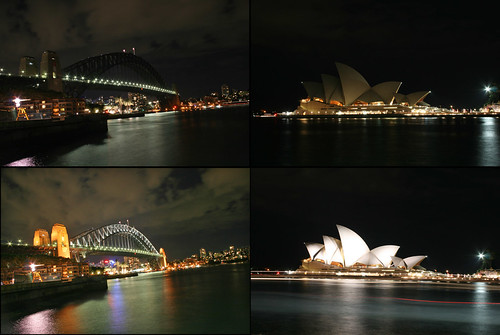
Photos comparing the vision of the Sydney Harbour Bridge and the Sydney Opera House during the Earth Hour on 28th March 2003 (top row) and after that event (bottom row). All 4 images were taken from the same place using a camera CANON EOS 400D, 400 ISO, f10 and 20 seconds exposure. The decreasing of the light pollution (seen specially well in the clouds) is quite evident.
Credit: Á.R.L-S. (AAO/MQ)


I emphasized, however, that the light pollution in Australia is (still) not bad at all. Australia has some of the darkest places on Earth (I was really impressed about how stars shine from the Australian Desert), are indeed Sydney, which has 4.5 million people, has by far better night skies that those seen from the city I’m from, Córdoba (Spain), with only 350 thousand people. As an example, just check this image I took in 2011 New Year Eve from the Opera Bar, just downstairs of the Sydney Opera House

Vision of the Sydney Opera House from the Opera Bar on the 2011 New Year Eve. It is just a 10 seconds exposure at f6.3 and 400 ISO using a CANON EOS 400D camera. The main stars of the Orion and Taurus (The Bull) constellations are clearly seen, as well as the Pleiades and even the Orion Nebula as a diffuse dot!
Credit: Á.R.L-S. (AAO/MQ)

After discussing the light pollution, its effects and some projects aimed to reduce it, I used the second half of my time to talk about my research at the Australian Astronomical Observatory / Macquarie University. I explained what an astronomer usually does, where the Siding Spring Observatory is, and presented some results of my own research about star-formation in galaxies.

A moment during my Public Talk at Sydney Observatory on 23rd March 2013 just before the Earth Hour. I was explaining here the problem of the light pollution, although later I talked about my research and work at the Australian Astronomical Observatory and Macquarie University.
Credit: Jeanette Landstedt (Sydney Observatory).

After the talk the participants enjoyed some stargazing using the amateur telescopes provided by the Sydney Observatory. I was among them and couldn’t stop talking to one and another group, as I was still being asked about what I said during my talk. It was great to be able to do this in the very relaxing atmosphere of an amateur observation. The only bad thing was that there was still a lot of light coming from the Moon, indeed, choosing the weekend before Easter for the Earth Hour was not good as it was not possible to really check the actual difference induced by the deficit of illumination in the sky.

Public Talk at UNSW: “Surprises of the Cosmos”

Next Friday 8th March 2013, at 6:30 pm, I’m giving a Public Lecture at the School of Physics of the University of New South Wales (UNSW), Sydney. I’m presenting an updated version of my nice talk Surprises of the Cosmos which I prepared in 2009 because of the Photo Exhibition co-organized between the Instituto Cervantes (Spain) and the Canary Islands Astrophysical Institute (IAC, Instituto de Astrofísica de Canarias, Spain) in 2009 because of the International Year of Astronomy. I participated in this exhibition and later I have given same talks here in Australia (Sydney, Melbourne and Canberra) publicizing it.


Flyer of the Public Talk “Surprises of the Cosmos” which I will give next Friday 8th March 2013 at the School of Physics of the University of New South Wales (UNSW), Sydney Credit: UNSW / Angel R. López-Sánchez.

In this talk I imagine we are far, far away from the Earth and take a journey from the deep Universe to our home planet. Our travel will start far away from the Earth, in galaxy clusters containing tens of thousands of galaxies and located more than 10 billion light years from us. We will see how galaxies formed and how we think our Milky Way and it’s neighbours have evolved in time. Once in our Galaxy we will have a look to some remarkable objects: star-forming regions, star clusters and nebulae that are the remnants of dead stars. Finally, we will reach the Solar System and have a look to the planets and the dwarf planets that orbit the Sun. We will also visit comets and asteroids, explain their origin and emphasis how the study of such bodies allow scientist to get a better understanding in the formation of the Sun and the planets around 4.7 billion years ago. We will finish the journey in our planet visiting some of the most important astronomical observatories of the Earth.

The details of the talk and how to reach the Lecture Theater are included in these dedicated UNSW webpage and in the UNSW Events in Facebook

Where: Physics Lecture Theatre, Old Main Building, UNSW Kensington Campus (near Gate 14, Barker St), Sydney

Date: Friday March 8th 2013

Time: 6:30pm (Refreshments served from 6pm)

You can see all the images of this exhibition with the text in Spanish in this link.

Finally, I want to thank PhD student Vicki Lowe for inviting me to give this talk.

I’ll see you there!

Moon, Jupiter, Jewel Box and Comet Lemmon

Besides being an astrophysicist I’m an active amateur astronomer. After 6 years living in Australia, finally in May 2012 I bought my own, small amateur telescope: Skywatcher Black Diamond Refractor Telescope, with an aperture of 80 mm and a focal distance of 600 mm. It provides beautiful images of the sky. However, besides once while stayed at Siding Spring Observatory and the two “great astronomical events” of 2012 (and the final reason I got the telescope), the Transit of Venus in June and the Total Solar Eclipse in November, I have not had too much time to play with this toy.

Last Monday 18th February it was clear in Sydney and I tried to get some shots of the conjunction between the Moon and Jupiter (actually, from South Australia the Moon occulted Jupiter!). This is the vision I got from my telescope:


Conjunction between the Moon and Jupiter observed from Sydney on 18th February 2013. I used my Skywatcher Black Diamond Telescope D = 80 mm, f = 600 mm and my CANON EOS 600D at primary focus, at 200 ISO. It is a composition of two images: one taken at speed 1/60 and another at 1/10. I did what I could to get a nice balance between them. Credit: Angel R. López-Sánchez.

After this, I decided to try to find the bright comet Lemmon 2012 F6, that was located near the Small Magellanic Cloud. It was actually easier I thought and, besides the light pollution, I got it. So on Tuesday 19th, again clear, I prepared the telescope but this time including the motors and performing an alignment of the mount to the South Celestial Pole. This task is not easy when there is too much light in the sky, as the stars used to do it are faint. At the end I got this view of the comet. I was not able to detect the tail with my eyes, however it does appear when combining several frames, as I did for this image.

My vision of the comet Lemmon 2012 F6 from Sydney on Tuesday 19th February 2012, at 21:20 AEST (10:20 UT). I combined 7 frames of 6 seconds exposure each (42 seconds total exposition time), at 1600 ISO using Skywatcher Black Diamond Telescope D = 80 mm, f = 600 mm and my CANON EOS 600D at primary focus. Note the faint tail moving towards the upper-left. Credit: Angel R. López-Sánchez.


An annotated version of this image can be found here:


Annotated version of my vision of the comet Lemmon 2012 F6 from Sydney on Tuesday 19th February 2012, at 21:20 AEST (10:20 UT). I combined 7 frames of 6 seconds exposure each (42 seconds total exposition time), at 1600 ISO using Skywatcher Black Diamond Telescope D = 80 mm, f = 600 mm and my CANON EOS 600D at primary focus. I have included an arrow folowing the faint tail, the orientation, and the position of the star &epsilon Tucanae. Credit: Angel R. López-Sánchez.

To get a good focus I decided to use the famous Jewel Box star cluster, very close to Mimosa (β Crucis).


Image of the “Jewel Box” star cluster (NGC 4755 or Kappa Crucis) in the Southern Cross from Sydney (actually, 4 km from the city center) on Tuesday 19th February 2013, 20:50 AEST (09:50 UT). It combines 6 images with 5 seconds exposure each ( 30 seconds total time) at 400 ISO, using a Skywatcher Black Diamond Telescope D = 80 mm, f = 600 mm and my CANON EOS 600D at primary focus. The bright star at the left is Mimosa, β Crucis, one of the brightest stars of the Southern Cross. Credit: Angel R. López-Sánchez.


Any of these images are very spectacular but considering that they have been taken just 4 km from the center of Sydney, with all the light pollution, plus the extra “fight” with the mozzies, I’m happy to share them with you.

NEA 2012 DA14 observed from the AAT

Yesterday I explained we are resuming the scientific observations at Siding Spring Observatory (NSW, Australia) since the recent bushfires on 13 January 2013. Today we have used this telescope to observe the Near Earth Asteroid (NEA) 2012 DA14, which is getting its closest encounter to our planet today (it will be at only 27000 km from the surface of the Earth). Here you have the details:


The path of the NEA 2012 DA14 from the AAT. Observed during the evening twilight on the 15 February 2013 using the FPI camera of the 2dF instrument at the 3.9m Anglo-Australian Telescope located at Siding Spring Observatory (NSW, Australia). 25 frames, 2 seconds exposure each, 5 seconds between frames. First frame obtained at 09:53:54 UT, last one at 09:56:22.
Support Astronomers: Lee Spitler (MQ/AAO) & Andy Green (AAO).
Night Assistant at the AAT: Steve Chapman (AAO).
Edition of the data and movie: Ángel R. López-Sánchez (AAO/MQ).
Link to the video in my Flick.

The data were obtained by Lee Spitler (MQ/AAO), Andy Green (AAO) and Steve Chapman (AAO) during the evening twilight while waiting the sky was dark enough to start the scheduled scientific observations. We will try to get more data of this object during the morning twilight. More to come soon!

Update at 14:45 AEST, 16th Feb 2013

I’ve checked there are some problems to watch the video using smartphones and tablets such iPhones and iPad. Just try this link and it should work, although you may get a low resolution version of it. I’m creating a new video to be uploaded to YouTube. At the same time, I’ve just finished this image showing a mosaic with 13 of the frames obtained for the video.

Mosaic with the path of the NEA 2012 DA14 from the AAT. Observed during the evening twilight on the 15 February 2013 using the FPI camera of the 2dF instrument at the 3.9m Anglo-Australian Telescope located at Siding Spring Observatory (NSW, Australia). Each frame has an exposition time of 2 seconds.Times are shown in Universal Time (UT), add +11 hours to get the local time in NSW.
Support Astronomers: Lee Spitler (MQ/AAO) & Andy Green (AAO).
Night Assistant at the AAT: Steve Chapman (AAO).
Edition of the data and movie: Ángel R. López-Sánchez (AAO/MQ).


Finally, I confirm we also observed the NEA at the AAT during the morning twilight.

Update at 16:55 AEST, 18th Feb 2013

An updated version of the video, which is now in HD and includes the celestial coordinates, has been included in this excellent article published today in The Conversation by Simon O’Toole (AAO).


The path of the NEA 2012 DA14 from the AAT. Observed during the evening twilight on the 15 February 2013 using the FPI camera of the 2dF instrument at the 3.9m Anglo-Australian Telescope located at Siding Spring Observatory (NSW, Australia). 25 frames, 2 seconds exposure each, 5 seconds between frames. First frame obtained at 09:53:54 UT, last one at 09:56:22.
Support Astronomers: Lee Spitler (MQ/AAO) & Andy Green (AAO).
Night Assistant at the AAT: Steve Chapman (AAO).
Edition of the data and movie: Ángel R. López-Sánchez (AAO/MQ).