Category Archives: Timelapses

My contribution to 2018 #StargazingABC

How can I say it in just few words? It was both very exciting and exhausting, with a little bit of bitter too. But, overall, last week at Siding Spring Observatory was one of the best experiences I have had in a long time working at the telescope, combining science research, amateur astronomy, outreach and science communication during the Stargazing ABC Live shows.
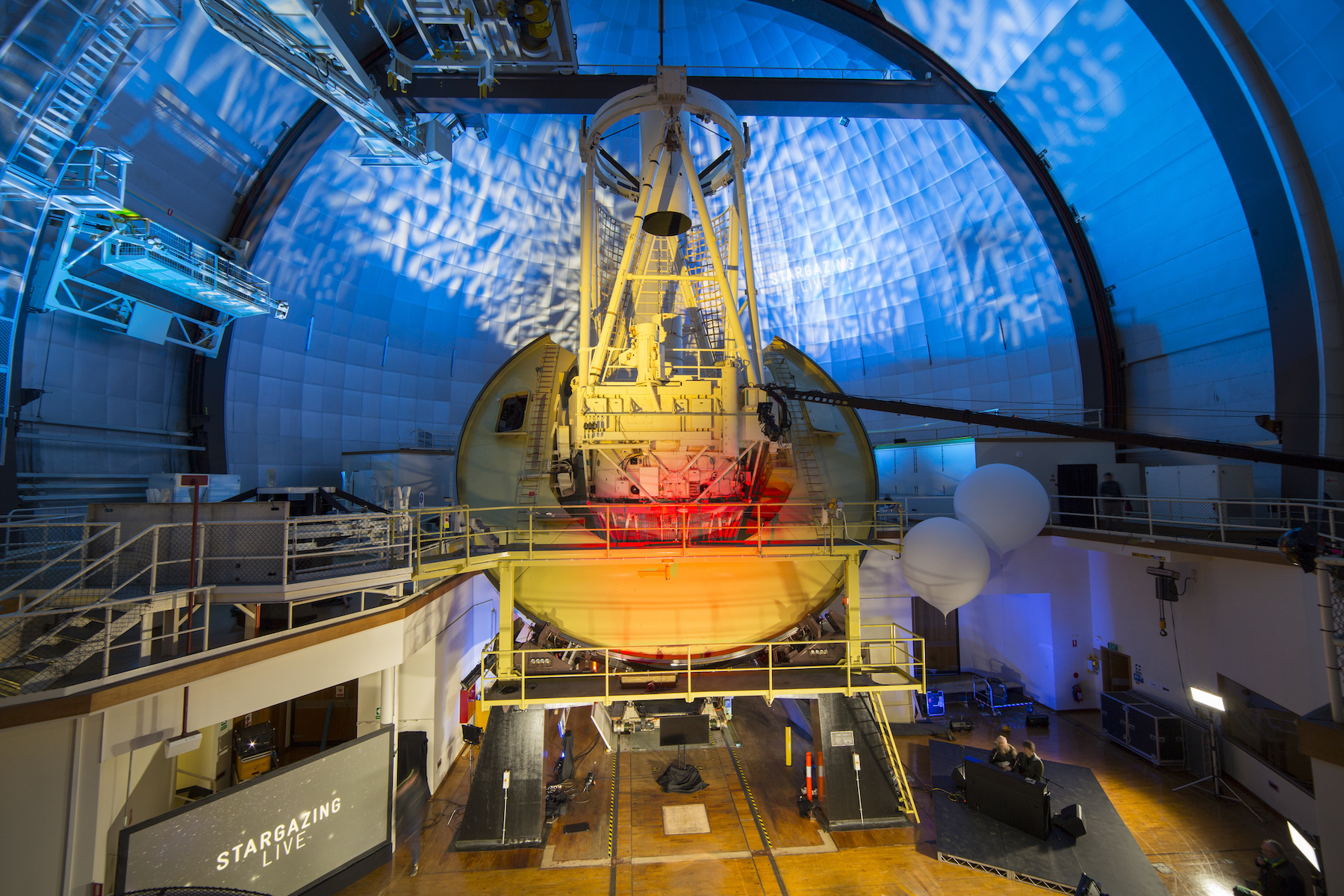
The AAT is ready for #StargazingABC. Hosts Julia Zemiro and Prof Brian Cox are sit in the piano, while Brian still rehearsing. Credit: Ángel R. López-Sánchez.

When I’m writing this, at 6:44pm 30th May 2018, I’m still observing at the Anglo-Australian Telescope. I’m doing it remotely from Sydney. It is my last night in a very long run (18 nights in May) for my own research project, which I will detail here eventually. I’m exhausted and need a good break, body and mind can’t survive this crazy rhythm, sleeping an average of 4-5 hours per day, and without any break during the weekends.

But let me at least quickly mention here my contribution to the 2018 Stargazing Live shows:

1. I provided A LOT OF information about Astronomy and the Anglo-Australian Telescope to the ABC and BBC crews. This is something that I’ve been doing during the last months, and might be considered as part of my role of “AAO Science Communicator Officer”.

2. I provided plenty of astrophotography and video-timelapse material, which was used during the shows. The most important of these is the new timelapse video “Stargazing at Siding Spring Observatory“, that you can enjoy here:

3. I spent some of my scheduled time at the Anglo-Australian Telescope to prepare a nice, new image of a beautiful astronomy object, that was later discussed during the show. It was the planetary nebula NGC 5189, for which I provided extra information in the previous post.

4. But the most important contribution for the show was actually observing with the AAT two transients reported by the citizen scientists who participated in a program to search for type Ia supernova in other galaxies. After confirming that the transient was there, we got spectroscopic information using KOALA+AAOmega, reduced the data, analysed the data, confirmed that both transients were type Ia supernova in distant galaxies, and wrote a science report with the discovery!
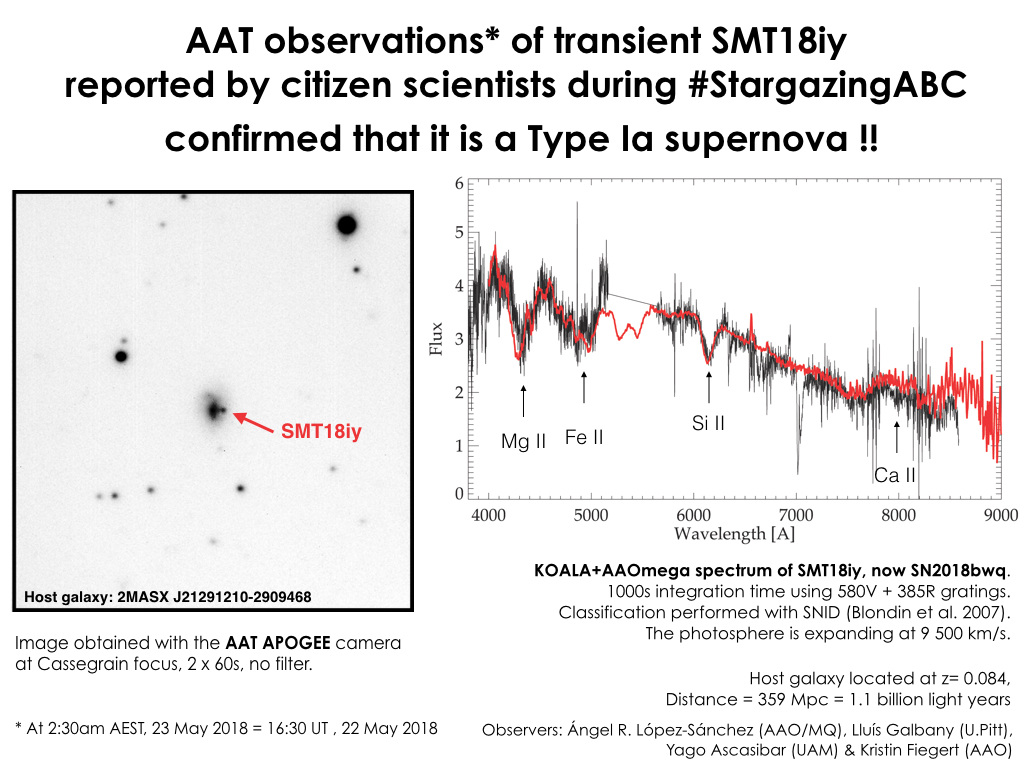
This was something I originally didn’t plan to do, but, as I said, it was my own research program that scheduled at the AAT during the StargazingABC, so I decided to do it and it got a reward, as this also allowed us to submit two science reports with the discoveries!

These two nights were really exciting! I really want to thank my friends and colleagues Lluís Galbany and Yago Ascasibar, as well as the AAT Night Assistant Kristin Fiegert (AAO), for their wonderful help in all of this.

The discovery of the transients and the confirmation that they were type Ia supernova in distant galaxies has appeared in many media news these days, including in ABC Science News, and also here: “Citizen scientists find two supernovae and (slightly) revise the age of the cosmos“.

It was also a privilege talking with Prof Brian Cox, who is absolutely great, and even recorded a short video with me for my son. Thank you a lot, Brian!

Prof Brian Cox and me are ready for #StargazingABC.

Where is the “bitter” I mentioned in the first paragraph? Well it is when the credit is not given. And not credit was given to me during the shows. I was still hoping at least having my name in the screen, in an ideal world even participating in person during the shows. But with my name (Ángel) and my strong English accent… well… perhaps in another life… I know what I did and I know how important my contribution was, and as I said I really enjoyed a lot all the time.

I hope I’ll be back if #StargazingABC returns in 2019!

PS: If you are in Australia, you can watch anytime the 3 episodes of 2018 #StargazingABC following this link to the ABC webpages.

Timelapse: A SAMI night at the AAT

See below the new Media Release published by the AAO. This new timelapse video has been also used for StargazingBBC and StargazingABC on March and April 2017.

This new astronomical time-lapse video features the unique SAMI (Sydney-AAO Multi-object Integral-field unit) instrument at the Anglo-Australian Telescope and the beauty of the dark sky over Siding Spring Observatory.

One of the most powerful instruments at the Anglo-Australian Telescope (Siding Spring Observatory, NSW) is the Sydney-AAO Multi-object Integral-field unit (SAMI). SAMI provides 13 fibred based IFUs called “hexabundles” that can “dissect” astronomical objects using spectroscopy. This instrument is used by the SAMI Galaxy Survey, that aims to “dissect” 3000 galaxies in different environments to help astronomers understand galaxy evolution and the tight relationship between gas and stars in galaxies.

However, unlike what the 2dF robot does, SAMI hexabundles must be plugged and unplugged manually very carefully by an expert user.

This video tells the story of a typical observing night with SAMI at the Anglo-Australian Telescope. In the first part, observers carefully prepare the SAMI instrument unplugging the plate they observed the previous night and plugging a complete new plate to be observed that night. SAMI observers usually need half an hour to complete this task, but in this timelapse video it is done in just a minute. Later they move to the AAT Control Room and start observations just as the sun sets. The twilight moves to a moonless, dark night, when only the stars shine over the Anglo-Australian Telescope, providing an spectacular view of the night sky from the Southern Hemisphere, and clear skies for the SAMI Galaxy Survey team to dissect distant galaxies.

In this timelapse you will see the Milky Way rising and setting, the Southern Cross with the Coalsack, the globular cluster 47 Tucanae near the Small Magellanic Cloud, the Large Magellanic Cloud with its strong star-forming region the Tarantula Nebula (30 Doradus), star clusters like the Pleiades moving behind the AAT, Orion rising and setting, the Carina Nebula rising, the magestic Emu in the Sky, and circumpolar stars (with the International Space Station) turning above the dome of the Anglo-Australian Telescope.

All the sequences have been filmed and processed in high resolution (4K) by astronomer Ángel R. López-Sánchez (Australian Astronomical Observatory / Macquarie University) while observing at the AAT for the SAMI Galaxy Survey, between September 2015 and March 2017. He used a CANON 5D Mark III with different lenses, all at f2.8. The night sequences tipically have 24 frames per second, each frame lasting 30 seconds in real time. Therefore 1 second of the night sequences corresponds to 12 minutes in real time.

To enjoy this video, watch it in full screen and at least in Full-HD (4K resolution recommended), in a dark room. As in real live, the details in the sky appear when we are far from the light pollution.

Credits of the video: Ángel R. López-Sánchez (Australian Astronomical Observatory / Macquarie University)
Featuring: Luca Cortese (ICRAR-UWA), Jesse van de Sande (University of Sydney) and Steve Chapman (Night Assistant at the AAT)
SAMI plugger: Ángel R. López-Sánchez (AAO/MQU)
Music: It’s personal (World in flames, 2011), Celestial Aeon Project.

Video: Space is just totally big and amazing

Last November some friends of the new Sydney on-line magazine A-star, Ryan Wittingslow and Harry Simpson, visited Siding Spring Observatory (Coonabarabran, NSW) to prepare a documentary about Astronomy and the telescopes at site. This is the nice video they have released, entitled Space is just totally big and amazing:

Documentary Space is just totally big and amazing prepared by A-star after their visit to the telescopes at Siding Spring Observatory. Credit: A-star.

As it happened while I was supporting astronomical observations at the Anglo-Australian Telescope (AAT), I was interviewed as part of the video. Although I talked about some few things (my research, my job at the AAO and my times as a young amateur astronomer in Spain), they only used my comments about astrophotography. Indeed, they asked me to include some scenes of my astronomical time-lapses on the documentary, and I think the result is great. I really love to see my astro photos and videos so well used. Thanks Ryan and Harry for this report!

Bright meteor over the AAT

This week I’m back at the Anglo-Australian Telescope (AAT, Siding Spring Observatory) as support astronomer. As the same time I’m helping visitors astronomer to get the best data using the 2dF instrument, I’m taking time-lapse sequences of the night sky using 2 CANON EOS 5D Mark III cameras. This afternoon, when checking the “preliminary” sequences of the previous night, I discovered a bright meteor in one of the frames. I was excited because at the beginning I thought it was a Leonid, but I checked and it seems to be a sporadic meteor or, perhaps, a meteor from the South Taurids shower.


The circumpolar Southern Sky, with the Magellanic Clouds, the Southern Cross and the Pointers (Alpha and Beta Centauri) over the Anglo-Australian Telescope (AAT), at Siding Spring Observatory (NSW, Australia). A bright meteor crosses the sky. Although it could have been a meteor of the Leonids meteor shower, the radiant (point in the sky from where the meteors of a meteor shower come from) was not in the sky. However it could be a meteor from the South Taurids shower. Photo taken at 2am AEST (UT+11) of the 17 Nov 2015 with a CANON EOS5D using a 16 mm lens at f2.8, 3200 ISO, 30 seconds exposure. Click here to get a higher resolution image. Credit: Ángel R. López-Sánchez (AAO/MQ).

A reddish-greenish sky glow is also seen in the image. This glow has been also observed from the observatories in Chile as is consequence of chemical reactions involving oxygen (green colours, usually forming ozone) and nitrogen (red colours) molecules in our atmosphere. These chemical reactions are induced by ultraviolet emission from the Sun, which is much more intense when the solar cycle is in maximum, as it has been in the last few years.

Timelapse of World Record Stargazing 2015

On Friday 21st August 2015, during the Australian National Science Week, the AAO and Centennial Parklands organized a public stargazing event in Centennial Park in Sydney. This event was part of an attempt to break the Guinness World Record for the “Most People Stargazing across Multiples sites in a Country,” organized by Mt Stromlo Observatory, RSAA/ANU, Canberra.

I helped in the organization of the event jointly organized by the Australian Astronomical Observatory and Centennial Parklands at Centennial Park. During a 10 minute period between 8:30 and 8:40 pm, 400 participants used small telescopes and binoculars to look at various objects in the night sky. I also prepared this time-lapse video, which compiles 2500 photos taken between 6pm and 9:30pm, shows people assembling in the field to listen to presentations by Prof. Fred Watson and Dr. Amanda Bauer before the official stargazing event began. A timeline of events are included in the video.

Time-lapse video of the Stargazing event jointly organized by the Australian Astronomical Observatory and Centennial Parklands at Centennial Park with the aim of break the Guinness World Record for the “Most People Stargazing across Multiples sites in a Country. The video compiles 2500 photos taken every 5 seconds between 6pm and 9:30pm. A Full HD version of the video is available in the AAO YouTube Channel.Credit of the video: Ángel R. López-Sánchez (AAO/MQ); Credit of the music: “Space Guardians”, by Fran Soto, Epic Soul Factory.

In total, 37 sites across Australia participated in achieving the Guinness Record World, including 7960 individual stargazers. The Guinness World Record for the “Most People Stargazing across Multiples sites in a Country” was confirmed on 15th October 2015. Congratulations to all involved!

More info: AAO Webpage: World Record Stargazing 2015