AAO #Scicomm events during Australian National Science Week 2017

The AAO organized and/or participated in 7 events during Australia’s National Science Week in August 2017, including the very successful and sold-out events “Star Tales of Winter Nights” and “Stargazing in the Park”.

Astronomers at the AAO’s “Star Tales of Winter Nights” event at the Powerhouse Museum during National Science Week 2017. From left to right: Adam Schaefer, Dr Devika Kotachery, Dr. Ángel López-Sánchez (MC), Carlos Bacigalupo and Rebecca Brown. Credit: Ángel López-Sánchez.

The event “Star Tales of Winter Nights”, hosted at Sydney’s Powerhouse Museum had a very similar structure than our ViVID Sydney Ideas events: 5 astronomers talking about science and later answering questions from the audience. The speakers were Rebecca Brown, Adam Schaefer, Dr Devika Kotachery, Carlos Bacigalupo and myself. This event was another big success for the AAO.

Setting up the telescopes for AAO’s “Stargazing in the Park” in Sydney’s Centennial Park. Credit: Ángel R. López-Sánchez.

AAO’s Ángel López-Sánchez, Stuart Ryder and Duncan Wright (from left to right) ready for “Stargazing in the Park” in Sydney’s Centennial Park. Credit: Ángel R. López-Sánchez.

On the other hand, the “Stargazing in the Park” in Sydney’s Centennial Park was another sold-out event, with more than 120 people enjoying first a short lecture about the AAO and introduction to stargazing and later looking at the sky through the telescopes.

AAO’s Stuart Ryder attending visitors at the AAO desk during the “Science and Tech” expo at Chatswood Library on Saturday 12th August. Credit: Ángel López-Sánchez.

During National Science Week 20017 the AAO also participated in two of the events organized by the recently created “North Sydney Science Hub” . First on Saturday 12th August in the “Science and Tech” expo at Chatswood Library, and later in the Public DiscussionBig Data And Visual Analytics – What is it good for?”, on Thursday 17th August, also at Chatswood Library, being myself one of the panelists of the discussion.

Panel for the Public Discussion “Big Data And Visual Analytics – What is it good for?”, on Thursday 17th August, also at Chatswood Library. From left to right: Mark Ballico (NMI), Tomasz Bednarz (Data61 and UNSW Art & Design), Angela (CSIRO) and Ángel R. López-Sánchez (AAO.MQU).  Credit: Ángel R. López-Sánchez.

Historic ESO-Australia agreement

This is BIG. Australian astronomers have tried for almost 2 decades to be part of the European Southern Observatory (ESO). Yesterday, 11th July 2017, at a ceremony happening during the Annual Meeting of the Astronomical Society of Australia (ASA) in Canberra, Australia, ESO’s Director General, Tim de Zeeuw, and the Australian Minister for Industry, Innovation and Science, Arthur Sinodinos, signed a 10 years Strategic Partnership between Australia and ESO.

Image composition showing all the ESO observatories and the Headquarters. Credit: ESO/M. Kornmesser.

Following the ESO-Australia Strategic Agreement, Australian astronomers (including me!) will have access to telescope time at La Silla and Paranal Observatories in Chile. The ESO-Australia Strategic Agreement also provides crucial opportunities for Australian influence and technical and scientific input, stimulating international research and industry collaborations.

This is particularly important for the Australian Astronomical Observatory (AAO), as we are developing key instrumentation for ESO (as the ESOP positioner for the VISTA telescope), and that was a key part of the deal, with new opportunities to develop further telescope instrumentation in the nearby future. That also means an important re-arrangement within the AAO, which details are still unknown, but in which we’ll give our best.

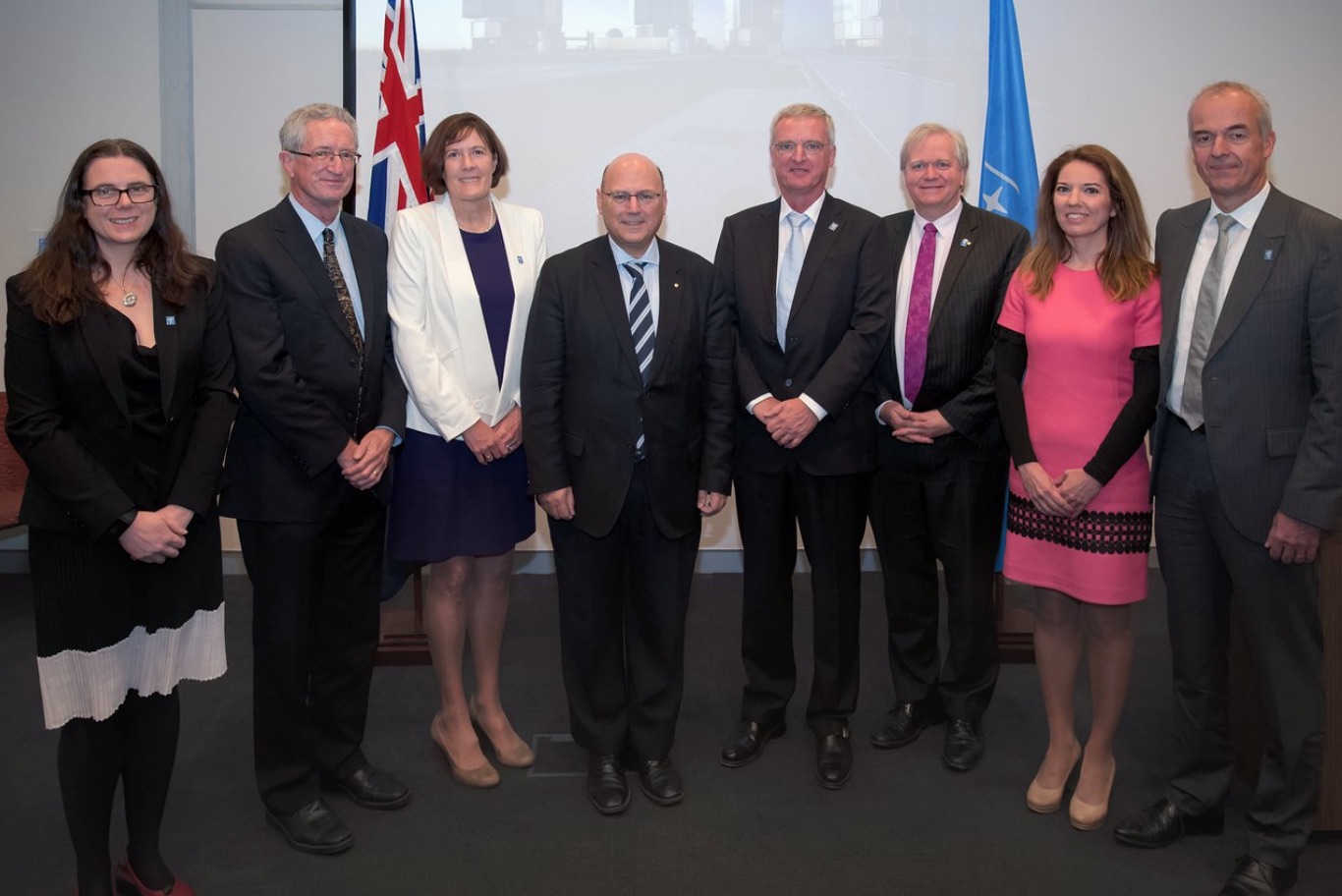
At a ceremony in Canberra, Australia, on 11 July 2017, an arrangement was signed to begin a ten-year strategic partnership between ESO and Australia. The partnership will further strengthen ESO’s programme, both scientifically and technically, and will give Australian astronomers and industry access to the La Silla Paranal Observatory. It may also be the first step towards Australia becoming an ESO Member State.
This picture shows all the signatories of the arrangement. From left to right: Virginia Kilborn, President of the Astronomical Society of Australia, Warrick Couch, Director of the Australian Astronomical Observatory, Sue Weston, Deputy Secretary, Department of Industry, Innovation and Science, Senator the Hon Arthur Sinodinos, Minister for Industry, Innovation and Science, Tim de Zeeuw, ESO Director General, Brian Schmidt, Vice Chancellor of the Australian National University, Laura Comendador, Head of the ESO Cabinet and Patrick Geeraert, ESO Director of Administration. Credit: Australian Government.

The Australian Government will invest $129 million over 10 years in the partnership, including the $26.1 million already announced for 2017-2018 Australian Budget. This may also be the first step towards Australia becoming an ESO Member State.

Exciting times await!

More details:

“Stargazing at The Calyx”, new science communication event series at Sydney’s Botanic Gardens

Article originally written by Ángel R. López-Sánchez for the “AAO Observer” 132, August 2017.

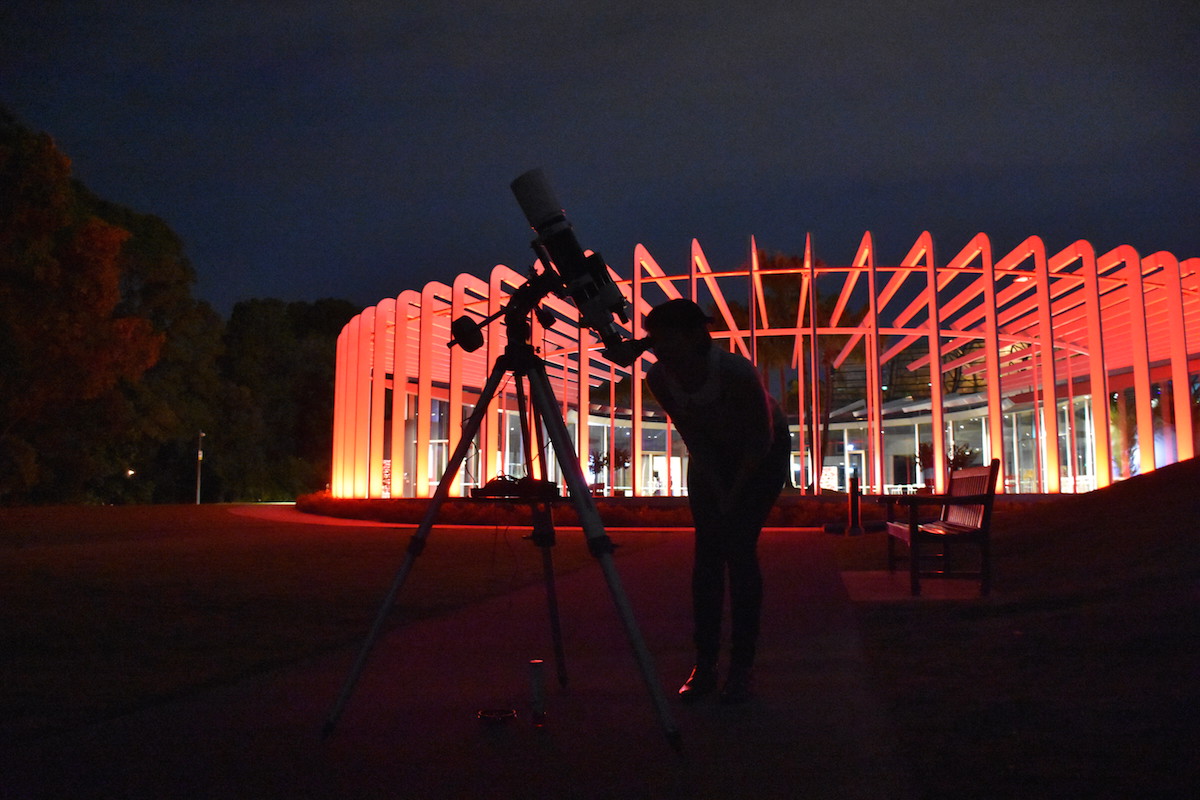
In June 2017 the Australian Astronomical Observatory (AAO) started a new Science Communication collaboration with historic Sydney’s Royal Botanic Gardens. The events “Stargazing at The Calyx” combine a short talk given by an astronomer followed by a stargazing session with amateur telescopes.

People are enjoying the view of the sky through amateur telescopes during the “Stargazing in the Calyx” science communication event at Sydney’s Botanic Gardens on Tuesday 4th July 2017. Credit: Christina McGhee (Sydney’s Botanic Gardens).

The first of these events was held on Monday 19th June 2017. It was so successful that the following “Stargazing in the Calyx” session, scheduled on Tuesday 4th July, was sold out in just 8 minutes after the tickets were available.

The organization of these events have received a hugely positive feedback, both about the venue (the brand-new “The Calyx” building at Sydney’s Botanic Gardens) and the atmosphere (people enjoyed dinner with drinks under the stars) and the entertaining and knowledgeable talks about the Southern Sky (given by AAO and Macquarie University astronomer Ángel López-Sánchez).

AAO/MQU astronomer Ángel López-Sánchez giving his talk “Introduction to the Southern Sky” as part of the “Stargazing at The Calyx” event at Sydney’s Botanic Gardens on Monday 19th June 2017. Credit: Christina McGhee (Sydney’s Botanic Gardens).

Besides some clouds and Sydney’s light pollution, participants really enjoyed the views of planets Jupiter and Saturn and the Moon through the telescopes, as well as observing globular cluster Omega Centauri and the famous “Jewel Box” star cluster in the Southern Cross, as well as learn to recognize the constellations of the winter nights at the southern hemisphere. Some of the telescopes were kindly provided by CSIRO, Sydney University, Macquarie University and some amateur astronomers who were also invited to these events.

The next “Stargazing at The Calyx” event is scheduled on Tuesday 3rd of October. We expect they will be repeated each 1 or 2 months.

“The Story of Light: Surveying the Cosmos”, in Vivid Sydney Ideas 2017

Article originally written by Ángel R. López-Sánchez for the “AAO Observer” 132, August 2017.

Following the success of our sold-out Event “The Story of Light – The Astronomer’s Perspective” for ViVID Sydney Ideas 2015, and “The Story of Light – Deciphering the data encoded on the cosmic light” (see photos and the video of this event), the Australian Astronomical Observatory (AAO) continued its collaboration with ViVID Sydney 2017 organizing “The Story of Light – Surveying the Cosmos”.

This successful science communication event was held at the Powerhouse Museum (Sydney) on Sunday 4th June 2017. Having an audience of 300 people, it was sold out more than two weeks before the event.

“The Story of Light – Surveying the Cosmos” was connected to the 2017 Southern Cross Astrophysics Conference: Surveying the Cosmos, the Science from massively multiplexed surveys, that was held in Luna Park, Sydney, between 5th and 9th June 2017.

Poster for the AAO’s “The Story of Light – Surveying the Cosmos” Science Communication event for Vivid Sydney Ideas 2017. Credit: Angel R. Lopez-Sanchez.

In this event, five professional astrophysicists discussed how astronomers map the Cosmos using the big data collected with optical and radio telescopes by large astronomical surveys.

How do astronomers explore the Universe? Astrophysicists use extremely sensitive telescopes and instruments to collect the light emitted by stars, gas and galaxies. The analysis of this data provides the information needed to unlock the mysteries of the Cosmos.

However, this is not an easy task. Over the last two decades large international collaborations have been formed with the aim to map the skies, catalogue celestial objects, extract their properties and perform statistical analyses. These large astronomical surveys are now providing major advances in our understanding of the Cosmos at all scales, from searching for planets around other stars to detecting gravitational waves.

Australia is at the forefront of these collaborations thanks to the unique instruments at the Anglo-Australian Telescope (AAT) and the development of radio-interferometers as the Australian SKA Pathfinder (ASKAP).

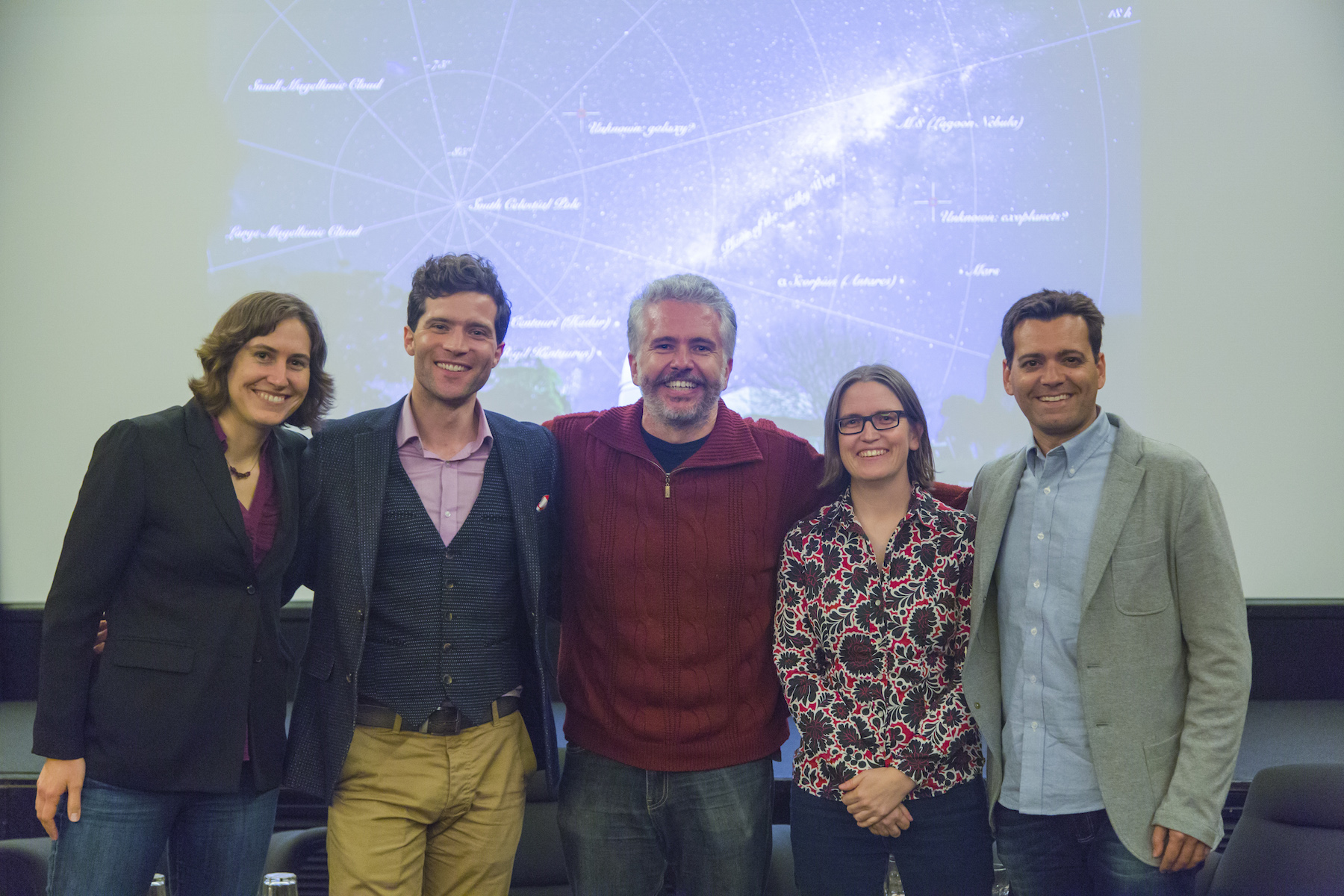
Panel members and MC of AAO’s “The Story of Light – Surveying the Cosmos” Science Communication event for Vivid Sydney Ideas 2017. From left to right: Katie Mack, Alan Duffy, Simon O’Toole, Tara Murphy and Ángel López-Sánchez. Credit: Duncan Wright (AAO/UNSW).

The panel members were Dr. Simon O’Toole (Australian Astronomical Observatory), who talked about surveying stars and exoplanets, Dr. Ángel R. López-Sánchez (Australian Astronomical Observatory / Macquarie University), who discussed how we surveying the galaxies, A/Prof. Tara Murphy (University of Sydney / CAASTRO), who invited us to surveying the invisible Universe, and Dr. Katie Mack (University of Melbourne), who talked about surveying the deep Universe. The event was hosted by famous astrophysicist and science communicator A/Prof. Alan R. Duffy (Swinburne University).

After short (15 minutes) talks, the panel answered questions about the Universe and challenging Physics questions as the nature of the dark matter and the dark energy. They also received some more philosophical questions that engaged the audience.

More information:

AAO joins organization of International Science Communication Festival “Pint of Science”

Article originally written by Ángel R. López-Sánchez for the “AAO Observer” 132, August 2017.

In 2017 the Australian Astronomical Observatory joined the international Science Communication festival Pint of Science. The festival started in the UK and runs every May in over 150 cities across 12 different countries, including Australia. This year Pint of Science took place in 13 cities across Australia (including Sydney) over 15, 16 and 17 May 2017.

The Pint of Science festival aims to promote Science and Science Communication in a very relaxing atmosphere: in a pub with a drink. It brings scientists to a local pub to discuss their latest research and findings with the public.
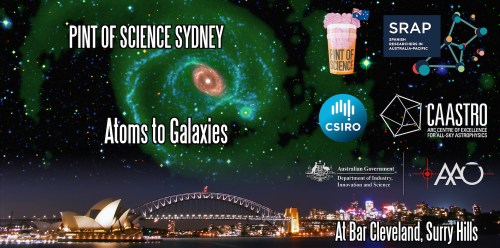
Poster of Sydney’s “Atoms to Galaxies” for Pint of Science Australia 2017. Credit: Ángel R. López-Sánchez.

The Australian Astronomical Observatory joined CSIRO, the ARC Centre of Excellence CAASTRO, and the Spanish Researchers in Australia-Pacific (SRAP) association as a sponsor of Sydney’s Pint of Science Festival in 2017. Our astronomer Ángel López-Sánchez (AAO/MQU) co-leaded the organization of the “Atoms to Galaxies” talks. These sessions included talks about Physics, Math, Chemistry and Astronomy and were hosted at Bar Cleveland, in Surry Hills.

Sydney’s “Atoms to Galaxies” program (which was the largest for Pint of Science Australia 2017) included talks about applied maths, search for exoplanets, explore quantum computing, play with the light, learn the origin of the chemical elements, map distant galaxies and challenge the laws of Physics.
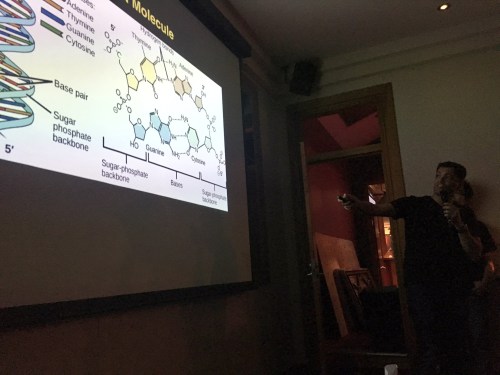
Angel López-Sánchez during his talk “The Cosmic Origin of the Elements”.

The first night, “Elements in Space”, included talks by AAO astronomer and engineer Kyler Kuehn, who talked about astronomy neutrinos presenting the work he conducted in Antarctica for his PhD Thesis, and by AAO and Macquarie University astronomer Ángel López-Sánchez, who transported the audience to distant stars and galaxies to know when and how the atoms that compose our body were created.
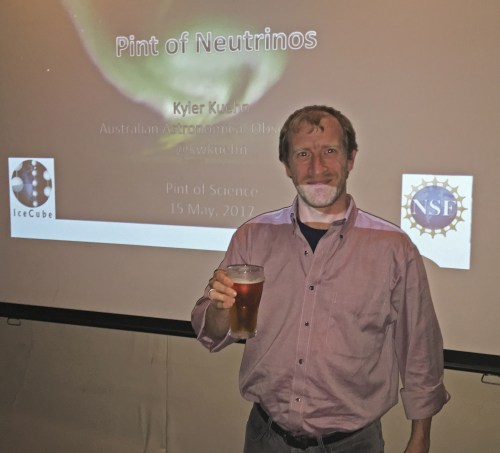
Kyler Kuehn (AAO) before starting his talk “Pint of neutrinos”. Credit: Ángel López-Sánchez.

In the third night, “Decodifying the Light of the Cosmos”, AAO astronomer an eResearch administrator Simon O’Toole described how we use the light collected by optical telescopes to search for planets around other stars, with the ultimate aim of finding an “Earth 2.0”.

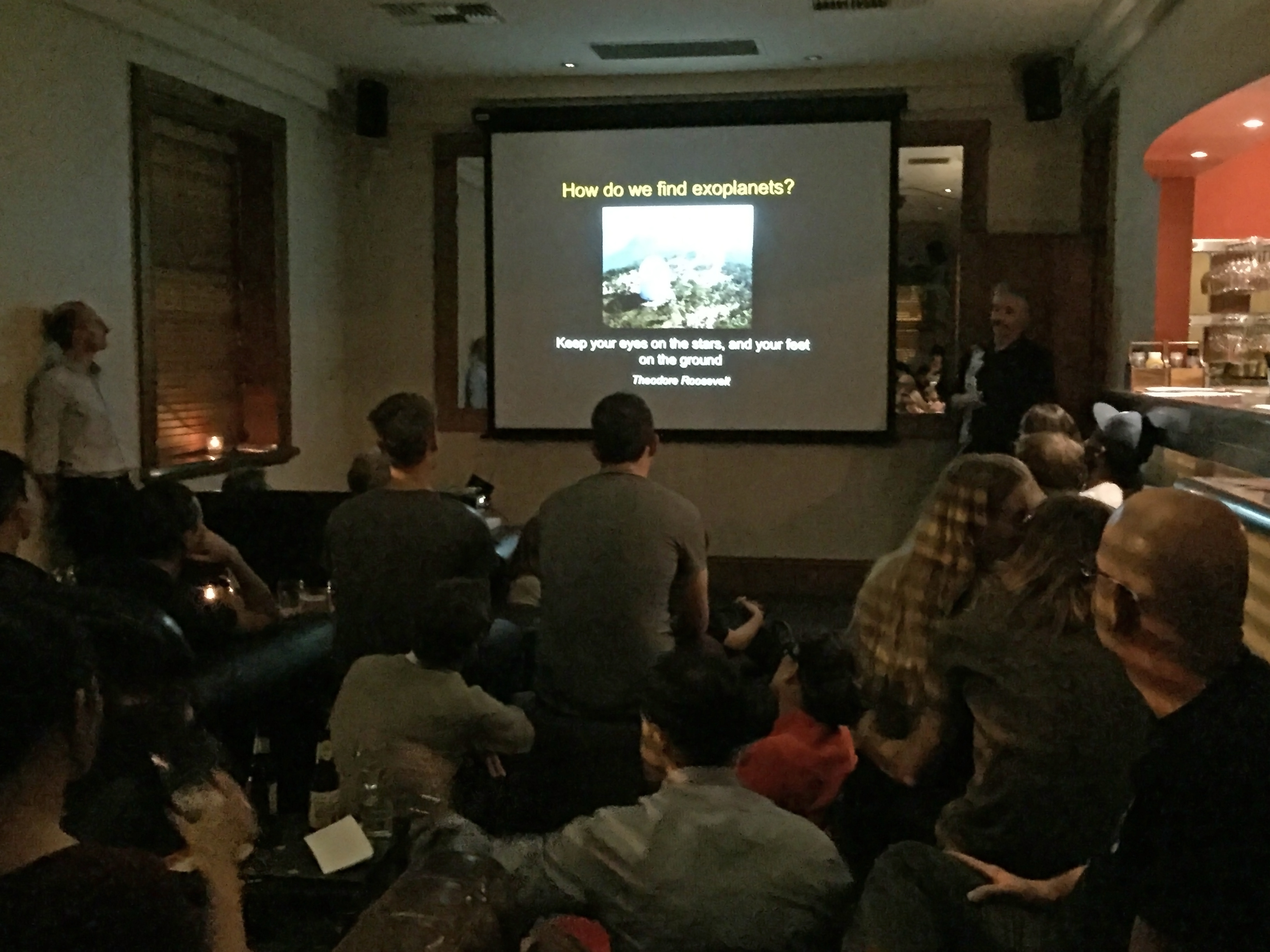
Simon O’Toole during his talk for “Pint of Science” festival “Searching for Earth 2.0”. Credit: Angel López-Sánchez.

Astronomers George Hobbs (CSIRO), Luke Barnes (University of Sydney) and Baerbel Koribalski (CSIRO), as well as physicists Dr. Sergio León-Saval (University of Sydney) and Prof. Jason Twamley (Macquarie University), and mathematician Emi Tanaka (University of Sydney) completed the “Atoms to Galaxies” program.
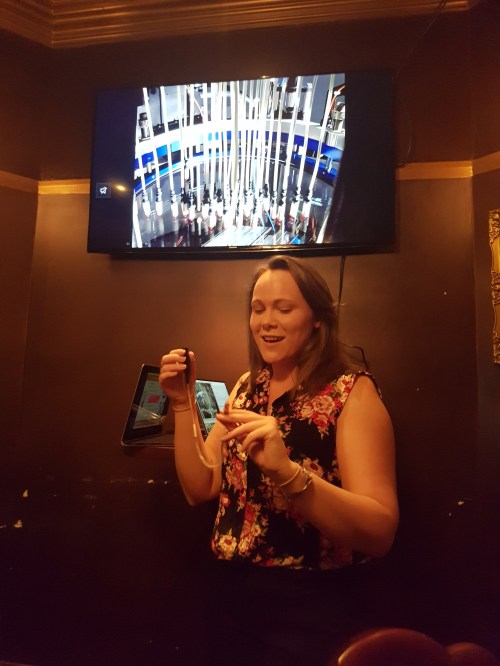
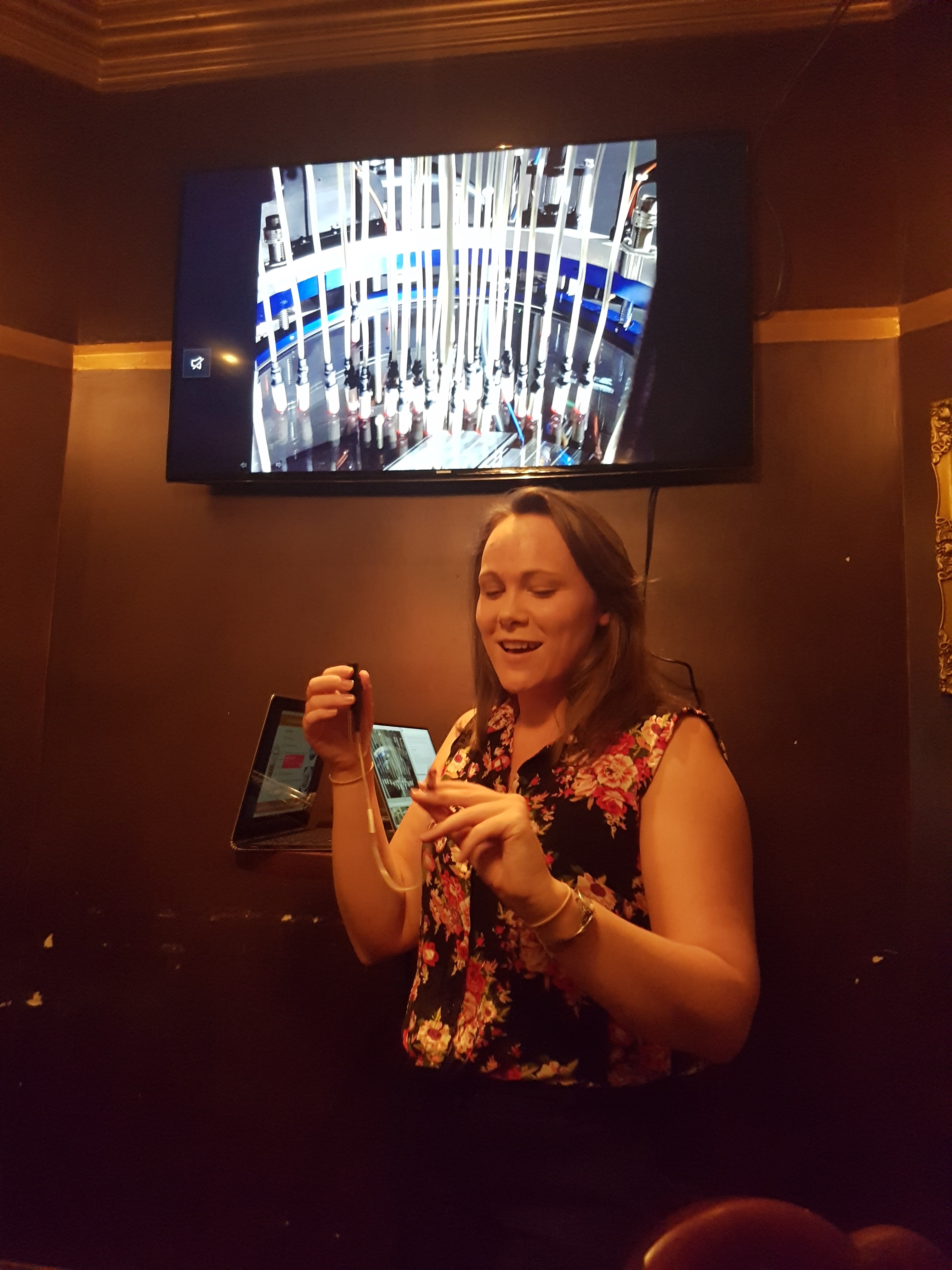
Rebecca Brown during her talk for “Pint of Science” festival explaining how the Starbugs developed for the new TAIPAN instrument at the UKST work. Credit: Rebecca Brown.

Besides organizing Sydney’s “Atoms to Galaxies” talks for Pint of Science Australia 2017, the Australian Astronomical Observatory was also present in the “Tech me out!” session Space Oddities on Wednesday 17th May. AAO’s optical engineer Rebecca Brown gave the talk “Capturing the Light of the Universe“, where she summarized the technologies used in optical telescopes, how they work and what we can learn, including example technologies developed at the AAO.


Addendum:

The details of the talks for the “Atoms to Galaxies” events in Pint of Science Sydney 2017  (info extracted from this AAO website) were:

Monday 15th May: Elements in Space

Tonight we will explore the conjunction between math, chemistry and astronomy. First Dr. Emi Tanaka (University of Sydney) will talk about how statistics feeds us, introducing the basic mathematical tools of statistics and their application in agriculture. Then Dr. Lamiae Azizi (University of Sydney) will be talking about how mathematical sciences coupled with computing have the potential to improve our lives. Finally, astrophysicist and science communicator Dr. Ángel López-Sánchez (Australian Astronomical Observatory / Macquarie University) will transport us to distant stars and galaxies to know when and how the atoms that compose our body were created.

More details and tickets for “Elements in Space” in the Pint of Science website.

Tuesday 16th May: Challenging the Laws of Physics

Tonight we will aim to change the Laws of Physics. Our first speaker, Prof. Jason Twamley (Macquarie University), will talk about quantum computing and why this research is so important. Then, astrophysicist Dr. George Hobbs (CSIRO) will explain what mysterious pulsars are and why their study is so important for physicists. After the break, cosmologist Dr. Luke Barnes (University of Sydney) will challenge our understanding of the physical constants to demonstrate that we live in a finely-tuned Universe.

More details and tickets for “Challenging the Laws of Physics” in the Pint of Science website.

Wednesday 17th May: Decodifying the Light of the Cosmos

Tonight we seek to get a better understanding of what the light can tell us about the Universe. Our first speaker, Dr. Sergio León-Saval (University of Sydney) will show us some of the photonic instruments that are now used in optical telescopes to direct the light of the stars from the optics to the detectors. In the second talk Dr. Simon O’Toole (Australian Astronomical Observatory) will describe how we use the light collected by optical telescopes to search for planets around other stars, with the ultimate aim of finding an “Earth 2.0”. Lastly, Dr. Baerbel Koribalski (CSIRO Astronomy and Space Science) will describe how radio-astronomers study the light of distant galaxies emitted in radio waves using facilities as the new “Australian SKA Pathfinder” (ASKAP) interferometer.

More details and tickets for “Decodifying the Light of the Cosmos” in the Pint of Science website.