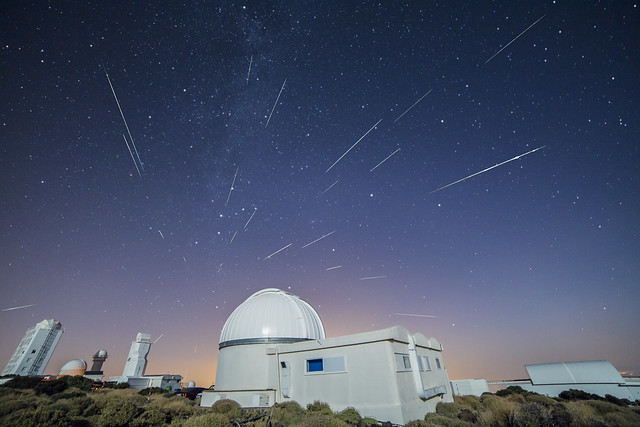
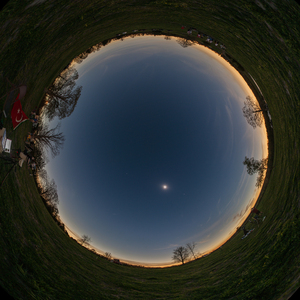
Perseids 2016 over the Teide Observatory. Combination of 25 meteors from the Perseids meteor shower detected in 24 frames. All frames were taken with a CANON EOS 5D Mark III with a Samyang 14mm lens, 30 seconds exposure at f/2.8 and ISO 800. Frames were taken between 0:00 and 2:30 UTC 12 August 2016 from the Teide Observatory (Tenerife, Canary Islands, Spain). The central dome is the Carlos Sánchez Telescope (TCS). The building at the right is the Quijote Experiment. The towers at the left belongs to the Solar Telescopes at site. The dome of the MONS Telescope is seen with some orange light.
The frame taken at 0:36 UTC was used for showing the landscape and the star field. The Moon was up, its light painted the landscape and buildings. In the background some light pollution from Santa Cruz de Tenerife and La Laguna can be seen (orange colours). The light pollution was enhanced because of the existence of dust in the atmosphere.
The estimated ZHR (Zenithal Hourly Rate) using these images is ZHR = 31 meteors/hour.
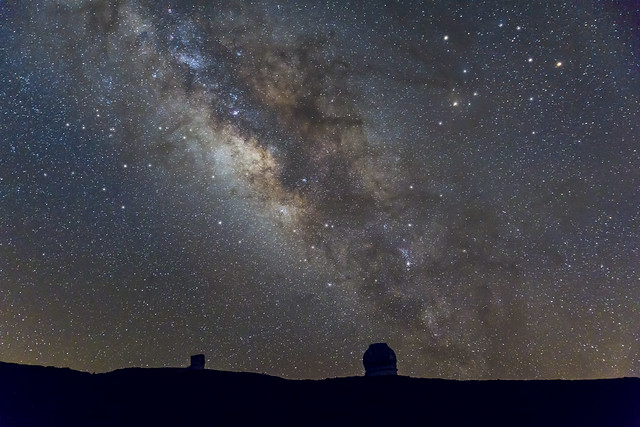
Milky Way over the 10.4m Gran Telescopio CANARIAS (GTC) and the 3.6m Telescopio Nazionale Galileo (TNG), Roque de los Muchachos Observatory, La Palma, Canary Islands, Spain.
Single frame, 15 seconds exposure at 1600 ISO over CANON EOS 5D Mark III, F=33mm and f/2.8. Taken on Wed 3 Aug 2016, 20:35 UTC.
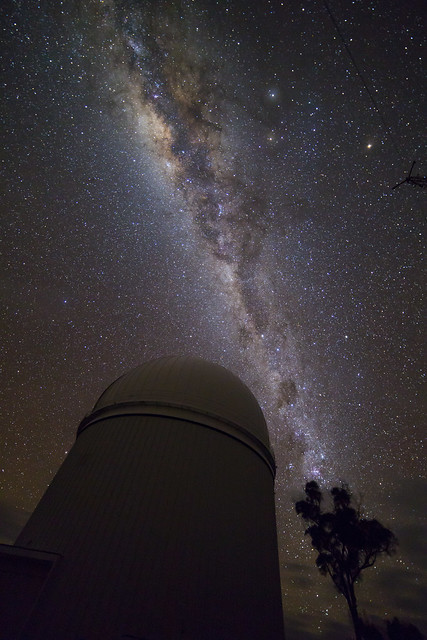
Vertical Milky Way over the Anglo-Australian Telescope. Image obtained on 30th June 2016 at 22:04 AEST (14:04 UTC) using a CANON 5D Mark III with a 14mm f2.8 wide lens. Single 30 seconds exposure at 3200 ISO. Besides the conversion from RAW to JPEG, no further image process was applied. The famous dark constellation “Emu in the Sky” seen by Australian Aboriginals, planets Mars and Saturn, bright star Antares in Scorpio, and nebulae such as Carina, Lagoon, and Trifid, are easily recognized in the image.
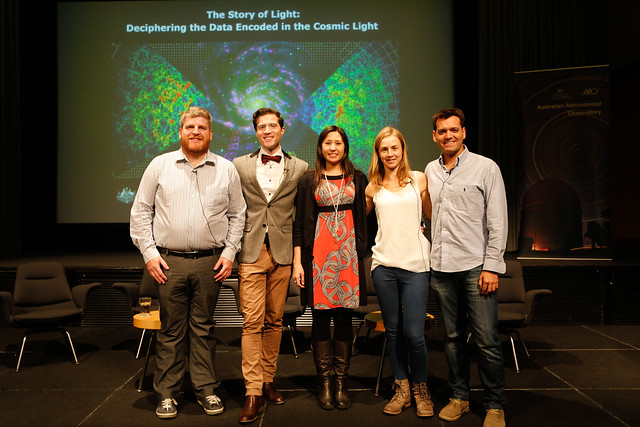
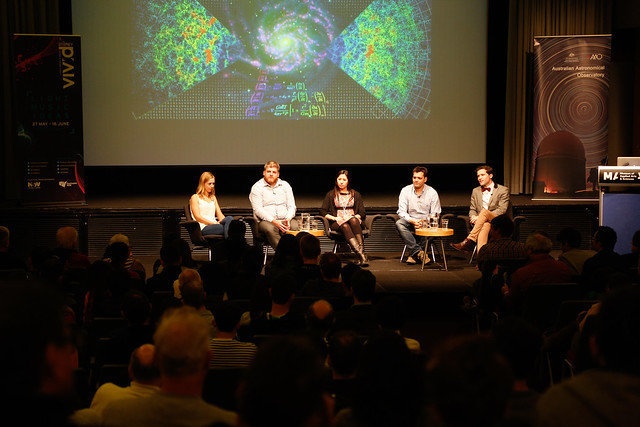
The five astronomers speaking during our “Sydney Vivid Ideas: The Story of Light” started at the Powerhouse Museum, Sydney, 29th May 2016. From left to right: Luke Barnes, Alan Duffy, Vanessa Moss, Liz Mannering and Ángel López-Sánchez. Photo credit: Jenny Ghabache (AAO).
The event was held at the PowerHouse Museum in Sydney on Sunday 29th May 2016. More than 160 people attended this special event. Five young astronomers (me included) talked about Astronomy and Big Data: the light and light-based technologies developed in Australian astronomy for both optical and radio telescopes; the tools, platforms, and techniques used for data analysis and visualization; how astronomers create simulation data; how some of these techniques are being used in other research areas; and the major scientific contributions toward our understanding of the Universe. Indeed, astronomers have been pioneers in developing “Data Science” techniques to make sense of this huge data deluge, many of which are now used in other areas.
We recorded all the event in video, and it is now publicly available in the AAO YouTube channel. Some photos of the event are also compiled below. I want to thank AAO/ITSO Research Astronomer Caroline Foster for helping recording and editing the video and Jenny Ghabache (AAO) for taking the photos of the event.
Full recording of the event “The Story of Light 2016: Deciphering the data encoded on the cosmic light” organised by the AAO for Vivid Sydney Ideas 2016. Credit: AAO. Acknowledgment: Caroline Foster (AAO).
The event was hosted by Alan Duffy (Swinburne University). I was in charge of explaining optical astronomy, the AAO, optical surveys and big data. Then my colleagues Vanessa Moss (Univ of Sydney/CAASTRO), Luke Barnes (Univ. of Sydney) and Liz Mannering (AAO/ICRAR) discussed radio astronomy, the ASKAP and big data (Vanessa), simulating, analysing and visualizing astronomy data (Luke) and astronomy data archive, the All-Sky Virtual Observatory (ASVO) and other virtual observatories (Liz ). After the short 12-15 minutes talks (well, as usual I took a bit more time), the panel welcomed questions from the audience (and even from Twitter using #SoLSydneyIdeas) for a discussion session about Light and Astronomy and the Australian contribution to the improvement of our understanding of the Universe.
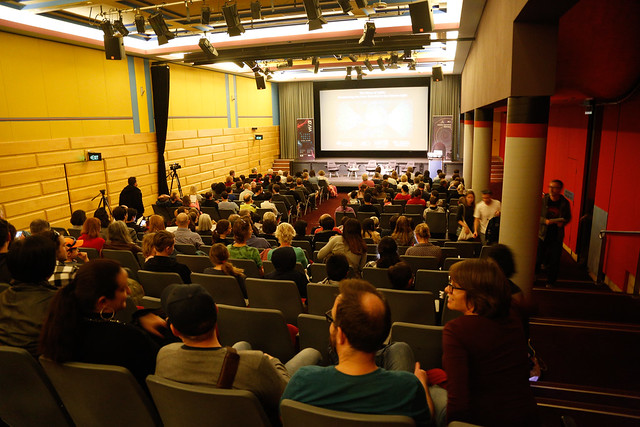
The Lecture Theatre a few minutes before our “Sydney Vivid Ideas: The Story of Light” started at the Powerhouse Museum, Sydney, 29th May 2016. Photo credit: Jenny Ghabache (AAO).
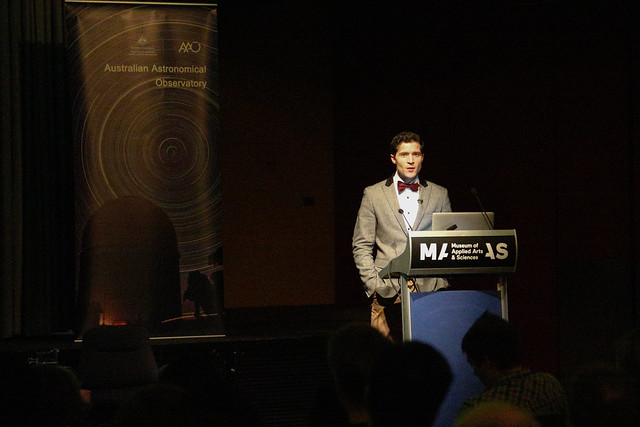
Our host, Alan Duffy, introducing the event. Photo credit: Jenny Ghabache (AAO).
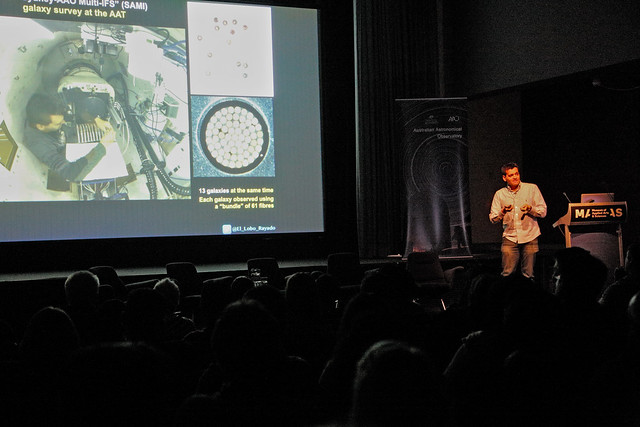
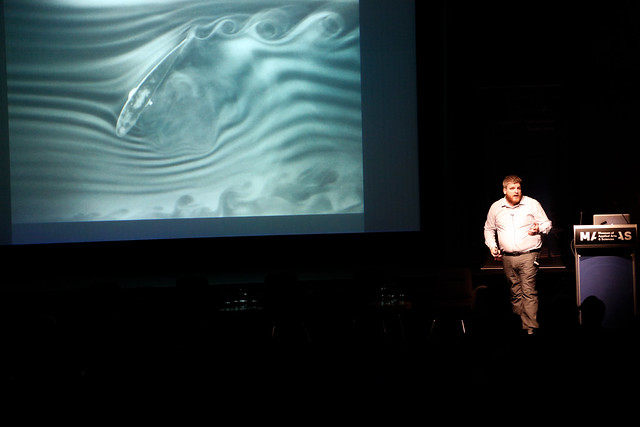
AAO/MQU Research Astronomer Ángel R. López-Sánchez talking about optical astronomy, the AAO and big data. Photo credit: Jenny Ghabache (AAO).
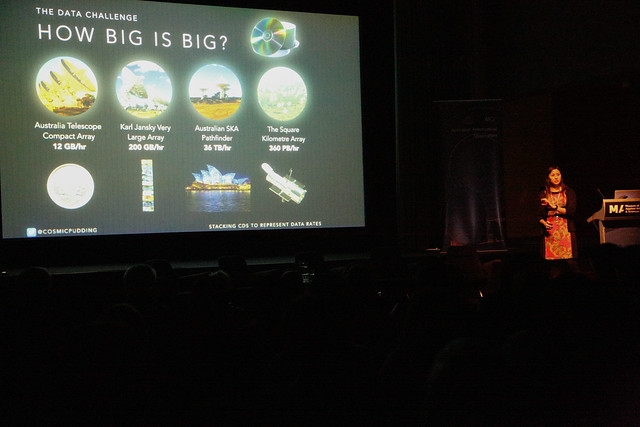
Vanessa Moss (Univ. of Sydney/CAASTRO) talking about radioastronomy, the ASKAP and big data. Photo credit: Jenny Ghabache (AAO).
Luke Barnes (Univ. of Sydney) talking about simulating, analysing and visualizing astronomy data. Photo credit: Jenny Ghabache (AAO).
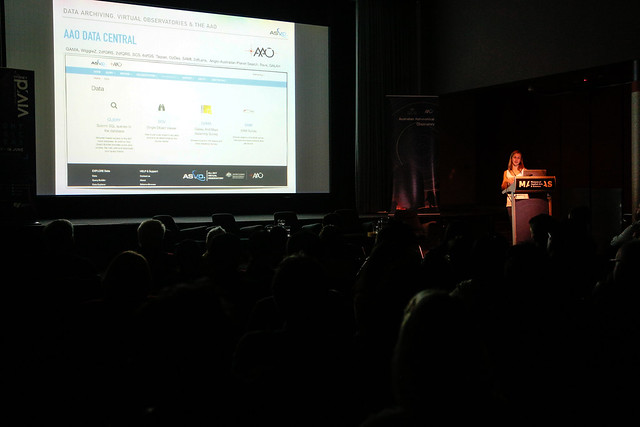
Liz Mannering (Univ. of Sydney) discussed astronomy data archive, the All-Sky Virtual Observatory (ASVO) and other virtual observatories. Photo credit: Jenny Ghabache (AAO).
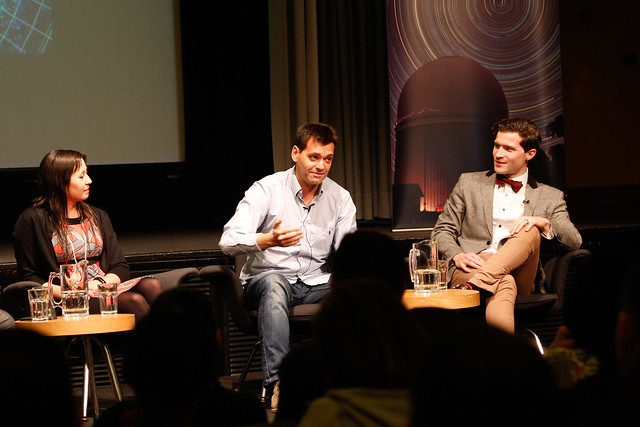
Panel discussion with all participants answering questions from the audience. Photo credit: Jenny Ghabache (AAO).
Angel Lopez-Sanchez answering a question from the audience. Photo credit: Jenny Ghabache (AAO).
And last… Well, if you want to see only my talk, here it is:
One of the scientific projects I’m involved actually is a citizen science program: Radio Galaxy Zoo. Using images from NASA’s Wide-Field Infrared Survey Explorer telescope (WISE) and the NRAO Very Large Array (VLA) in New Mexico, USA, Radio Galaxy Zoo requests participants to associate radio emission (which is related to the relativistic electrons ejected from a massive black hole) with galaxies as seen in infrared light. The aim is to get a better understanding of the super-massive black holes that are located in the center of the galaxies and quantify their importance in galaxy evolution.
My colleagues Julie Banfield (Australian National University) and Ivy Wong (ICRAR and University of Western Australia) lead the Radio Galaxy Zoo (RGZ) team, that was launched on December 2013. Since then, more than 10,000 volunteers have joined in with Radio Galaxy Zoo, classifying over 1.6 million images.
The wide-angle tail galaxy discovered by Terentev and Matorny is one of the largest known, and its host cluster is now known as the Matorny-Terentev cluster. Credit: Radio Galaxy Zoo.
Well, the news is that two RGZ volunteer participants from Russia, Ivan Terentev and Tim Matorny, have discovered a rare galaxy cluster. They found that one particular radio-source had just one of a line of radio blobs that delineate a C-shaped “wide angle tail galaxy” (WAT). The C-shaped was formed because the massive galaxy hosting the super-massive black hole and its associated jets are moving through intergalactic gas, indicating the existence of a cluster of galaxies. The new wide-angle tail galaxy is one of the largest known, and its host cluster is now known as the Matorny-Terentev cluster.
There is plenty of information in the Radio Galaxy Zoo webpage, the CAASTRO Press Release and in this nice Article in “The Conversation” by Ray Norris (CSIRO/Western Sydney University and PI of the EMU project to be conducted in the ASKAP), so I’ll just add here the nice interview to Ivy Wong (ICRAR and University of Western Australia) in Ten News Australia yesterday.