
Last Tuesday 1st of March the famous NASA webpage Astronomy Picture of the Day (APOD) released a very nice image of the galaxy NGC 3310 obtained with the 8.2m Gemini North Telescope in Hawaii (U.S.A.).

Nice image of the starburst spiral galaxy NGC 3310 in the Ursa Major obtained with the 8.2m Gemini North Telescope in Hawaii (U.S.A.). This image was obtained for the “Cosmic Poll” contest organized by the International Telescopes Support Office at the Australian Astronomical Observatory (AAO) and appeared as APOD on 1st March 2016. Colours codify the light received in blue (B, blue) and red (R, green) filters, plus the emission of the ionized gas (Hα filter) coded in red.AAO ITSO Office, Gemini Obs./AURA & T. A. Rector (U. Alaska Anchorage).
NGC 3310 lies at a distance of around 50 million years from us, within stars of the Northern constellation of the Ursa Mayor (meaning we cannot see it here from Australia, well, it has a maximum elevation of ~5 degrees from Siding Spring Observatory). The spiral structure in NGC 3310 looks like what we expect for our own Milky Way galaxy, with plenty of star-forming regions (in red-pink colours tracing the Hα emission). However in the case of NGC 3310, the star-formation activity seems to be more extreme.
It seems that NGC 3310 started experiencing an interaction with a dwarf galaxy around 100 million years ago. This interaction has triggered a very strong star-formation event (that is why NGC 3310 is defined as a starburst galaxy), and has “broken” the external areas of the galaxy as consequence of the intense tidal forces. In the image, all regions showing red-pink colours (tracing Hα emission) are nebulae. These regions are found almost everywhere within NGC 3310, sometimes even forming some peculiar alignments of red-pink-ish regions as that “ray” that goes from the centre of the galaxy till the upper left corner. It is interesting to note that, although the interaction with the dwarf galaxy happened ~100 million years ago, the fact of finding this large amount of Hα emission informs that the star-formation activity is still important today. The colliding dwarf galaxy was probably engulfed by NGC 3310, its remaining debris could be that diffuse arc-like structure we observed in the outskirts of the galaxy in the upper part of the image.
These are the kind of objects (starburst galaxies) and the kind of features (enhanced Hα activity, tidal distortions of the stellar component of the galaxy, tails, rays…) I studied in a sample of dwarf galaxies for my PhD Thesis (I still have to tell all of that here…).
Beside tracing the nebular (Hα) emission, the image also allows to distinguish that the majority of the stars in NGC 3310 have blue colours, even in its external areas. Again, this fact informs that the dominant stellar populations in this galaxy are relatively young, as only young stars emit a lot of light in blue and ultraviolet colours.
Although it was not said in the APOD I would like to remark that the idea of observing this galaxy in the 8.2m Gemini North Telescope came from the International Telescopes Support Office at the Australian Astronomical Observatory (AAO). In particular, mi colleagues Elaina Hyde, Richard McDermid, Caroline Foster-Guanzon and Stuart Ryder (AAO) organized a very interesting outreach initiative, the Cosmic Poll, asking the people to emit a vote for which kind of object would they like to be observed at the 8.2m Gemini Telescope. The winning entry was “an individual galaxy”, and later they decided to observe NGC 3310. Furthermore they organised an on-line event,a live-stream with the Gemini North Telescope (is available on YouTube) explaining how the telescope works and giving details of the observatory. The Gemini Observatory website also included this in its blog. After processing and cleaning the images, the final result is that you see in APOD.
I couldn’t help myself, though, and decided to play a bit with the colours, levels, contrast and lights of the image to try to get an enhanced image of this very nice object. In my opinion, the central part of the galaxy is a bit too bright (it should be, of course, the real difference in brightness between the central part of NGC 3310 and the diffuse stellar streams in its outskirts is several orders of magnitude, but for illustration purposes I have found that it is a good idea to minimize that) and the outskirts of the galaxy are not that easy to see. So here it goes my enhanced image of NGC 3310 with Gemini North:
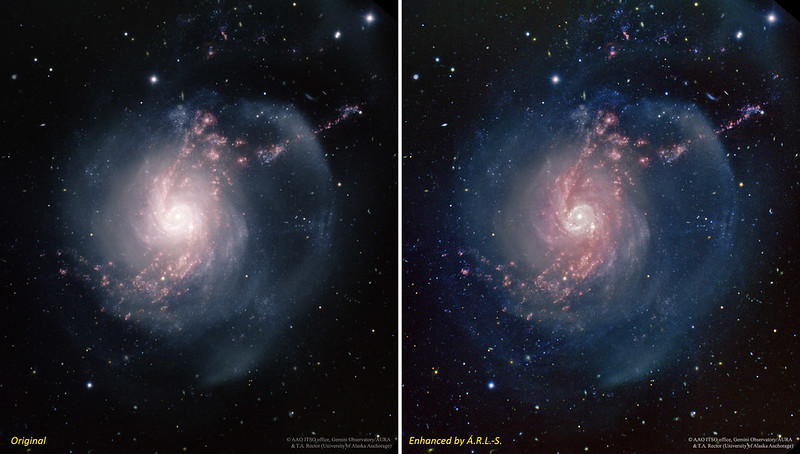
Comparison between the image of the starburst spiral galaxy NGC 3310 obtained by the 8.2m Gemini North Telescope and published in APOD on 1st March 2016 (left) and the same image enhanced by myself (right). Credit: AAO ITSO Office, Gemini Obs./AURA & T. A. Rector (U. Alaska Anchorage), Enhancement: Ángel R. López-Sánchez (AAO/MQ)
What do you think? What image do you like more?






 A/Prof. Ángel R. López-Sánchez