Tag Archives: 2dF

A 2dF night at the Anglo-Australian Telescope

One of the most complex astronomical instruments nowadays available is the Two Degree Field (2dF) system at the Anglo-Australian Telescope (AAT, Siding Spring Observatory, NSW, Australia). The main part of 2dF is a robot gantry which allows to position up to 400 optical fibers in any object anywhere within a “two degree field” of the sky.

The 2dF instrument attached to the primary focus of the AAT. Note that the mirror of the telescope is opened. This image was chosen to be part of the Stories from Siding Spring Observatory Photo Exhibition the AAO organized last year.
Credit: Á.R.L-S.

392 optical fibers are fed to the AAOmega spectrograph, which allows to obtain the full optical spectrum of every object targeted by an optical fiber. The remaining 8 optical fibers are actually fibre-bundles and are used to get an accurate tracking of the telescope while astronomers are observing that field, which may last up to 3 hours. 2dF possesses two field plates: one located at the primary focus of the telescope and another at the position of the robot gantry. While a field is being observed in one plate, 2dF configures the next field on the other plate. A tumbling mechanism is used to exchange the plates. 2dF was designed at the AAO in the late 90s and, since then, it has been used by a large number of international astrophysicists. In a clear night, 2dF can obtain high-quality optical spectroscopic data of more than 2,800 objects.

Indeed, this sophisticated instrument has conducted observations for hundreds of astronomical projects, including galaxy surveys such as the 2dF Galaxy Redshift Survey, the WiggleZ Dark Energy Survey, and the Galaxy And Mass Assembly (GAMA), survey which is still on going and in which I actively participate. The optical fibers of 2dF can be also fed the new HERMES spectrograph, which is now starting the ambitious Galactic Archaeology with HERMES (GALAH) survey at the AAT. GALAH aims to observe around 1 million galactic stars to measure elemental abundances and measure stellar kinematics.

Frame of the time-lapse video “A 2dF night at the Anglo-Australian Telescope”. The 2dF robot gantry moving and positioning the optical fibers. Credit: Á.R.L-S.

How does 2dF move and position the optical fibers? A very nice way of explain it is using the time-lapse technique, that is, taking many images and then adding all to get a movie of the robot while moving and positioning the fibers. That is why in 2012 I decided to create the video, A 2dF night at the AAT, which assembles 14 time-lapse sequences taken at the AAT during September and November 2011 while I was working at the AAT as support astronomer of the 2dF instrument. Actually, this time-lapse video shows not only how 2dF works but also how the AAT and the dome move and the beauty of the Southern Sky in spring and summer. The time-lapse lasts for 2.9 minutes and combines more than 4000 frames obtained using a CANON EOS 600D provided with a 10-20mm wide-angle lens.

Time-lapse video “A 2dF night at the AAT”. I recommend to follow the link to YouTube and watch it at HD and full screen in a dark room. Credit: Á.R.L-S.

The video consists in three kinds of sequences created at 24 frames per second (fps). The first 3 sequences show how the 2dF robot gantry moves the optical fibers over a plate located at the primary focus of the telescope. Although in real life 2dF needs around 40-45 minutes to configure a full field with 400 fibers, the time-lapse technique allows to speed this process. The first 2 sequences have been assembled taking 1 exposure per second, therefore 1 second of the video corresponds to 24 seconds in real life. The third sequence considers an exposure each 3 seconds, and hence it shows the robot moving very quickly. The next four sequences show the movement of the telescope and the dome. All of them were obtained taking 2 images per second (a second in the movie corresponds to 12 seconds in real life). The long black tube located at the primary focus of the telescope is 2dF. The remaining sequences, all obtained during the night, were created taking exposures of 30 seconds, and hence each second in the video corresponds to 12 minutes in real life.

Frame of the time-lapse video “A 2dF night at the Anglo-Australian Telescope”. The AAT telescope, with 2dF (the long, black tube) attached at its primary focus, is prepared to start observing. Credit: Á.R.L-S.

Astronomical time-lapse videos allow to see the movement of the Moon, planets and stars in a particular position in the Earth, something that conventional videos cannot achieve. In particular, dim stars and faint sky features, such as the Milky Way with its bright and dark clouds and the Magellanic Clouds, can be now easily recorded. As in my first time-lapse video, The Sky over the AAT, I set the camera up at the beginning of the night, let it run, and check on its progress occasionally. I used at focal of f5.6 and an ISO speed of 1600 ISO for the night sequences.
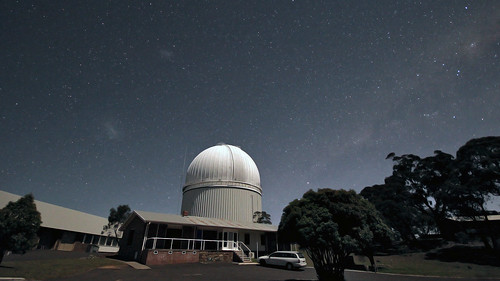
Frame of the time-lapse video “A 2dF night at the Anglo-Australian Telescope”. The Magellanic Cloud rise while the Milky Way sets over the Anglo-Australian Telescope at Siding Spring Observatory on 3 Nov 2011. Some kangaroos can be seen in the ground. Credit: Á.R.L-S.

However, the procedure that took more time was processing the hundreds of individual photographies included in each sequence. In many cases, I needed more than 12 hours of computer time, including 3 or 4 iterations per sequence, to get a good combination of low noise and details of the sky, plus “cleaning” bad pixels or cosmic rays. In particular, for this video I tried hard to show the colours of the stars, a detail which is usually lost when increasing the contrast to reveal the faintest stars. In the last sequence of the video, Aldebaran and Betelgeuse appear clearly red, while the stars in the Pleiades and Rigel have a blue color.

Frame of the time-lapse video “A 2dF night at the Anglo-Australian Telescope”. A dark night at The Anglo-Australian Telescope (23 Sep 2011). Orion constellation is seen over the AAT dome. The red colour of Alderaban and Betelgeuse and blue colours of Pleiades and Rigel are clearly distinguished. Credit: Á.R.L-S.

As I did for my previous time-lapse, here I also included a sequence which shows the trails created by the stars as they move in the sky as a consequence of the rotation of the Earth. This sequence shows the Celestial Equator and stars at the South (top) and North (bottom) Celestial Hemisphere. Note that star trails have indeed many different colours. Other details that appear in this time-lapse video are clouds moving over the AAT, satellites and airplanes crossing the sky, the nebular emission of the Orion and Carina nebulae, the moonlight entering in the AAT dome, and kangaroos “jumping” in the ground.

Frame of the time-lapse video “A 2dF night at the Anglo-Australian Telescope”. Startrails over the Anglo-Australian Telescope on 23 Sep 2011. The colours of the stars are clearly seen in this image, which stacks 1h 6min of observing time. Credit: Á.R.L-S.

Finally, I chose an energetic soundtrack which moves with both 2dF and the sky. It is the theme Blue Raider of the group Epic Soul Factory, by the composer Cesc Villà. Actually, all sequences were created to fit the changes in the music, something that also gave me some headaches. But I think the result was worth all the effort.

Stories from Siding Spring Observatory

Tonight we’re opening the photo exhibition Stories from Siding Spring Observatory at Sydney Observatory.

Baner of the Photo Exhibition Stories from Siding Spring Observatory opening tonight at Sydney Observatory. The Exhibition will be opened to the public between 18 April 2013 and 13 August 2013. As the general visit to Sydney Observatory, it is free.
Credit: Á.R.L-S.

This photo exhibition compiles 25 photos plus four time-lapse videos taken at the Siding Spring Observatory by staff of the Australian Astronomical Observatory. I have actively participated in the organization of this photo exhibition, not only providing some photos (see below) but also the 4 time-lapse videos, one of them specifically prepared for this.

The idea of organizing the photo exhibition came after the terrible bushfires that destroyed the Warrumbungle National Park and seriously affected Siding Spring Observatory on 13th January 2013. Luckily any telescope experienced any damage and we were back at the telescopes just 1 month after the bushfires. However, some houses and facilities, including the ANU Lodge, were destroyed in the bushfires. The vegetation at the site was also seriously affected, and indeed the views from there are not now as beautiful as they were before.

As the brochure of the Exhibition quotes,

Siding Spring Observatory sits on a mountaintop in the Warrumbungle Range, 400 km northwest of Sydney and 25 km west of the town of Coonabarabran. Run by the Australian National University, it is Australia’s most important site for optical astronomy.

On 13 January 2013 a bushfire swept through the observatory. Despite damage to some buildings, the telescopes were unharmed and are now back at work.

The photos in this exhibition tell stories of life and work on the mountain. They were taken by staff of the Australian Astronomical Observatory (AAO), which operates two telescopes there: the 4-m Anglo-Australian Telescope (AAT) and the UK Schmidt telescope.

Yesterday evening some of us were there installing the Exhibition and hanging frames and labels from the walls of the Sydney Observatory:

Working hard to get all frames and labels done on time!
Credit: Á.R.L-S.

Jamie Gilbert (AAO) carefully hanging label to my photo “Day and Night”.
Credit: Á.R.L-S.

The photos I’m providing for the Exhibition are these:

The 3.9m Anglo-Australian Telescope (AAT).
Credit: Á.R.L-S.

The 2dF instrument attached to the primary focus of the AAT.
Note that the mirror of the telescope is opened.
Credit: Á.R.L-S.

Day and Night at the AAT.
Credit: Á.R.L-S.

Circumpolar stars over the AAT on a dark winter night.
Credit: Á.R.L-S.

Double Rainbow at the sunrise over the Warrumbungle National Park. Photos taken from the catwalk of the AAT by Amanda Bauer (AAO) and processed and stitched by me.
Credit: Amanda Bauer & Ángel R. López-Sánchez.

but you can find many more photos I took at Siding Spring Observatory during the last years in this album of my Flickr.

However I have to confess that, as Amanda Bauer says in her blog, the best of the photos we have chosen is this spectacular panorama of the Milky Way over the AAT obtained by Jamie Gilbert (AAO):

Panorama of the Milky Way over the Anglo-Australian Telescope (AAT) using a CANON 5D Mark III. More information about this image: here.
Credit: Jamie Gilbert (AAO)

and that is why this photo is the largest one!

Jamie Gilbert and the frame with his panorama “The Milky Way over the AAT” during the installation of the photos of the “Stories from Siding Spring Observatory” Exhibition at Sydney Observatory on the evening of 16 April 2013
Credit: Á.R.L-S.

The Photo Exhibition Stories from Siding Spring Observatory is open to the public between 18 April 2013 and 13 August 2013. As the general visit to Sydney Observatory, it is free, so do not miss it if you have a chance!

NEA 2012 DA14 observed from the AAT

Yesterday I explained we are resuming the scientific observations at Siding Spring Observatory (NSW, Australia) since the recent bushfires on 13 January 2013. Today we have used this telescope to observe the Near Earth Asteroid (NEA) 2012 DA14, which is getting its closest encounter to our planet today (it will be at only 27000 km from the surface of the Earth). Here you have the details:


The path of the NEA 2012 DA14 from the AAT. Observed during the evening twilight on the 15 February 2013 using the FPI camera of the 2dF instrument at the 3.9m Anglo-Australian Telescope located at Siding Spring Observatory (NSW, Australia). 25 frames, 2 seconds exposure each, 5 seconds between frames. First frame obtained at 09:53:54 UT, last one at 09:56:22.
Support Astronomers: Lee Spitler (MQ/AAO) & Andy Green (AAO).
Night Assistant at the AAT: Steve Chapman (AAO).
Edition of the data and movie: Ángel R. López-Sánchez (AAO/MQ).
Link to the video in my Flick.

The data were obtained by Lee Spitler (MQ/AAO), Andy Green (AAO) and Steve Chapman (AAO) during the evening twilight while waiting the sky was dark enough to start the scheduled scientific observations. We will try to get more data of this object during the morning twilight. More to come soon!

Update at 14:45 AEST, 16th Feb 2013

I’ve checked there are some problems to watch the video using smartphones and tablets such iPhones and iPad. Just try this link and it should work, although you may get a low resolution version of it. I’m creating a new video to be uploaded to YouTube. At the same time, I’ve just finished this image showing a mosaic with 13 of the frames obtained for the video.

Mosaic with the path of the NEA 2012 DA14 from the AAT. Observed during the evening twilight on the 15 February 2013 using the FPI camera of the 2dF instrument at the 3.9m Anglo-Australian Telescope located at Siding Spring Observatory (NSW, Australia). Each frame has an exposition time of 2 seconds.Times are shown in Universal Time (UT), add +11 hours to get the local time in NSW.
Support Astronomers: Lee Spitler (MQ/AAO) & Andy Green (AAO).
Night Assistant at the AAT: Steve Chapman (AAO).
Edition of the data and movie: Ángel R. López-Sánchez (AAO/MQ).


Finally, I confirm we also observed the NEA at the AAT during the morning twilight.

Update at 16:55 AEST, 18th Feb 2013

An updated version of the video, which is now in HD and includes the celestial coordinates, has been included in this excellent article published today in The Conversation by Simon O’Toole (AAO).


The path of the NEA 2012 DA14 from the AAT. Observed during the evening twilight on the 15 February 2013 using the FPI camera of the 2dF instrument at the 3.9m Anglo-Australian Telescope located at Siding Spring Observatory (NSW, Australia). 25 frames, 2 seconds exposure each, 5 seconds between frames. First frame obtained at 09:53:54 UT, last one at 09:56:22.
Support Astronomers: Lee Spitler (MQ/AAO) & Andy Green (AAO).
Night Assistant at the AAT: Steve Chapman (AAO).
Edition of the data and movie: Ángel R. López-Sánchez (AAO/MQ).

Back observing at the Anglo-Australian Telescope

On 13th January 2013 the Siding Spring Observatory and the beautiful Warrumbungle National Park near Coonabarabran (NSW, Australia) were terribly affected by the worst bushfire in NSW in the last decade. Although the astronomical facilities have not experienced any severe damage, the bushfire has destroyed some houses at the Observatory (including the Lodge), burnt tens of houses and destroyed the majority of the trees in the National Park.

However, tonight Thursday 14 February, after a month and a day since the bushfire, astronomers are recommencing observing with the 3.9-m Anglo-Australian Telescope at Siding Spring Observatory. I’m one of these astronomers who are now performing the observations remotely from the Australian Astronomical Observatory (AAO) headquarters in North Ryde, Sydney, supported by technical staff at the telescope. The AAO has made public today a press release informing that astronomers are back to work at the AAT!.

The Spindle Galaxy with the AAT. It is an edge-on lenticular galaxy classified as NGC 3155 or Caldwell 53. The data were obtained on 14 February 2013 using the FPI camera of the 2dF instrument at the 3.9m Anglo-Australian Telescope located at Siding Spring Observatory. 8 x 20 s + 5 x 40 s + 1 x 60 s integration time (460 s), combined with IRAF. Colours derived using U, V and I images obtained at the 2.5m Cerro Tololo International Observatory by Kuchinski et al. (2000).
First astronomical observations after the bushfires on 13 January 2013.
Credit: Ángel R. López-Sánchez (AAO/MQ) & Lee Spitler (MQ/AAO),
Night Assistant at the AAT: Steve Chapman (AAO)
.

Although we are using tonight the Two Degrees Field (2dF) instrument with the AAOmega spectrograph, which allows the acquisition of up to 392 simultaneous spectra of objects anywhere within a two degree field on the sky, we have also used the auxiliary camera that 2dF possesses, the Focal Plane Imager, to take some images of the Spindle galaxy, also known NGC 3115 or Caldwell 53, a lenticular (S0) galaxy located at around 32 million light years from Earth.

However, tonight’s observations are having the AAT looking up to a billion light-years out into space to test our ideas about the still mysterious Dark Energy.