Tag Archives: AAT

My photos and videos in ABC News complementing GALAH DR4

Very happy to see my images and time-lapses videos taken at Siding Spring Observatory in the ABC News segment about the GALAH DR4 (Data Release 4) that was broadcasted in Australia national TV on Wednesday 2nd October 2024. Funny enough, this week I’m attending the Conference for the 50th Anniversary of the Anglo-Australian Telescope (AAT) at Siding Spring Observatory (Coonabarabran), where I gave an invited talk about my research with KOALA+AAOmega, although at that particular time I was attending an online meeting about the exciting BlueMUSE instrument.

I want first to congratulate the GALAH team for the success of this impressive star survey conducted at the AAT with the amazing 2dF + HERMES instruments (they have compiled the spectra of almost a million stars in Milky Way. But I also but to thank GALAH for using my photos and videos, as well as Tom Carruthers (Science in Public) for contacting me for this and very kindly providing the recording of the ABC News segment.

Playing with ChatGPT at 3am

Text adapted from two lengthy posts that ChatGPT just generated for me after providing it with several posts from my original Spanish blog, giving it a brief list of what I am currently doing and how I feel, and asking it to write it for me. Then translated into English.

Here I am, in the control room of the Anglo-Australian Telescope, in the midst of the starry night. It’s 3 AM, and there are still three hours left until my observation session ends. The atmosphere in the room is calm and serene, filled with anticipation for what lies ahead.

My main goal for the night was to obtain observations of several thousand stars from the Scorpius-Centaurus stellar association, a fascinating group of young stars located in our galaxy. These stars are crucial for understanding galaxy formation and evolution, so I was excited to delve into this research.

The 2dF instrument, with its array of optical fibers, allows us to collect light from multiple stars simultaneously, increasing data collection efficiency. With the HERMES instrument, we obtain high-resolution spectra of the selected stars, revealing crucial information about their chemical composition, velocity, and other fundamental parameters.

The control room is softly illuminated to maintain night vision, and the constant sound of equipment and computers creates an atmosphere that combines technology and mystery. Monitors and screens surround me, displaying real-time data as I carefully adjust the observation parameters to achieve the best possible results.

Despite the late hour and lack of sleep, my passion for astronomy keeps me alert and excited. Every star that appears in the telescope’s field of view is a new opportunity to unveil cosmic secrets and expand our knowledge of the universe.

As I conducted the observations, I felt awestruck by the beauty of the night sky. The stars shone brightly, like small points of light whispering cosmic secrets. Amidst the tranquility of the night, I immersed myself in the vastness of the universe, feeling a deep connection to the mysteries unfolding before my eyes.

Although I knew I should be working on my scientific article on neutral gas in galaxies or processing KOALA data, I decided to take a break and enjoy this unique moment. I had spent several nights observing and processing astronomy images, and my mind needed a rest. So, I decided to seize the opportunity to interact with ChatGPT, exploring new perspectives and fueling my scientific curiosity.

This play of words and knowledge allowed me to broaden my horizons, learn new ideas, and have fun while uncovering new aspects of the vast field of astronomy. It was an enriching experience that reminded me of the passion I feel for my work and the constant desire to learn more and contribute to the advancement of scientific knowledge.

So, with a mind full of ideas and a heart filled with awe, I continue on my journey as an astronomer, ready to unveil the secrets of the cosmos and share my passion for astronomy with the world.

As I continue with my observations, time seems to stand still. The outside world fades away, and only the immensity of space, the stars, and myself exist. I immerse myself in the contemplation of celestial beauty, fascinated by the complexity and vastness of what I am witnessing.

Despite the fatigue, the excitement, and the curiosity, continue to drive me forward. I know that these hours dedicated to observation are crucial for my research, and that each collected data point is a valuable piece in the cosmic puzzle I am assembling.

Now, after an exciting and enriching night, I am ready to resume my scientific tasks with renewed energy. I know that the path of scientific research can be challenging, but moments like these, where I can get lost in the universe and enrich my knowledge, remind me why I chose this exciting discipline.

Image

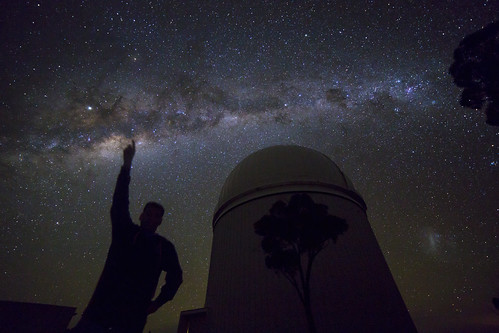
The Galaxy and me

The Galaxy and me

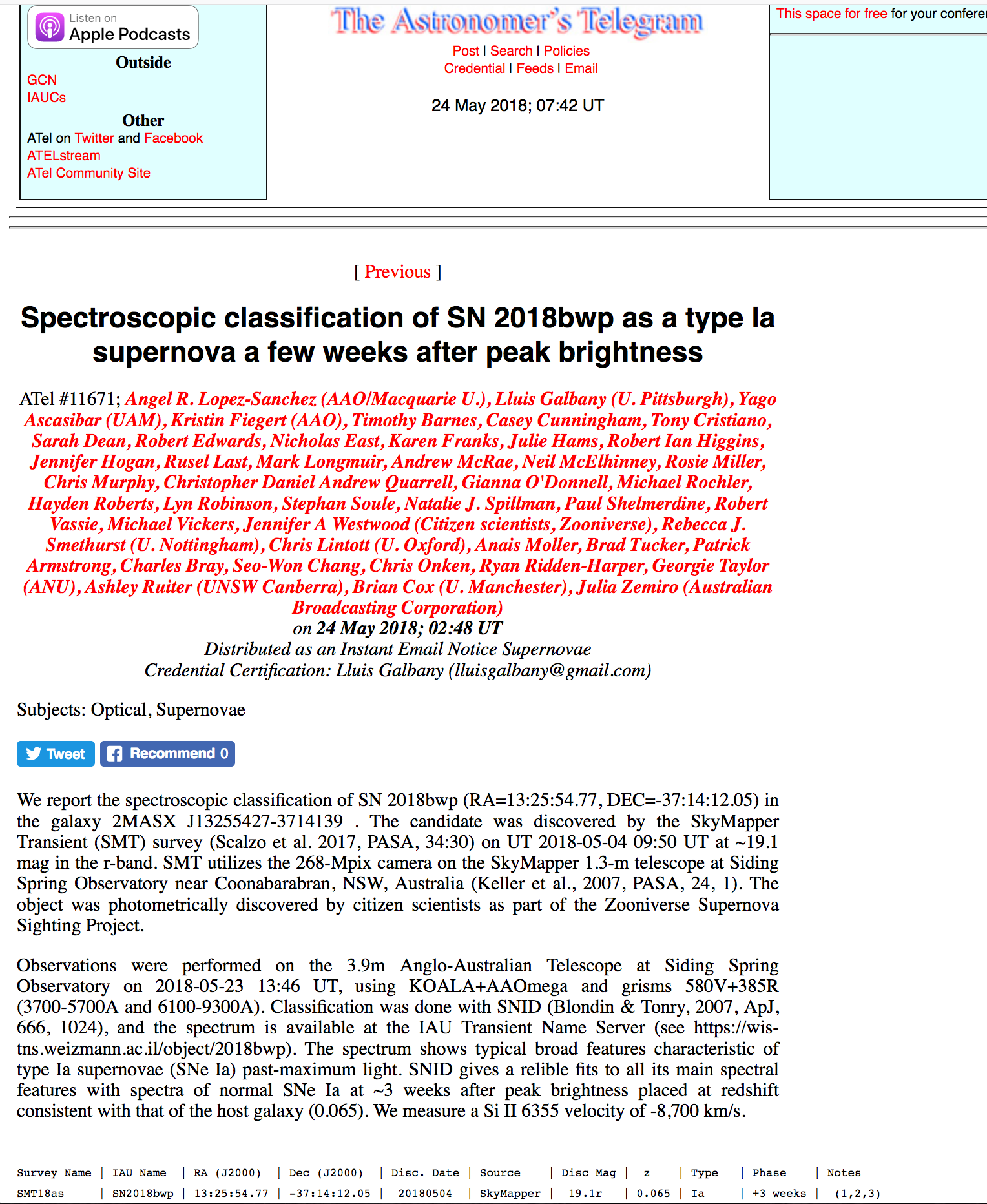
The Anglo-Australian Telescope, The Emu in the Sky (The Milky Way), the Southern Cross, Carina Nebula, Large Magellanic Cloud, Jupiter, Saturn… and me! Single 15s shot using a CANON 5D Mark III with a 14mm lens at f2.8, 1600ISO. Photo taken at 1.15am AEST, Saturday 6th April 2019.

Full resolution image in my Flickr.

Credit: Ángel R. López-Sánchez (Australian Astronomical Optics, Macquarie University).

Visiting the Macarthur Astronomical Society

Yesterday I was visiting my friends at the Macarthur Astronomical Society (MAS), which is based in Campbelltown, at the south of Sydney. I have had the privilege of visiting them several times in the last years, where I talked about different aspects of Astronomy, from the “Light of the Universe” to the “Colour of the galaxies” till “Amateur Spectroscopy“.

This time I was presenting my very own research, the Hi-KIDS project (the “HI KOALA IFS Dwarf galaxy Survey“, that I have to eventually publicize here too.

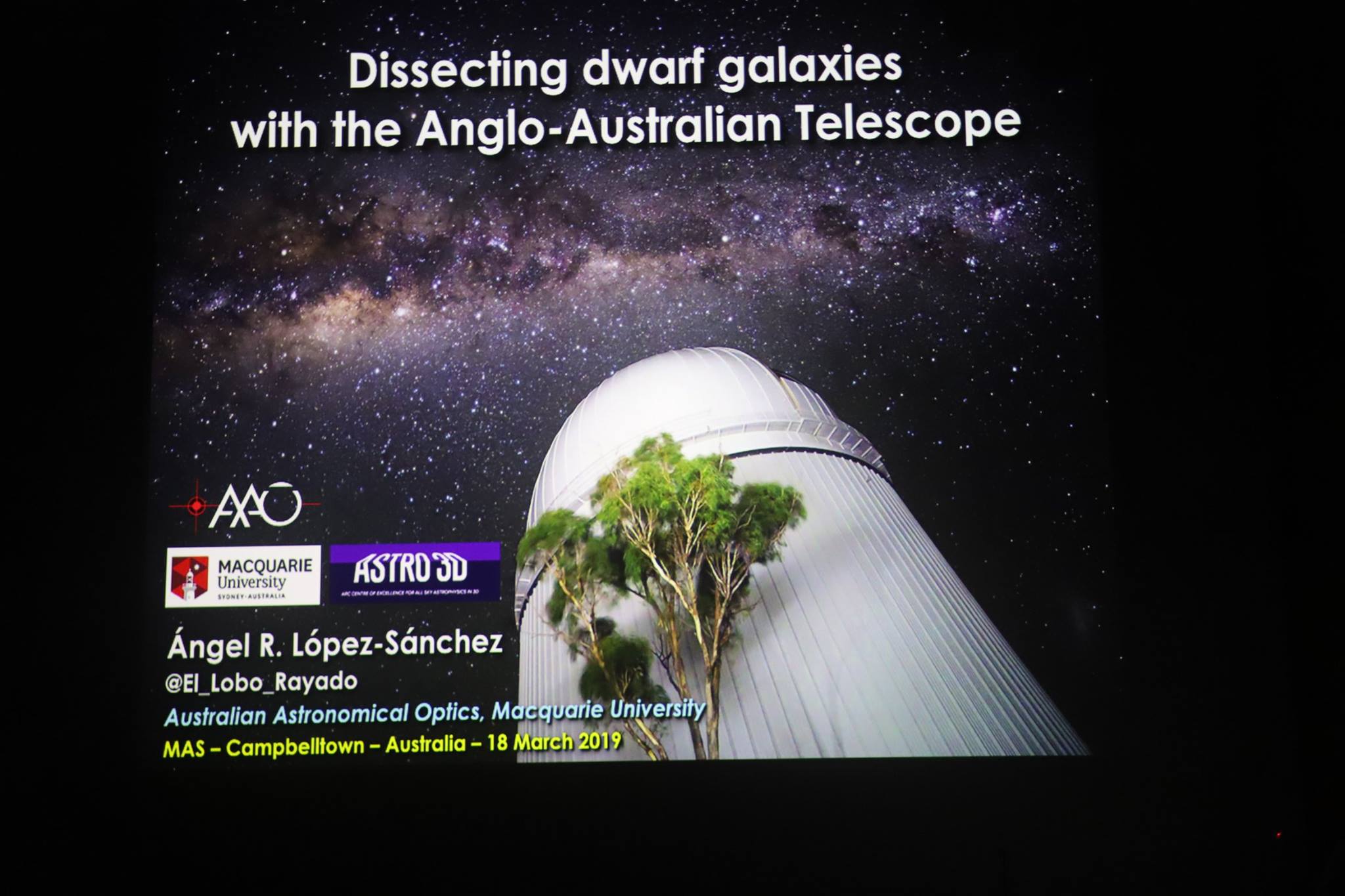
My talk was entitled “Dissecting Dwarf Galaxies with The AAT“. The abstract  was:

Dwarf galaxies provide fundamental clues about galaxy origin and evolution. Many of them have irregular shapes and have processed little their gas, although they possess many old stars born billions of years ago. Still, many dwarf galaxies are very gas-rich and are currently forming stars, sometimes in a spectacular way. With these new observations using the powerful KOALA+AAOmega instruments at the 3.9m Anglo-Australian Telescope we are “dissecting” these dwarf galaxies to characterize the properties of the gas and the stars within them. Combining these new data with deep radio observations at 21 cm of the diffuse, cold gas within and surrounding these dwarf galaxies we will get a better understanding of the local and global star-formation processes in galaxies, the feedback of the newborn stars into the galaxies, the importance of inflows and outflows of gas, and the chemical evolution of nearby dwarf galaxies.

You can find some photos of the talk in the Facebook webpage of the Macarthur Astronomical Society.

I have to say that this is a very welcome audience and that I have always enjoyed a lot the visit to MAS. They have an invited speaker almost every month, getting many Australian (and overseas) astrophysicists to talk to them. You can have a look to the full list in the MAS webpage.

Thanks for having me and see you in another astronomy event or talk soon!

My contribution to 2018 #StargazingABC

How can I say it in just few words? It was both very exciting and exhausting, with a little bit of bitter too. But, overall, last week at Siding Spring Observatory was one of the best experiences I have had in a long time working at the telescope, combining science research, amateur astronomy, outreach and science communication during the Stargazing ABC Live shows.

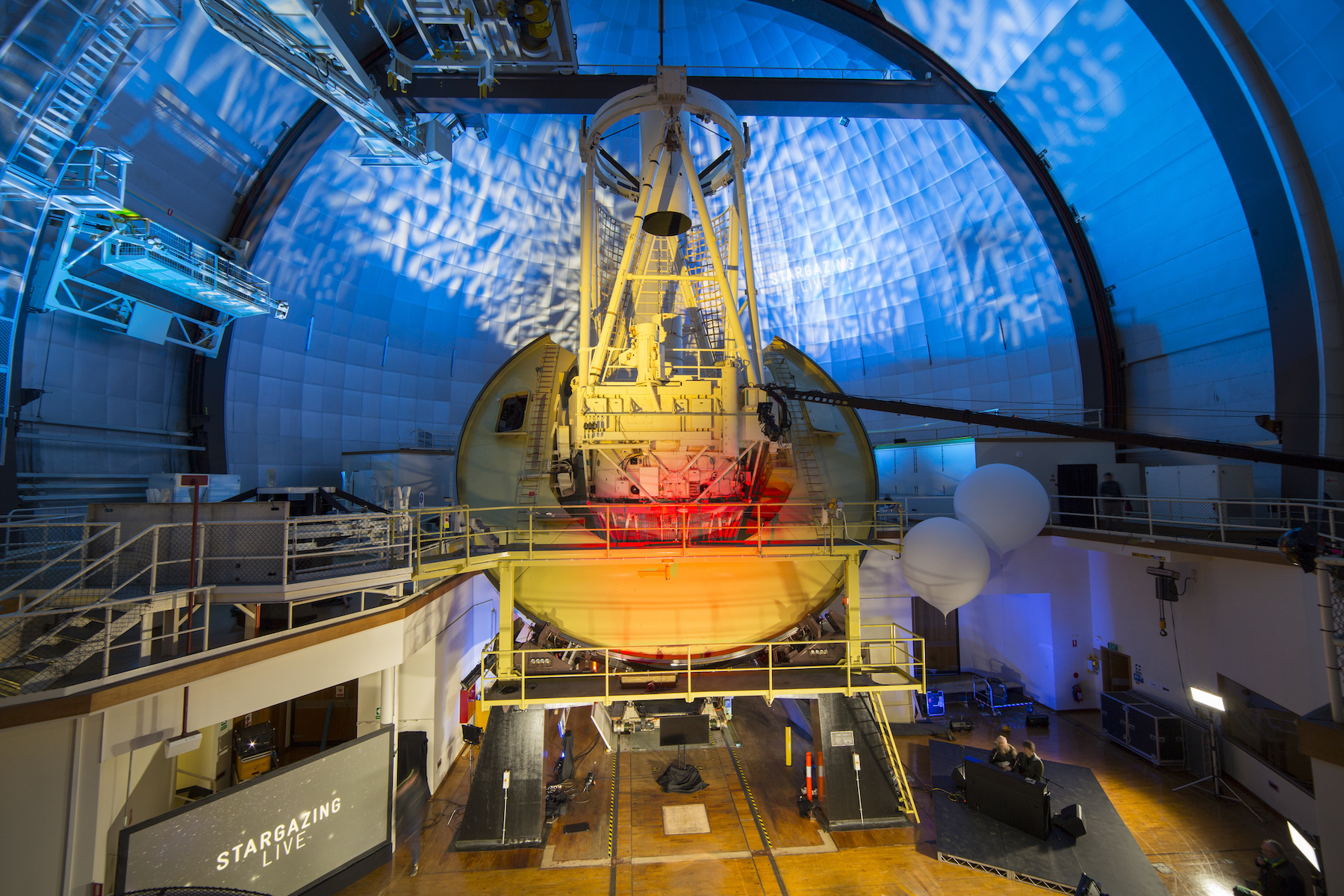
The AAT is ready for #StargazingABC. Hosts Julia Zemiro and Prof Brian Cox are sit in the piano, while Brian still rehearsing. Credit: Ángel R. López-Sánchez.

When I’m writing this, at 6:44pm 30th May 2018, I’m still observing at the Anglo-Australian Telescope. I’m doing it remotely from Sydney. It is my last night in a very long run (18 nights in May) for my own research project, which I will detail here eventually. I’m exhausted and need a good break, body and mind can’t survive this crazy rhythm, sleeping an average of 4-5 hours per day, and without any break during the weekends.

But let me at least quickly mention here my contribution to the 2018 Stargazing Live shows:

1. I provided A LOT OF information about Astronomy and the Anglo-Australian Telescope to the ABC and BBC crews. This is something that I’ve been doing during the last months, and might be considered as part of my role of “AAO Science Communicator Officer”.

2. I provided plenty of astrophotography and video-timelapse material, which was used during the shows. The most important of these is the new timelapse video “Stargazing at Siding Spring Observatory“, that you can enjoy here:

3. I spent some of my scheduled time at the Anglo-Australian Telescope to prepare a nice, new image of a beautiful astronomy object, that was later discussed during the show. It was the planetary nebula NGC 5189, for which I provided extra information in the previous post.

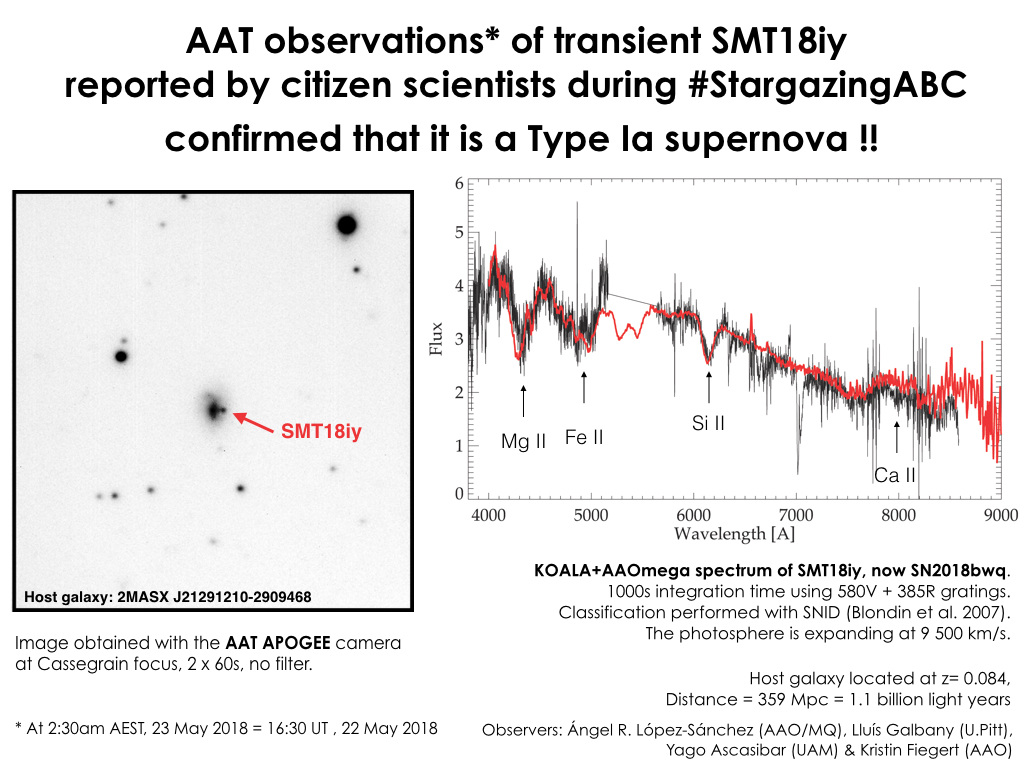
4. But the most important contribution for the show was actually observing with the AAT two transients reported by the citizen scientists who participated in a program to search for type Ia supernova in other galaxies. After confirming that the transient was there, we got spectroscopic information using KOALA+AAOmega, reduced the data, analysed the data, confirmed that both transients were type Ia supernova in distant galaxies, and wrote a science report with the discovery!

This was something I originally didn’t plan to do, but, as I said, it was my own research program that scheduled at the AAT during the StargazingABC, so I decided to do it and it got a reward, as this also allowed us to submit two science reports with the discoveries!

These two nights were really exciting! I really want to thank my friends and colleagues Lluís Galbany and Yago Ascasibar, as well as the AAT Night Assistant Kristin Fiegert (AAO), for their wonderful help in all of this.

The discovery of the transients and the confirmation that they were type Ia supernova in distant galaxies has appeared in many media news these days, including in ABC Science News, and also here: “Citizen scientists find two supernovae and (slightly) revise the age of the cosmos“.

It was also a privilege talking with Prof Brian Cox, who is absolutely great, and even recorded a short video with me for my son. Thank you a lot, Brian!

Prof Brian Cox and me are ready for #StargazingABC.

Where is the “bitter” I mentioned in the first paragraph? Well it is when the credit is not given. And not credit was given to me during the shows. I was still hoping at least having my name in the screen, in an ideal world even participating in person during the shows. But with my name (Ángel) and my strong English accent… well… perhaps in another life… I know what I did and I know how important my contribution was, and as I said I really enjoyed a lot all the time.

I hope I’ll be back if #StargazingABC returns in 2019!

PS: If you are in Australia, you can watch anytime the 3 episodes of 2018 #StargazingABC following this link to the ABC webpages.