
During the last few days the news are talking about the “Supermoon” happening on Monday 14th November. The reports (some examples here, here and here) say that “it will be the brightest Full Moon in years“. Even we at the Australian Astronomical Observatory have been asked about this “very rare phenomenon“. But how much is true about all of this?
Let’s take a look. First of all we should have clear that the Moon, as any other small body moving around a larger body, has an elliptical orbit.
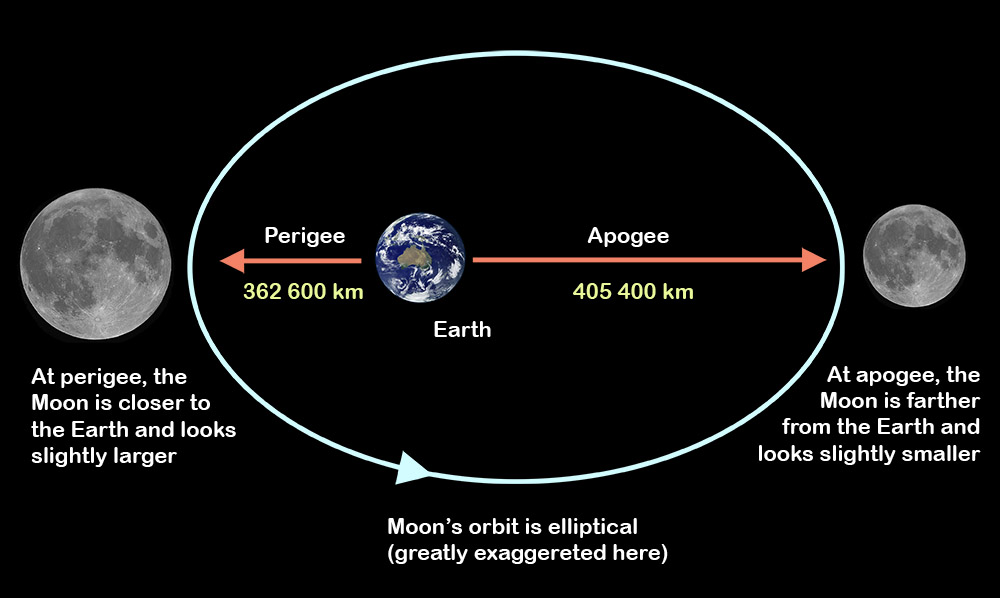
Diagram explaining the movement of the Moon around the Earth following an elliptical orbit and defining the perigee and the apogee. Not in scale. Credit: Ángel R. López-Sánchez. Moon image: Paco Bellido.
Planets also move around the Sun following elliptical orbits, as it was discovered by the great astronomer (and the first real astrophysicist in History, although he also had to work as an astrologer to get a salary) Johannes Kepler at the beginning of the 17th century.
This means that sometimes the Moon is closer to the Earth and sometimes it is farther from the Earth, just depending on where it is located within its orbit. The point on the Moon’s orbit closest to Earth is called the perigee (at an average distance of 362 600 km) and the point farthest away is the apogee (at an average distance of 405 400 km). On average the Moon-Earth distance is about 382 900 kilometers.
Therefore, just because of its distance, the apparent size of the Moon is a bit larger than usual when it is at the perigee, while it seems a bit smaller than usual when the Moon is at the apogee. An image can explain this much better than words:
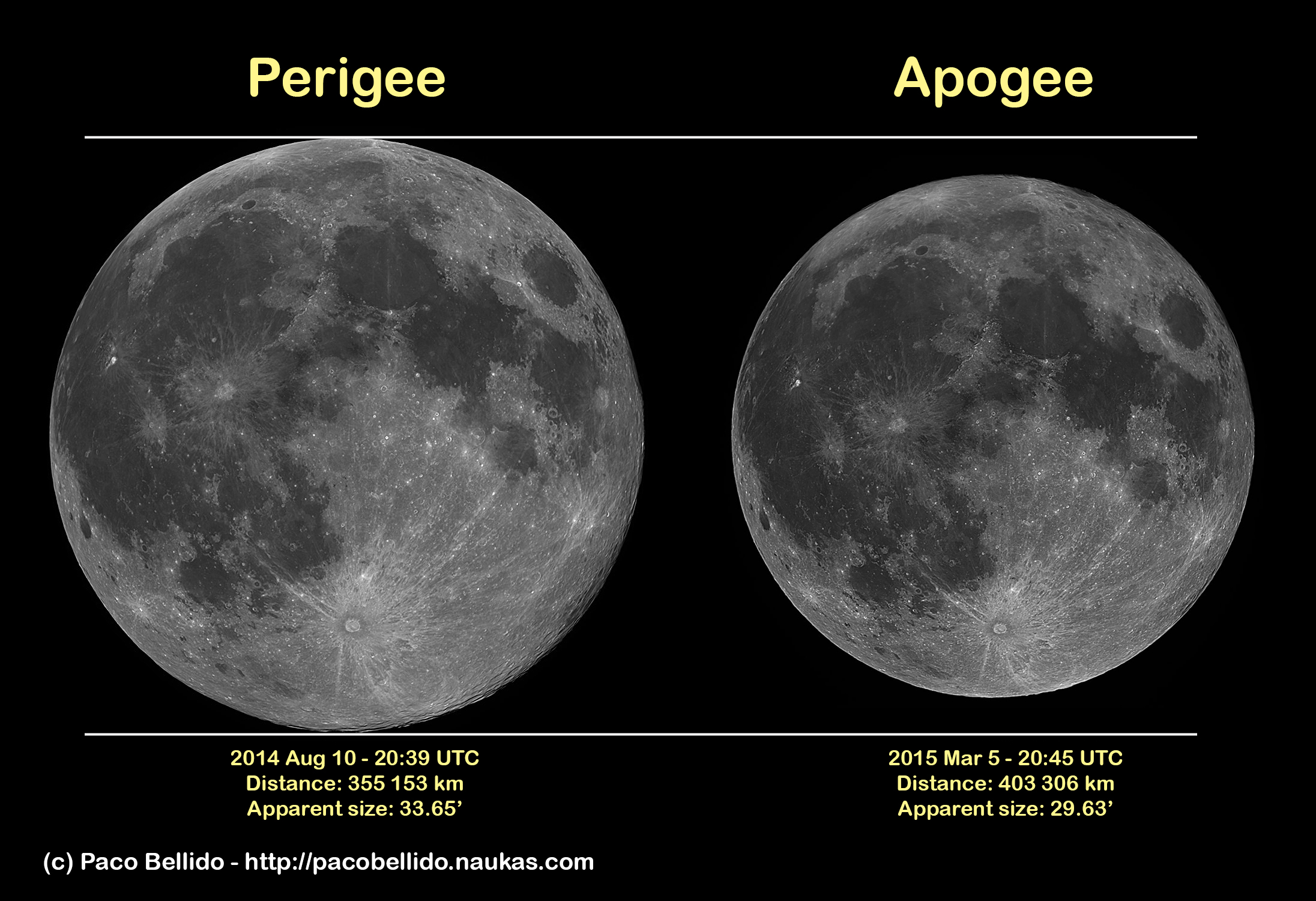
Comparison of the apparent size of the Moon when it is located at the perigee (left) and when it is at the apogee (right). Credit: Paco Bellido.
These photos were taken by the Spanish astrophotographer and friend Paco Bellido in 2014 and 2015 from Córdoba (Spain), my natal city, and clearly show the different apparent size that the Moon has at the perigee (left) when compared to where it is at the apogee (right).
What does happen when the full moon coincides with the perigee? Well, that is a supermoon! The next time this will occur is next Tuesday, 15th November, 12:52am Sydney time. In that moment the Moon will be ~13% larger and ~30% brighter than a full moon happening in the apogee (a “micromoon“). From Sydney (and Australia) the best moment to see it will be on the evening of Monday 14th November, and actually many people are planning to enjoy watching the “supermoon” appearing over the Pacific Ocean at the dusk from Sydney’s famous beaches and clifts.
Regarding this, it is important to say that our brain tricks us when observing the Moon or the Sun close to the horizon: they do appear to be larger than they do higher up in the sky. This is called the Moon illusion, some studies suggest that the perception is that the Moon is almost 3 times larger near the horizon that when located near the zenith.
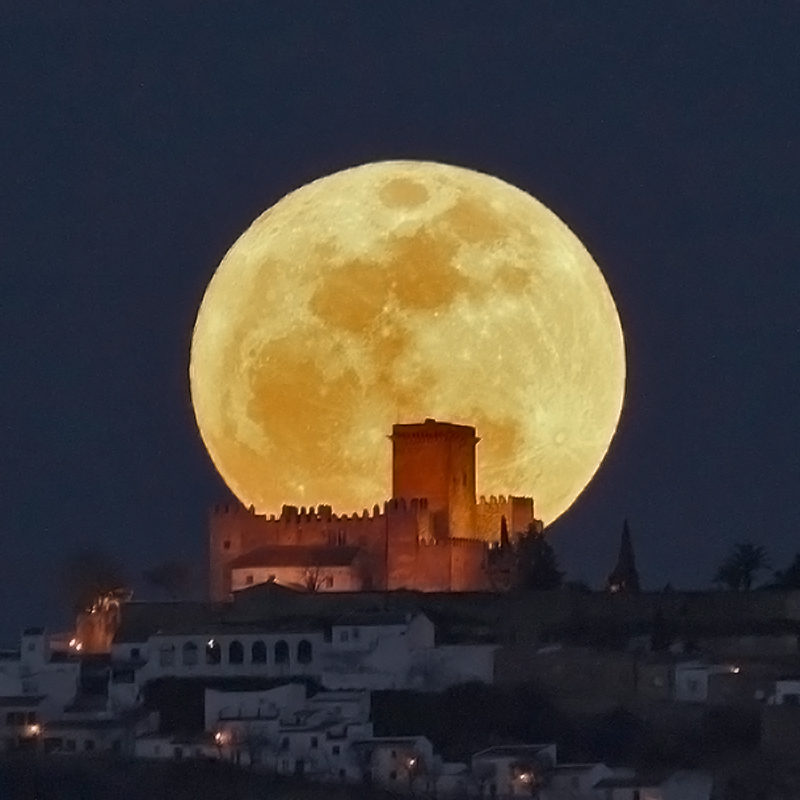
Supermoon over Espejo’s Castle (Córdoba, Spain) on 20th March 2011. This photo, taken by Paco Bellido, has been widely used in many places since then. Now people still try to reproduce this photo with their cameras when full moon… More info (in Spanish) in Paco’s blog “El beso en la luna“. Credit: Paco Bellido.
However, I must insist that the term “supermoon” does not come from Astronomy but from the pseudoscience of astrology. Perhaps that is one of the reasons why many people are talking about this. The term “supermoon” was coined by the US astrologer Richard Nolle in 1979, who defined it as ‘a New or a Full Moon that occurs when the Moon is at or near (within 90% of) its closest approach to Earth in its orbit’.
Nolle, who associated supermoons to catastrophes without any scientific evidence that this was true, didn’t know that we astronomers already had a scientific term to describe this alignment: the perigee-syzygy of the Earth-Moon-Sun system. The word “syzygy” means a perfect alignment between three bodies, that are in a perfect straight line. The most famous examples of syzygies are the lunar and solar eclipses, when the alignment of the Sun, Earth and Moon happens on the lunar nodes (the two points where the plane of the orbit of the Moon around the Earth and the plane of orbit of the Earth around the Sun intercept).
As other “expressions”, such as “blood moon” (a lunar eclipse) or “blue moon” (the second full moon within the same calendar month), the term “supermoon” has become very popular lately, perhaps also because all the action in social media. But these definitions are not official astronomical terms. Indeed, a “blue moon” does not have a proper astronomical definition, and may happen or not depending on the time zone the observer is located.
In any case all the excitement about the supermoon happening on Tuesday 15th (for us in Sydney, but for the majority of the world on Monday 14th) it that the exact moment of the full moon (12:52 am Sydney time) is really close to the perigee, happening at a distance of only 356 536 km from us. The supermoon was not that close since 26th January 1948, when it was at 356 460 km, and it will not be that close till 26 November 2034, when it happens at 356 472 km.
Check the numbers, please. 356 532 km, 356 460 km, 356 472 km… they all just differ in tens of kilometers! That is only a difference of a 0.02% ! Even considering the distances happening on other supermoons (I forgot to say we typically have 2-3 supermoons per year, last 17th October and next 13 Dec will be also supermoons), the differences are just within around 500 km, what is translated into a difference of only 0.14%.
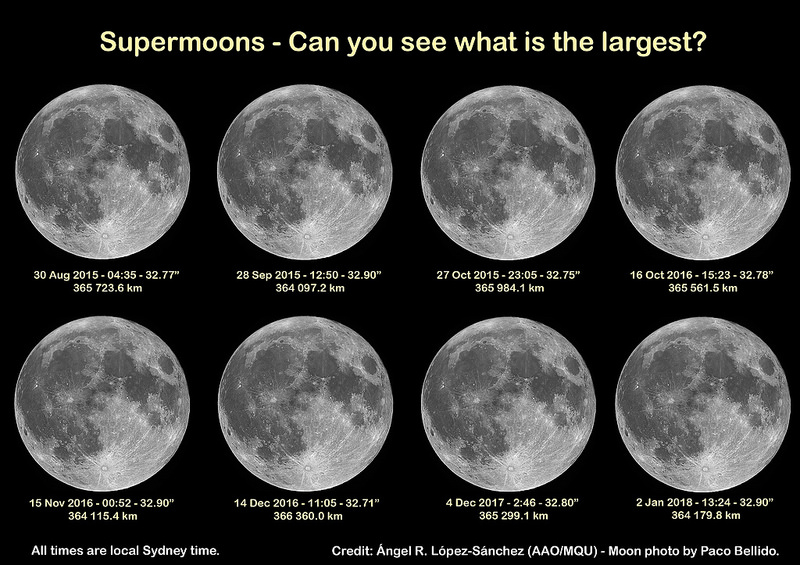
Illustration: Supermoons: can you see what is the largest? Eight supermoons between 2015 and 2018, images have been scaled to the apparent size of the Moon considering its distance from Sydney when the full moon is happening. The dates are times indicated are the moment of the Full Moon. The sizes and distances are computed assuming the observer is located in Sydney, Australia.
This is an illustration, not real photos taken from Sydney (I can’t travel to the future!). The original Moon image is the photo of the “micromoon” that Spanish astrophotographer Paco Pellido took on 5 March 2015 from Córdoba, Spain, which is the image I use in this post. An image without labels can be found here. The high resolution image is available here. Credit: Ángel R. López-Sánchez, Moon Photo Credit: Paco Bellido.
Let me say it again: the difference of the distance between the Earth and the Moon during a “supermoon”, with these happening typically 2-3 times per year (for full moon, 4-5 times per year in total including new moon), is only the 0.14%. Do you think you’ll be able to notice this with your naked eye?
However, giving numbers (talking quantitatively) the media can say “it is a rare event, the closest supermoon in almost 70 years“. But in practice you’ll not notice a thing. It will be a supermoon essentially similar to all of those we have every year.

Distance from the observer to the Moon depending on when rising or setting (top) or when it is near the zenith (bottom). Credit: Ángel R. López-Sánchez. Moon image: Paco Bellido.
There is more. Besides the lunar illusion, the moon is actually a bit further away from us when it is rising or setting than when it is near the zenith, as the image above clearly shows. The difference on the distance between the observer and the Moon may vary between few thousand an twelve thousand kilometers. This is called “diurnal effect” as it is, indeed, larger than the difference of few hundreds of kilometers found for supermoons. In both cases, I insist, the differences on the apparent size of the Moon can’t be noted with the naked eye.
Here again it is important to have a bit of critical thought about what all of this means. In any case this “supermoon” is a great excuse to forget about our domestic problems, look at the sky and be amazed by all the beautiful things that are hiding among the stars.
More info:
- Supermoon: closest Full Moon to Earth since 1948 (Time and Date).
- Moon Distance Calculator (Time and Date).
- http://cosmos4u.blogspot.com.au/2016/11/why-you-should-embrace-14-november.html
- http://www.skyandtelescope.com/observing/supermoons-a-unique-observing-challenge/
PS: Ah, yes, a curiosity: it is me who will be observing at the Anglo-Australian Telescope (AAT) the night of Monday 14th till Tuesday 15th… That is, quantitatively talking this will be the worst night since the AAT was built to be observing there…
Update 17 November:
I’ve included the illustration comparing the size of the Moon for 8 supermoons, as seen from Sydney. This started as a game in social media on Monday. I also prepared this illustration showing the sizes of the 12 full moons in 2016, as seen from Sydney. Do you identify the micromoon and the 3 supermoons?

Illustration: Full Moons in 2016 as seen from Sydney. All the full moons in 2016, scaled in size following the Moon’s apparent size as seen from Sydney. The micromoon corresponds to 22nd Apr (top right) and the thre supermoons are 16 Oct, 14 Nov (15 Nov Sydney time) and 14 Dec. This is an illustration, not real photos taken from Sydney (I can’t travel to the future!). The original Moon image is the photo of the “micromoon” that Spanish astrophotographer Paco Pellido took on 5 March 2015 from Córdoba, Spain, which is the image I use in this post. The image without labels is here. A high resolution image is available in my Flickr. Credit: Ángel R. López-Sánchez. Moon photo credit: Paco Bellido.





 A/Prof. Ángel R. López-Sánchez