Tag Archives: astronomy

Video of the “Story of Light” in Vivid Sydney 2016

Following the success of our sold-out Event “The Story of Light – The Astronomer’s Perspective” for ViVID Sydney Ideas 2015, the Australian Astronomical Observatory (AAO) continued its collaboration with ViVID Sydney 2016 organizing “The Story of Light – Deciphering the data encoded on the cosmic light”. But actually it was me who was in charge of the organization.
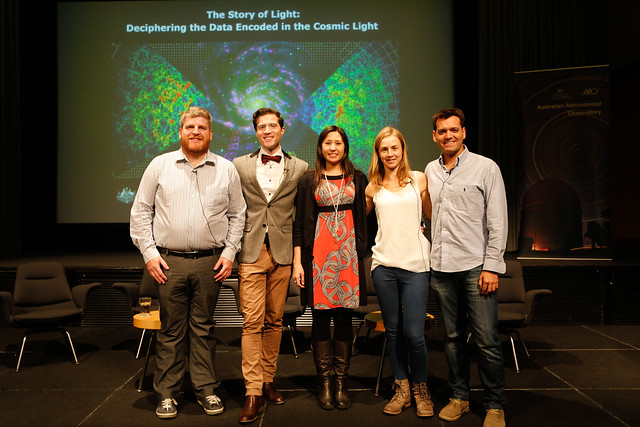
The five astronomers speaking during our “Sydney Vivid Ideas: The Story of Light” started at the Powerhouse Museum, Sydney, 29th May 2016. From left to right: Luke Barnes, Alan Duffy, Vanessa Moss, Liz Mannering and Ángel López-Sánchez. Photo credit: Jenny Ghabache (AAO).

The event was held at the PowerHouse Museum in Sydney on Sunday 29th May 2016. More than 160 people attended this special event. Five young astronomers (me included) talked about Astronomy and Big Data: the light and light-based technologies developed in Australian astronomy for both optical and radio telescopes; the tools, platforms, and techniques used for data analysis and visualization; how astronomers create simulation data; how some of these techniques are being used in other research areas; and the major scientific contributions toward our understanding of the Universe. Indeed, astronomers have been pioneers in developing “Data Science” techniques to make sense of this huge data deluge, many of which are now used in other areas.

We recorded all the event in video, and it is now publicly available  in the AAO YouTube channel. Some photos of the event are also compiled below. I want to thank AAO/ITSO Research Astronomer Caroline Foster for helping recording and editing the video and Jenny Ghabache (AAO) for taking the photos of the event.

Full recording of the event “The Story of Light 2016: Deciphering the data encoded on the cosmic light” organised by the AAO for Vivid Sydney Ideas 2016. Credit: AAO. Acknowledgment: Caroline Foster (AAO).

The event was hosted by Alan Duffy (Swinburne University). I was in charge of explaining optical astronomy, the AAO, optical surveys and big data. Then my colleagues  Vanessa Moss (Univ of Sydney/CAASTRO), Luke Barnes (Univ. of Sydney) and Liz Mannering (AAO/ICRAR) discussed radio astronomy, the ASKAP and big data (Vanessa), simulating, analysing and visualizing astronomy data (Luke) and astronomy data archive, the All-Sky Virtual Observatory (ASVO) and other virtual observatories (Liz ). After the short 12-15 minutes talks (well, as usual I took a bit more time), the panel welcomed questions from the audience (and even from Twitter using #SoLSydneyIdeas) for a discussion session about Light and Astronomy and the Australian contribution to the improvement of our understanding of the Universe.
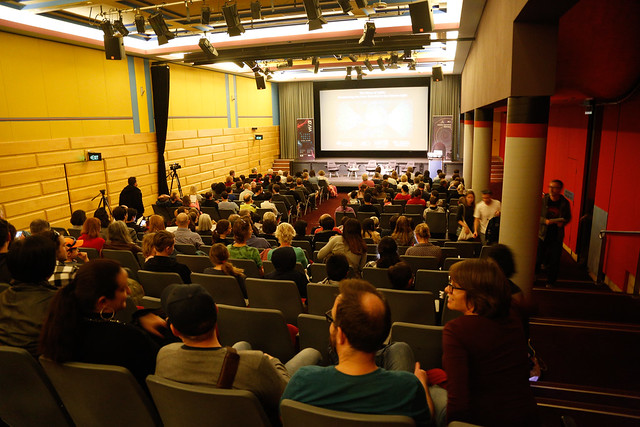
The Lecture Theatre a few minutes before our “Sydney Vivid Ideas: The Story of Light” started at the Powerhouse Museum, Sydney, 29th May 2016. Photo credit: Jenny Ghabache (AAO).
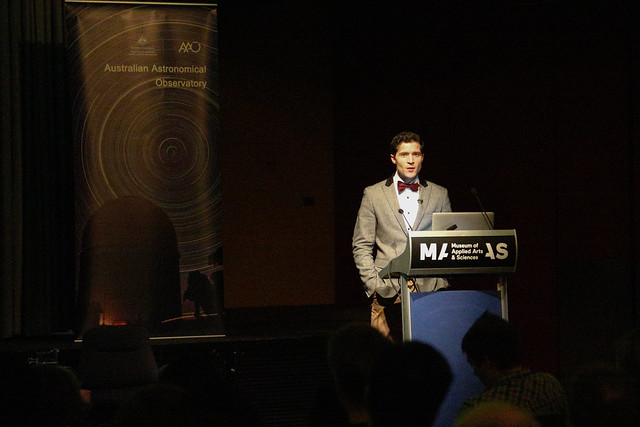
Our host, Alan Duffy, introducing the event. Photo credit: Jenny Ghabache (AAO).
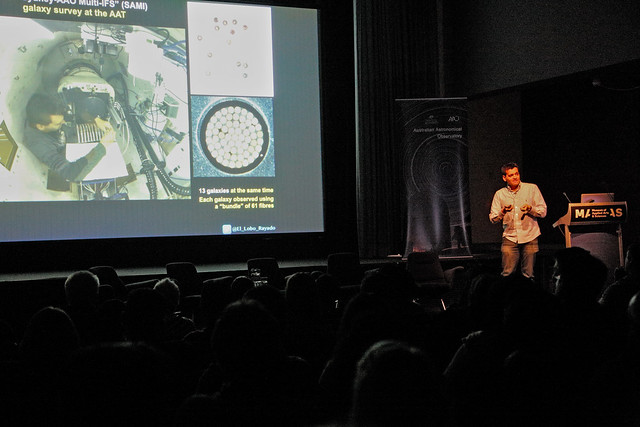
AAO/MQU Research Astronomer Ángel R. López-Sánchez talking about optical astronomy, the AAO and big data. Photo credit: Jenny Ghabache (AAO).
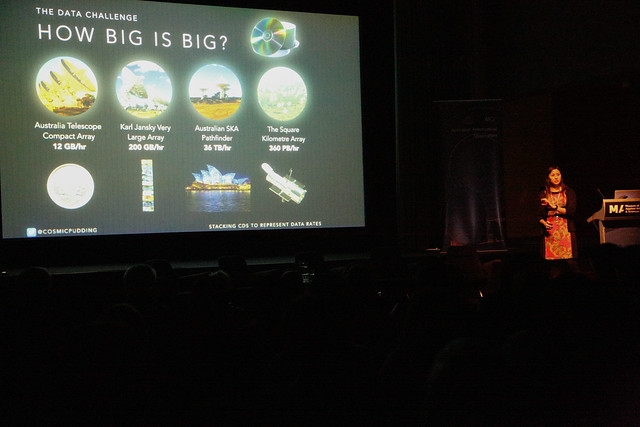
Vanessa Moss (Univ. of Sydney/CAASTRO) talking about radioastronomy, the ASKAP and big data. Photo credit: Jenny Ghabache (AAO).
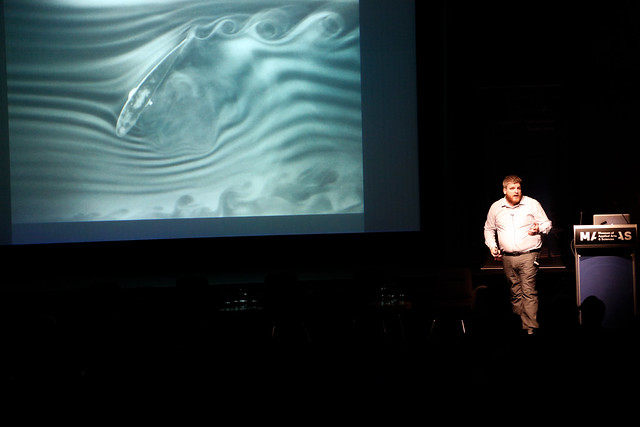
Luke Barnes (Univ. of Sydney) talking about simulating, analysing and visualizing astronomy data. Photo credit: Jenny Ghabache (AAO).
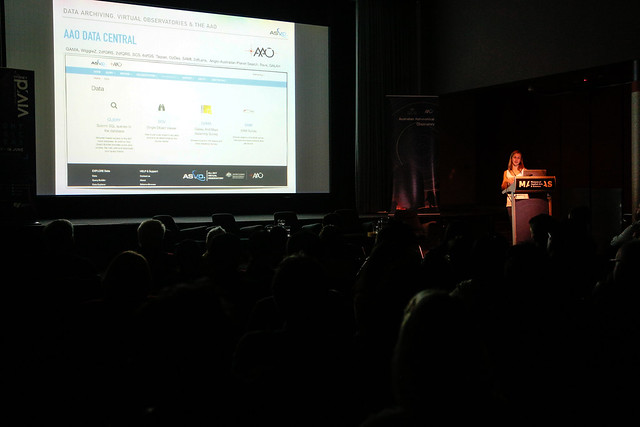
Liz Mannering (Univ. of Sydney) discussed astronomy data archive, the All-Sky Virtual Observatory (ASVO) and other virtual observatories. Photo credit: Jenny Ghabache (AAO).
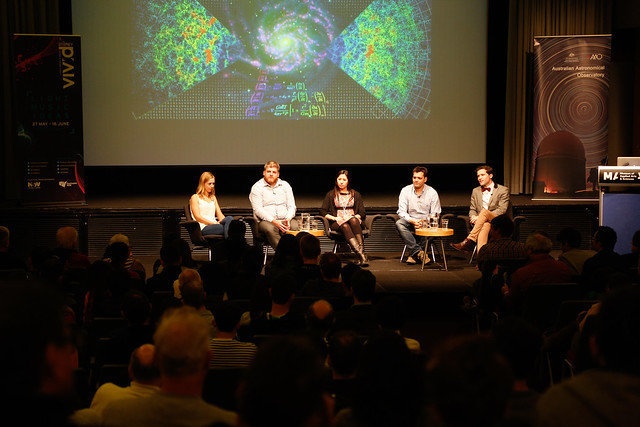
Panel discussion with all participants answering questions from the audience. Photo credit: Jenny Ghabache (AAO).
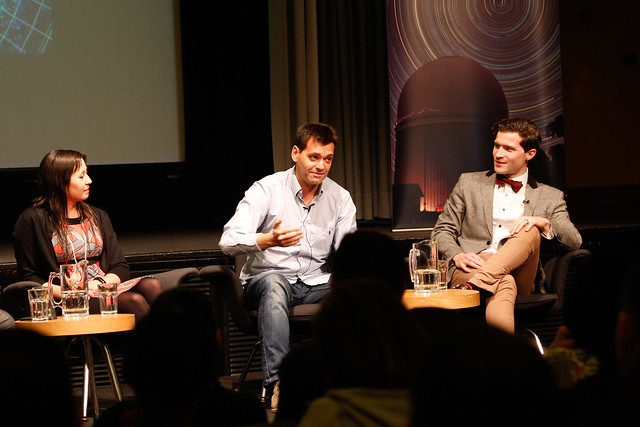
Angel Lopez-Sanchez answering a question from the audience. Photo credit: Jenny Ghabache (AAO).

And last… Well, if you want to see only my talk, here it is:

Citizen scientists discover huge galaxy cluster

One of the scientific projects I’m involved actually is a citizen science program: Radio Galaxy Zoo. Using images from NASA’s Wide-Field Infrared Survey Explorer telescope (WISE) and the NRAO Very Large Array (VLA) in New Mexico, USA,  Radio Galaxy Zoo requests participants to associate radio emission (which is related to the relativistic electrons ejected from a massive black hole) with galaxies as seen in infrared light. The aim is to get a better understanding of the super-massive black holes that are located in the center of the galaxies and quantify their importance in galaxy evolution.

My colleagues Julie Banfield (Australian National University) and Ivy Wong  (ICRAR and University of Western Australia) lead the Radio Galaxy Zoo (RGZ) team, that was launched on December 2013. Since then, more than 10,000 volunteers have joined in with Radio Galaxy Zoo, classifying over 1.6 million images.

The wide-angle tail galaxy discovered by Terentev and Matorny is one of the largest known, and its host cluster is now known as the Matorny-Terentev cluster. Credit: Radio Galaxy Zoo.

The wide-angle tail galaxy discovered by Terentev and Matorny is one of the largest known, and its host cluster is now known as the Matorny-Terentev cluster. Credit: Radio Galaxy Zoo.

Well, the news is that two RGZ volunteer participants from Russia, Ivan Terentev and Tim Matorny, have discovered a rare galaxy cluster. They found that one particular radio-source had just one of a line of radio blobs that delineate a C-shaped “wide angle tail galaxy” (WAT). The C-shaped was formed because the massive galaxy hosting the super-massive black hole and its associated jets are moving through intergalactic gas, indicating the existence of a cluster of galaxies. The new wide-angle tail galaxy is one of the largest known, and its host cluster is now known as the Matorny-Terentev cluster.

The details of this discovery has been published this week in the prestigious scientific journal MNRAS, the paper “Radio Galaxy Zoo: discovery of a poor cluster through a giant wide-angle tail radio galaxy” was lead by Julie Banfield (ANU).

There is plenty of information in the Radio Galaxy Zoo webpage, the  CAASTRO Press Release and in this nice Article in “The Conversation” by Ray Norris (CSIRO/Western Sydney University and PI of the EMU project to be conducted in the ASKAP), so I’ll just add here the nice interview to Ivy Wong  (ICRAR and University of Western Australia) in Ten News Australia yesterday.

More information:

Spiral galaxy NGC 4027 with AAT: an outreach exercise

During this week I’m curator of the @astrotweep, a Twitter account that each week features an astronomer or planetary scientist taking about their research, science and life. I’m having a lot of fun with it, although I have to recognize it is extra work.

I chose to do it this week because there are some few things happening. In particular, I’m supporting observations at the Anglo-Australian Telescope (Siding Spring Observatory, NSW, Australia) using the 2dF / HERMES instruments. I thought it would be nice to be tweeting life how observations are doing. And that is precisely what I’ve doing today.

On top of that, “this morning” I had an idea. As we always have some “free time” at the AAT after completing the “2dF first night setup” (1) I decided to observe a nice bright deep sky object and get a nice image with the AAT. I was starting to search for a suitable target, but then I though, why don’t I ask the public what do they want to observe?

After consulting with my supervisors and getting the OK to do this, I initiated a poll in both @astrotweeps and @AAOastro asking the public to vote for one of the four following astro objects:

  1. The elliptical galaxy NGC 2865.
  2. The planetary nebula NGC 4361.
  3. The warped and almost edge-on spiral galaxy ESO 510-G13.
  4. The barred spiral galaxy NGC 4027.

For around 8 hours people were casting their vote, we received 153 unique votes in total combining the @AAOastro and the @astrotweets accounts.

And the winner (2) was… the barred spiral galaxy NGC 4027!

But surprises didn’t end here. In the afternoon, when I was starting to prepare the instruments for the night (I’m conducting observations remotely from Sydney), I explained to astronomers and technicians at the AAT what we were doing. Rob Paterson, our afternoon technician, then told me “Do you know we already have the new CCD camera installed in 2dF and just waiting for testing it?

Let me explain why I was so excited when I heard this. For years the 2dF instrument has had an auxiliary camera, the FPI camera, that we use for properly positioning 2dF in the requested field. Rarely it has been used for science, as it is just a 516×516 pixels camera without filters. Occasionally I have also used it for getting some images of deep sky objects. But, as it has no filters, I had to get the color of the images elsewhere, usually taking archive data taken with other telescopes. But the new CCD camera in 2dF does have filters!

Rob phoned Steve Lee, the head of the Night Assistants at the AAT, and with Bob Dean the three of them managed to prepare CACTI (that is the name of the new camera) to have it ready for us.

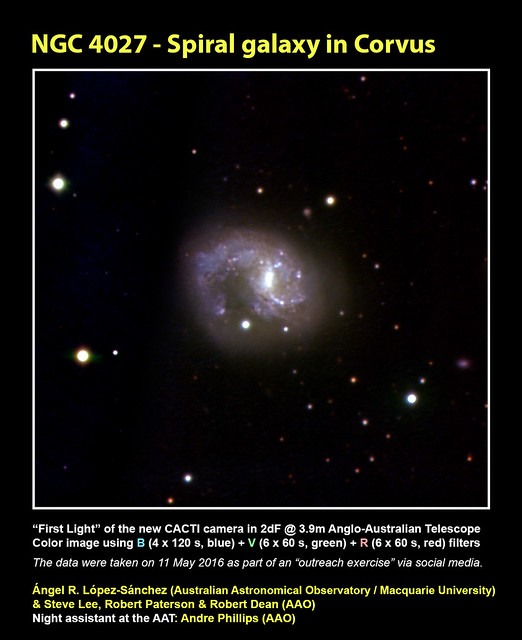
Although there is still a lot to be done and tests to be conducted, the very first images I got this evening are quite promising. Here is the final result:

Spiral galaxy NGC 4027 located at around 75 million light years in Corvus (The Crow). This barred spiral galaxy, also identified as Arp 22, is identified as a peculiar galaxy by the extended arm, thought to be the result of a collision with another galaxy millions of years ago. This image is the “First Light” of the new CACTI camera in 2dF @ 3.9m Anglo-Australian Telescope. Color image using B (4 x 120 s, blue) + V (6 x 60 s, green) + R (6 x 60 s, red) filters. The data were taken on 11 May 2016 as part of an “outreach exercise” via social media. Click here to get a higher resolution image. Credit: Ángel R. López-Sánchez (AAO/MQ) & Steve Lee, Robert Paterson & Robert Dean (AAO). Night assistant at the AAT: Andre Phillips (AAO).

Note that this image, that actually is the “first light” of the CACTI camera, only combines 6 minutes in V and R and 8 minutes in B, that is, it is not deep at all. Furthermore not extra calibrations were taken (some flatfield images would have been nice). The deep image obtained by the 3.6m NTT telescope (ESO La Silla Observatory, Chile) provides many more details and resolution… but of course they were using the EFOSC instrument, which was specifically designed for deep imaging in optical filters. And the  image of NGC 4027 obtained by David Malin (AAO) using photographic plates at the AAT in 1982 is much more colorful.

But I still think it is a pretty result, particularly as this new image of NGC 4027 was obtained as a completely improvised “outreach exercise” using social media, in which 153 people voted for their favorite object to be observed at the 3.9m Anglo-Australian Telescope.

I really hope to repeat this exercise soon.

(1) A 2dF Plate must be configured with a scientific field, that is, allocating ~350 optical fibres to different objects in the sky. This takes ~ 20-30 minutes.

(2) Just to provide the details of the votes, see table below:

OBJECT    @Astrotweeps   @AAOastro       COMBINED

NGC 2865               5                  4                    9    ( 6% )

NGC 4361            36                   9                   45   (29%)

ESO 510-G13      36                  7                     43   (28%)

NGC 4027           36                20                    56   (37%)

TOTAL              113                 40                   153

Come to our ViVID Sydney 2016 Astronomy Event!

During the last months I’ve been working hard to organize an Astronomy event during the famous ViVID Sydney festival, 27th May – 18th June 2016. With the title “The Story of Light – Deciphering the data encoded on the cosmic light”, this science communication event is presented by the Australian Astronomical Observatory (AAO). It follows our sold-out Event “The Story of Light – The Astronomer’s Perspective” for ViVID Sydney 2015, that was originally planned as part of the International Multiwavelength Dissection of Galaxies  Conference I organized last year (now I’m realizing I never talked about this here…).

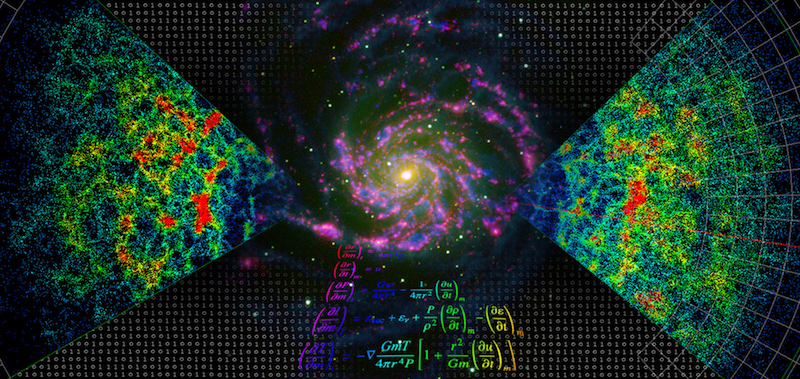
Banner image of the “The Story of Light – Deciphering the data encoded on the cosmic light” event on Sunday 29th May 2016. The image represents a multiwavelength photo of the galaxy M101 (center), the 2dF Galaxy Redshift Survey (AAO, left and right), the equations of the stellar interiors, and a background of 1s and 0s codifying astronomical data. Credit of the composition: Ángel R. López-Sánchez. Credit of the 2dFGRS: AAO, Credit of image of M 101: Ángel R. López-Sánchez.

Banner image of the “The Story of Light – Deciphering the data encoded on the cosmic light” event on Sunday 29th May 2016. The image represents a multiwavelength photo of the galaxy M101 (center), the 2dF Galaxy Redshift Survey (AAO, left and right), the equations of the stellar interiors, and a background of 1s and 0s codifying astronomical data. Credit of the composition: Ángel R. López-Sánchez. Credit of the 2dFGRS images: AAO. Credit of image of M 101: Ángel R. López-Sánchez.

This event will be held at the PowerHouse Museum (Sydney) on Sunday 29th May, 2:00-3:30pm. Four professional astrophysicists will discuss what astronomy provides in the context of exploiting big data:

  • The light and light-based technologies developed in Australian astronomy for both optical and radio telescopes; the tools, platforms, and techniques used for data analysis and visualization
  • How astronomers create simulation data
  • How some of these techniques are being used in other research areas and;
  • The major scientific contributions toward our understanding of the Universe.

Indeed, for decades, astrophysicists have developed novel approaches to exploring the light of the Cosmos, most recently through data-intensive techniques, analytics and visualization tools to extract the information collected by extremely sensitive telescopes and instruments. Astronomers have been pioneers in developing data science techniques to make sense of this huge data deluge, many of which are now used in other areas.

There is no need to say that I’m very excited about this new ViVID Sydney event, not only because of all the effort I’ve already put into this but also because I’m one of the astronomers in the panel! I’ll be talking about optical Astronomy, discussing the importance of the optical spectroscopy, how it is done with the AAO telescopes, and describing some of their current a future instruments.

But that is not all. I’m also extremely happy to do this with four great astronomers and science communicators:  Vanessa Moss (CAASTRO/Univ. of Sydney), who will talk about radioastronomy & big Data and the ASKAP,  Luke Barnes (Univ. of Sydney), discussing simulating, analysing and visualisation of astronomy data, and Elizabeth Mannering (AAO/ICRAR), who will describe the importance of Data Archive, Virtual Observatories, and the ASVO project at the AAO. On top of that, the host of our event is the famous astronomer and science communicator Alan Duffy (Swinburne University). I’m sure it is going to be quite an experience.

This event, however, is not free, as a ticket for the entry to the PowerHouse Museum ($15  for adults, $8 concession) is needed. You can get your tickets in the Event Webpage of the PowerHouse Museum.

For more information and a full description of the speakers, please check our AAO webpage. The link to this event in the ViVID Sydney website is here.

I hope to see you there!

Starburst spiral galaxy NGC 3310 with Gemini North

Last Tuesday 1st of March the famous NASA webpage Astronomy Picture of the Day (APOD) released a very nice image of the galaxy NGC 3310 obtained with the 8.2m Gemini North Telescope in Hawaii (U.S.A.).

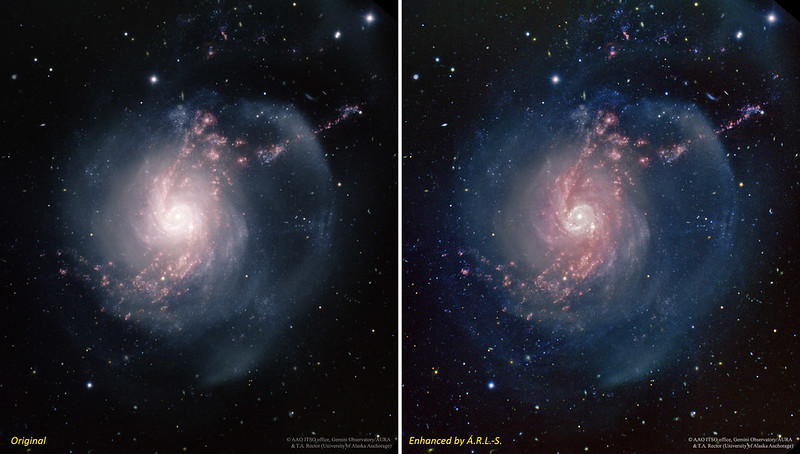
Nice image of the starburst spiral galaxy NGC 3310 in the Ursa Major obtained with the 8.2m Gemini North Telescope in Hawaii (U.S.A.). This image was obtained for the “Cosmic Poll” contest organized by the International Telescopes Support Office at the Australian Astronomical Observatory (AAO) and appeared as APOD on 1st March 2016. Colours codify the light received in blue (B, blue) and red (R, green) filters, plus the emission of the ionized gas (Hα filter) coded in red.AAO ITSO Office, Gemini Obs./AURA & T. A. Rector (U. Alaska Anchorage).

NGC 3310 lies at a distance of around 50 million years from us, within stars of the Northern constellation of the Ursa Mayor (meaning we cannot see it here from Australia, well, it has a maximum elevation of ~5 degrees from Siding Spring Observatory). The spiral structure in NGC 3310 looks like what we expect for our own Milky Way galaxy, with plenty of star-forming regions (in red-pink colours tracing the Hα emission). However in the case of NGC 3310, the star-formation activity seems to be more extreme.

It seems that NGC 3310 started experiencing an interaction with a dwarf galaxy around 100 million years ago. This interaction has triggered a very strong star-formation event (that is why NGC 3310 is defined as a starburst galaxy), and has “broken” the external areas of the galaxy as consequence of the intense tidal forces. In the image, all regions showing red-pink colours (tracing Hα emission) are nebulae. These regions are found almost everywhere within NGC 3310, sometimes even forming some peculiar alignments of red-pink-ish regions as that “ray” that goes from the centre of the galaxy till the upper left corner. It is interesting to note that, although the interaction with the dwarf galaxy happened ~100 million years ago, the fact of finding this large amount of Hα emission informs that the star-formation activity is still important today. The colliding dwarf galaxy was probably engulfed by NGC 3310, its remaining debris could be that diffuse arc-like structure we observed in the outskirts of the galaxy in the upper part of the image.

These are the kind of objects (starburst galaxies) and the kind of features (enhanced Hα activity, tidal distortions of the stellar component of the galaxy, tails, rays…) I studied in a sample of dwarf galaxies for my PhD Thesis (I still have to tell all of that here…).

Beside tracing the nebular (Hα) emission, the image also allows to distinguish that the majority of the stars in NGC 3310 have blue colours, even in its external areas. Again, this fact informs that the dominant stellar populations in this galaxy are relatively young, as only young stars emit a lot of light in blue and ultraviolet colours.

Although it was not said in the APOD I would like to remark that the idea of observing this galaxy in the 8.2m Gemini North Telescope came from the International Telescopes Support Office at the Australian Astronomical Observatory (AAO). In particular, mi colleagues Elaina Hyde, Richard McDermid, Caroline Foster-Guanzon and Stuart Ryder (AAO) organized a very interesting outreach initiative, the Cosmic Poll, asking the people to emit a vote for which kind of object would they like to be observed at the 8.2m Gemini Telescope. The winning entry was “an individual galaxy”, and later they decided to observe NGC 3310. Furthermore they organised an on-line event,a live-stream with the Gemini North Telescope (is available on YouTube) explaining how the telescope works and giving details of the observatory. The Gemini Observatory website also included this in its blog. After processing and cleaning the images, the final result is that you see in APOD.

I couldn’t help myself, though, and decided to play a bit with the colours, levels, contrast and lights of the image to try to get an enhanced image of this very nice object. In my opinion, the central part of the galaxy is a bit too bright (it should be, of course, the real difference in brightness between the central part of NGC 3310 and the diffuse stellar streams in its outskirts is several orders of magnitude, but for illustration purposes I have found that it is a good idea to minimize that) and the outskirts of the galaxy are not that easy to see. So here it goes my enhanced image of NGC 3310 with Gemini North:

Comparison between the image of the starburst spiral galaxy NGC 3310 obtained by the 8.2m Gemini North Telescope and published in APOD on 1st March 2016 (left) and the same image enhanced by myself (right). Credit: AAO ITSO Office, Gemini Obs./AURA & T. A. Rector (U. Alaska Anchorage), Enhancement: Ángel R. López-Sánchez (AAO/MQ)

What do you think? What image do you like more?