Tag Archives: astronomy

Visiting the Macarthur Astronomical Society

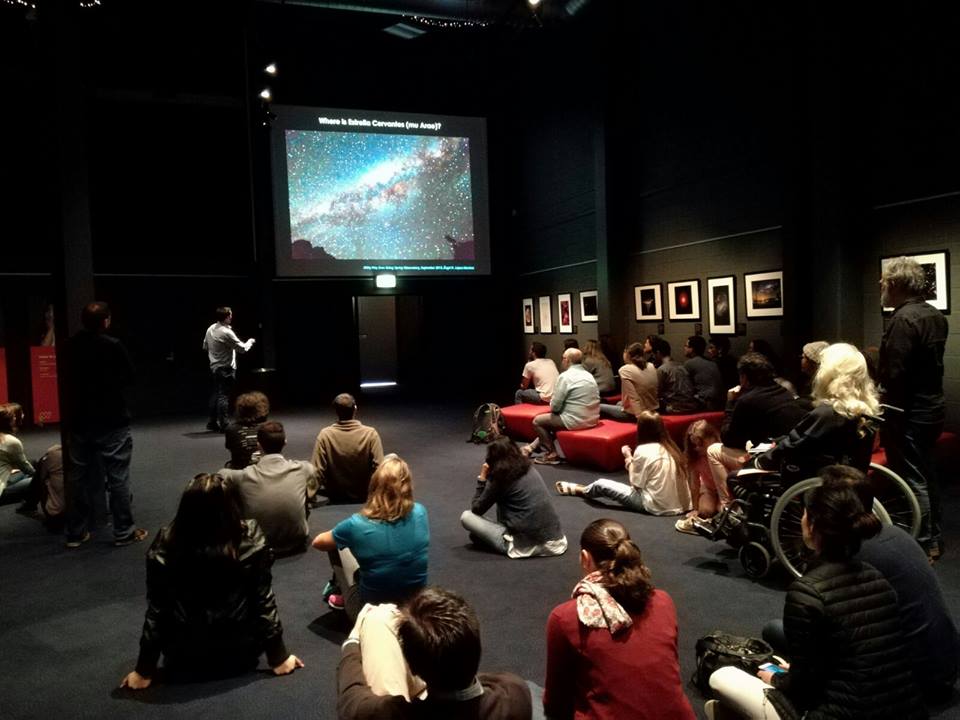
Yesterday I was visiting my friends at the Macarthur Astronomical Society (MAS), which is based in Campbelltown, at the south of Sydney. I have had the privilege of visiting them several times in the last years, where I talked about different aspects of Astronomy, from the “Light of the Universe” to the “Colour of the galaxies” till “Amateur Spectroscopy“.

This time I was presenting my very own research, the Hi-KIDS project (the “HI KOALA IFS Dwarf galaxy Survey“, that I have to eventually publicize here too.

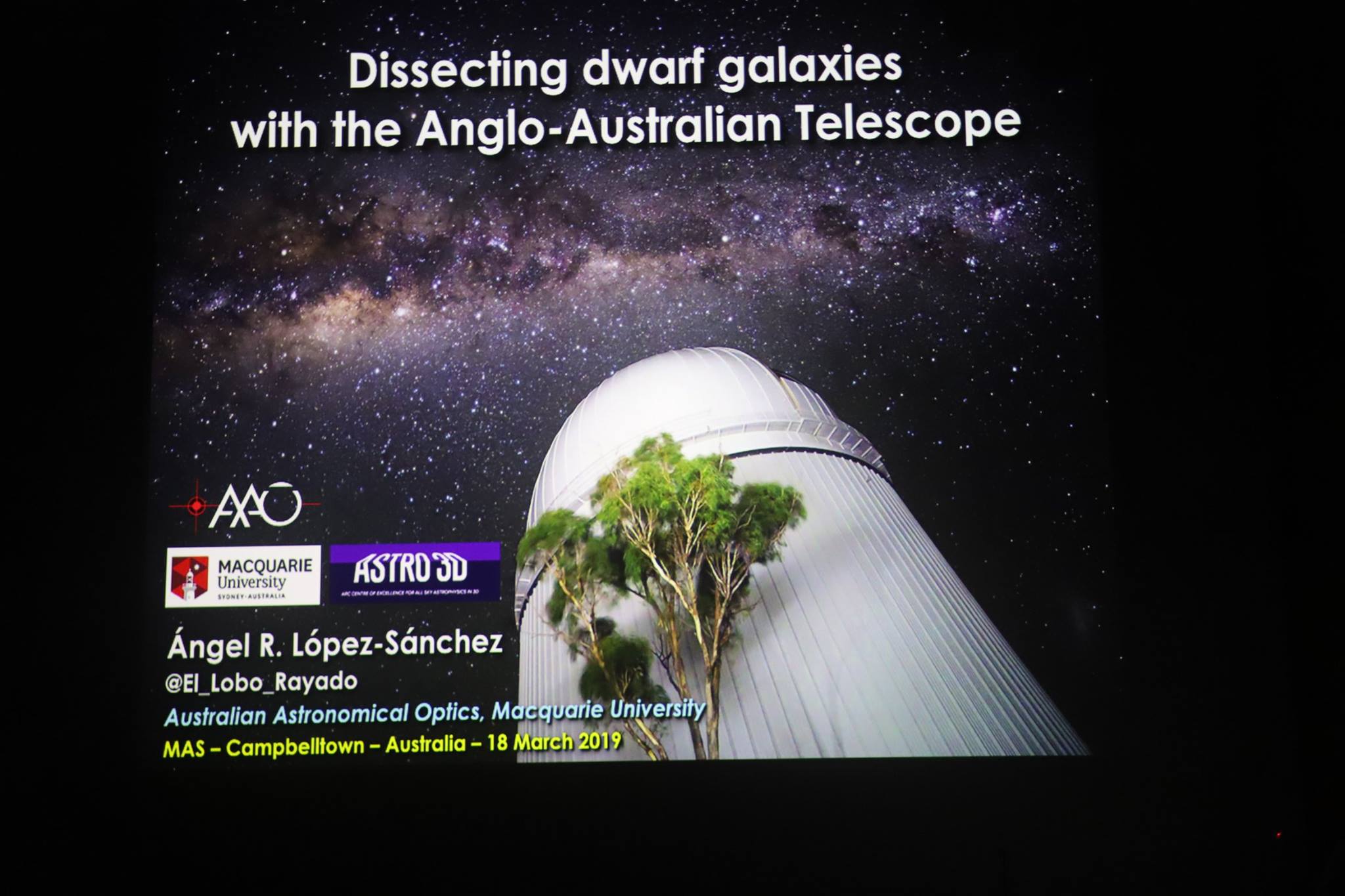
My talk was entitled “Dissecting Dwarf Galaxies with The AAT“. The abstract  was:

Dwarf galaxies provide fundamental clues about galaxy origin and evolution. Many of them have irregular shapes and have processed little their gas, although they possess many old stars born billions of years ago. Still, many dwarf galaxies are very gas-rich and are currently forming stars, sometimes in a spectacular way. With these new observations using the powerful KOALA+AAOmega instruments at the 3.9m Anglo-Australian Telescope we are “dissecting” these dwarf galaxies to characterize the properties of the gas and the stars within them. Combining these new data with deep radio observations at 21 cm of the diffuse, cold gas within and surrounding these dwarf galaxies we will get a better understanding of the local and global star-formation processes in galaxies, the feedback of the newborn stars into the galaxies, the importance of inflows and outflows of gas, and the chemical evolution of nearby dwarf galaxies.

You can find some photos of the talk in the Facebook webpage of the Macarthur Astronomical Society.
I have to say that this is a very welcome audience and that I have always enjoyed a lot the visit to MAS. They have an invited speaker almost every month, getting many Australian (and overseas) astrophysicists to talk to them. You can have a look to the full list in the MAS webpage.

Thanks for having me and see you in another astronomy event or talk soon!
Intriguing Wolf-Rayet star discovered

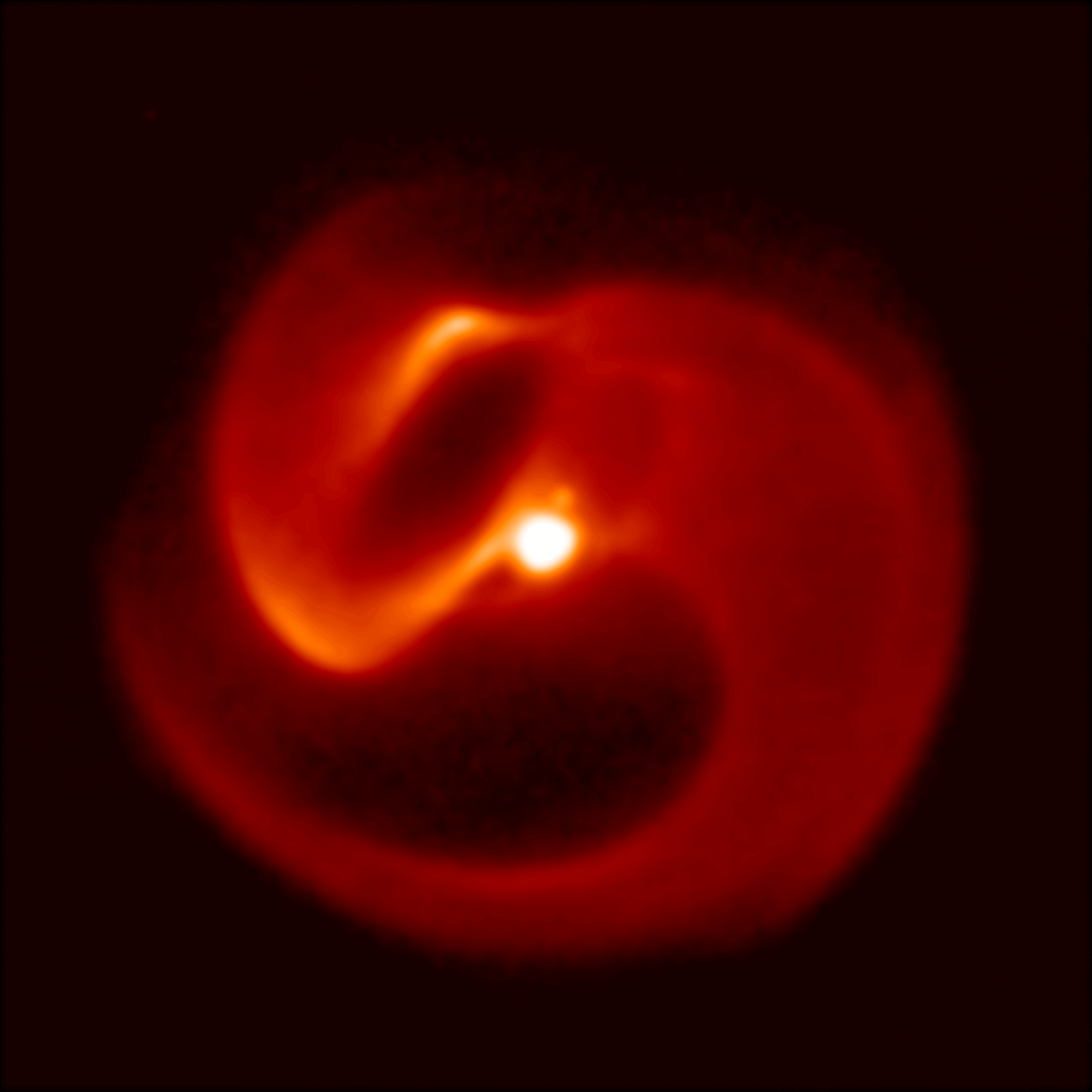
A new, very intriguing Wolf-Rayet star has been discovered in the Milky Way. Actually it is a massive triple star system. It has been nicknamed Apep after an ancient Egyptian deity, this may be the first ever gamma-ray burst progenitor found.

The research has been mainly conducted at the University of Sydney using data from the Anglo-Australian Telescope (AAT) and ESO’s Very Large Telescope. The announcement was made public yesterday in several media releases by the European Southern Observatory and the University of Sydney, following the publication of the research paper in Nature Astronomy.


Image of Apep captured in the thermal infrared with the VISIR camera on the European Southern Observatory’s VLT telescope in Chile. Credit: Professor Peter Tuthill/ESO.

Earlier this week I was contacted from a journalist from The Age, Liam Mannix, who wanted to talk to me as “expert of Wolf-Rayet stars who has not participated in this research”. He called me and I spent 20 minutes to half an hour explaining what Wolf-Rayet stars are, the few of these stars known in our Galaxy (~600s) as they are the descendant of the most massive stars (and these are quite rare), and more. Of course, this conversation was latter summarized in a line in the article that he prepared:

Systems like this are very, very rare,” says Angel Lopez-Sanchez, an astrophysicist at Macquarie University who studies Wolf-Rayets and was not involved in the research. “It is a very exciting finding.”

But in any case I’m very happy I had this conversation with Liam and that I could contribute at least to the dissemination of this nice work.

My contribution to 2018 #StargazingABC

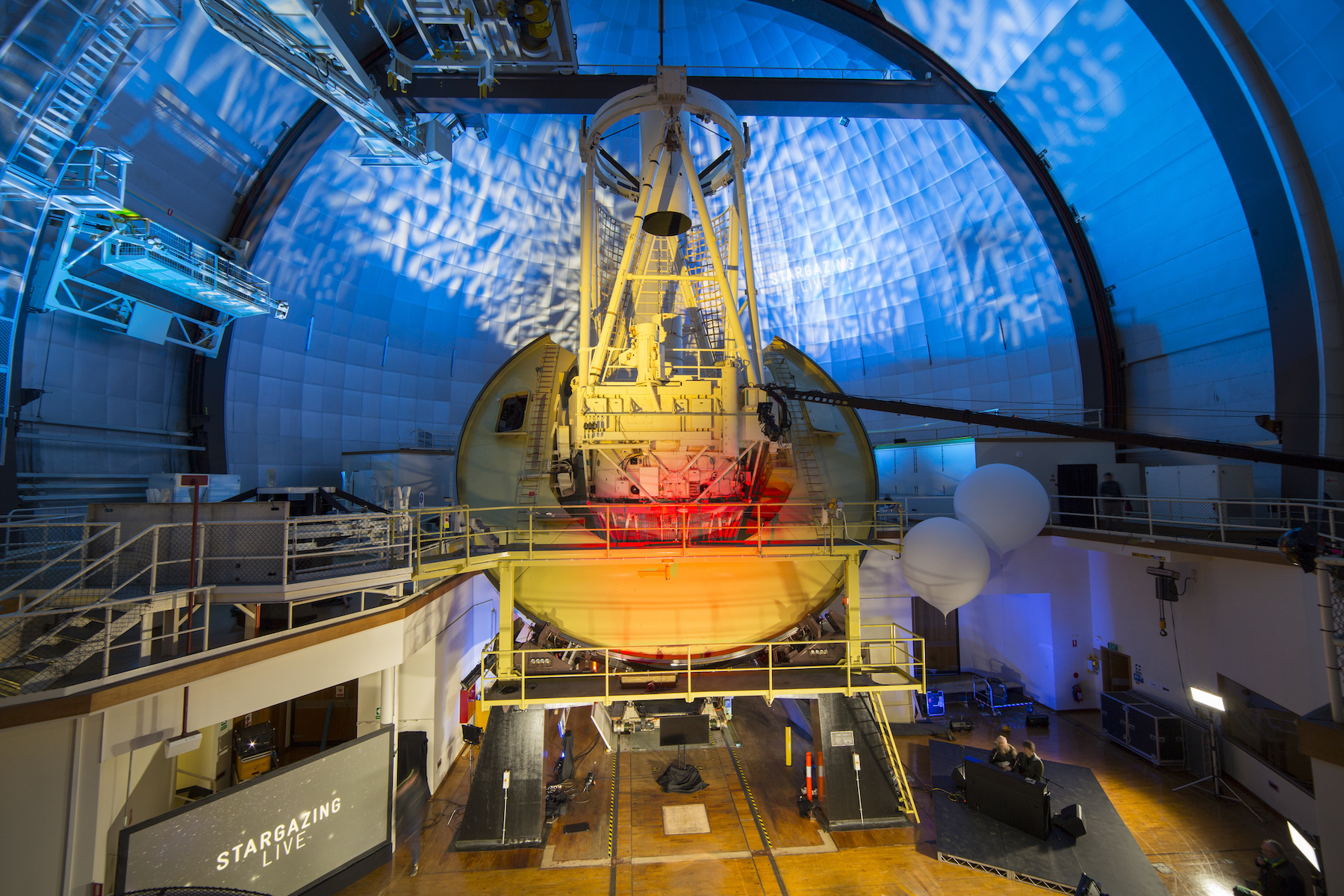
How can I say it in just few words? It was both very exciting and exhausting, with a little bit of bitter too. But, overall, last week at Siding Spring Observatory was one of the best experiences I have had in a long time working at the telescope, combining science research, amateur astronomy, outreach and science communication during the Stargazing ABC Live shows.

The AAT is ready for #StargazingABC. Hosts Julia Zemiro and Prof Brian Cox are sit in the piano, while Brian still rehearsing. Credit: Ángel R. López-Sánchez.

When I’m writing this, at 6:44pm 30th May 2018, I’m still observing at the Anglo-Australian Telescope. I’m doing it remotely from Sydney. It is my last night in a very long run (18 nights in May) for my own research project, which I will detail here eventually. I’m exhausted and need a good break, body and mind can’t survive this crazy rhythm, sleeping an average of 4-5 hours per day, and without any break during the weekends.

But let me at least quickly mention here my contribution to the 2018 Stargazing Live shows:

1. I provided A LOT OF information about Astronomy and the Anglo-Australian Telescope to the ABC and BBC crews. This is something that I’ve been doing during the last months, and might be considered as part of my role of “AAO Science Communicator Officer”.

2. I provided plenty of astrophotography and video-timelapse material, which was used during the shows. The most important of these is the new timelapse video “Stargazing at Siding Spring Observatory“, that you can enjoy here:

3. I spent some of my scheduled time at the Anglo-Australian Telescope to prepare a nice, new image of a beautiful astronomy object, that was later discussed during the show. It was the planetary nebula NGC 5189, for which I provided extra information in the previous post.

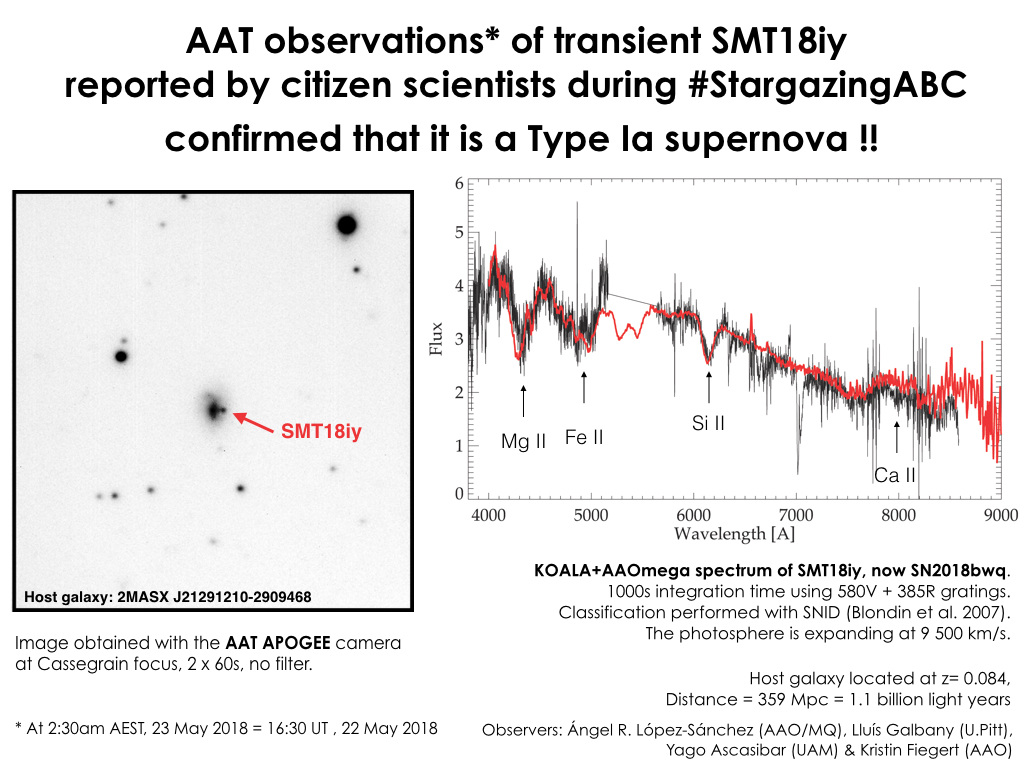
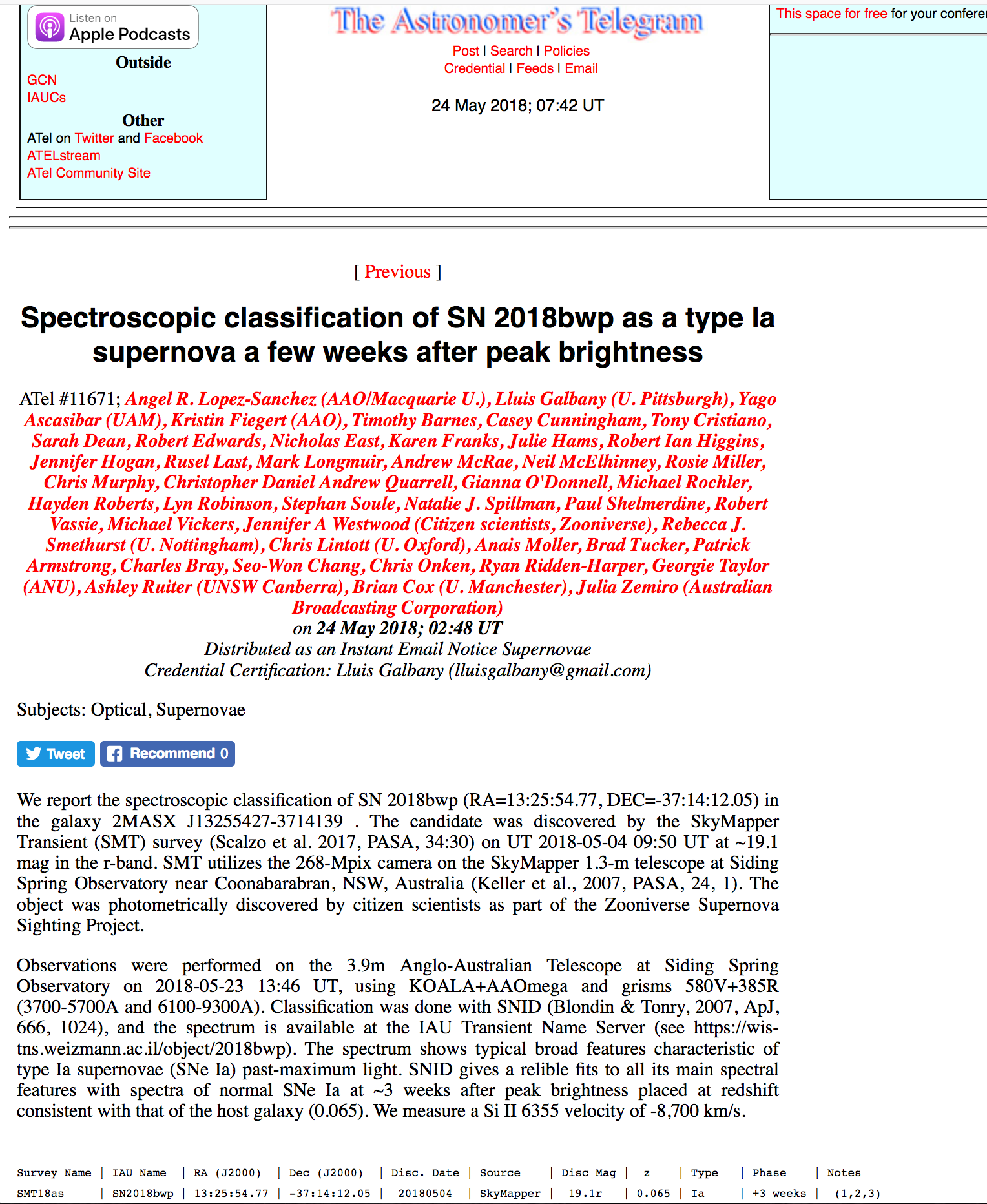
4. But the most important contribution for the show was actually observing with the AAT two transients reported by the citizen scientists who participated in a program to search for type Ia supernova in other galaxies. After confirming that the transient was there, we got spectroscopic information using KOALA+AAOmega, reduced the data, analysed the data, confirmed that both transients were type Ia supernova in distant galaxies, and wrote a science report with the discovery!

This was something I originally didn’t plan to do, but, as I said, it was my own research program that scheduled at the AAT during the StargazingABC, so I decided to do it and it got a reward, as this also allowed us to submit two science reports with the discoveries!

These two nights were really exciting! I really want to thank my friends and colleagues Lluís Galbany and Yago Ascasibar, as well as the AAT Night Assistant Kristin Fiegert (AAO), for their wonderful help in all of this.

The discovery of the transients and the confirmation that they were type Ia supernova in distant galaxies has appeared in many media news these days, including in ABC Science News, and also here: “Citizen scientists find two supernovae and (slightly) revise the age of the cosmos“.

It was also a privilege talking with Prof Brian Cox, who is absolutely great, and even recorded a short video with me for my son. Thank you a lot, Brian!

Prof Brian Cox and me are ready for #StargazingABC.

Where is the “bitter” I mentioned in the first paragraph? Well it is when the credit is not given. And not credit was given to me during the shows. I was still hoping at least having my name in the screen, in an ideal world even participating in person during the shows. But with my name (Ángel) and my strong English accent… well… perhaps in another life… I know what I did and I know how important my contribution was, and as I said I really enjoyed a lot all the time.

I hope I’ll be back if #StargazingABC returns in 2019!

PS: If you are in Australia, you can watch anytime the 3 episodes of 2018 #StargazingABC following this link to the ABC webpages.

Planetary nebula NGC 5189 around WR-like star with the AAT for #StargazingABC

This is the object we observed at the Anglo-Australian Telescope as part of the “Stargazing Live” events at Siding Spring Observatory (NSW, Australia).

We used the APOGEE camera at the AAT Cassegrain focus and took some short exposures in several broad-band filters (B, V, R and I).

The planetary nebular NGC 5189 is located in the constellation of Musca (“The Fly”), near the South Celestial Pole.

The distance to NGC 5189 is around 1780 light-years from Earth, as measured in 2008.

It shows one of the more remarkable complex morphologies among all the known planetary nebulae, with many structures at different scales, indicating that the progenitor star experienced multiple outbursts.

Each outburst had different velocities, inducing shock-waves in the surrounding gas.

The central star is classified as Wolf-Rayet-type [WR] because it is very hot, it shows intense features of helium, carbon and oxygen, and it has very high stellar winds.

The most massive stars undergo the Wolf-Rayet (WR) phase before exploding as supernova, but the central stars of ~10% of planetary nebula also show Wolf-Rayet-type features.

The Wolf-Rayet-type stars in planetary nebulae are much older objects than the “standard” WR stars, as they descend from evolved low-mass stars and not from high-mass stars.

That is why Wolf-Rayet-type stars in planetary nebula are named [WR].

Wolf-Rayet-type stars are closely related to white dwarf stars.

The central Wolf-Rayet-type star in NGC 5189 is a very rare, low-mass (about the mass of the Sun) WO (oxygen-rich) star. Its temperature is 165 000 K and its stellar wind moves at 2500 km/s.

The Wolf-Rayet-type star in NGC 5189 has a companion star of around 0.8 times the mass of our Sun. It needs 4 days to complete an orbit around the [WR] star, as discovered in 2015.

The complex morphology in NGC 5189 seems to be consequence of the interaction between the progenitor of the Wolf-Rayet-type star and its companion star.

In the AAT image, the green color is coming from glowing nitrogen and hydrogen, the blue color from glowing oxygen. The red color is coming from the stellar emission

Astronomy event at Scienceworks, Melbourne

Article originally written for the blog of the Spanish Researchers in Australia-Pacific (SRAP-IEAP) association.

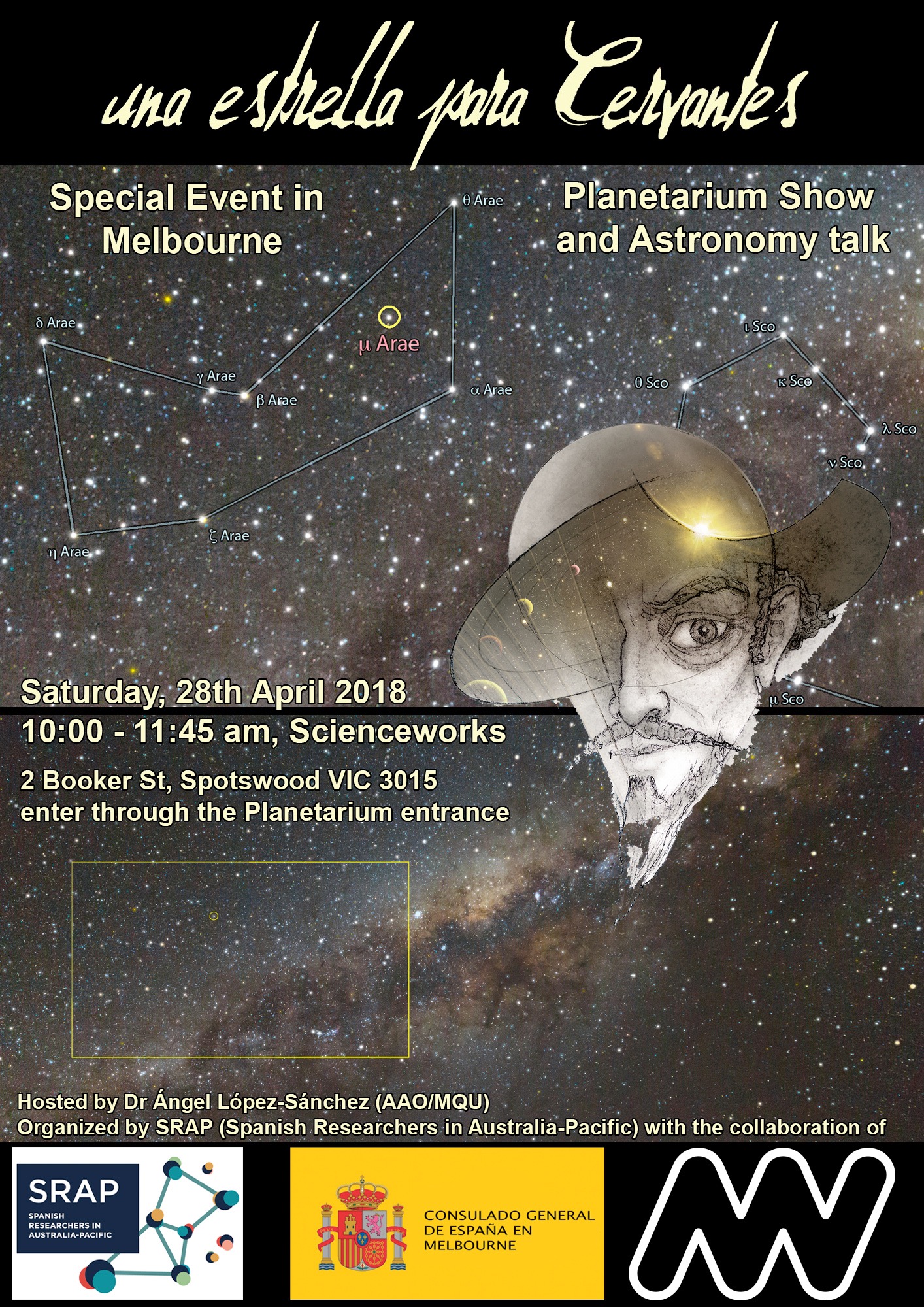
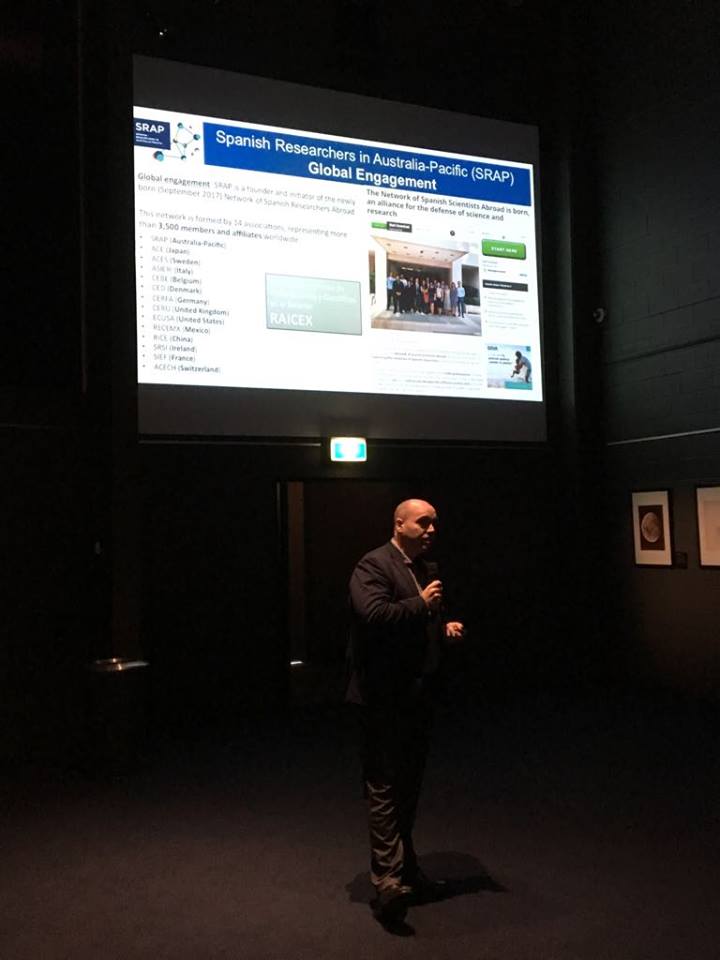
Last Saturday 28th April we had a very special event at Scienceworks (Melbourne, Victoria): a Astronomy talk and a special projection of the planetary show “Una estrella para Cervantes” (A star for Cervantes). The event was hosted by astrophysicist and science communicator Ángel R. López-Sánchez (AAO/MQU), who was in charge of giving a talk about the techniques that astronomers use for detecting planets around other stars and how they survey the sky. Our Chair, Sergio León-Saval (University of Sydney) also provided an overview of our association. The event was organized by Elena López Varela, Ángel R. López-Sánchez and Kate Bernard.

Astronomer Ángel López-Sánchez during his talk. Credit: SRAP-IEAP.

Sergio León-Saval (left) and Ángel López-Sánchez (second left) with the Kate Bernard, director of Sciencework (second right) and Elena López Varela (righe). Credit: SRAP.-IEAP

Sergio León-Saval during his talk about SRAP-IEAP. Credit: SRAP-IEAP.

We really thank the very friendly staff of Sciencework, who really helped to get this event happening, and to the support of the Consulado General de España en Melbourne. We also thank staff at the Planetarium of Pamplona, specially to Javier Armentia, for their help providing on time the high-resolution files of the movie.