On Friday 21st August 2015, during the Australian National Science Week, the AAO and Centennial Parklands organized a public stargazing event in Centennial Park in Sydney. This event was part of an attempt to break the Guinness World Record for the “Most People Stargazing across Multiples sites in a Country,” organized by Mt Stromlo Observatory, RSAA/ANU, Canberra.
I helped in the organization of the event jointly organized by the Australian Astronomical Observatory and Centennial Parklands at Centennial Park. During a 10 minute period between 8:30 and 8:40 pm, 400 participants used small telescopes and binoculars to look at various objects in the night sky. I also prepared this time-lapse video, which compiles 2500 photos taken between 6pm and 9:30pm, shows people assembling in the field to listen to presentations by Prof. Fred Watson and Dr. Amanda Bauer before the official stargazing event began. A timeline of events are included in the video.
Time-lapse video of the Stargazing event jointly organized by the Australian Astronomical Observatory and Centennial Parklands at Centennial Park with the aim of break the Guinness World Record for the “Most People Stargazing across Multiples sites in a Country. The video compiles 2500 photos taken every 5 seconds between 6pm and 9:30pm. A Full HD version of the video is available in the AAO YouTube Channel.Credit of the video: Ángel R. López-Sánchez (AAO/MQ); Credit of the music: “Space Guardians”, by Fran Soto, Epic Soul Factory.
In total, 37 sites across Australia participated in achieving the Guinness Record World, including 7960 individual stargazers. The Guinness World Record for the “Most People Stargazing across Multiples sites in a Country” was confirmed on 15th October 2015. Congratulations to all involved!
This is the “first light” of my new CANON 5D Mark III DSLR camera!
This image combines 5 x 15 seconds frames, using a Tamrom 24 mm lens at f/2.8. The Milky Way setting over the trees at Siding Spring Observatory, on 8 September 2015.
DP ENGLISH: This story belongs to the series “Double Post” which indicates posts that have been written both in English in The Lined Wolf and in Spanish in El Lobo Rayado.
DP ESPAÑOL: Esta historia entra en la categoría “Doble Post” donde indico artículos que han sido escritos tanto en español en El Lobo Rayado como en inglés en The Lined Wolf.
Last night half of the world (Eastern Asia, Australasia, Pacific and the Americas) enjoyed a total lunar eclipse. Again clouds were moving around over Sydney during all the day, I actually see the moon rising in the evening and in just few minutes moving into the clouds. The sky was almost completely covered when the eclipse started, at around 20:15 local time. I was fearing that, as it happened with the partial solar eclipse visible in Sydney last 29th April, I would not be able to get any useful image of the eclipse.
In any case, as I did for the occultation of Saturn by the Moon last May, I set up my telescope in the backyard and prepared everything for taking some photos of the event. Although I followed the eclipse almost completely, the clouds only allowed me to get good images in three occasions. These are the results:
Visions of a Total Lunar Eclipse within clouds. 8 October 2014 from Sydney. Data obtained using Telescope Skywatcher Black Diamond D = 80 mm, f = 600 mm, with a CANON EOS 600D at primary focus. The Red Moon compiles 40 frames taken at 1/3 s & ISO 800. Stacking using Lynkeos software, final processing with Photoshop. Credit: Á.R.L-S. (AAO/MQ)
It is not too much but I hope you like it. I will wait for the next total lunar eclipse to try to get the time-lapse sequence of all the event.
DP ENGLISH: This story belongs to the series “Double Post” which indicates posts that have been written both in English in The Lined Wolf and in Spanish in El Lobo Rayado.
DP ESPAÑOL: Esta historia entra en la categoría “Doble Post” donde indico artículos que han sido escritos tanto en español en El Lobo Rayado como en inglés en The Lined Wolf.
I’ve been waiting year and a half to finally see this happening. One of the displays I prepared for the Stories from Siding Spring Observatory Photo Exhibition (that was organized by staff of the Australian Astronomical Observatory (AAO) and originally released on 17th April 2013 at the Sydney Observatory), was a new time-lapse video compiling scenes showing all the telescopes at the Siding Spring Observatory (Coonabarabran, NSW, Australia) before the terrible bushfires that destroyed the Warrumbungle National Park and seriously affected the very same Observatory on 13th January 2013. However I couldn’t do this time-lapse video public until today, as it is the very first video to be included in the AAO Youtube channel. So here it is the time-lapse video “The Sky over Siding Spring Observatory:
Video time-lapse The Sky over Siding Spring Observatory. To enjoy it as its best, I strongly recommend you to see it at its highest resolution (FullHD) and full screen in a dark room. Credit: Video Credit: Ángel R. López-Sanchez (AAO/MQ), Music: Point of no return (Rogert Subirana).
I think this is the best time-lapse video I have created so far. It last 4:30 minutes and it compiles the best time-lapse sequences I obtained at Siding Spring Observatory between August 2011 and March 2013, during my support astronomer duties for the 4-metre Anglo-Australian Telescope (AAT). Telescopes at Siding Spring Observatory featured include the Uppsala Near Earth Object Survey Telescope, the UNSW Automated Patrol Telescope, the 2.3m ANU Telescope, 1.2m Skymapper ANU, the 1.2m UK Schmidt Telescope (AAO) and the very own Anglo-Australian Telescope (AAT).
Throughout the video, watch for several astronomical objects: our Milky Way Galaxy, the Large and Small Magellanic Clouds, the Moon rising and setting, the planets Venus, Mars, Jupiter and Saturn, Zodiacal Light, Earth-orbiting satellites, airplanes crossing the sky, the Pleiades and Hyades star clusters, the Coalsack and the Carina nebulae, and famous constellations like the Southern Cross, Taurus, Orion, and Scorpio.
The time-lapse technique consists of taking many images and then adding all to get a movie with a very high resolution. In particular, the camera CANON EOS 600D and two lenses (a 10-20 mm wide-angle lens and a standard 35-80 mm lens) were used to get the frames of this time-lapse video. Except for those frames taken during the sunset in the first scene, frames usually have a 30 seconds exposure time, with a ISO speed of 1600. Some few scenes were shot using 15 or 20 seconds exposure time. All sequences were created at 24 fps (frames per second), and hence a second in the movie corresponds to 12 minutes in real time for the majority of the scenes. In total, the video combines around 5800 individual frames. Processing each 10 – 20 seconds sequence took between five and six hours of computer time. Care was taken to remove artifacts and hot pixels from individual frames, minimize background noise, and get an appropriate colour/contrast balance.
I hope you like it. Comments and posting about it in social media are very welcome.
DPENGLISH: This story belongs to the series “Double Post” which indicates posts that have been written both in English in The Lined Wolf and in Spanish in El Lobo Rayado.
DPESPAÑOL: Esta historia entra en la categoría “Doble Post” donde indico artículos que han sido escritos tanto en español en El Lobo Rayado como en inglés en The Lined Wolf.
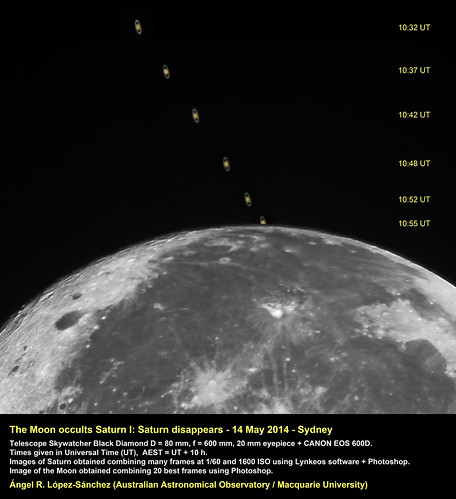
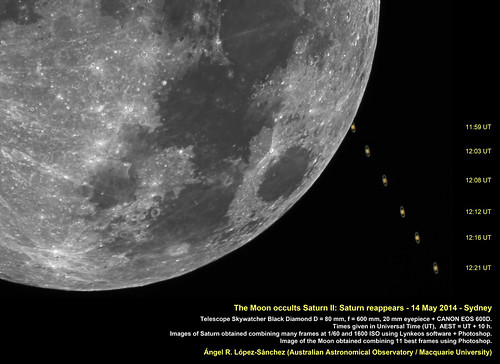
Today Sunday I’ve used some of my free time to process the images I took last Wednesday, when Saturn was occulted by an almost full Moon. These are my two final images showing how Saturn first disappears behind the Moon and it reappears an hour later.
The Moon occults Saturn I: Saturn disappears. 14 May 2014 from Sydney. Data obtained using Telescope Skywatcher Black Diamond D = 80 mm, f = 600 mm, 20 mm eyepiece + CANON EOS 600D. All times are given in Universal Time, add 10 hours to get the local time in Sydney (AEST) that date. Images of Saturn obtained combining many frames at 1/60 and 1600 ISO using Lynkeos software + Photoshop. Image of the Moon obtained combining 20 best frames using Photoshop. Credit: Á.R.L-S. (AAO/MQ)
The Moon occults Saturn I: Saturn disappears. 14 May 2014 from Sydney. Data obtained using Telescope Skywatcher Black Diamond D = 80 mm, f = 600 mm, 20 mm eyepiece + CANON EOS 600D. All times are given in Universal Time, add 10 hours to get the local time in Sydney (AEST) that date. Images of Saturn obtained combining many frames at 1/100 and 1600 ISO using Lynkeos software + Photoshop. Image of the Moon obtained combining 11 best frames using Photoshop. Credit: Á.R.L-S. (AAO/MQ)
Getting nice images of Saturn was much trickier than I expected: the setup I used the other night it is not the best to observe Saturn, as more magnification and a good tracking are needed. On the other hand, the Moon was very bright so I had to use short exposition times, and hence Saturn appeared very dim. At the end I manage to get a kind of “master Saturn” combining the best frames I took during the night and later combine it with the data of each position to get the final view of Saturn at each time. For the Moon it was much easier, although you’ll perhaps realize that the second image is somewhat better than the first. The reason is that some parts of the Moon were actually saturated with the 1/60 seconds exposures, and that is why I later used 1/100 seconds for getting Saturn reappearing. In any case, I hope you like them.







 A/Prof. Ángel R. López-Sánchez