Besides being an astrophysicist I’m an active amateur astronomer. After 6 years living in Australia, finally in May 2012 I bought my own, small amateur telescope: Skywatcher Black Diamond Refractor Telescope, with an aperture of 80 mm and a focal distance of 600 mm. It provides beautiful images of the sky. However, besides once while stayed at Siding Spring Observatory and the two “great astronomical events” of 2012 (and the final reason I got the telescope), the Transit of Venus in June and the Total Solar Eclipse in November, I have not had too much time to play with this toy.
Last Monday 18th February it was clear in Sydney and I tried to get some shots of the conjunction between the Moon and Jupiter (actually, from South Australia the Moon occulted Jupiter!). This is the vision I got from my telescope:

Conjunction between the Moon and Jupiter observed from Sydney on 18th February 2013. I used my Skywatcher Black Diamond Telescope D = 80 mm, f = 600 mm and my CANON EOS 600D at primary focus, at 200 ISO. It is a composition of two images: one taken at speed 1/60 and another at 1/10. I did what I could to get a nice balance between them. Credit: Angel R. López-Sánchez.
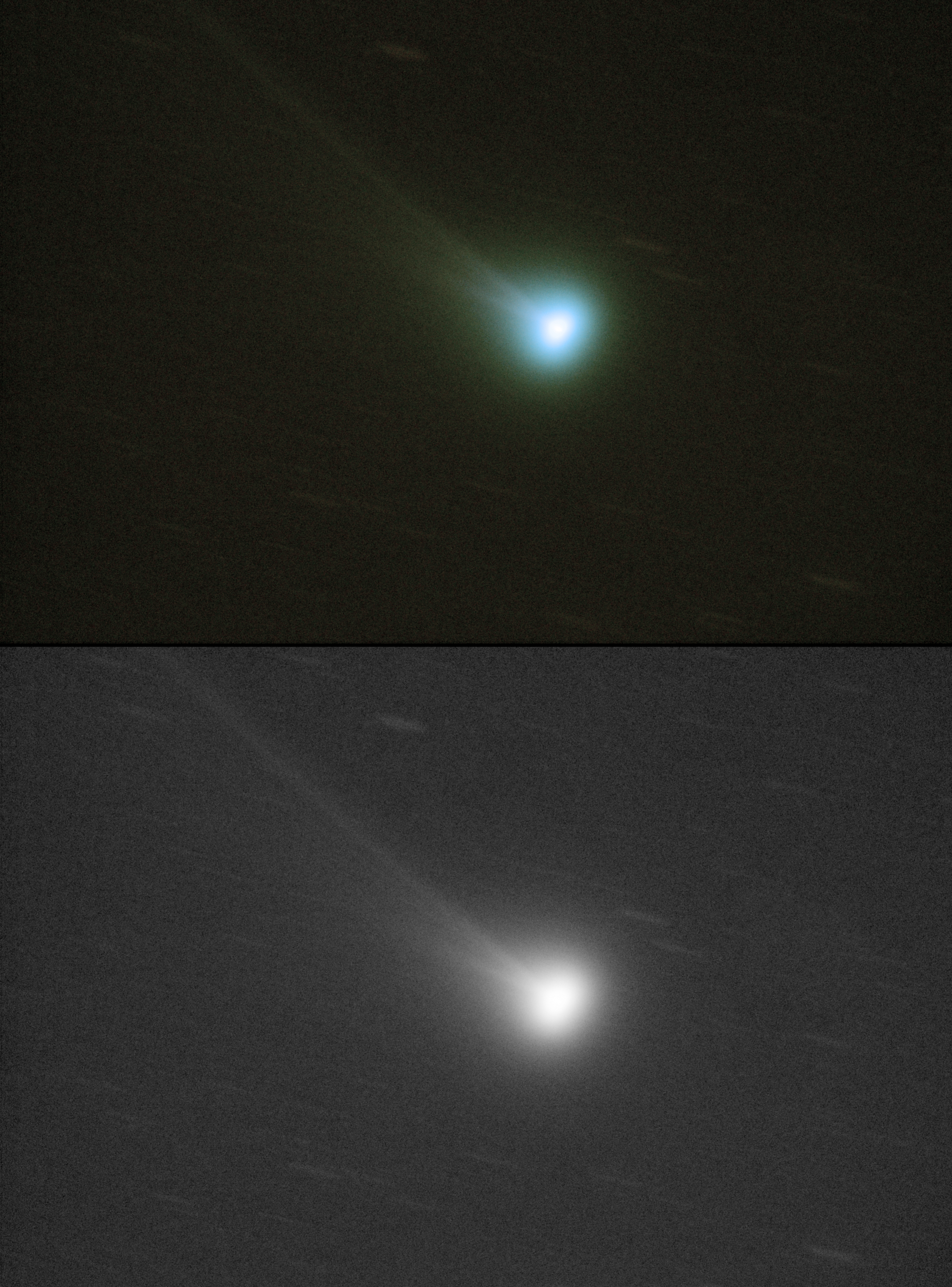
After this, I decided to try to find the bright comet Lemmon 2012 F6, that was located near the Small Magellanic Cloud. It was actually easier I thought and, besides the light pollution, I got it. So on Tuesday 19th, again clear, I prepared the telescope but this time including the motors and performing an alignment of the mount to the South Celestial Pole. This task is not easy when there is too much light in the sky, as the stars used to do it are faint. At the end I got this view of the comet. I was not able to detect the tail with my eyes, however it does appear when combining several frames, as I did for this image.

My vision of the comet Lemmon 2012 F6 from Sydney on Tuesday 19th February 2012, at 21:20 AEST (10:20 UT). I combined 7 frames of 6 seconds exposure each (42 seconds total exposition time), at 1600 ISO using Skywatcher Black Diamond Telescope D = 80 mm, f = 600 mm and my CANON EOS 600D at primary focus. Note the faint tail moving towards the upper-left. Credit: Angel R. López-Sánchez.
An annotated version of this image can be found here:

Annotated version of my vision of the comet Lemmon 2012 F6 from Sydney on Tuesday 19th February 2012, at 21:20 AEST (10:20 UT). I combined 7 frames of 6 seconds exposure each (42 seconds total exposition time), at 1600 ISO using Skywatcher Black Diamond Telescope D = 80 mm, f = 600 mm and my CANON EOS 600D at primary focus. I have included an arrow folowing the faint tail, the orientation, and the position of the star &epsilon Tucanae. Credit: Angel R. López-Sánchez.
To get a good focus I decided to use the famous Jewel Box star cluster, very close to Mimosa (β Crucis).

Image of the “Jewel Box” star cluster (NGC 4755 or Kappa Crucis) in the Southern Cross from Sydney (actually, 4 km from the city center) on Tuesday 19th February 2013, 20:50 AEST (09:50 UT). It combines 6 images with 5 seconds exposure each ( 30 seconds total time) at 400 ISO, using a Skywatcher Black Diamond Telescope D = 80 mm, f = 600 mm and my CANON EOS 600D at primary focus. The bright star at the left is Mimosa, β Crucis, one of the brightest stars of the Southern Cross. Credit: Angel R. López-Sánchez.
Any of these images are very spectacular but considering that they have been taken just 4 km from the center of Sydney, with all the light pollution, plus the extra “fight” with the
mozzies, I’m happy to share them with you.






 A/Prof. Ángel R. López-Sánchez