Tag Archives: Outreach

Timelapse video: The Sky over the Anglo-Australian Telescope

A dark winter night, with the Milky Way crossing the firmament while its center in located near the zenith, is one of the most astonishing views we can enjoy. This vision is only obtained from the Southern Hemisphere and it is really inspiring. In particular, the Milky Way shines over the Siding Spring Observatory, near Coonabarabran (NSW), where the famous Anglo-Australian Telescope (AAT) is located. With the idea of sharing the beauty of the night sky to everybody, in May 2011 I decided to start taking timelapse photography while I was working as support astronomer at the AAT. This technique consists on taking many images and then adding all to get a movie with a very high resolution. The best shots I obtained by September 2011 were included in the video The Sky over the Anglo-Australian Telescope, which is available both in YouTube and in several MOV/MP4 files (HD, iPad, iPhone) in my personal AAO webpage.


“The Sky over the Anglo-Australian Telescope” was my first public timelapse video, released in November 2011.
Credit: Ángel R. López-Sánchez (AAO/MQ), the credit of the music is Echoes from the past, by Dj Fab.

The video, which lasts for 2.7 minutes, is the results of combining around 3800 different frames obtained using a CANON EOS 600D between June and September 2011. Except for those frames used for the sunset in the first scene, all frames have a 30 seconds exposure time, with a ISO speed of 1600. As the videos were created at 24 fps (frames per second), each second in the movie corresponds to 12 minutes in real time. I used several lens to take the images (standard 50 mm, 50mm x 0.65 focal reducer and a 10 mm wide-angle lens). The focal chosen was 5.6 (for the 50 mm lens) or 4.5 (10 mm wide-angle lens). Processing each sequence of the movie took five to six hours of computer time, and usually I had to repeat this at least once for each sequence, to improve the quality. The soundtrack I chose is an extract of the music Echoes from the past, by the french composer Dj Fab, which gives energy to the timelapse.

The Milky Way is setting at Siding Spring Observatory on 21 Sep 2011.
Click here to get the full resolution frame.
Credit: Á.R. L-S.

As my main job while I’m at the AAT is providing instrumental and scientific support to the astronomers who are observing in this telescope, I always set the camera up at the beginning of the night, let it run, and check on its progress occasionally. Sometimes this was not easy: wind knocked the camera over on a couple of times, often the battery ran out, and even once I had an encounter with some intransigent kangaroos. However, finally I got this material, which does not only show the magnificent Milky Way rising and setting above the dome of the AAT, but also stars circling the South Celestial Pole, the Magellanic Clouds over the AAT, satellites and airplanes crossing the sky, the Moon rising and setting, and the most famous constellations as Orion, Carina and the Southern Cross.

Circumpolar star traces (2.7 hours) over the Anglo-Australian Telescope on 20 Sep 2011.
Click here to get the full resolution frame.
Credit: Á.R. L-S.

I hope you enjoy the result. More timelapse videos to come soon!

Stories from Siding Spring Observatory

Tonight we’re opening the photo exhibition Stories from Siding Spring Observatory at Sydney Observatory.

Baner of the Photo Exhibition Stories from Siding Spring Observatory opening tonight at Sydney Observatory. The Exhibition will be opened to the public between 18 April 2013 and 13 August 2013. As the general visit to Sydney Observatory, it is free.
Credit: Á.R.L-S.

This photo exhibition compiles 25 photos plus four time-lapse videos taken at the Siding Spring Observatory by staff of the Australian Astronomical Observatory. I have actively participated in the organization of this photo exhibition, not only providing some photos (see below) but also the 4 time-lapse videos, one of them specifically prepared for this.

The idea of organizing the photo exhibition came after the terrible bushfires that destroyed the Warrumbungle National Park and seriously affected Siding Spring Observatory on 13th January 2013. Luckily any telescope experienced any damage and we were back at the telescopes just 1 month after the bushfires. However, some houses and facilities, including the ANU Lodge, were destroyed in the bushfires. The vegetation at the site was also seriously affected, and indeed the views from there are not now as beautiful as they were before.

As the brochure of the Exhibition quotes,

Siding Spring Observatory sits on a mountaintop in the Warrumbungle Range, 400 km northwest of Sydney and 25 km west of the town of Coonabarabran. Run by the Australian National University, it is Australia’s most important site for optical astronomy.

On 13 January 2013 a bushfire swept through the observatory. Despite damage to some buildings, the telescopes were unharmed and are now back at work.

The photos in this exhibition tell stories of life and work on the mountain. They were taken by staff of the Australian Astronomical Observatory (AAO), which operates two telescopes there: the 4-m Anglo-Australian Telescope (AAT) and the UK Schmidt telescope.

Yesterday evening some of us were there installing the Exhibition and hanging frames and labels from the walls of the Sydney Observatory:

Working hard to get all frames and labels done on time!
Credit: Á.R.L-S.

Jamie Gilbert (AAO) carefully hanging label to my photo “Day and Night”.
Credit: Á.R.L-S.

The photos I’m providing for the Exhibition are these:

The 3.9m Anglo-Australian Telescope (AAT).
Credit: Á.R.L-S.

The 2dF instrument attached to the primary focus of the AAT.
Note that the mirror of the telescope is opened.
Credit: Á.R.L-S.

Day and Night at the AAT.
Credit: Á.R.L-S.

Circumpolar stars over the AAT on a dark winter night.
Credit: Á.R.L-S.

Double Rainbow at the sunrise over the Warrumbungle National Park. Photos taken from the catwalk of the AAT by Amanda Bauer (AAO) and processed and stitched by me.
Credit: Amanda Bauer & Ángel R. López-Sánchez.

but you can find many more photos I took at Siding Spring Observatory during the last years in this album of my Flickr.

However I have to confess that, as Amanda Bauer says in her blog, the best of the photos we have chosen is this spectacular panorama of the Milky Way over the AAT obtained by Jamie Gilbert (AAO):

Panorama of the Milky Way over the Anglo-Australian Telescope (AAT) using a CANON 5D Mark III. More information about this image: here.
Credit: Jamie Gilbert (AAO)

and that is why this photo is the largest one!

Jamie Gilbert and the frame with his panorama “The Milky Way over the AAT” during the installation of the photos of the “Stories from Siding Spring Observatory” Exhibition at Sydney Observatory on the evening of 16 April 2013
Credit: Á.R.L-S.

The Photo Exhibition Stories from Siding Spring Observatory is open to the public between 18 April 2013 and 13 August 2013. As the general visit to Sydney Observatory, it is free, so do not miss it if you have a chance!

Earth Hour 2013 in Sydney

Last 23rd March 2013 I was invited to give a Public Talk at Sydney Observatory because of the Earth Hour 2013. More than 200 people attended this event, I have to say I think it was not because of me but because of the possibility of getting a somewhat darker sky than usual in the city center. Earth Hour is a worldwide event organized by the World Wide Fund for Nature (WWF) that encourages households and businesses to turn off their non-essential lights for one hour. The aim of this is to raise awareness about the need to take action on climate change and, in particular, the problem of the light pollution. The Earth Hour first took place in 31st March 2007 in Sydney, which has a participation of 2.2 million Sydneysiders. In 2008 many other cities around the world adopted the event, creating a movement in which now participates around 1 billion people in more than 150 countries.

What is light pollution? It can be defined as the excessive or inappropriate outdoor lighting. Common forms of light pollution include glare, sky glow, light trespass, and light clutter. As the International Dark Sky Association (IDA) specifies in its main brouchure

Urban dwellers everywhere are losing the ability to see planets and stars in the night sky. The spectacular view of the Cosmos that has inspired science and art throughout history is disappearing. The glow of uncontrolled outdoor lighting has hidden the stars and changed our perception of the night. Light pollution wastes energy ( = MONEY! ), harms ecosystems, increases greenhouse gasses, threatens astronomical research and affect human health. Better lightning is the solution! The problems from light pollution can be solved by utilizing efficient, modestly bright outdoor lighting fixtures that are directed toward the ground and shielded to control glare.

Empire State Building in New York city at night. The light pollution is a terrible problem in large cities, giving the sky that orange colour. Sadly, today many children think that this is the real color of the night sky. Picture taken in October 2004.
Credit: Charliebrown7034 (Wikipedia).

Beside the negative effect that the light pollution has in the environment and its effects in animals and persons, I want to emphasize that its main consequence (at least, that which sadly is more important) is the huge amount of money which is wasted to illuminate the clouds and hide the stars. People around the world are realizing that this stupid kind of pollution has an easy solution. However it is responsibility of we, scientists, to talk about this to the general public and also to our Governments. Following the document Public Lighting—Energy Efficient Street Lighting published in July 2008 by the Australian Government,

In Australia, public lighting is the single largest source of local government’s greenhouse gas emissions, typically accounting for 30 to 50% of their CO2 emissions. There are 1.94 million public lights — one for every 10 Australians — that annually cost A$210 million, use 1,035 GWh of electricity and are responsible for 1.15 million tonnes of CO2 emissions.

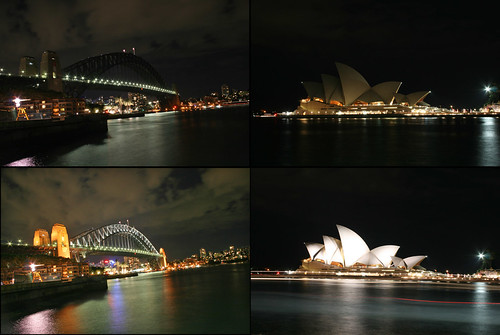
Photos comparing the vision of the Sydney Harbour Bridge and the Sydney Opera House during the Earth Hour on 28th March 2003 (top row) and after that event (bottom row). All 4 images were taken from the same place using a camera CANON EOS 400D, 400 ISO, f10 and 20 seconds exposure. The decreasing of the light pollution (seen specially well in the clouds) is quite evident.
Credit: Á.R.L-S. (AAO/MQ)


I emphasized, however, that the light pollution in Australia is (still) not bad at all. Australia has some of the darkest places on Earth (I was really impressed about how stars shine from the Australian Desert), are indeed Sydney, which has 4.5 million people, has by far better night skies that those seen from the city I’m from, Córdoba (Spain), with only 350 thousand people. As an example, just check this image I took in 2011 New Year Eve from the Opera Bar, just downstairs of the Sydney Opera House

Vision of the Sydney Opera House from the Opera Bar on the 2011 New Year Eve. It is just a 10 seconds exposure at f6.3 and 400 ISO using a CANON EOS 400D camera. The main stars of the Orion and Taurus (The Bull) constellations are clearly seen, as well as the Pleiades and even the Orion Nebula as a diffuse dot!
Credit: Á.R.L-S. (AAO/MQ)

After discussing the light pollution, its effects and some projects aimed to reduce it, I used the second half of my time to talk about my research at the Australian Astronomical Observatory / Macquarie University. I explained what an astronomer usually does, where the Siding Spring Observatory is, and presented some results of my own research about star-formation in galaxies.

A moment during my Public Talk at Sydney Observatory on 23rd March 2013 just before the Earth Hour. I was explaining here the problem of the light pollution, although later I talked about my research and work at the Australian Astronomical Observatory and Macquarie University.
Credit: Jeanette Landstedt (Sydney Observatory).

After the talk the participants enjoyed some stargazing using the amateur telescopes provided by the Sydney Observatory. I was among them and couldn’t stop talking to one and another group, as I was still being asked about what I said during my talk. It was great to be able to do this in the very relaxing atmosphere of an amateur observation. The only bad thing was that there was still a lot of light coming from the Moon, indeed, choosing the weekend before Easter for the Earth Hour was not good as it was not possible to really check the actual difference induced by the deficit of illumination in the sky.

Public Talk at UNSW: “Surprises of the Cosmos”

Next Friday 8th March 2013, at 6:30 pm, I’m giving a Public Lecture at the School of Physics of the University of New South Wales (UNSW), Sydney. I’m presenting an updated version of my nice talk Surprises of the Cosmos which I prepared in 2009 because of the Photo Exhibition co-organized between the Instituto Cervantes (Spain) and the Canary Islands Astrophysical Institute (IAC, Instituto de Astrofísica de Canarias, Spain) in 2009 because of the International Year of Astronomy. I participated in this exhibition and later I have given same talks here in Australia (Sydney, Melbourne and Canberra) publicizing it.


Flyer of the Public Talk “Surprises of the Cosmos” which I will give next Friday 8th March 2013 at the School of Physics of the University of New South Wales (UNSW), Sydney Credit: UNSW / Angel R. López-Sánchez.

In this talk I imagine we are far, far away from the Earth and take a journey from the deep Universe to our home planet. Our travel will start far away from the Earth, in galaxy clusters containing tens of thousands of galaxies and located more than 10 billion light years from us. We will see how galaxies formed and how we think our Milky Way and it’s neighbours have evolved in time. Once in our Galaxy we will have a look to some remarkable objects: star-forming regions, star clusters and nebulae that are the remnants of dead stars. Finally, we will reach the Solar System and have a look to the planets and the dwarf planets that orbit the Sun. We will also visit comets and asteroids, explain their origin and emphasis how the study of such bodies allow scientist to get a better understanding in the formation of the Sun and the planets around 4.7 billion years ago. We will finish the journey in our planet visiting some of the most important astronomical observatories of the Earth.

The details of the talk and how to reach the Lecture Theater are included in these dedicated UNSW webpage and in the UNSW Events in Facebook

Where: Physics Lecture Theatre, Old Main Building, UNSW Kensington Campus (near Gate 14, Barker St), Sydney

Date: Friday March 8th 2013

Time: 6:30pm (Refreshments served from 6pm)

You can see all the images of this exhibition with the text in Spanish in this link.

Finally, I want to thank PhD student Vicki Lowe for inviting me to give this talk.

I’ll see you there!

From “El Lobo Rayado” to “The Lined Wolf”

Ángel R. López-Sánchez and the 2dF instrument at the 3.9m Anglo-Australian Telescope. Credit: Ella Pellegrini (Daily Telegraph).

Ángel R. López-Sánchez and the 2dF instrument at the 3.9m Anglo-Australian Telescope. Credit: Ella Pellegrini (Daily Telegraph).

Welcome to my new blog!

My name is Ángel R. López-Sánchez. I’m a Spanish astrophysicist working at the Australian Astronomical Observatory (AAO) and in the Department of Astronomy, Astrophysics and Astrophotonics of the Macquarie University (Sydney, NSW, Australia). My research in Astrophysics is focused in the analysis of star formation phenomena in galaxies of the local Universe, especially in dwarf starbursts and spiral galaxies, but using a multiwavelength approach.

In 2003, while starting my PhD thesis at the Instituto de Astrofísica de Canarias (IAC, Canary Islands Institute for Astronomy, Spain) I decided to create a blog about Astronomy to share with Spanish speakers my interests about this fascinating science. That was the birth of my blog El Lobo Rayado. I chose this title because in that moment I was analyzing a very interesting class of starburst galaxies, the so-called Wolf-Rayet galaxies. A bad translation from English to Spanish of Wolf (which means Lobo) and Rayet (which does not have a translation into Spanish, but it sounds like Lined) seemed a very original title for a blog about Astronomy, furthermore considering that then I was spending a lot of time analyzing optical spectra of galaxies showing many emission lines. In 2003 blogs were not as common as they are today, and I can say that El Lobo Rayado was one of the very first (if not the first) Spanish blogs fully dedicated to Astronomy and Astrophysics written by a Spanish astrophysicist.

I got my PhD in Astrophysics in December 2006. I presented a detailed analysis of a sample of Wolf-Rayet galaxies, the majority of the optical and near-infrared observations were obtained by myself using the telescopes available at the Spanish astronomical observatories of El Roque de los Muchachos (La Palma), Izaña (Tenerife) and Calar Alto (Almeria).

In 2007 I moved to Australia to work at the CSIRO Astronomy and Space Science (then just known as Australia Telescope National Facility) as radio-astronomer. Actually, I’m a weird mix between an optical and a radio astronomer, although I’m also using data from other wavelenghts. Indeed, I’m combining ultraviolet, optical, infrared and radio data to characterise the physical and chemical properties of galaxies and get clues about their nature and evolution. Since January 2011 I’m working at the Australian Astronomical Observatory (AAO) and Macquarie University (MQ) in Sydney (NSW, Australia).

My passion for Astronomy actually started when I was a kid, in the mountain ranges near my natal city, Córdoba (Spain), when I became an active amateur astronomer. Since 1991 I belong to the Agrupación Astronómica de Córdoba (AAC, Córdoba Astronomical Association). Besides being now a professional astronomer, I still feel like an amateur astronomer and indeed I enjoy a lot observing the sky with my eyes, binoculars or small telescopes and taking astronomical pictures using my own equipment.

I consider that outreach and publicizing Astronomy to the general public is very important and I’m usually involved in these activities. That is the reason I created both El Lobo Rayado and The Lined Wolf.

However, The Lined Wolf is not just a translation of El Lobo Rayado. Actually, I’m NOT going to translate a single post from one blog to the other. They will be complementary tools: I’ll continue writing in Spanish in El Lobo Rayado, as I consider it is very important to reach non-English speakers: the majority of the astronomical information, including press releases and hot news, is in English, and hence non-English speakers can still found some extra information about the most recent news about Astronomy in El Lobo Rayado. On the other hand, in the last few years I’ve been thinking it is also important for me to create my own blog about Astronomy in English. However, in this case my idea is to publicize my own research and explain the scientific papers I’m publishing, together with some of the adventures which involves to be a professional astronomer (observations in remote telescopes, conferences, workshops…). That is the aim that the blog The Lined Wolf has.

That also means I have to start from the beginning. There are many posts I still have to write here, just considering I’ll need at least a post per paper published in a refereed journal, plus posts showing some of my beautiful multiwavelength images. Shall we begin?