Tag Archives: Outreach

Astronomy event at Scienceworks, Melbourne

Article originally written for the blog of the Spanish Researchers in Australia-Pacific (SRAP-IEAP) association.

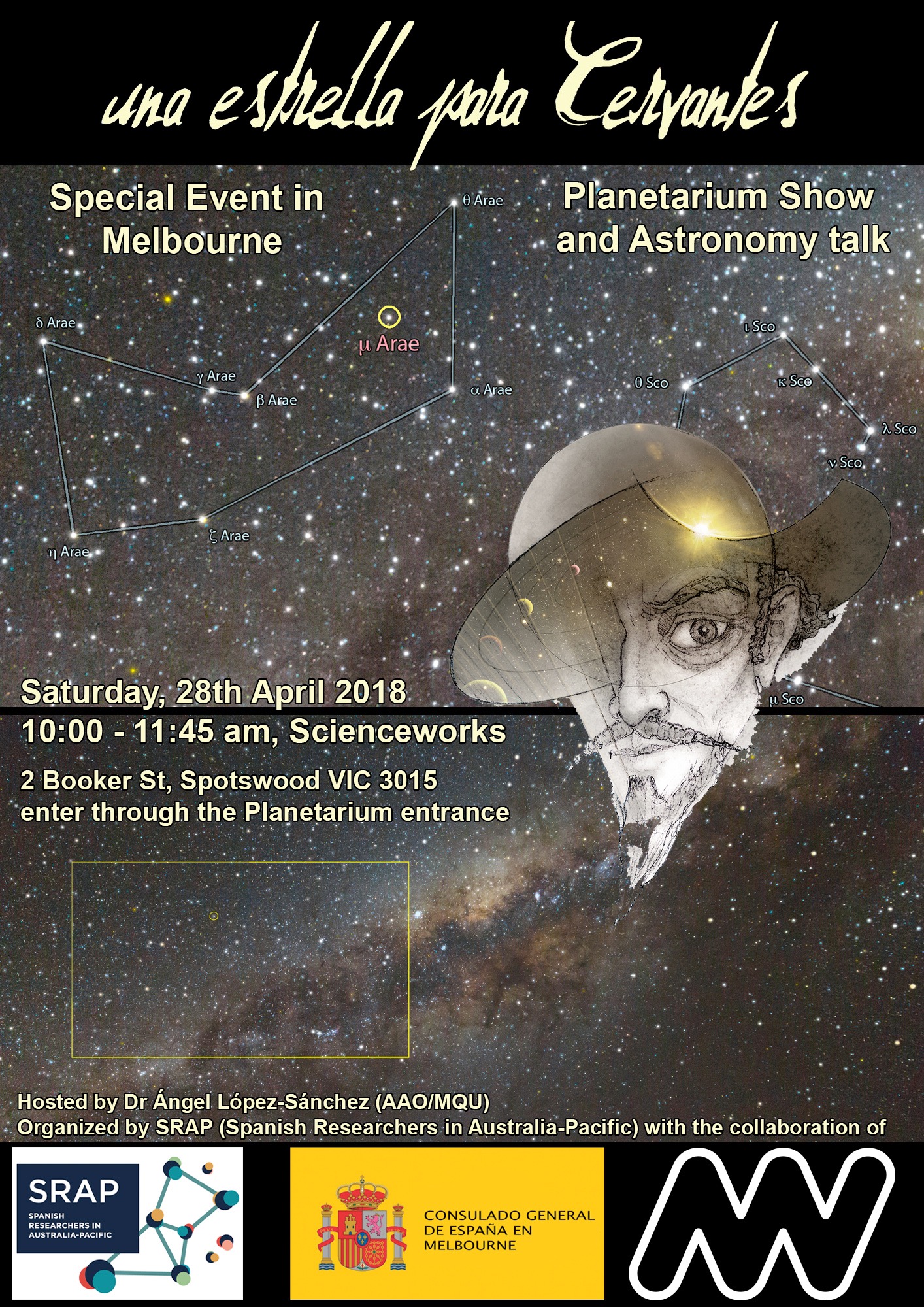
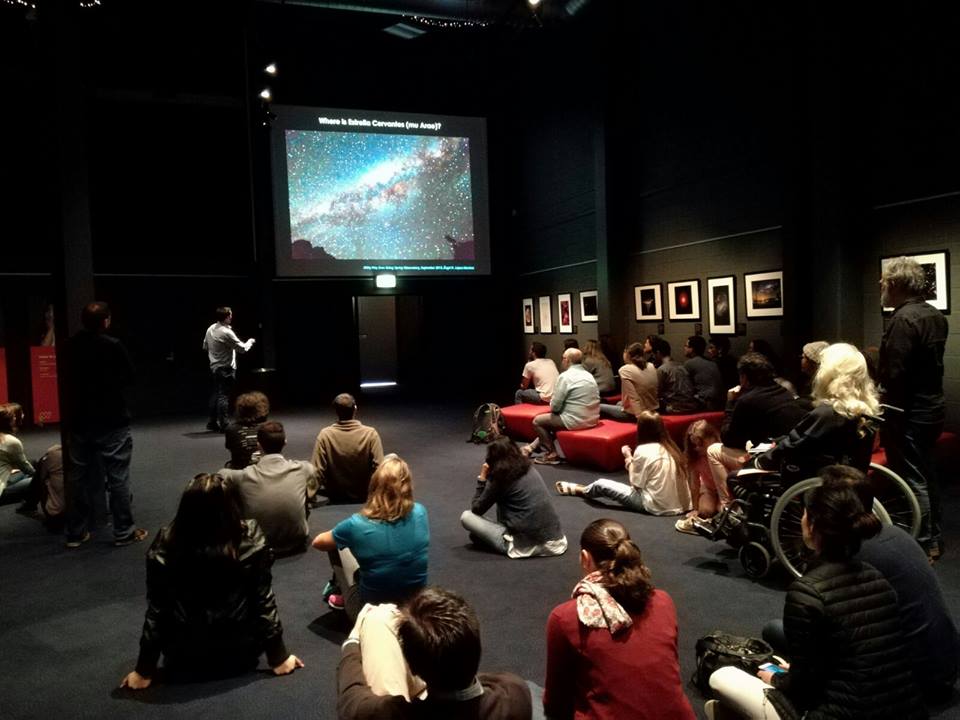
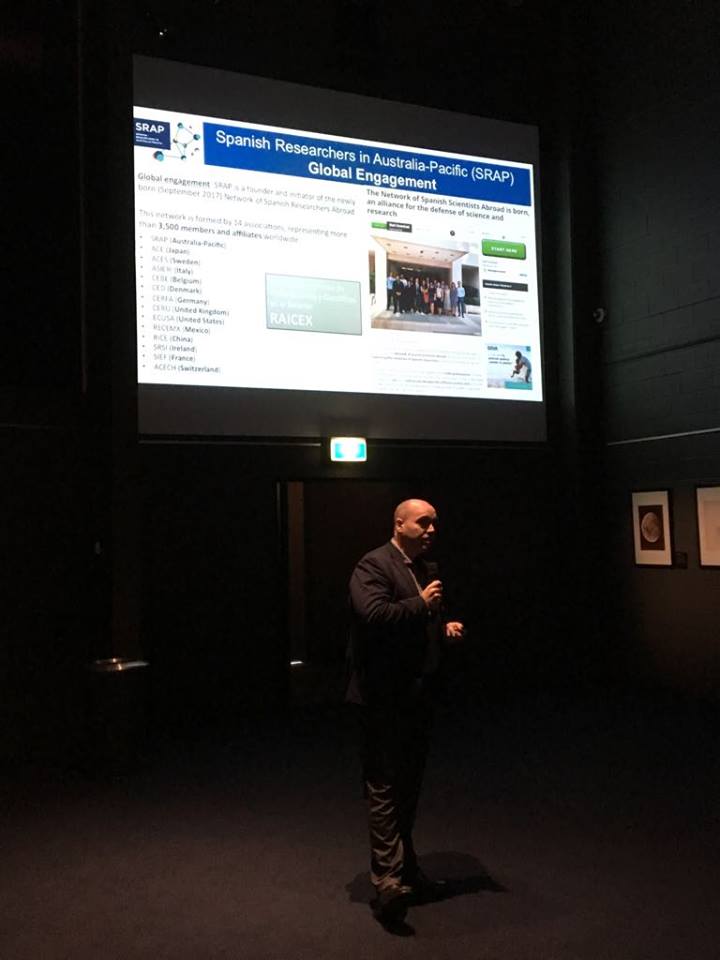
Last Saturday 28th April we had a very special event at Scienceworks (Melbourne, Victoria): a Astronomy talk and a special projection of the planetary show “Una estrella para Cervantes” (A star for Cervantes). The event was hosted by astrophysicist and science communicator Ángel R. López-Sánchez (AAO/MQU), who was in charge of giving a talk about the techniques that astronomers use for detecting planets around other stars and how they survey the sky. Our Chair, Sergio León-Saval (University of Sydney) also provided an overview of our association. The event was organized by Elena López Varela, Ángel R. López-Sánchez and Kate Bernard.

Astronomer Ángel López-Sánchez during his talk. Credit: SRAP-IEAP.

Sergio León-Saval (left) and Ángel López-Sánchez (second left) with the Kate Bernard, director of Sciencework (second right) and Elena López Varela (righe). Credit: SRAP.-IEAP

Sergio León-Saval during his talk about SRAP-IEAP. Credit: SRAP-IEAP.

We really thank the very friendly staff of Sciencework, who really helped to get this event happening, and to the support of the Consulado General de España en Melbourne. We also thank staff at the Planetarium of Pamplona, specially to Javier Armentia, for their help providing on time the high-resolution files of the movie.

SciComm experiment: #SuperBlueBloodMoon vs #LunarEclipse

As I expected the news about the Lunar Eclipse happening on the 31st of January 2018 was in the media and social media all around the world… even though in many countries (Europe, South America) the Lunar Eclipse was not visible.

In my humble opinion, many of the articles in general outlets and media were not very well written and actually very hype, which created that people were actually confused about what was happening.

Of course, I complained a lot about how the news were presented in the media. I’m a huge defender of inviting people to look at the sky (I’m continuously doing it!) but not exaggerating what people should expect to see. In this sense I’m an “old-schooler” as I really consider facts and naming things properly are important.

After having some discussions with friends in social media about all of this, I decided to create a poll in Twitter to explore this more (thanks @DarkSapiens and @vrruiz).

Furthermore, following the “noise” in Twitter, I had the feeling that young people care less about the actual name of the phenomenon than older people. That is, young people didn’t dislike naming the event as a Super Blue Blood Moon.

And that was the beginning. As a scientist I wanted to test if my hypothesis was right.

Hypothesis: At least in Twitter, as I see in my timeline, young astronomers/science communicators seem to prefer or at least are less molest with the term #SuperBlueBloodMoon than old astronomers/science communicators.

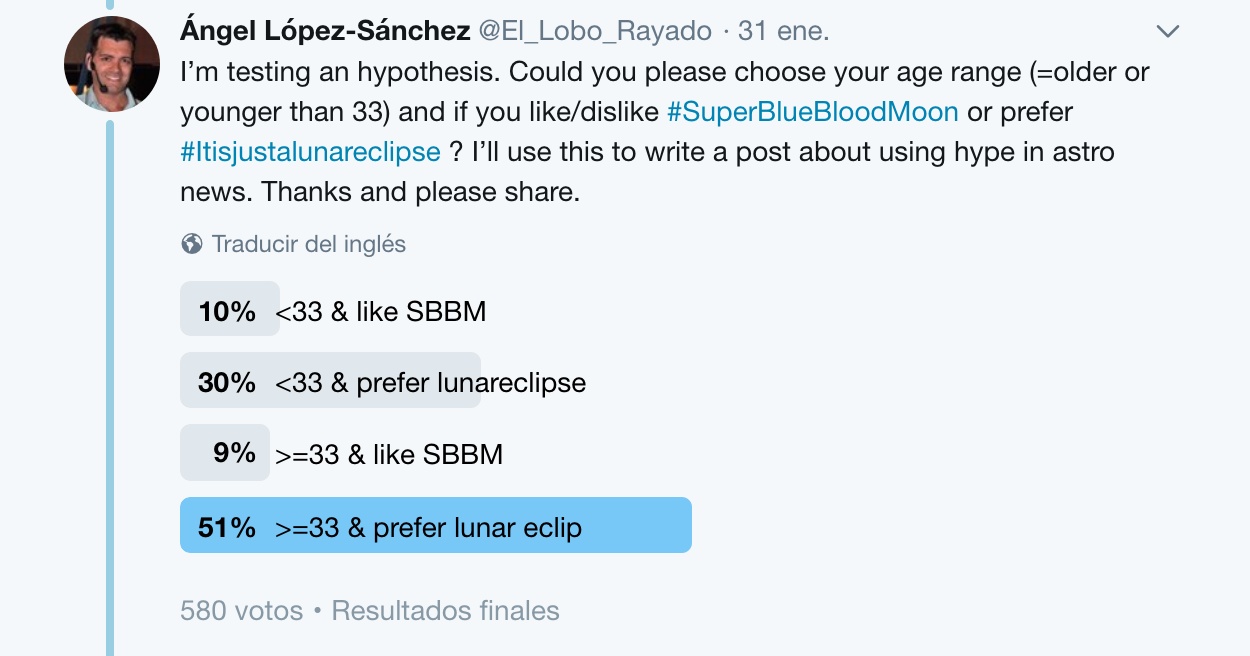
Experiment in Tweet: I’m testing an hypothesis. Could you please choose your age range (=older or younger than 33) and if you like/dislike or prefer ? I’ll use this to write a post about using hype in astro news. Thanks and please share.

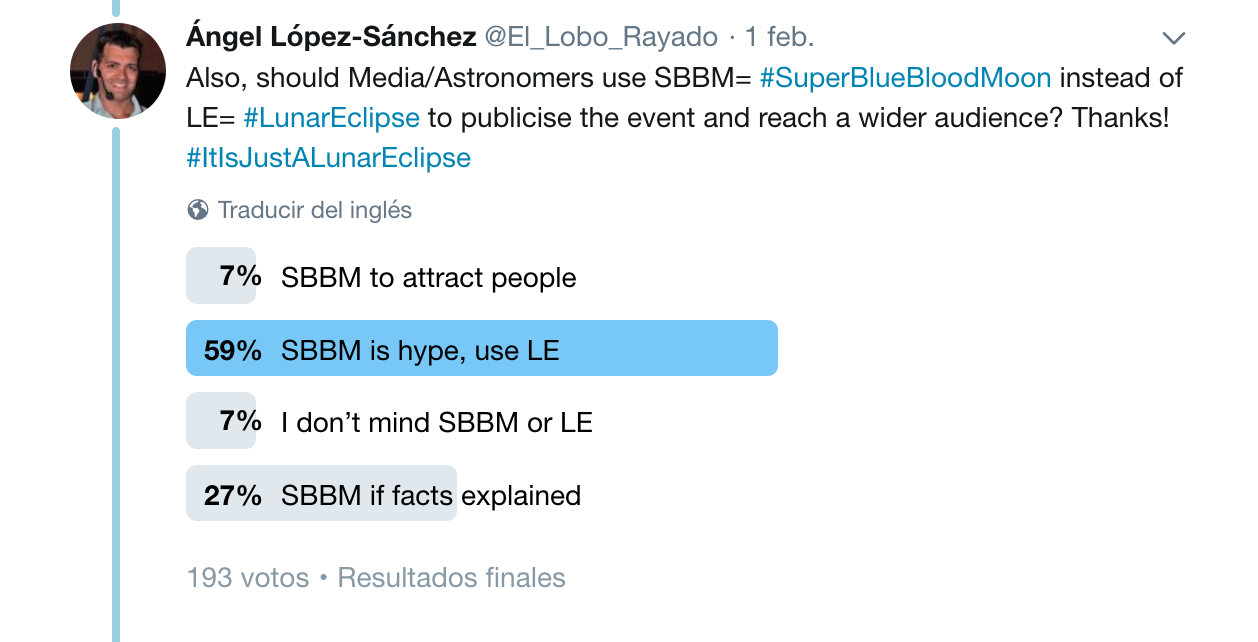
Below is the screenshot with the question and the results. Huge thanks to the 580 people who contributed in this poll (11% of my followers).

The conclusions that we can get from these results, that as I’ve said apply for my vision in Twitter, which is biased for the people who I follow or follow me, are the following.

First, the majority of my followers/people who answered this question are older than 32 years (60%). Fair enough.

Second, combined, only 19% of the answers agree with “I like SBBM”. I’m happy about this. And this was actually expected, because there should be a huge bias in the people that follow me in Twitter.

But the interesting thing for me is that, attending to these results, younger people like SBBM more than older people. The ratio between YES/NO is 25% for <33 years and only 15% for >=33 years.

Without any additional statistical analysis including uncertainties, this result seems to support my hypothesis and the reason of this experiment: young astronomers/science communicators seem to prefer or at least are less molest with the term #SuperBlueBloodMoon than old astronomers/science communicators.

But I also asked two extra questions.

Question 1: Also, should Media/Astronomers use SBBM= instead of LE= to publicise the event and reach a wider audience? Thanks!

The results here are also interesting. 3 people in 5 agree that using SBBM is hype (yes!). I was expecting this answer would have been around 2/3, but it is still a good proportion.

In any case, I also got some feedback about this:

27% of the answers (a bit more than 1 in 4 people) support using SBBM in the title of the news as long as the facts are explained in the text (which was rarely the case).

Very few people (7%) support using SBBM to attract people. And attending to the results provided by the experiment above, the majority of the answers are coming from young astronomers, as example my AAO colleague and friend Becky Brown:

My conclusion here: although some people think than using SBBM is a good thing to attract people to the news or observing the sky (but see next question), the majority of the people consider that SBBM is hype and should not be used, unless the facts are well explained in the text of the news.

Question 2: What do you consider is the most important consequence of using instead of for publicising the event?

Well, here 61% of the answers agree that “it is not that good to do that” as science/pseudoscience mix and people were confused. And indeed people were confused! During the last week I’ve been giving some virtual talks in Spain with students, and I received the question “what was the SBBM?”. They didn’t know it was a lunar eclipse, and they show some connections with astrology (!!!).

A couple of extra examples in the UK and Australia were provided as comments by two astrophysicists:

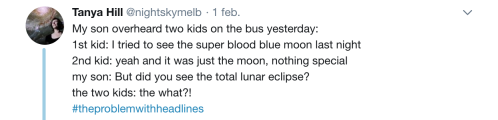
Still, 27% (more than 1 in 4) of the answers agree on using SBBM for getting the extra attention by Media (I assume that considering facts are explained, something that didn’t happen very often).

Only 12% of the answers agree that using SBBM instead of Lunar Eclipse encourage people to look the sky.

My conclusion to this question: although it might help to encourage people to look at the sky and for sure will attract the attention of the media, we should refrain to use SBBM as it confuses people at the same time that mixes science and pseudoscience.

What are your thoughts?

The “Super Blood Blue Moon” is just a lunar eclipse

In the last few days I’ve already answered some few emails and questions in social media about the Super Blood Blue Moon happening on the night from 31st January to 1st February 2018. What is this? Is this really important?

Short answer: No, it is not! This is just a lunar eclipse. The rest is hype to sell the story.

Visions of a Total Lunar Eclipse within clouds - 8 October 2014 - Sydney

Visions of a Total Lunar Eclipse within clouds – 8 October 2014 – Sydney. More information and high resolution images in my Flickr. Credit: Ángel R. López-Sánchez.

Long answer: Let me use an email I wrote yesterday replying the questions asked by a journalist about this astronomical event.

1. Can you please define “super moon” “blood moon” and “blue” moon as they occur individually?

—> Supermoon: this is a term that many astronomers (me included) don’t like, as it was introduced by an astrologer (not an astronomer) but it is now very popular. It is just the moment the full moon is happening near the perigee (the Moon in its closest point to Earth). But, that is the important thing, the difference in size of a “supermoon” with respect an average moon is that a supermoon is ~5-6% larger than the average moon. That is almost nothing!!! Many people are confused with the “14% difference” between the supermoon and the micromoon (when the moon is near the apogee, the farthest point to the Earth).

I insist: it is VERY difficult for our naked eye to distinguish a supermoon from an “average” moon.

You can read a lot about this in the post I wrote two years ago and also in the second episode entitled “Blueberry Moon” of the new science podcast “The Skyentists” produced by Kirsten Banks and me.

—> Blood moon: If we astronomers don’t like the term “supermoon”, we really hate the name of “blood moon”. This is just a lunar eclipse!!

—> Blue moon: the now “standard” definition of a blue moon is when a second full moon is happening within the same calendar month. That is, it was full moon on Jan 2nd, the second full moon this month in Jan 31st is a blue moon.

HOWEVER, strictly talking THIS IS NOT TRUE FOR EASTERN AUSTRALIA (NSW, Tasmania, Victoria) and New Zealand, as the moment of the full moon is actually at 00:26am Feb 1st (Sydney/Melbourne time). It is true for Queensland (at 11:26pm Jan 31st), Alice Spring (at 10:56pm Jan 31st) and Perth (9:56pm Jan 31st).

In any case, the ONLY IMPORTANT real astronomical event is that this is a lunar eclipse (the rest is added to create some hype).

You can get plenty of information about the lunar eclipse in this webpage in timeanddate.com and also in this PDF file from NASA Lunar Eclipses.

All the important information for the lunar eclipse happening on the 31st Jan 2018. Credit: F. Espenak / NASA. Here the PDF file.

Australian astronomers have also written about this lunar eclipse. I recommend to have a look to this nice article published by Tanya Hill in The Conversation and also this article by Alan Duffy in Australia’s Science Channel

2. Is this the first time a super blue blood moon has occurred in 150 years?

Probably not, I don’t know, we actually don’t care about this much… It is just a lunar eclipse!!!!

3. How significant is this lunar event?

As I said, it is just a lunar eclipse. That is the point. The rest is added.

4. We are in north-west Victoria. What can people expect to see?

It does not matter where you are in Australia (or in the world, as long as it is night) to see this event. The only differences will be the local weather conditions… if the weather is good, you’ll see a very nice lunar eclipse. It is a perfect opportunity to enjoy the sky!!

5. Are there any tips to getting the best view of the eclipse, or what would be the best times to see it?

The best moment to see the eclipse is when the moon is completely covered by the Earth’s shadow. This happens between 11:52pm and 1:08pm, with the maximum eclipse at 12:30am. You’ll see a red-orange moon in the sky, pretty spectacular.

Addendum 31st Jan: I’ve been using the hashtag #itisjustalunareclipse in social media to say that, at the end… it is just a lunar eclipse!

References:

31 January 2018 — Total Lunar Eclipse in http://www.timeandate.com
PDF file with all info of the lunar eclipse from NASA Lunar Eclipses.
Supermoons, post published in this blog, 11 Nov 2016
A blue blood supermoon is coming, by Alan Duffy in Australia’s Science Channel, 24 Jan 2018
The next Full Moon brings a lunar eclipse, but is it a Super Blood Blue Moon as well? That depends…, Tanya Hill in The Conversation, 29 Jan 2018.
A beginner’s guide to the Moon, Ian Musgrave and Genelle Weule in ABC News, 31 Jan 2018.
The “Trifecta” Lunar Eclipse on January 31st, great article by Kelly Beatty in Sky & Telescope, 29 Jan 2018.

AAO #Scicomm events during Australian National Science Week 2017

The AAO organized and/or participated in 7 events during Australia’s National Science Week in August 2017, including the very successful and sold-out events “Star Tales of Winter Nights” and “Stargazing in the Park”.

Astronomers at the AAO’s “Star Tales of Winter Nights” event at the Powerhouse Museum during National Science Week 2017. From left to right: Adam Schaefer, Dr Devika Kotachery, Dr. Ángel López-Sánchez (MC), Carlos Bacigalupo and Rebecca Brown. Credit: Ángel López-Sánchez.

The event “Star Tales of Winter Nights”, hosted at Sydney’s Powerhouse Museum had a very similar structure than our ViVID Sydney Ideas events: 5 astronomers talking about science and later answering questions from the audience. The speakers were Rebecca Brown, Adam Schaefer, Dr Devika Kotachery, Carlos Bacigalupo and myself. This event was another big success for the AAO.

Setting up the telescopes for AAO’s “Stargazing in the Park” in Sydney’s Centennial Park. Credit: Ángel R. López-Sánchez.

AAO’s Ángel López-Sánchez, Stuart Ryder and Duncan Wright (from left to right) ready for “Stargazing in the Park” in Sydney’s Centennial Park. Credit: Ángel R. López-Sánchez.

On the other hand, the “Stargazing in the Park” in Sydney’s Centennial Park was another sold-out event, with more than 120 people enjoying first a short lecture about the AAO and introduction to stargazing and later looking at the sky through the telescopes.

AAO’s Stuart Ryder attending visitors at the AAO desk during the “Science and Tech” expo at Chatswood Library on Saturday 12th August. Credit: Ángel López-Sánchez.

During National Science Week 20017 the AAO also participated in two of the events organized by the recently created “North Sydney Science Hub” . First on Saturday 12th August in the “Science and Tech” expo at Chatswood Library, and later in the Public DiscussionBig Data And Visual Analytics – What is it good for?”, on Thursday 17th August, also at Chatswood Library, being myself one of the panelists of the discussion.

Panel for the Public Discussion “Big Data And Visual Analytics – What is it good for?”, on Thursday 17th August, also at Chatswood Library. From left to right: Mark Ballico (NMI), Tomasz Bednarz (Data61 and UNSW Art & Design), Angela (CSIRO) and Ángel R. López-Sánchez (AAO.MQU).  Credit: Ángel R. López-Sánchez.

“Stargazing at The Calyx”, new science communication event series at Sydney’s Botanic Gardens

Article originally written by Ángel R. López-Sánchez for the “AAO Observer” 132, August 2017.

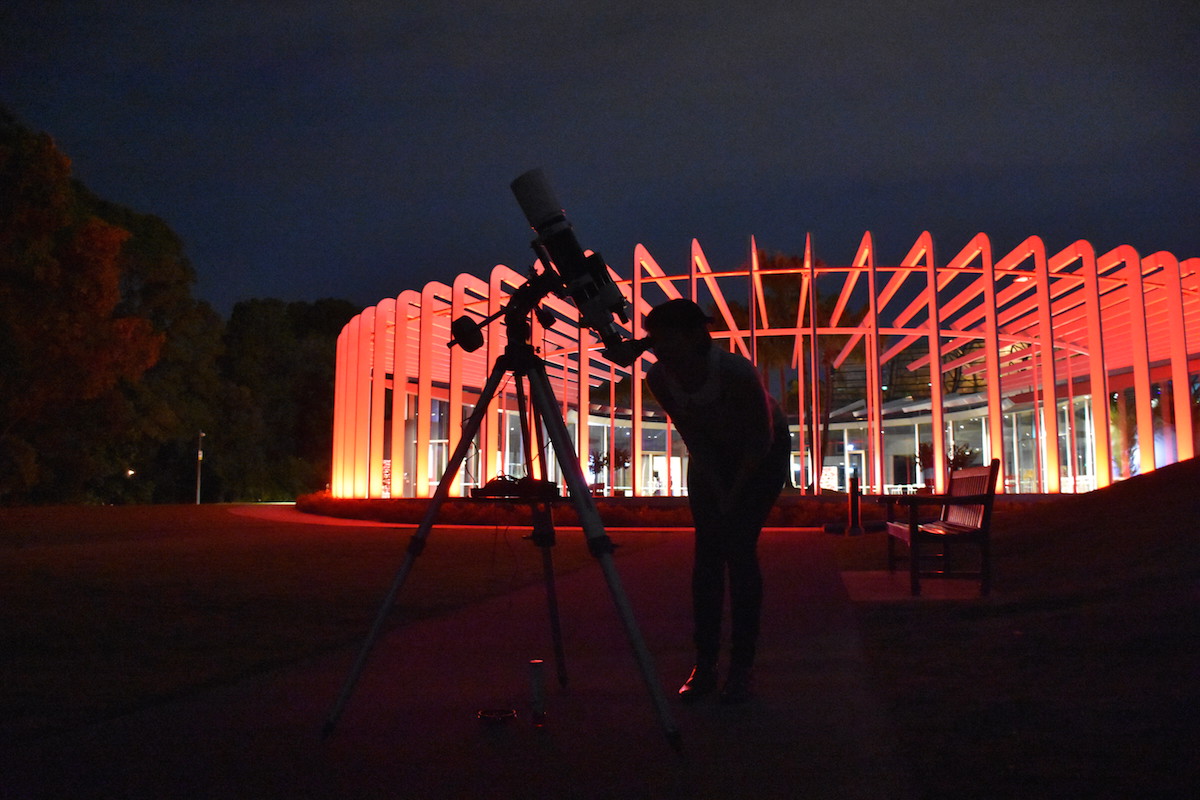
In June 2017 the Australian Astronomical Observatory (AAO) started a new Science Communication collaboration with historic Sydney’s Royal Botanic Gardens. The events “Stargazing at The Calyx” combine a short talk given by an astronomer followed by a stargazing session with amateur telescopes.

People are enjoying the view of the sky through amateur telescopes during the “Stargazing in the Calyx” science communication event at Sydney’s Botanic Gardens on Tuesday 4th July 2017. Credit: Christina McGhee (Sydney’s Botanic Gardens).

The first of these events was held on Monday 19th June 2017. It was so successful that the following “Stargazing in the Calyx” session, scheduled on Tuesday 4th July, was sold out in just 8 minutes after the tickets were available.

The organization of these events have received a hugely positive feedback, both about the venue (the brand-new “The Calyx” building at Sydney’s Botanic Gardens) and the atmosphere (people enjoyed dinner with drinks under the stars) and the entertaining and knowledgeable talks about the Southern Sky (given by AAO and Macquarie University astronomer Ángel López-Sánchez).

AAO/MQU astronomer Ángel López-Sánchez giving his talk “Introduction to the Southern Sky” as part of the “Stargazing at The Calyx” event at Sydney’s Botanic Gardens on Monday 19th June 2017. Credit: Christina McGhee (Sydney’s Botanic Gardens).

Besides some clouds and Sydney’s light pollution, participants really enjoyed the views of planets Jupiter and Saturn and the Moon through the telescopes, as well as observing globular cluster Omega Centauri and the famous “Jewel Box” star cluster in the Southern Cross, as well as learn to recognize the constellations of the winter nights at the southern hemisphere. Some of the telescopes were kindly provided by CSIRO, Sydney University, Macquarie University and some amateur astronomers who were also invited to these events.

The next “Stargazing at The Calyx” event is scheduled on Tuesday 3rd of October. We expect they will be repeated each 1 or 2 months.