On Friday 21st August 2015, during the Australian National Science Week, the AAO and Centennial Parklands organized a public stargazing event in Centennial Park in Sydney. This event was part of an attempt to break the Guinness World Record for the “Most People Stargazing across Multiples sites in a Country,” organized by Mt Stromlo Observatory, RSAA/ANU, Canberra.
I helped in the organization of the event jointly organized by the Australian Astronomical Observatory and Centennial Parklands at Centennial Park. During a 10 minute period between 8:30 and 8:40 pm, 400 participants used small telescopes and binoculars to look at various objects in the night sky. I also prepared this time-lapse video, which compiles 2500 photos taken between 6pm and 9:30pm, shows people assembling in the field to listen to presentations by Prof. Fred Watson and Dr. Amanda Bauer before the official stargazing event began. A timeline of events are included in the video.
Time-lapse video of the Stargazing event jointly organized by the Australian Astronomical Observatory and Centennial Parklands at Centennial Park with the aim of break the Guinness World Record for the “Most People Stargazing across Multiples sites in a Country. The video compiles 2500 photos taken every 5 seconds between 6pm and 9:30pm. A Full HD version of the video is available in the AAO YouTube Channel.Credit of the video: Ángel R. López-Sánchez (AAO/MQ); Credit of the music: “Space Guardians”, by Fran Soto, Epic Soul Factory.
In total, 37 sites across Australia participated in achieving the Guinness Record World, including 7960 individual stargazers. The Guinness World Record for the “Most People Stargazing across Multiples sites in a Country” was confirmed on 15th October 2015. Congratulations to all involved!
DPENGLISH: This story belongs to the series “Double Post” which indicates posts that have been written both in English in The Lined Wolf and in Spanish in El Lobo Rayado.
DPESPAÑOL: Esta historia entra en la categoría “Doble Post” donde indico artículos que han sido escritos tanto en español en El Lobo Rayado como en inglés en The Lined Wolf.
Unlike the rest of sciences, Astrophysics is not based on carefully experiments designed in a laboratory but in the direct observation of the Universe. Astrophysicists get their data via the analysis of the light we receive from the Cosmos. For achieving this we use extremely sensitive instruments that collect the light emitted by planets, stars, nebulae and galaxies. Certainly, there are some alternative ways to study the Universe besides using the light, as analyzing meteorites or moon rocks, detecting energetic particles such as cosmic rays and neutrinos, or perhaps even using gravitational waves if they actually exist. But the main tool astrophysicists have today to investigate the Cosmos is the study of the radiation we receive from the outer space. Light is the key piece of the Astrophysics we make today.
As the aim is to observe the very faint light coming from objects located even billions of light years away, astronomical observatories are built in relatively isolated places, which are typically located high over the sea level. To observe the Universe, we astrophysicists need dark skies that are not affected by the nasty light pollution created by our society. The inadequate use of the artificial light emitted by streetlight of the cities induces an increasing of the brightness of the night sky. This happens as a consequence of the reflection and diffusion of the artificial light in the gases and particles of dust of the atmosphere. Besides the huge economic waste that it means, light pollution also has a very negative impact on the ecosystem, increases the amount of greenhouse gases in the atmosphere, and drastically diminishes the visibility of the celestial bodies. Unfortunately the light pollution is the reason that a large part of the mankind cannot enjoy a dark starry sky. How is the firmament when we observe it from a dark place? This time-lapse video shows as an example the sky over Siding Spring Observatory (Australia), where the Anglo-Australian Telescope (AAT), managed by the Australian Astronomical Observatory (AAO) and where I work, is located. The darkness of the sky in this observatory allows us to clearly see with our own eyes the Milky Way (the diffuse band of stars that crosses the sky) and many other celestial bodies such as the Magellanic Clouds, the Orion and Carina nebulae, or the Pleiades and Hyades star clusters.
Movie: Time-lapse video “The Sky over the Siding Spring Observatory”. More information about this video in this post in the blog. Credit: Ángel R. López-Sánchez (AAO/MQ).
On the other hand, after traveling during hundreds, millions, or billions of years throughout the deep space, the information codified in the light that reaches us is disrupted by the atmosphere of the Earth in the last millionth of a second of its trip. Hence professional telescopes are built on the top of the mountains, where the atmosphere is more stable than a sea level. Even though, many times this is not enough: our atmosphere distorts the light coming from space and prevents the identification of objects located very close in the sky. New techniques have been developed for compensating the effect of the atmosphere in the quality of the light we receive from the Cosmos. In particular, the adaptive optics technique induces in real time slight modifications to the shape of the primary mirror of the telescope, and therefore they counteract the distortion created by the atmosphere. In any case, astrophysicists need to direct the light received by the telescope to a detector, which transforms light energy into electric energy. This has been the purpose of the CCD (Charge-Couple Device) chips, firstly used by astronomers, and later popularized in smartphones and digital cameras. Very sophisticated optical systems are built to direct the light from the telescope to the detectors. Some of the systems created to manipulate our collection and processing of light are based on optical fibres. This new technology has created the branch of Astrophotonic. Indeed, the AAO, together with the University of Sydney and Macquarie University (Australia), are pioneers in the field of Astrophotonic. The next video shows how the light from the Cosmos is studied at the AAT. First it is collected using the primary mirror of the telescope, which has a diameter of 4 meters, and then it is sent using optical fibres to a dark room where the AAOmega spectrograph is located. This spectrograph, which is a series of special optics, separates the light into its rainbow spectrum, in a similar way a prism separates white light into a rainbow. The separated light is later focussed onto the CCD detector.
Movie: Rainbow Fingerprints, showing how the light of distant galaxies in collected by the Anglo-Australian Telescope and directed to the AAOmega spectrograph using optical fibres. More information: at the AAO webpages. Credit: Australian Astronomical Observatory (AAO), Movie produced by Amanda Bauer (AAO).
Specifically, this video shows how astrophysicists analyse the light coming from distant galaxies to understand their nature and properties. In particular, the video reveals the final science quality spectra for two different types of galaxies, one spiral (top panel) and one elliptical (bottom panel), using actual data obtained with the AAT and the AAOmega spectrograph. The information codified in the rainbow fingerprint identifies each galaxy unambiguously: distance, star formation history, chemical composition, age, physical properties as the temperature or the density of the diffuse gas, and many more. All this information has been captured within a single ray of light that has travelled hundred of millions of years to reach us. Similarly, the properties of stars (luminosity, mass, temperature, chemical composition, kinematics, …), nebulae, and any other celestial body (planets, comets, asteroids, quasars, …) are analyzed through its light. And studying tiny changes in the amount of light we receive from nearby stars we are now finding thousands of exoplanets in the Milky Way.
The “rainbow fingerprints” video shown before includes only the observations of two galaxies, but actually the AAT is able to observe around 350 objects at the same time. This is achieved using the 2dF robot, which can configure 400 optical fibres within a circular field of view with a diameter of 4 full moons. The majority of the optical fibres are allocated to observe galaxies (or stars), but some few optical fibres are used to get an accurate guiding of the telescope or to obtain important calibration data. With this technology the AAT is a survey machine, and indeed it is a pioneer of galaxy surveys. Around 1/3 of all the galaxy distances known today have been obtained using the AAT. The most recent galaxy survey completed at the AAT is the “Galaxy And Mass Assembly” (GAMA) survey, that has collected the light of more than 300 thousand galaxies located in some particular areas of the sky. The next movie shows the 3D distribution of galaxies in one of the sky areas observed by GAMA. This simulated fly through shows the real positions and images of the galaxies that have been mapped by GAMA. Distances are to scale, but the galaxy images have been enlarged for a viewing pleasure.
Movie: “Fly through of the GAMA Galaxy Catalogue”, showing a detailed map of the Universe where galaxies are in 3D. More information in the Vimeo webpage of the video. Crédito: Made by Will Parr, Dr. Mark Swinbank and Dr. Peder Norberg (Durham University) using data from the SDSS (Sloan Digital Sky Survey) and the GAMA (Galaxy And Mass Assembly) surveys.
However, to really understand what happens in the Universe, astrophysicists use not only the light that our eyes can see (the optical range) but all the other “lights” that make up the electromagnetic spectrum, from the very energetic gamma rays to the radio waves. The light codified in the radio waves is studied using radiotelescopes, many of them located in the surface of the Earth. The study of the light in radio frequencies allows us to detect the diffuse, cold gas existing in and around galaxies, the coldest regions of the interstellar medium and where the stars are formed, and energetic phenomena associated to galaxy nuclei hosting an active super-massive black hole in its centre. Many technological achievements, including the invention of the Wi-Fi, come from Radioastronomy. The study of the infrared, ultraviolet, X ray and gamma ray lights must be done using space telescopes, as the atmosphere of the Earth completely blocks these kinds of radiation. As an example, the next image shows how the nearby spiral galaxy M 101 is seen when we use all the lights of the electromagnetic spectrum. Light in X rays traces the most violent phenomena in the galaxy, which are regions associated to supernova remnants and black holes. The ultraviolet (UV) light marks where the youngest stars (those born less than 100 million years ago) are located. Optical (R band) and near-infrared (H band) lights indicate where the sun-like and the old stars are found. The emission coming from ionized hydrogen (H-alpha) reveals the star-forming regions, that is, the nebulae, in M 101. Mid-infrared (MIR) light comes from the thermal emission of the dust, which has been heated up by the young stars. Finally, the image in radio light (neutral atomic hydrogen, HI, at 21 cm) maps the diffuse, cold, gas in the galaxy.
Imagen: Mosaic showing six different views of the galaxy M 101, each one using a different wavelength. Images credit: X ray data (Chandra): NASA/CXC/JHU/K.Kuntz et al,; UV data(GALEX): Gil de Paz et al. 2007, ApJS, 173, 185; R and Hα data (KPNO): Hoopes et al. 2001, ApJ, 559, 878; Near-Infrared data (2MASS): Jarrett et al. 2003, AJ, 125, 525, 8 microns data (Spitzer): Dale et al. 2009, ApJ, 703, 517; 21cm HI data (VLA): Walter et al. 2008, AJ, 136, 2563, ”The H I Nearby Galaxy Survey”. Credit of the composition: Ángel R. López-Sánchez (AAO/MQ).
In any case, today Astrophysics does not only use observations of the light we collect from the Cosmos, but also includes a prominent theoretical framework. “Experiments” in Astrophysics are somewhat performed using computer simulations, where the laws of Physics, together with some initial conditions, are taken into account. When the computer runs, the simulated system evolves and from there general or particular trends are obtained. These predictions must be later compared with the real data obtained using telescopes. Just to name some few cases, stellar interiors, supernova explosions, and galaxy evolution are modeled through careful and sometimes expensive computer simulations. As an example, the next movie shows a cosmological simulation that follows the development of a spiral galaxy similar to the Milky Way from shortly after the Big Bang to the present time. This computer simulation, that required about 1 million CPU hours to be completed, assumes that the Universe is dominated by dark energy and dark matter. The simulation distinguishes old stars (red colour), young stars (blue colour) and the diffuse gas available to form new stars (pale blue), which is the gas we observe using radiotelescopes. This kind of cosmological simulations are later compared with observations obtained using professional telescopes to progress in our understanding of the Cosmos.
Movie: Computer simulation showing the evolution of a spiral galaxy over about 13.5 billion years, from shortly after the Big Bang to the present time. Colors indicate old stars (red), young stars (white and bright blue) and the distribution of gas density (pale blue); the view is 300,000 light-years across. The simulation ran on the Pleiades supercomputer at NASA’s Ames Research Center in Moffett Field, Calif., and required about 1 million CPU hours. It assumes a universe dominated by dark energy and dark matter. More information about this animation in this NASA website. Credit: F. Governato and T. Quinn (Univ. of Washington), A. Brooks (Univ. of Wisconsin, Madison), and J. Wadsley (McMaster Univ.).
In summary, thanks to the analysis of the light we know where stars, galaxies, and all the other celestial bodies are, what are they made of, how do the move, and more. Actually, much of the research that we astrophysicists do today combines observing and analyzing light coming from very different spectral ranges, X rays, ultraviolet, optical, infrared and radio waves. In many cases, we are using techniques that have been known for only few decades and that are still waiting to be fully exploited. The detailed study of the light coming from the Cosmos will provide new important astronomical discoveries in the nearby future and, at the same time, will impulse new technologies; many of them will be applied in medicine and communications. The light techniques we are developing for Astrophysics will have a direct application to our everyday life and will improve the welfare state of our society, besides deepens the understanding of the vast Universe we all live in.
My colleague Andy Green has just finished this really nice short film (12 minutes) showing how the re-aluminising of the 4-metre mirror of the Anglo-Australian Telescope. This procedure consists on first carefully cleaning the surface of the mirror and strip off the old reflective coating, then prepare and polish the glass surface, and finally secure the mirror inside the large vacuum chamber metal tank for aluminising. The glass surface is then covered with a really thin layer of aluminium, which only has 100 atoms thick. Of course, the mirror has to be removed from the telescope first, and has to be put back at the end. Staff at the AAT need around 1 week (5 days) to complete the process.
Film “Aluminising the Anglo-Australian Telescope”, that is available in the AAO YouTube Channel. Credit: Andy Green (AAO), Narrated by: Fred Watson (AAO), Additional video by Pete Poulus, Fred Kamphues and Ángel R. López-Sánchez (AAO/MQ).
The footage for this film was shot on location at the Anglo-Australian Telescope using a Canon 5D Mark III and a Canon 6D by Andy Green. The aerial footage of the Anglo-Australian Telescope building was filmed by Peter Poulos of iTelescope. Some additional archive footage of the telescope filmed by Fred Kamphues. The night sky sequences were obtained by me as part of my astronomical timelapses at the Siding Spring Observatory. The music was performed by the Czech National Symphony Orchestra. The pieces are “Peer Gynt Suite No. 1, Op. 46 – IV. In the Hall Of The Mountain King” composed by Edvard Grieg and “In The Steppes of Central Asia” composed by Alexander Borodin. All music is public domain, courtesy of Musopen.
On 16th October 1974, His Royal Highness the Prince of Wales formally opened the 3.9m Anglo-Australian Telescope (AAT, Siding Spring Observatory, NSW, Australia) for scientific operations. Hence the AAT (the telescope where I work) turned 40 last Thursday. We actually had some celebrations and events at the Australian Astronomical Observatory that day, including the release of this wonderful 8 min movie: Steve and the Stars,
The star of the show is Head Telescope Operator, Steve Lee, who has worked at the AAT for almost its entire 40 years of operation. Steve guides this video tour of working with the AAT, exploring how observational techniques have changed from the 1970s to today’s digital age, and the AAT’s exciting future pursuing more world-class discoveries. Famous astrophotographer David Malin co-stars the show. Some material taken from my astronomical time-lapses has been also used for this film.
After the public event for the “AAT 40th Anniversary Celebration” I couldn’t help myself and took this photo with all of us:
Photo taken at the end of the public event for the “AAT 40th Anniversary Celebration”, Thursday 16th Oct 2014. From left to right: Warrick Couch (AAO Director), Steve Lee (Head AAT Operators), Amanda Bauer (AAO Outreach Officer), David Malin (AAO famous astrophotographer) and Andrew Hopkins (Head of AAT Astro Science). Ah, yes, it is also me smiling as a little kid. Credit: Á.R.L.-S.
Last Tuesday 29th April the Earth, the Moon, and the Sun aligned to produce one of the most spectacular astronomical phenomena we can see: a solar eclipse. The 29th April solar eclipse was actually not a total eclipse (i.e., the disc of the Moon didn’t cover all the disc of the Sun) but an Annular eclipse. The annular phase could be only visible in Antarctica, but a partial solar eclipse was seen throughout Australia in the late afternoon. More information about this solar eclipse can be found in the NASA Eclipse Website managed by the astrophysicist Fred Espenak.
The Sun would be eclipsed by the Moon during the sunset, it was then a perfect opportunity to get some nice photos of the eclipsed Sun with some famous buildings such the Sydney Opera House or Sydney Harbour Bridge. With this excuse, but also with the idea of showing the wonders of Nature to the public, a group of astrophysicists working at Australian Astronomical Observatory (AAO) decided use this solar eclipse to organize our first “Guerrilla Astronomy” event (*). The aim of these activities is to set up amateur telescopes in a public area (a park or a shopping center) and explain to the public who is around what Astronomy is, what astronomers do, and what the “Australian Astronomical Observatory” is. More of these events are coming in the future, but this was our first “test” to see how we can organize and manage the activity.
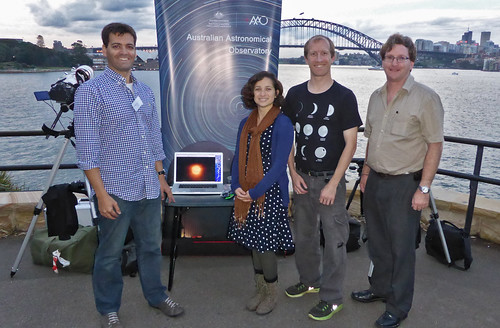
Participants to the first AAO “Guerrilla Astronomy” Event. From right to left, Stuart Ryder (AAO/AusGO), Kyler Kuehn (AAO), Paola Oliva-Altamiro (Swinburne/AAO) and Ángel R. López-Sánchez (AAO/MQ). The laptop shows the only good image we could get of the eclipse using my telescope. Mrs Macquarie Chair, Sydney Botanic Gardens / Domain, 29 Apr 2014. Photo Credit: Stuart Ryder (AAO/AusGO).
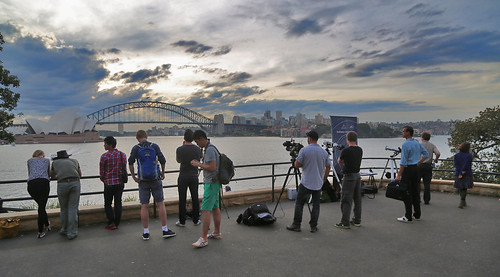
Given the time and position of the Sun during the eclipse, we decided that a really nice spot to prepare our telescopes would be Mrs Macquarie Chair point, in the Domain, Sydney Botanic Gardens. From there a very dramatic view of the Sydney Opera House and the Sydney Harbour Bridge is seen. We first requested permission to do this to the authorities of the Domain, who were really nice and even allowed us to park by free. Actually, they also came along to see the eclipse and they liked our idea of organizing more “Guerrilla Astronomy” events there in the nearby future.
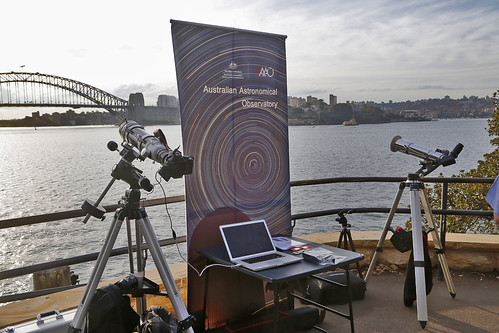
All set up for eclipse: two telescopes (Stuart’s at the right, mine at the left), the AAO banner, my laptop and camera to take photos through the telescope, the eclipse glasses and extra information about the eclipse to give to the visitors. Mrs Macquarie Chair, Sydney Botanic Gardens / Domain, 29 Apr 2014. Photo Credit: Ángel R. López-Sánchez (AAO/MQ).
It was four of us, Stuart Ryder (AAO/AusGO), Kyler Kuehn (AAO), Paola Oliva-Altamiro (Swinburne/AAO) and myself, who participated in this first “Guerrilla Astronomy” event. Just to have everything ready on time, we were setting up telescopes, AAO banner and laptop around an hour before the beginning of the eclipse. The weather seemed very clear in the morning, but in the afternoon, as we feared, some clouds started to arrive from the west. We already knew this would be a killer… but we had to try!
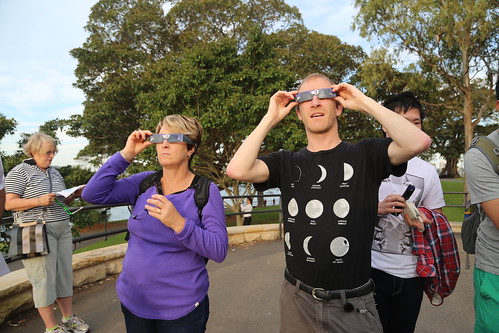
Kyler and visitor using the solar glasses. First AAO “Guerrilla Astronomy” Event: partial solar eclipse on 29 April 2014 over Sydney Harbour. Mrs Macquarie Chair, Sydney Botanic Gardens / Domain. Photo Credit: Paola Oliva-Altamiro (Swinburne/AAO).
Little girl using the eclipse glasses. First AAO “Guerrilla Astronomy” Event: partial solar eclipse on 29 April 2014 over Sydney Harbour. Mrs Macquarie Chair, Sydney Botanic Gardens / Domain. Photo Credit: Paola Oliva-Altamiro (Swinburne/AAO).
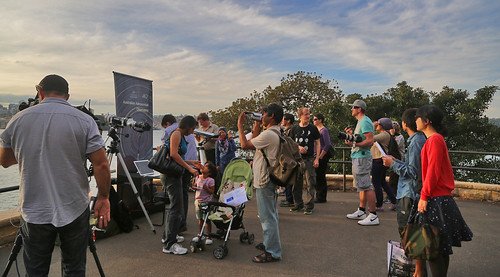
Visitors, but clouds please go away! First AAO “Guerrilla Astronomy” Event: partial solar eclipse on 29 April 2014 over Sydney Harbour. Mrs Macquarie Chair, Sydney Botanic Gardens / Domain. Photo Credit: Paola Oliva-Altamiro (Swinburne/AAO).
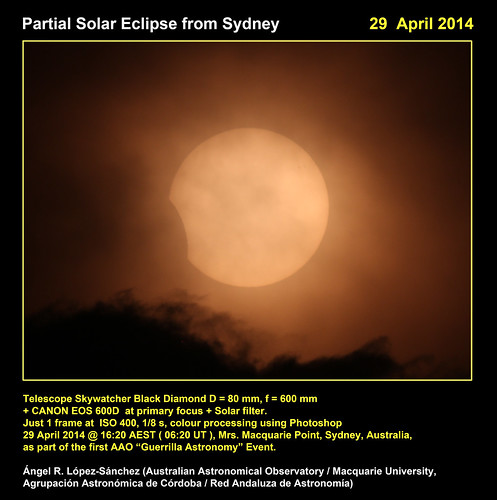
We actually were a bit lucky at the beginning, and hence we could see the Sun within thin clouds and follow the eclipse for 10 minutes. I even could take a nice image:
Partial Solar Eclipse from Sydney on 29 Apr 2014. Telescope Skywatcher Black Diamond D = 80 mm, f = 600 mm + CANON EOS 600D at primary focus + Solar filter. Just 1 frame at ISO 400, 1/8 s, colour processing using Photoshop. 29 April 2014 @ 16:20 AEST ( 06:20 UT ). First AAO “Guerrilla Astronomy” Event: partial solar eclipse on 29 April 2014 over Sydney Harbour. Mrs Macquarie Chair, Sydney Botanic Gardens / Domain. Photo Credit: Ángel R. López-Sánchez (AAO/MQ).
After that, thick clouds arrived and this happened:
5-seconds timelapse video obtained combining 25 images taken with Telescope Skywatcher Black Diamond D = 80 mm, f = 600 mm + CANON EOS 600D at primary focus + Solar filter, at ISO 400, 1/8 s, showing how the clouds completly cover the eclipsed sun. 29 April 2014 @ 16:20 AEST ( 06:20 UT ). The direct link to the YouTube video is here. Credit: Ángel R. López-Sánchez (AAO/MQ).
Once the Sun was completely covered by thick clouds we just waited and hoped for a little gap, but unfortunately this never happened and we didn’t see the Sun again that day.
Stuart and his telescope, Kyler and visitors, all hoping the clouds go away. First AAO “Guerrilla Astronomy” Event: partial solar eclipse on 29 April 2014 over Sydney Harbour. Mrs Macquarie Chair, Sydney Botanic Gardens / Domain. Photo Credit: Paola Oliva-Altamiro (Swinburne/AAO).
The eclipsed sun is setting behind those think clouds. First AAO “Guerrilla Astronomy” Event: partial solar eclipse on 29 April 2014 over Sydney Harbour. Mrs Macquarie Chair, Sydney Botanic Gardens / Domain. Photo Credit: Ángel R. López-Sánchez (AAO/MQ).
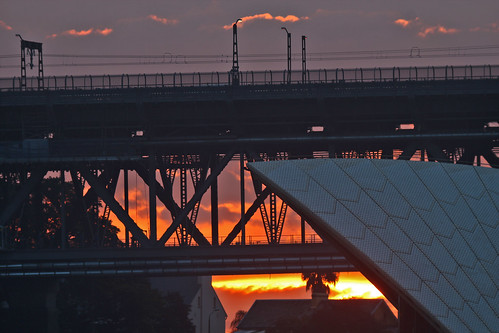
Well, it would have been really nice to see the eclipsed sun setting over the Sydney Harbour Bridge and sinking later close to the Sydney Opera House, I’m sure the images and time-lapse video would have been quite spectacular, but the best I got was this image:
An eclipsed sun should be setting around there… Imagen taken using a Telescope Skywatcher Black Diamond D = 80 mm, f = 600 mm + CANON EOS 600D at primary focus. First AAO “Guerrilla Astronomy” Event: partial solar eclipse on 29 April 2014 over Sydney Harbour. Mrs Macquarie Chair, Sydney Botanic Gardens / Domain. Photo Credit: Ángel R. López-Sánchez (AAO/MQ).
In any case, all four AAO participants were very happy about how the event was and, as I said, we are expecting to repeat these “Guerrilla Astronomy” activities in the nearby future.
Next solar eclipse to touch Australia will be on 9 March 2016, but it will also be a partial eclipse only visible on the northern and western parts of the continent. The next total eclipse to be seen from Australia will happen on 20 April 2023 and it will just touch the coast of Western Australia. We have to wait until 22 July 2028 to see a total solar eclipse in Sydney. Actually, Sydney is almost exactly in the center of the totality.
(*) Note that the word “Guerrilla” comes from Spanish, however the name didn’t come from me but from an idea my colleague Amanda Bauer (AAO Outreach Officer) had some months ago. As a native Spanish speaker I have to confess it is really hard to hear the pronunciation of “Guerrilla” following English phonemes as “Guerrilla Astronomy” sounds almost identical to “Gorilla Astronomy“. I would encourage to try to pronounce “Guerrilla” as it is said in Spanish (geˈri.ʝa) to be released of this confusion, but of course that is only my modest suggestion than can be completely ignored…









 A/Prof. Ángel R. López-Sánchez