Very happy to see my images and time-lapses videos taken at Siding Spring Observatory in the ABC News segment about the GALAH DR4 (Data Release 4) that was broadcasted in Australia national TV on Wednesday 2nd October 2024. Funny enough, this week I’m attending the Conference for the 50th Anniversary of the Anglo-Australian Telescope (AAT) at Siding Spring Observatory (Coonabarabran), where I gave an invited talk about my research with KOALA+AAOmega, although at that particular time I was attending an online meeting about the exciting BlueMUSE instrument.
I want first to congratulate the GALAH team for the success of this impressive star survey conducted at the AAT with the amazing 2dF + HERMES instruments (they have compiled the spectra of almost a million stars in Milky Way. But I also but to thank GALAH for using my photos and videos, as well as Tom Carruthers (Science in Public) for contacting me for this and very kindly providing the recording of the ABC News segment.
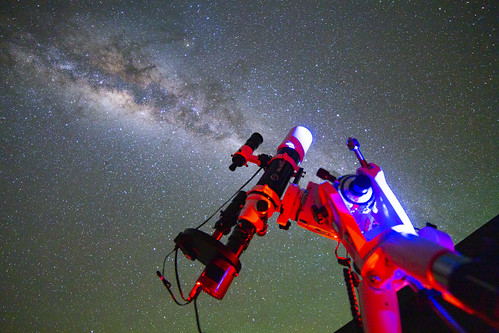
The Milky Way rising over Siding Spring Observatory (NSW, Australia) while my amateur telescope observes under a dark sky. Single, 30s exposure, frame using a CANON 5D Mark III with 14mm lens at f2.8, ISO1600, taken the 22nd April 2021at 2:09am local time. Minimum process (curves, luminosity, contrast, saturation and noise reduction) with Photoshop Raw. This is part of a time-lapse I still have to process!
The sky is open to everybody. Thanks to the advance of the technology, amateur astronomers are obtaining outstanding images of the sky, even from their backyards, using DSLR cameras and small telescopes. In this webinar I provided a very broad introduction to the basics of Astrophotography, from the best settings for getting the images using DSLRs and telescopes to how to process the data.
Please, note that I couldn’t go in deep in almost any aspect of Astrophotography, just providing some very global ideas, enumerating the techniques, providing some key tricks (focusing, stacking images, use RAW) and show some of my best astrophotos.
I want to thank Brad Tucker (RSAA, ANU) for the invitation to give this webinar, also thanks for being the MC for this.
Instead of just providing the link to the Twitter thread, I’m compiling all the tweets I sent about my amateur astronomy session at Siding Spring Observatory last night, 1st March 2020, while finally testing my new equipment (mount and cameras) from a dark place.
OK, good news: I did the polar alignment of the mount using 3 methods (@zwoasi ASIAir + guider / canon 5D, eye using polar scope of mount) and all agree!! I got an accuracy of 16” in total, which I think it is awesome!
Yep, this is now working! It took me an extra while to get the calibration of the auto-guiding good, but now errors are within 0.4-0.6”, which is great… so observing again Carina Neb. 3 min, Skywatcher BD80+ZWO 178MC, single 3 min exposure, no filter, from Siding Spring Observatory.
So here I am, in the bed at my room at the ANU Lodge at Siding Spring Observatory, controlling my amateur telescope at 50m using my son’s iPad… I’m sleepy so I’ll probably let it running and get some sleep
zzz moved it to M83 and it works… 5 minute exposures, now applying a small dithering between exposures…. launched 40 and continue zzzz
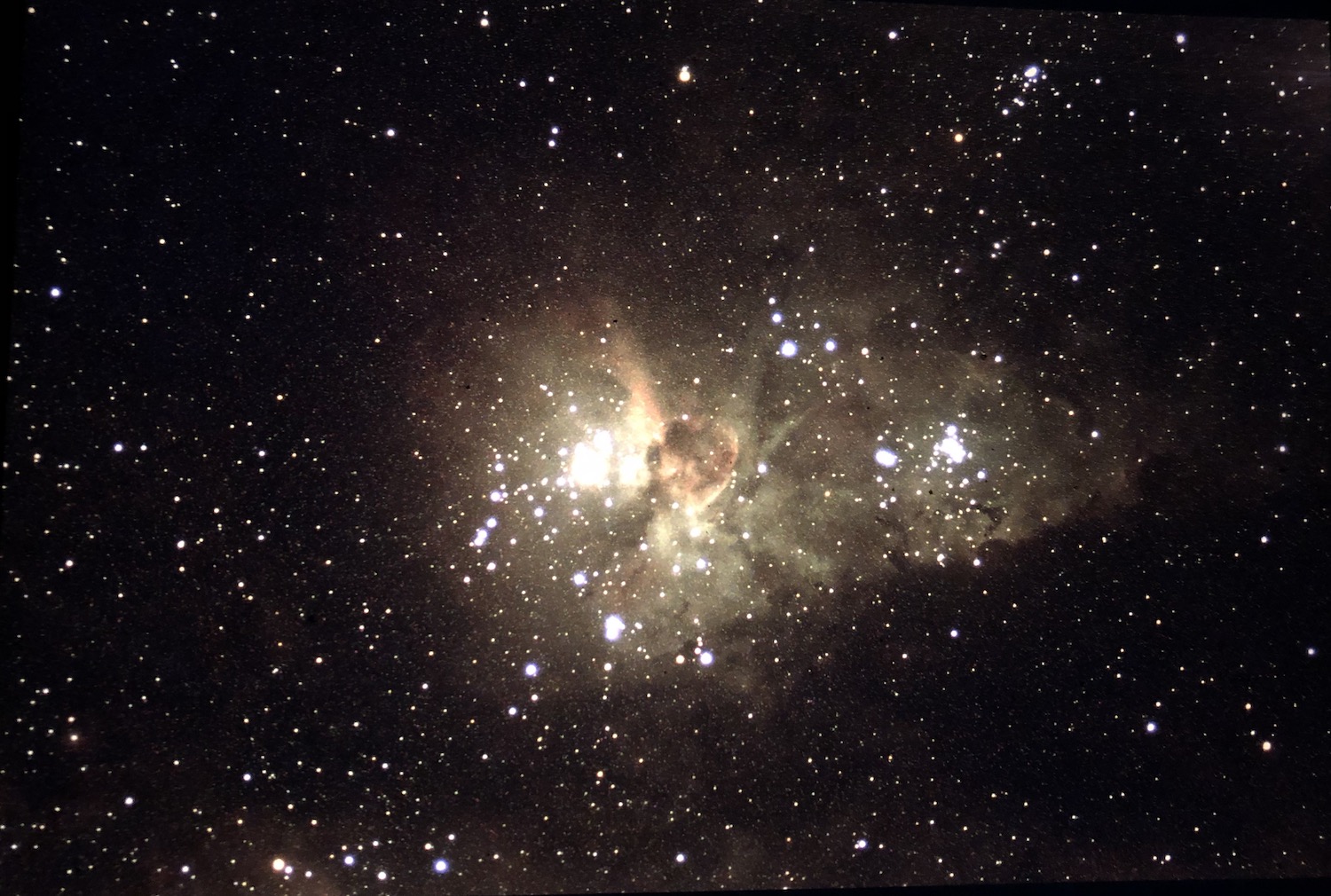
Results! Carina Nebula, 52 x 3 min exposures, almost perfect guiding, processed with Siril, color/stretch with Photoshop, using Skywatcher BD80 & @zwoasi178MC. No light pollution filter, from Siding Spring Observatory last night, 1st March 2020. Only 2 darks & no dithering.
The center of the Carina Nebula with massive star Eta Carina. Full resolution in my Flickr.
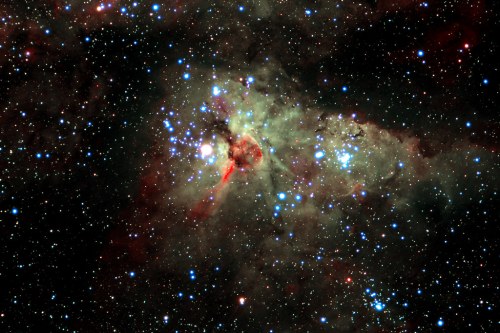
Please, do compare it with the image of the same nebula I took from Sydney, 60 x 60s exposures, fair guiding, @Optolong_filterlight pollution filter last Thursday night (basically same processing).
Carina Nebula, 27 Feb 2020 from my backyard in Frenchs Forest, 15 km N from Sydney’s city center. Skywatcher Black Diamond & ZWO ASI178MC. 60 frames x 60s each, aligned & stacked with Siril software, color + extra processing with Photoshop. No darks, no flats, but the Optolong UHC light pollution filter was used. Full resolution in my Flickr.
Something else learned with this (although later I remembered I read about it before): if the tracking+guiding is excellent you HAVE TO DITHER the field between frames. Otherwise you’ll get these low-intensity stripes that are impossible to remove…
Luckily, I DID dither for M83: 40×5 min exposures, almost perfect guiding, processed with Siril, color/stretch with Photoshop, using Skywatcher BD80 & @zwoasi178MC. No light pollution filter, from Siding Spring Observatory last night, 1st March 2020. Only 2 darks used!
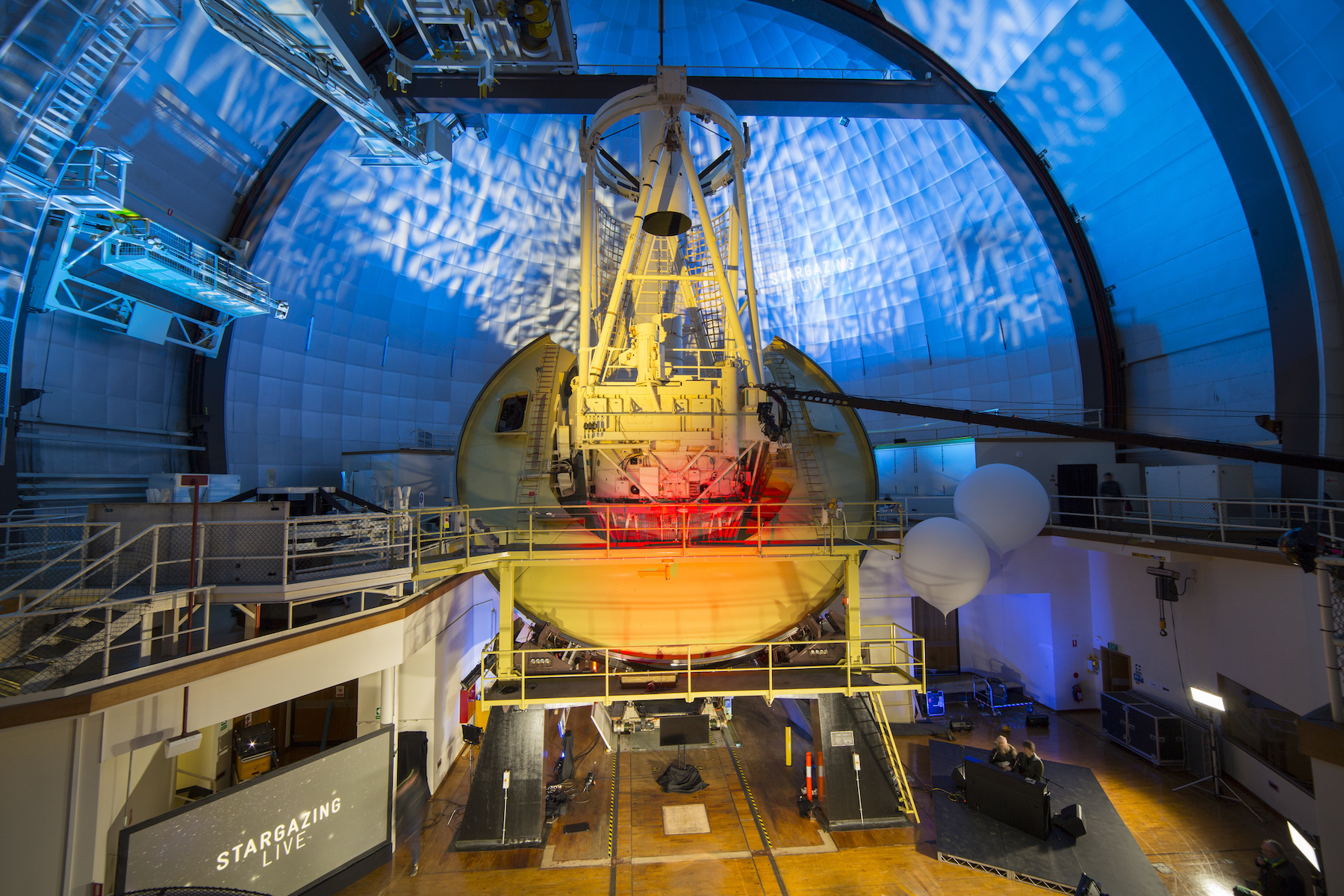
How can I say it in just few words? It was both very exciting and exhausting, with a little bit of bitter too. But, overall, last week at Siding Spring Observatory was one of the best experiences I have had in a long time working at the telescope, combining science research, amateur astronomy, outreach and science communication during the Stargazing ABC Live shows.
The AAT is ready for #StargazingABC. Hosts Julia Zemiro and Prof Brian Cox are sit in the piano, while Brian still rehearsing. Credit: Ángel R. López-Sánchez.
When I’m writing this, at 6:44pm 30th May 2018, I’m still observing at the Anglo-Australian Telescope. I’m doing it remotely from Sydney. It is my last night in a very long run (18 nights in May) for my own research project, which I will detail here eventually. I’m exhausted and need a good break, body and mind can’t survive this crazy rhythm, sleeping an average of 4-5 hours per day, and without any break during the weekends.
1. I provided A LOT OF information about Astronomy and the Anglo-Australian Telescope to the ABC and BBC crews. This is something that I’ve been doing during the last months, and might be considered as part of my role of “AAO Science Communicator Officer”.
2. I provided plenty of astrophotography and video-timelapse material, which was used during the shows. The most important of these is the new timelapse video “Stargazing at Siding Spring Observatory“, that you can enjoy here:
3. I spent some of my scheduled time at the Anglo-Australian Telescope to prepare a nice, new image of a beautiful astronomy object, that was later discussed during the show. It was the planetary nebula NGC 5189, for which I provided extra information in the previous post.
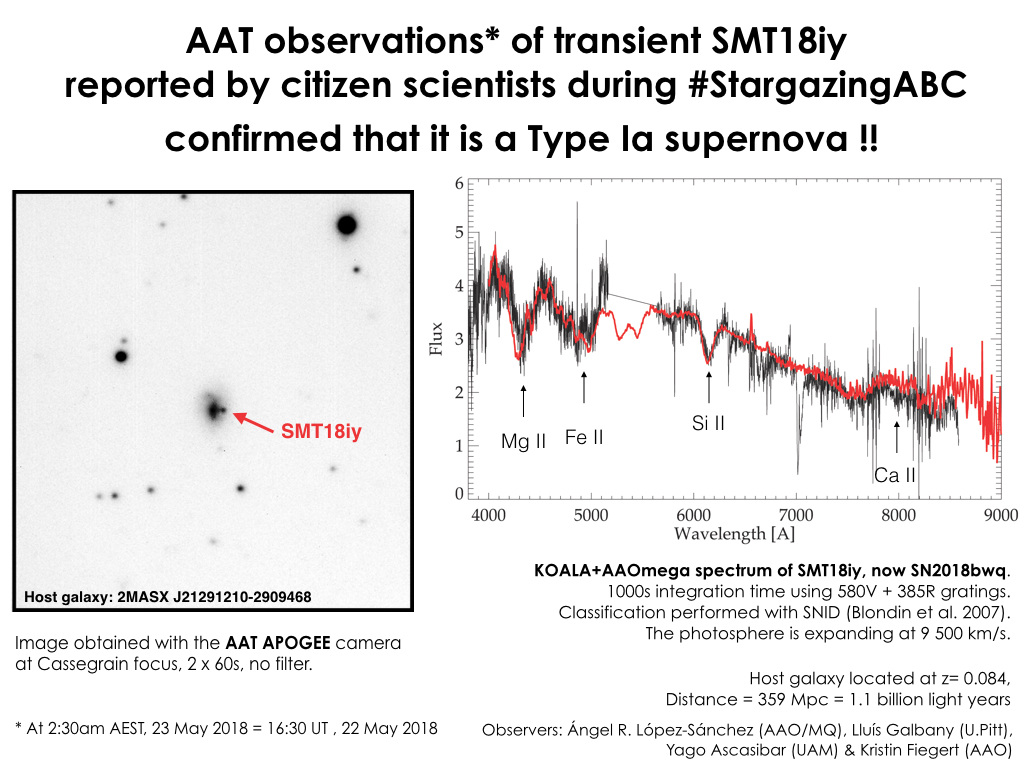
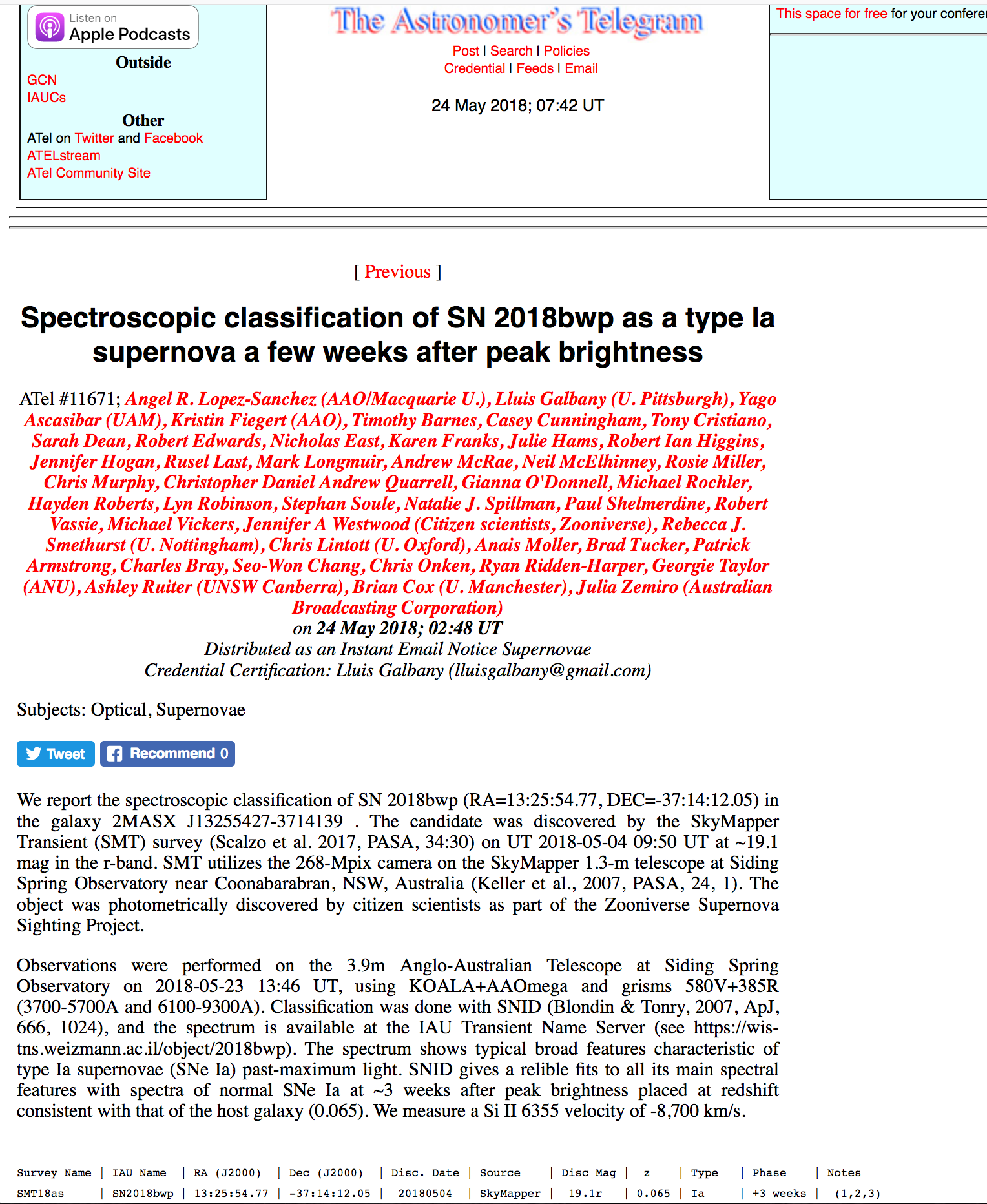
4. But the most important contribution for the show was actually observing with the AAT two transients reported by the citizen scientists who participated in a program to search for type Ia supernova in other galaxies. After confirming that the transient was there, we got spectroscopic information using KOALA+AAOmega, reduced the data, analysed the data, confirmed that both transients were type Ia supernova in distant galaxies, and wrote a science report with the discovery!
This was something I originally didn’t plan to do, but, as I said, it was my own research program that scheduled at the AAT during the StargazingABC, so I decided to do it and it got a reward, as this also allowed us to submit two science reports with the discoveries!
These two nights were really exciting! I really want to thank my friends and colleagues Lluís Galbany and Yago Ascasibar, as well as the AAT Night Assistant Kristin Fiegert (AAO), for their wonderful help in all of this.
It was also a privilege talking with Prof Brian Cox, who is absolutely great, and even recorded a short video with me for my son. Thank you a lot, Brian!
Prof Brian Cox and me are ready for #StargazingABC.
Where is the “bitter” I mentioned in the first paragraph? Well it is when the credit is not given. And not credit was given to me during the shows. I was still hoping at least having my name in the screen, in an ideal world even participating in person during the shows. But with my name (Ángel) and my strong English accent… well… perhaps in another life… I know what I did and I know how important my contribution was, and as I said I really enjoyed a lot all the time.
I hope I’ll be back if #StargazingABC returns in 2019!
PS: If you are in Australia, you can watch anytime the 3 episodes of 2018 #StargazingABC following this link to the ABC webpages.

















 A/Prof. Ángel R. López-Sánchez