The Milky Way over Siding Spring Observatory, on Friday 23rd Aug 2019, 9pm local time, during a Stargazing event as part of a tour for Australian Geographic.
10 x 30 seconds exposures taken using a camera is a CANON 5D Mark III in a tripod (no tracking). The lens was a Samyang 14mm at f2.8.
RAW to TIFF conversion in Photoshop, star alignment and median stacking with Siril software.
The high-resolution image is available in my Flickr.
Credit: Ángel R. López-Sánchez (Australian Astronomical Optics, Macquarie University) + all participants.
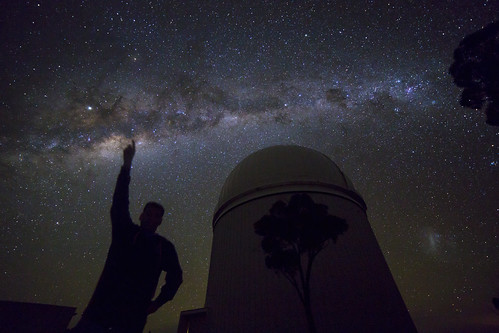
The Anglo-Australian Telescope, The Emu in the Sky (The Milky Way), the Southern Cross, Carina Nebula, Large Magellanic Cloud, Jupiter, Saturn… and me! Single 15s shot using a CANON 5D Mark III with a 14mm lens at f2.8, 1600ISO. Photo taken at 1.15am AEST, Saturday 6th April 2019.
How can I say it in just few words? It was both very exciting and exhausting, with a little bit of bitter too. But, overall, last week at Siding Spring Observatory was one of the best experiences I have had in a long time working at the telescope, combining science research, amateur astronomy, outreach and science communication during the Stargazing ABC Live shows.
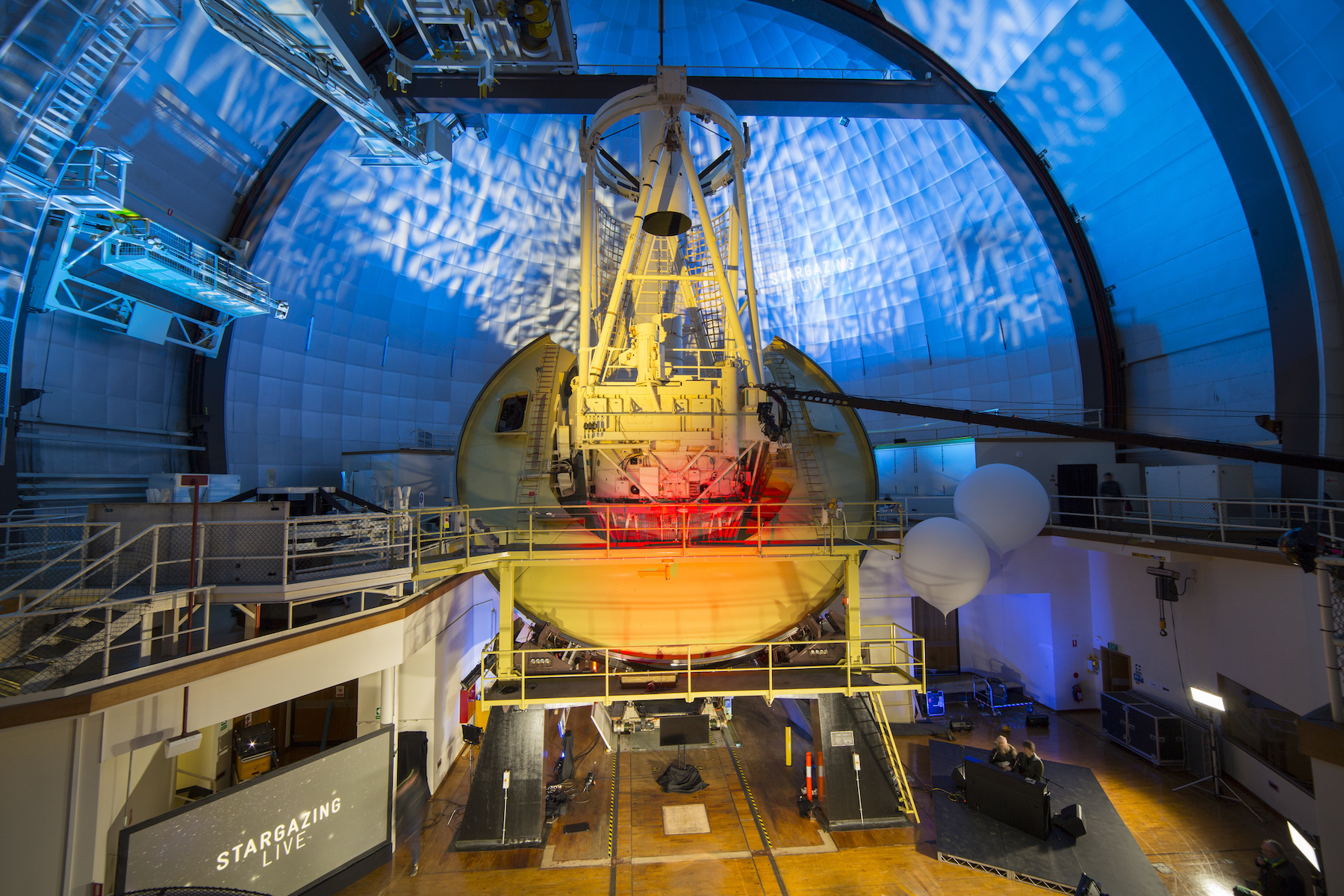
The AAT is ready for #StargazingABC. Hosts Julia Zemiro and Prof Brian Cox are sit in the piano, while Brian still rehearsing. Credit: Ángel R. López-Sánchez.
When I’m writing this, at 6:44pm 30th May 2018, I’m still observing at the Anglo-Australian Telescope. I’m doing it remotely from Sydney. It is my last night in a very long run (18 nights in May) for my own research project, which I will detail here eventually. I’m exhausted and need a good break, body and mind can’t survive this crazy rhythm, sleeping an average of 4-5 hours per day, and without any break during the weekends.
1. I provided A LOT OF information about Astronomy and the Anglo-Australian Telescope to the ABC and BBC crews. This is something that I’ve been doing during the last months, and might be considered as part of my role of “AAO Science Communicator Officer”.
2. I provided plenty of astrophotography and video-timelapse material, which was used during the shows. The most important of these is the new timelapse video “Stargazing at Siding Spring Observatory“, that you can enjoy here:
3. I spent some of my scheduled time at the Anglo-Australian Telescope to prepare a nice, new image of a beautiful astronomy object, that was later discussed during the show. It was the planetary nebula NGC 5189, for which I provided extra information in the previous post.
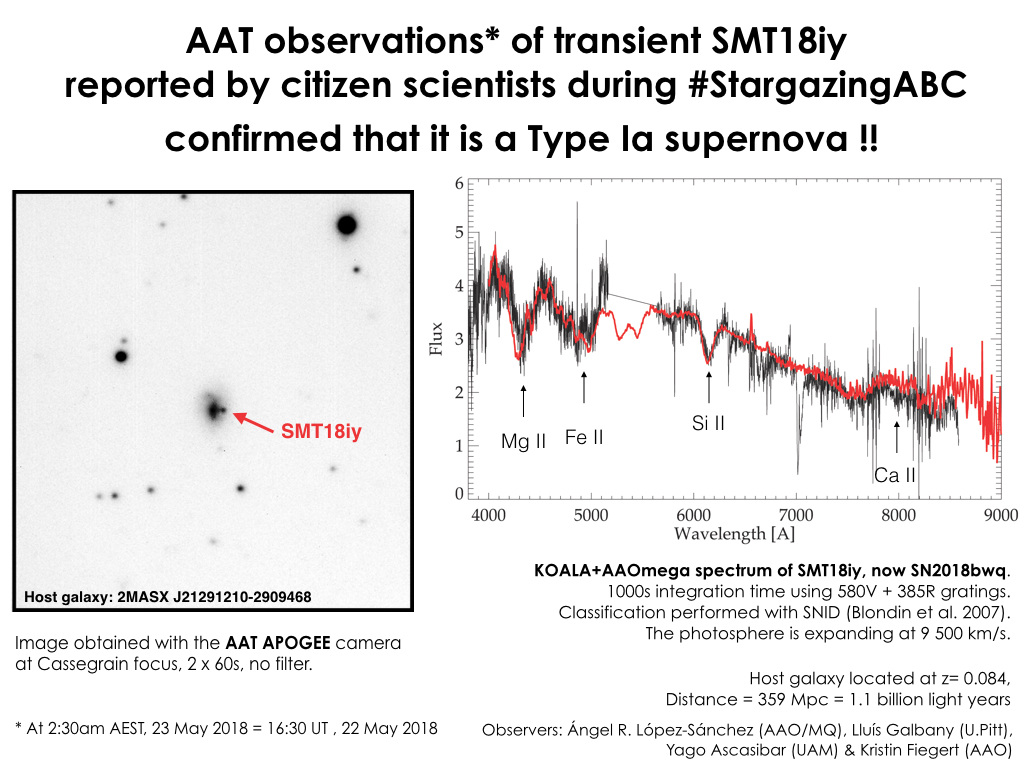
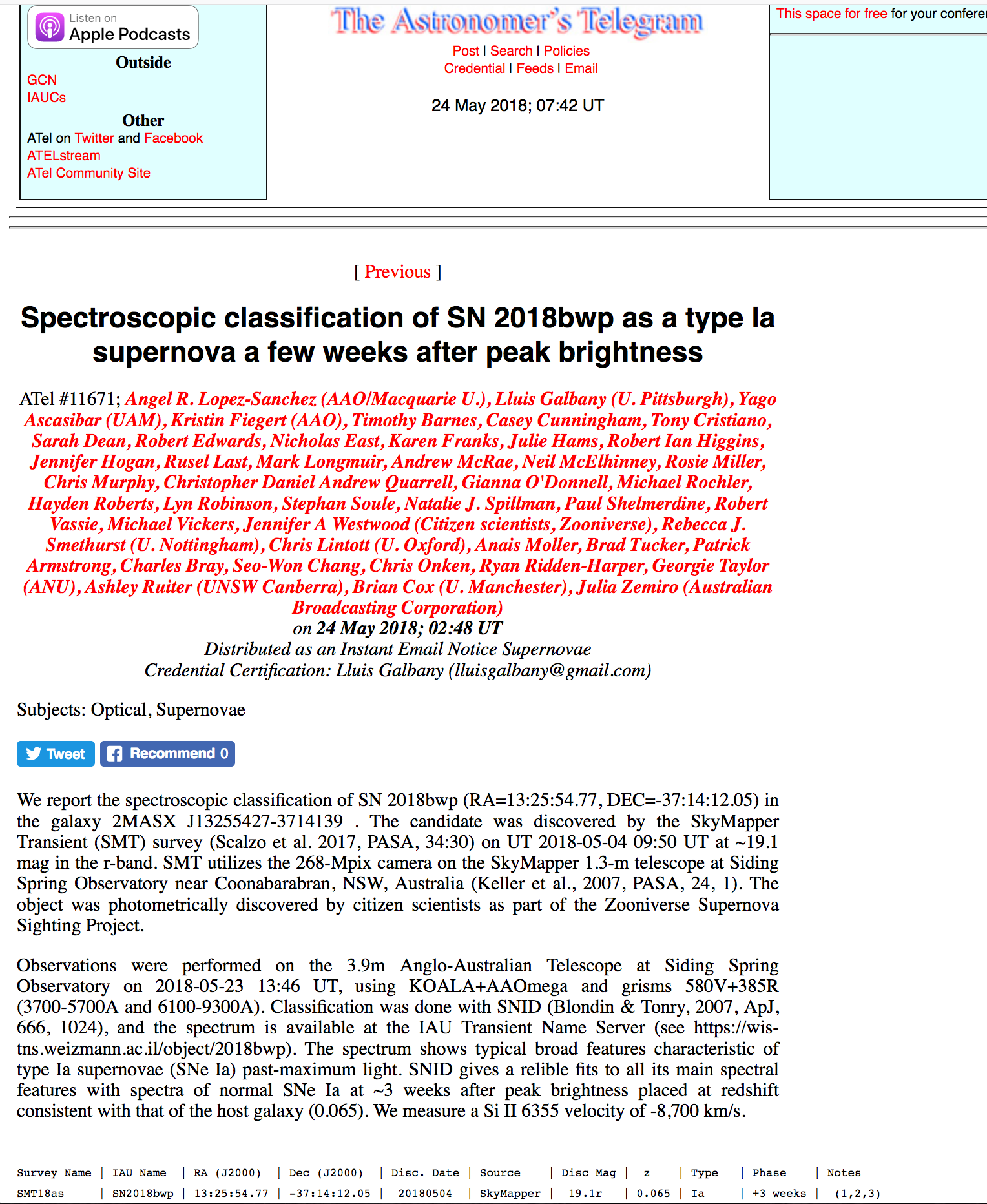
4. But the most important contribution for the show was actually observing with the AAT two transients reported by the citizen scientists who participated in a program to search for type Ia supernova in other galaxies. After confirming that the transient was there, we got spectroscopic information using KOALA+AAOmega, reduced the data, analysed the data, confirmed that both transients were type Ia supernova in distant galaxies, and wrote a science report with the discovery!
This was something I originally didn’t plan to do, but, as I said, it was my own research program that scheduled at the AAT during the StargazingABC, so I decided to do it and it got a reward, as this also allowed us to submit two science reports with the discoveries!
These two nights were really exciting! I really want to thank my friends and colleagues Lluís Galbany and Yago Ascasibar, as well as the AAT Night Assistant Kristin Fiegert (AAO), for their wonderful help in all of this.
It was also a privilege talking with Prof Brian Cox, who is absolutely great, and even recorded a short video with me for my son. Thank you a lot, Brian!
Prof Brian Cox and me are ready for #StargazingABC.
Where is the “bitter” I mentioned in the first paragraph? Well it is when the credit is not given. And not credit was given to me during the shows. I was still hoping at least having my name in the screen, in an ideal world even participating in person during the shows. But with my name (Ángel) and my strong English accent… well… perhaps in another life… I know what I did and I know how important my contribution was, and as I said I really enjoyed a lot all the time.
I hope I’ll be back if #StargazingABC returns in 2019!
PS: If you are in Australia, you can watch anytime the 3 episodes of 2018 #StargazingABC following this link to the ABC webpages.
After a very intense trip to Spain during July to September, I’m finally back to Australia, just in time to participate in the amazing StarFest 2016 in Coonabarabran, the “Astronomical Capital of Australia”, where Siding Spring Observatory is located.
First, on Friday 30th September we enjoyed the “Science in the Pub” event. I was part of the panel with Elisabete da Cunha (ANU), Fred Watson (AAO), Brad Moore (iTelescope) and David Malin (AAO). We talked about how astronomical images are taken and how to get the colours in Astronomy, with a lot of fun facts (thanks Fred!) about “what our eyes and brain try to see”.
“Science in the Pub” event in Coonabarabran (NSW, Australia) during StarFest 2016, Friday 30th September 2016. Participants are (from left to right): Ángel López-Sánchez (AAO/MQU), Elisabete da Cunha (ANU), Fred Watson (AAO), Brad Moore (iTelescope) and David Malin (AAO). High resolution version here. Photo credit: Steve Chapman (AAO).
Selfie Elisabete da Cunha and me took just moments before starting the “Science in the Pub” event in Coonabarabran (NSW, Australia) during StarFest 2016, Friday 30th September 2016. High resolution version here. Photo credit: Steve Chapman (AAO).
Me and the gift I received after the “Science in the Pub” event in Coonabarabran (NSW, Australia) during StarFest 2016, Friday 30th September 2016. High resolution version here. Photo credit: Steve Chapman (AAO).
On Saturday October 1st was the “Siding Spring Observatory Open Day”. Besides the bad weather, we had plenty of visitors of all ages, from kids to students to elders, all interested about Astronomy and Space. As usual I couldn’t stop talking to everyone, but I also took some photos. As I was jet-lagged (it was just 36 hours after I landed on Sydney) I was very early at the AAT and took some few photos with all ready to go!
The Anglo-Australian Telescope (AAT) is ready to start StarFest 2016!. Photo taken on Saturday 1 October 2016 during Siding Spring Observatory Open Day, part of StarFest 2016, in Coonabarabran (NSW, Australia). High resolution version here. Photo credit: Ángel R. López-Sánchez (AAO/MQ).
A lot of visitors at the Anglo-Australian Telescope during StarFest 2016 in Coonabarabran (NSW, Australia). Photo taken on Saturday 1 October 2016 during Siding Spring Observatory Open Day, part of StarFest 2016, in Coonabarabran (NSW, Australia). High resolution version here. Photo credit: Ángel R. López-Sánchez (AAO/MQ).
Doug Gray (AAO) explains how the AAT works to visitors of StarFest 2016. Photo taken on Saturday 1 October 2016 during Siding Spring Observatory Open Day, part of StarFest 2016, in Coonabarabran (NSW, Australia). High resolution version here. Photo credit: Ángel R. López-Sánchez (AAO/MQ).
A wonderful local orchestra was playing famous themes inside the AAT dome during the StarFest 2016. Photo taken on Saturday 1 October 2016 during Siding Spring Observatory Open Day, part of StarFest 2016, in Coonabarabran (NSW, Australia). High resolution version here. Photo credit: Ángel R. López-Sánchez (AAO/MQ).
However, it was particularly exciting to have a local orchestra playing in the dome! I don’t know who had the idea but was great, so I hope they do it again in the future. I couldn’t help myself and took this video of the orchestra playing two very famous themes: Star Wars and Indiana Jones.
A local orchestra plays the Star Wars & Indiana Jones themes inside the dome of the 3.9m Anglo-Australian Telescope (AAT) at Siding Spring Observatory near Coonabarabran (NSW, Australia) during StarFest 2016. Saturday 1 October 2016. Video credit: Ángel R. López-Sánchez (AAO/MQ).
I really enjoyed this day, and I’m looking forward participating again in StarFest 2017!
Last November some friends of the new Sydney on-line magazine A-star, Ryan Wittingslow and Harry Simpson, visited Siding Spring Observatory (Coonabarabran, NSW) to prepare a documentary about Astronomy and the telescopes at site. This is the nice video they have released, entitled Space is just totally big and amazing:
As it happened while I was supporting astronomical observations at the Anglo-Australian Telescope (AAT), I was interviewed as part of the video. Although I talked about some few things (my research, my job at the AAO and my times as a young amateur astronomer in Spain), they only used my comments about astrophotography. Indeed, they asked me to include some scenes of my astronomical time-lapses on the documentary, and I think the result is great. I really love to see my astro photos and videos so well used. Thanks Ryan and Harry for this report!











 A/Prof. Ángel R. López-Sánchez