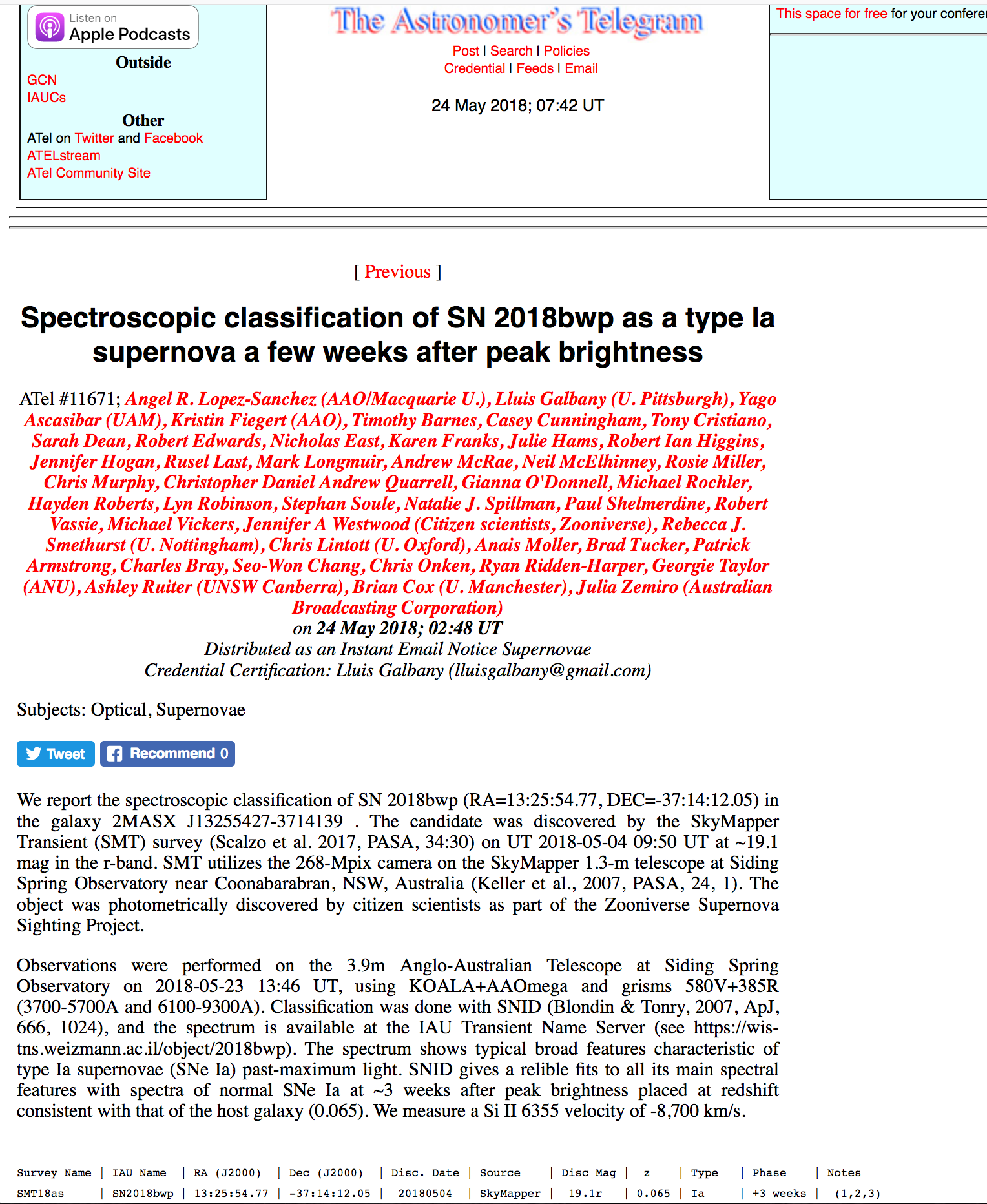
Tag Archives: StargazingABC

My contribution to 2018 #StargazingABC

How can I say it in just few words? It was both very exciting and exhausting, with a little bit of bitter too. But, overall, last week at Siding Spring Observatory was one of the best experiences I have had in a long time working at the telescope, combining science research, amateur astronomy, outreach and science communication during the Stargazing ABC Live shows.
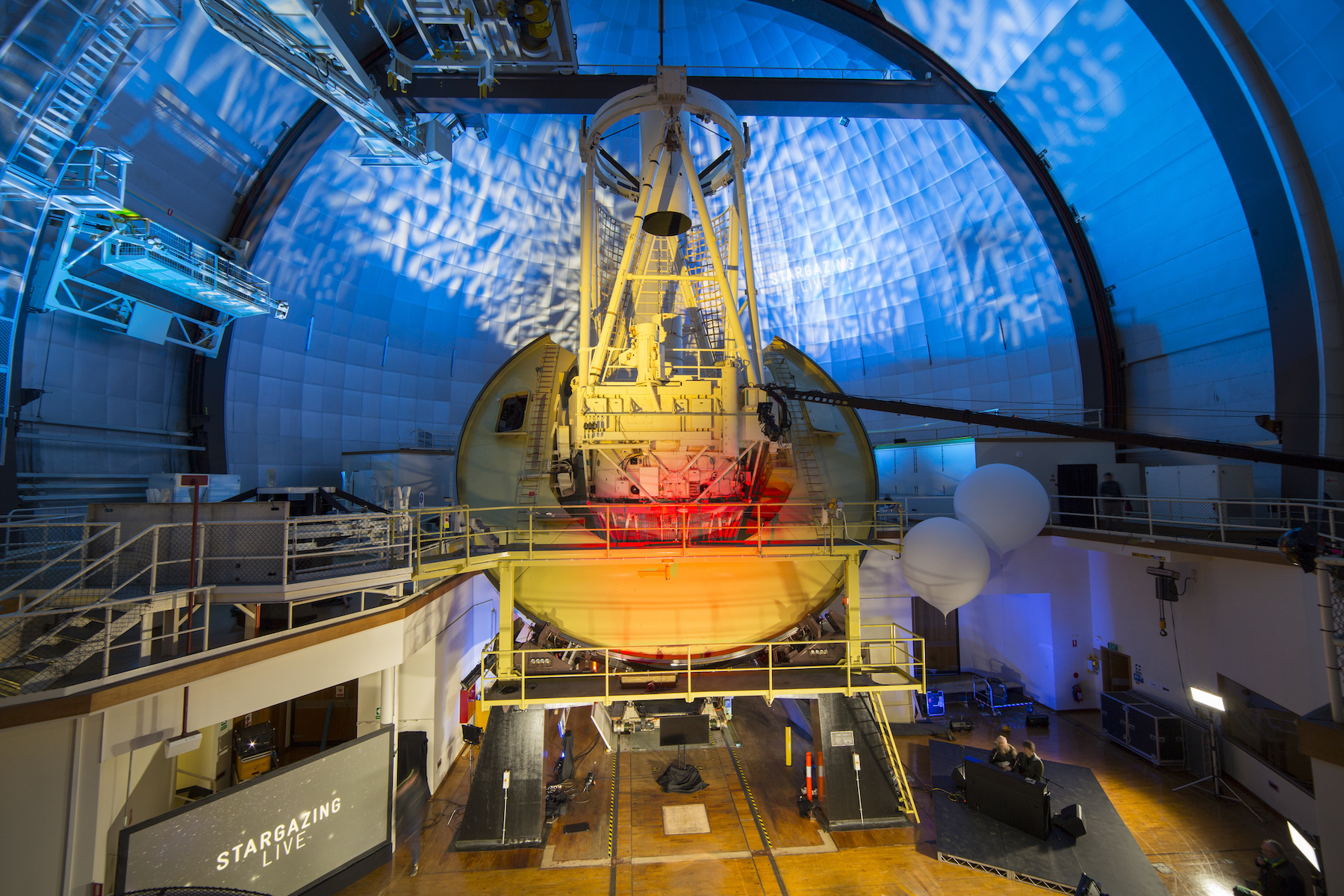
The AAT is ready for #StargazingABC. Hosts Julia Zemiro and Prof Brian Cox are sit in the piano, while Brian still rehearsing. Credit: Ángel R. López-Sánchez.

When I’m writing this, at 6:44pm 30th May 2018, I’m still observing at the Anglo-Australian Telescope. I’m doing it remotely from Sydney. It is my last night in a very long run (18 nights in May) for my own research project, which I will detail here eventually. I’m exhausted and need a good break, body and mind can’t survive this crazy rhythm, sleeping an average of 4-5 hours per day, and without any break during the weekends.

But let me at least quickly mention here my contribution to the 2018 Stargazing Live shows:

1. I provided A LOT OF information about Astronomy and the Anglo-Australian Telescope to the ABC and BBC crews. This is something that I’ve been doing during the last months, and might be considered as part of my role of “AAO Science Communicator Officer”.

2. I provided plenty of astrophotography and video-timelapse material, which was used during the shows. The most important of these is the new timelapse video “Stargazing at Siding Spring Observatory“, that you can enjoy here:

3. I spent some of my scheduled time at the Anglo-Australian Telescope to prepare a nice, new image of a beautiful astronomy object, that was later discussed during the show. It was the planetary nebula NGC 5189, for which I provided extra information in the previous post.

4. But the most important contribution for the show was actually observing with the AAT two transients reported by the citizen scientists who participated in a program to search for type Ia supernova in other galaxies. After confirming that the transient was there, we got spectroscopic information using KOALA+AAOmega, reduced the data, analysed the data, confirmed that both transients were type Ia supernova in distant galaxies, and wrote a science report with the discovery!
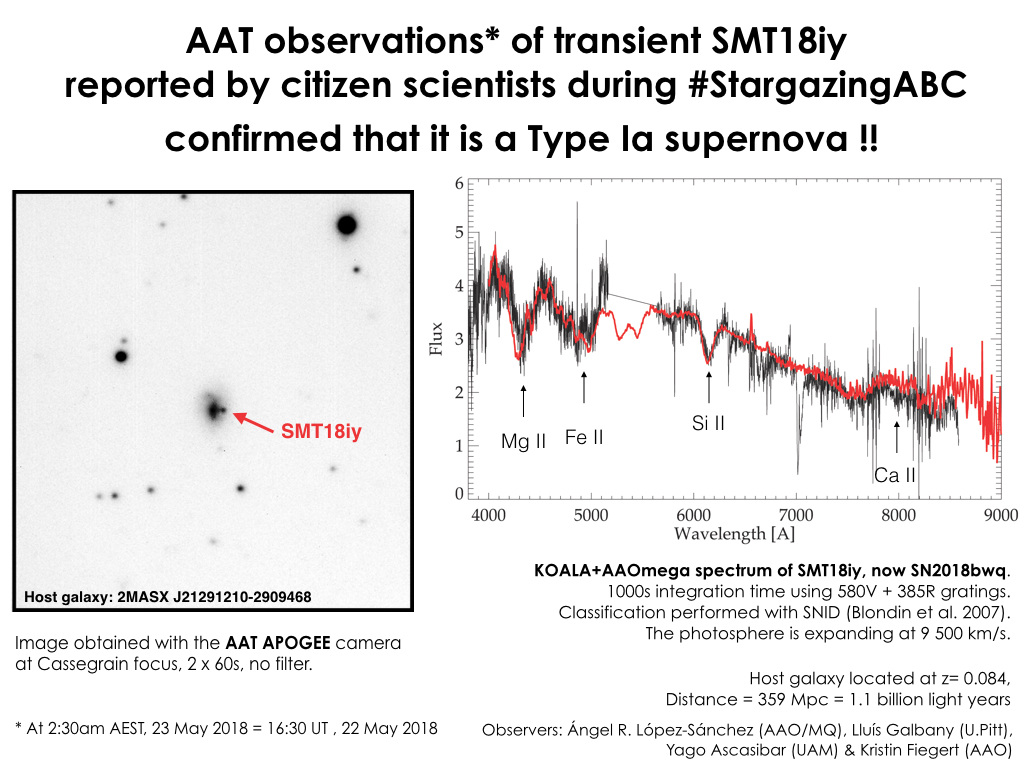
This was something I originally didn’t plan to do, but, as I said, it was my own research program that scheduled at the AAT during the StargazingABC, so I decided to do it and it got a reward, as this also allowed us to submit two science reports with the discoveries!

These two nights were really exciting! I really want to thank my friends and colleagues Lluís Galbany and Yago Ascasibar, as well as the AAT Night Assistant Kristin Fiegert (AAO), for their wonderful help in all of this.

The discovery of the transients and the confirmation that they were type Ia supernova in distant galaxies has appeared in many media news these days, including in ABC Science News, and also here: “Citizen scientists find two supernovae and (slightly) revise the age of the cosmos“.

It was also a privilege talking with Prof Brian Cox, who is absolutely great, and even recorded a short video with me for my son. Thank you a lot, Brian!

Prof Brian Cox and me are ready for #StargazingABC.

Where is the “bitter” I mentioned in the first paragraph? Well it is when the credit is not given. And not credit was given to me during the shows. I was still hoping at least having my name in the screen, in an ideal world even participating in person during the shows. But with my name (Ángel) and my strong English accent… well… perhaps in another life… I know what I did and I know how important my contribution was, and as I said I really enjoyed a lot all the time.

I hope I’ll be back if #StargazingABC returns in 2019!

PS: If you are in Australia, you can watch anytime the 3 episodes of 2018 #StargazingABC following this link to the ABC webpages.
Planetary nebula NGC 5189 around WR-like star with the AAT for #StargazingABC

This is the object we observed at the Anglo-Australian Telescope as part of the “Stargazing Live” events at Siding Spring Observatory (NSW, Australia).

We used the APOGEE camera at the AAT Cassegrain focus and took some short exposures in several broad-band filters (B, V, R and I).

The planetary nebular NGC 5189 is located in the constellation of Musca (“The Fly”), near the South Celestial Pole.

The distance to NGC 5189 is around 1780 light-years from Earth, as measured in 2008.

It shows one of the more remarkable complex morphologies among all the known planetary nebulae, with many structures at different scales, indicating that the progenitor star experienced multiple outbursts.

Each outburst had different velocities, inducing shock-waves in the surrounding gas.

The central star is classified as Wolf-Rayet-type [WR] because it is very hot, it shows intense features of helium, carbon and oxygen, and it has very high stellar winds.

The most massive stars undergo the Wolf-Rayet (WR) phase before exploding as supernova, but the central stars of ~10% of planetary nebula also show Wolf-Rayet-type features.

The Wolf-Rayet-type stars in planetary nebulae are much older objects than the “standard” WR stars, as they descend from evolved low-mass stars and not from high-mass stars.

That is why Wolf-Rayet-type stars in planetary nebula are named [WR].

Wolf-Rayet-type stars are closely related to white dwarf stars.

The central Wolf-Rayet-type star in NGC 5189 is a very rare, low-mass (about the mass of the Sun) WO (oxygen-rich) star. Its temperature is 165 000 K and its stellar wind moves at 2500 km/s.

The Wolf-Rayet-type star in NGC 5189 has a companion star of around 0.8 times the mass of our Sun. It needs 4 days to complete an orbit around the [WR] star, as discovered in 2015.

The complex morphology in NGC 5189 seems to be consequence of the interaction between the progenitor of the Wolf-Rayet-type star and its companion star.

In the AAT image, the green color is coming from glowing nitrogen and hydrogen, the blue color from glowing oxygen. The red color is coming from the stellar emission

Successful BBC and ABC Stargazing Live TV events at Siding Spring Observatory

Article originally written by Ángel R. López-Sánchez for the “AAO Observer” 132, August 2017. Credits of all the photos: Ángel R. López-Sánchez.

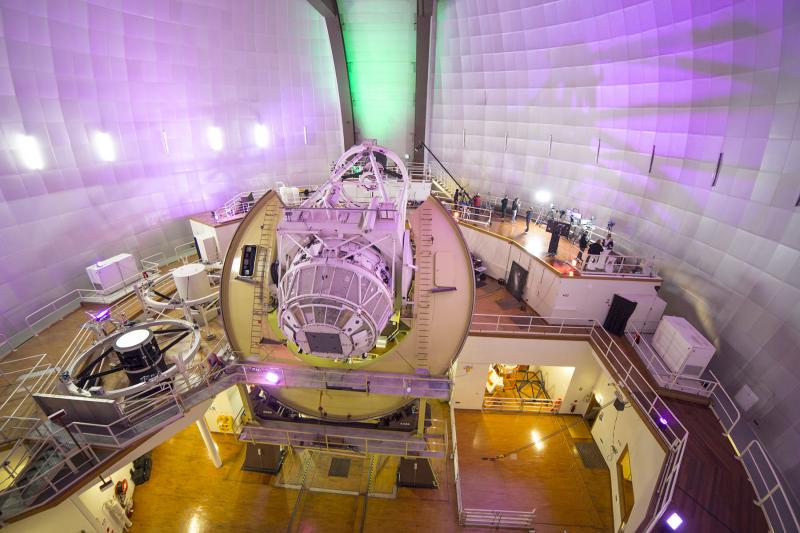
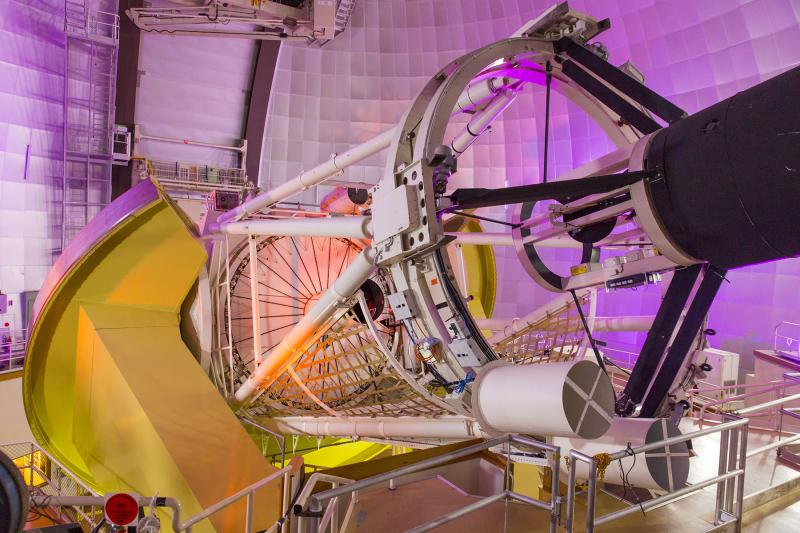
Colorful lights in dome of our Anglo-Australian Telescope in preparation for the Stargazing Live TV shows.

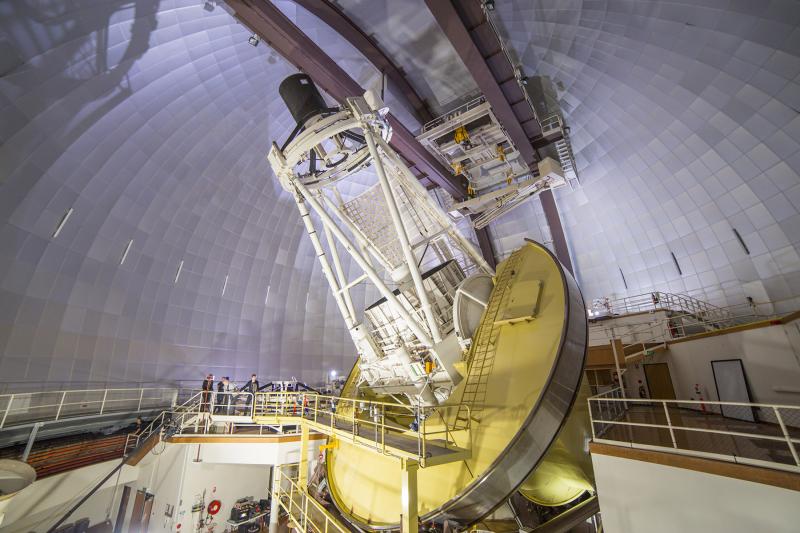
During two weeks in late March and early April 2017, famous physicist and TV presenter Professor Brian Cox co-hosted two “Stargazing TV” shows emitted live from Siding Spring Observatory in the BBC and in the ABC. The stage of these major TV events was our Anglo-Australian Telescope, (AAT) at Siding Spring Observatory, on the edge of the Warrumbungle National Park near Coonabarabran, NSW.

BBC Stargazing Live shows at Siding Spring Observatory were emitted on the early morning of Wednesday 29th, Thursday 30th and Friday 31st March 2017 (evenings of the previous days in the UK). BBC Stargazing Live TV shows were hosted by Professor Brian Cox and TV presenter and comedian Dara Ó Briain, with the participation of biologist and BBC presenter Liz Bonnin and Broome-based amateur astronomer Greg Quicke (who was very popular in social media, receiving the nickname of #SpaceGandalf).

During BBC Stargazing Live astrophysicist and science communicator Lisa Harvey-Smith (CSIRO) was also interviewed. Astronomer and journalist Chris Lintott (Oxford University) was in charge of reporting the news of the citizen science project “The Search for Planet 9“, led by astronomers at the Australian National University and launched in the first episode of BBC Stargazing Live. This citizen science project uses images taken with the Skymapper telescope at Siding Spring Observatory to search for a new planet in our Solar System.

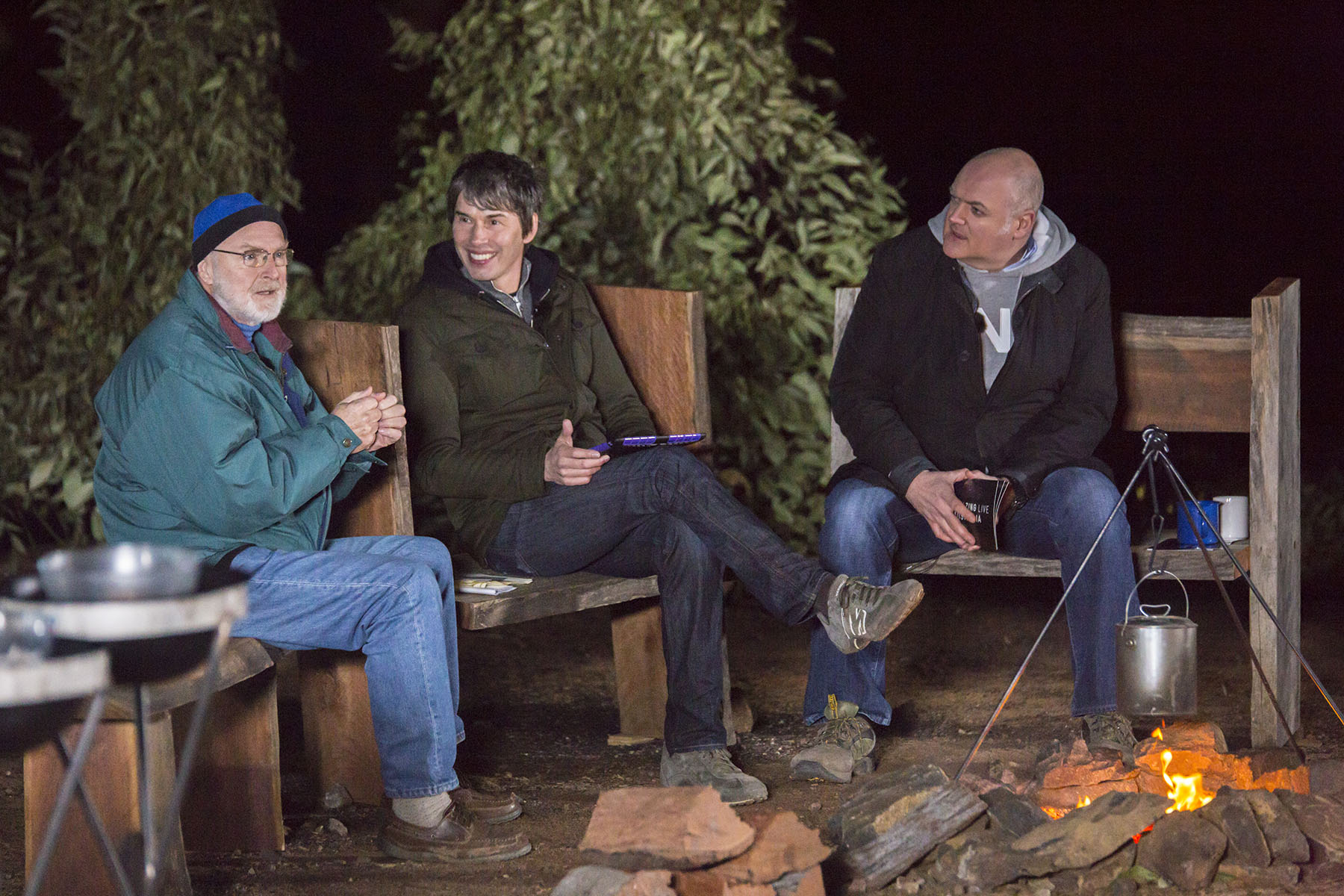
#StargazingABC live episodes were emitted the following week (Tuesday 4th, Wednesday 5th and Thursday 6th April 2017). Hosts Professor Brian Cox and TV presenter Julia Zemiro were joined by astronomers to inspire Australia to explore our Universe and tackle astronomy’s most intriguing questions. Astronomer Lisa Harvey-Smith (CSIRO) also participated as TV presenter for the #StargazingABC shows.

AAO’s Fred Watson, Steve Lee and David Malin were interviewed several times during the ABC and BBC Stargazing Live shows.

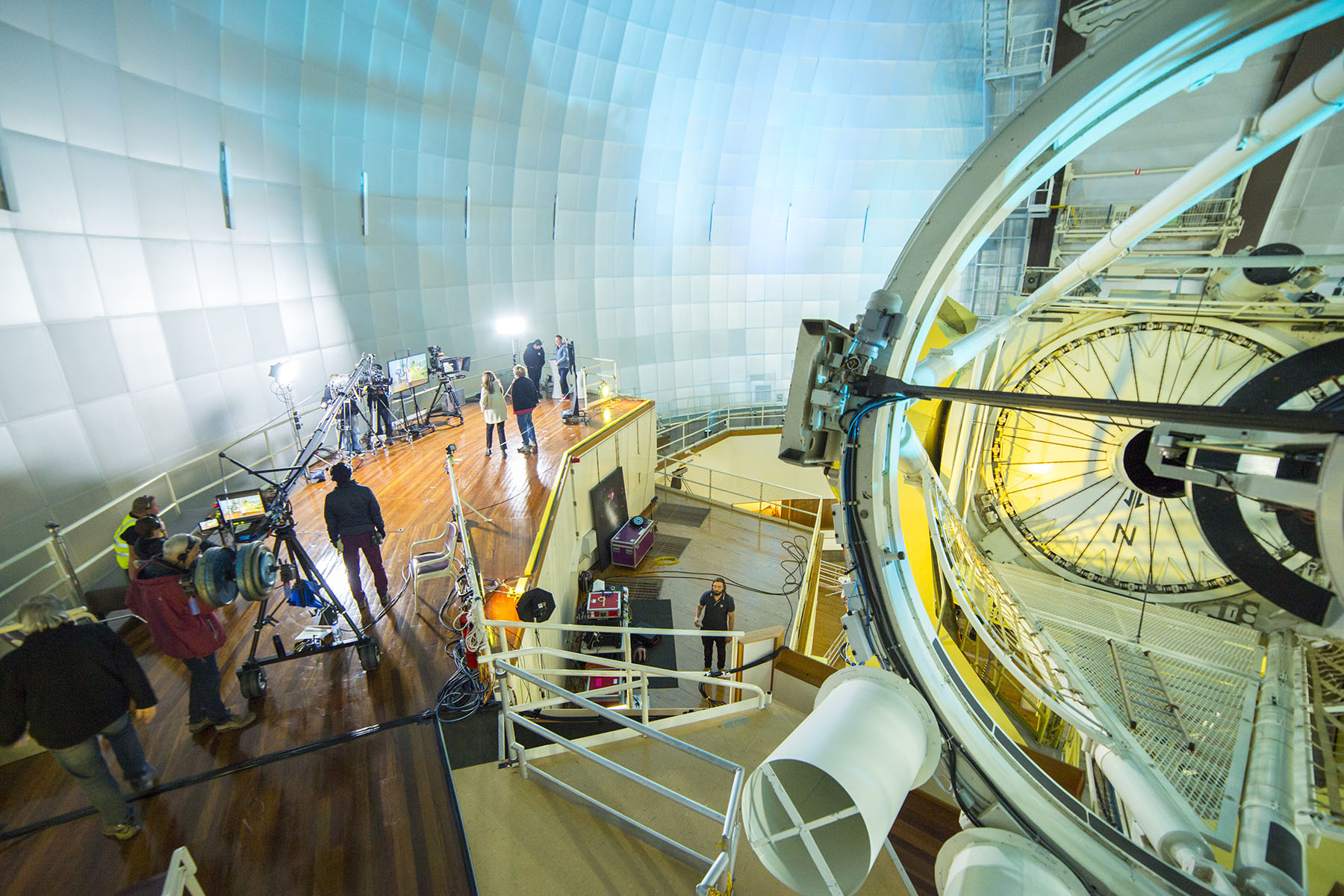
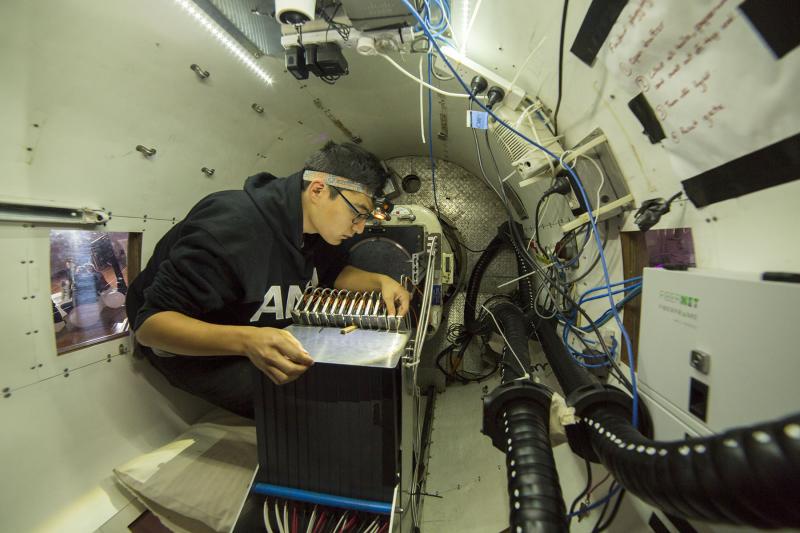
SAMI observers at the Anglo-Australian Telescope shared the dome with ABC crew while preparing instrument and telescope for observations on the afternoon of Sunday 2nd April.

For #StargazingABC first episode, the Milky Way, AAO astronomers Ángel López-Sánchez and Steve Lee prepared a new astronomical color image using data taken with the CACTI auxiliary camera of the AAT, which was broadcasted in the episode. This image shows Diffuse gas and dust in the heart of the Carina Nebula. The bright star is Eta Carinae, a massive double star at the end of its live that will soon explode as a supernova. The “Keyhole” is the dark cloud in the centre of the image.

Both Stargazing Live ABC events were very successful. #StargazingABC live episodes reached 2.7 million viewers across metro and regional Australia. They also had a huge impact in social media. ABC 1st TV episode reached over 240K people and had more than 8K reactions in Facebook, comments and shares, similar numbers to those obtained with ABC TV’s New Year’s Eve Family Fireworks stream. Regarding Twitter, the #StargazingABC hashtag reached 18.4 million users and produced 16.8K tweets from 6.3K unique contributors. 12.8K of these tweets were produced during the broadcasts, making #StargazingABC trend no.1 in Australia.

Credits of all the photos: Ángel R. López-Sánchez.

More information: AAO news: ABC Stargazing Live at the AAT.