Monthly Archives: March 2021

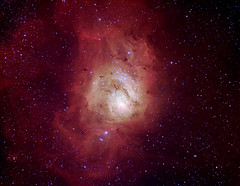
A quick view of the Rosetta nebula

I didn’t want to miss getting a nice image of one of my all-time favourite nebulae, the Rosetta nebula, before it was too late in the season and moved into the west.

This image combines 15 x 60s exposures in each color channel, using broad-band filters B (blue), G (green) and R (red). I also tried to achieve natural colours (i.e. the colours we would see with our eyes).

The data were taken at 10:30pm, Sunday 15 March 2021, from Siding Spring Observatory (near Coonabarabran, NSW, Australia).

I used a ZWO ASI1600MM-Pro with the ZWO 2″ BGR filters, my new 7×2″ ZWO filter wheel, a Skywatcher Black Diamond 80mm with an Orion x0.8 focal reducer (effective focal length 480 mm, f/6). I used the ZWO ASIAir to control the camera, filter wheel, the mount (Skywatcher AZ-EQ6) and the guiding system (ASI120MM + Orion 50mm finderscope *).

The data have been processed with SIRIL, then converted into TIF using Fits Liberator using a logarithmic stretch, and finally combined in Photoshop to get the colours and the final details. Darks, flats and biases were used.

I usually try to get at least 30-40 frames per filter, but as I said this was a compromise to get a nice colour shot of this nebulae before it set, and hence I took 15 exposures per filter, and only 60 seconds (and the highest gain in the camera, hence the noise that can be seen when zooming in). Otherwise I would have taken ~5 minute exposures with a lower gain and 40 of them.

In any case, I hope you like it.

Credit: Ángel R. López-Sánchez (AAO-MQ).

Full resolution available in My Flickr.
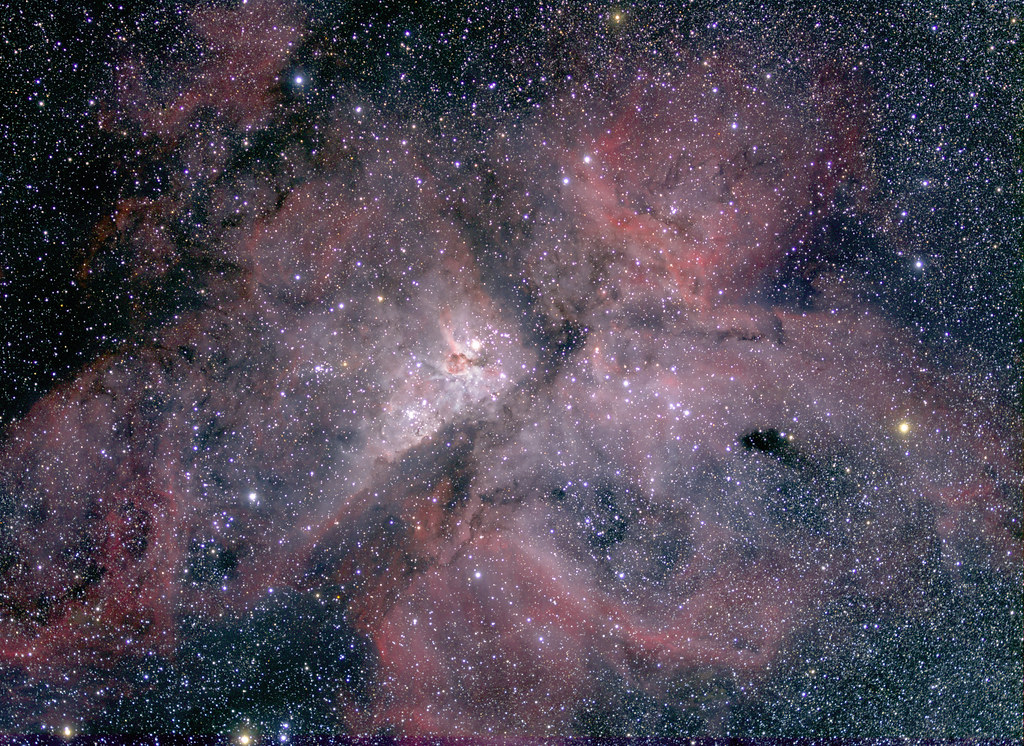
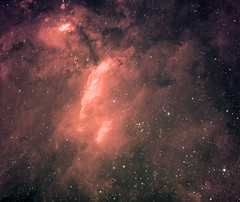
Carina Nebula in natural colours

Image of the Carina Nebula using broad-band filters B (blue), G (green) and R (red), trying to achieve natural colours (i.e. the colours we would see with our eyes).

For avoiding saturating the brightest part of the nebula, only 10s exposures were taken, with a small “manual” (*) dithering pattern. 42 single frames were combined in each filter (7 minutes per filter).

The data were taken at around 3am, Saturday 13 March 2021, from Siding Spring Observatory (near Coonabarabran, NSW, Australia).

I used a ZWO ASI1600MM-Pro with the ZWO 2″ BGR filters, my new 7×2″ ZWO filter wheel, a Skywatcher Black Diamond 80mm with an Orion x0.8 focal reducer (effective focal length 480 mm, f/6). I used the ZWO ASIAir to control the camera, filter wheel, the mount (Skywatcher AZ-EQ6) and the guiding system (ASI120MM + Orion 50mm finderscope *).

The data have been processed with SIRIL, and then Photoshop for getting the colours. Darks were used but not flats were taken.

Credit: Ángel R. López-Sánchez (AAO-MQ).

Full resolution available in My Flickr.

(*) Well, actually I didn’t use guiding: the ZWO ASIAir didn’t want to talk to the mount, and I had to reset the mount a couple of times because, after doing the 3-stars alignment, the solution was completely wrong, once it pointed me to the ground to go to Canopus! After 3 hours fighting, very tired and cold, I decided to do something quick at least for saving the night. This was it. I had to do the dithering manually moving slightly the telescope with the keypad every 3-4 exposures. Dithering is VERY important for removing extra noise / artefacts of the camera.

PS: The astrometry of the image can be found in this link. Well, actually I uploaded the previous version I quickly created, that had too much magenta. But I wanted to check a curious object in the image, V* FU Car, a carbon star with magnitudes V = 11.2 and G= 12.4 en G, meaning V-G = -1.2 mag!