Article originally written for the AAO’s Newsletter published on 29th June 2021.
During the last year I’ve been setting up my telescope in the backyard to do astrophotography as an amateur astronomer. This has been possible thanks to getting a good mount (Skywatcher AZ-EQ6-Pro) that allows me to do auto-guiding, and using a little but very clever device (it’s a modified Raspberri Pi manufactured by ZWO called “ASIAir”) that allows me to connect mount and cameras (the main camera for astrophotography and the auxiliary camera for auto-guiding) together, being everything controlled using my son’s iPad (who, with only 8 years, has been also helping me with all of this). In the last months I’ve been able to get a process so smooth that I only need 10 minutes for setup (checking polar alignment, guiding, focus) and then the telescope is observing all the night (it will automatically move to a parked position at the end of the run).
My amateur telescope equipment in the backyard (15 km from Sydney’s centre) ready for astrophotography in April 2021. The telescope is my Skywatcher Black Diamond 80, f=600mm (f/7.5) that I bought for the Transit of Venus 2012. The x0.8 Orion focal reducer is included here. I use the ZWO ASIAir to control the main camera, the mount (Skywatcher AZ-EQ6 Pro) and the guiding system (ASI120MM + Orion 50mm finderscope). The ZWO Filter Wheel has 7 positions with 2” filters (ZWO LBGR filters, Baader 3.5nn H-alpha, Antlia 3nm [O III], and a hand-made dark filter). The main camera is a ZWO 1600MM-Pro, usually set at -20C.
I must confess this has been a lot of fun for me, also for keeping extra busy and awake during the many meetings / workshops in the middle of the night we all are having lately. I’m getting some nice photos, particularly of nebulae, as I’m using some ultra-narrow (3.5nm thickness) H-alpha and [O III] filters. One of my favourite images is the Cat’s Paw nebula, who would have told me just some few years ago I will be able to get such an image with all these details using a 80mm refractor telescope in Sydney!
Deep H-alpha image of the Cat’s Paw Nebula (NGC 6334) in Scorpius obtained from my backyard, 15 km from Sydney’s city centre. All the information in my Flickr. Credit: Ángel R. López-Sánchez (AAO-MQ).
Hence, when last May, I was starting to use TAIPAN and observing with this new instrument, I couldn’t help myself…
While Tayyaba and Anthony helped me to get trained for TAIPAN observing, I decided to check if the instrument could be used for observing HII regions in the outskirts of the nearby spiral galaxy M 83, as well as observing the dwarf galaxies in the neighbourhood. Unfortunately this has been hard for the 1.2m UKST because of the faintness of the targets, but at least I got some test data from the central parts of M83 and some dwarf galaxies, including beautiful starburst NGC 5253.
However, I was thrilled to be using TAIPAN to observe M83 while, at the same time, in my backyard, my small telescope was also observing M 83 to get a new color-image of this galaxy. It was quite exciting and rewarding!
Colour image of M83 and surroundings combining data in B, G, R and Luminosity filters (8 hours in total combining 2 minute exposures). Data taken on 16 and 17 May 2021 while observing with TAIPAN remotely from my home office. This is still work in progress. Credit: Ángel R. López-Sánchez (AAO-MQ).
This image is still work in process, because we need to take usually hundreds of frames in each filter to get a good astronomical image to mitigate the light pollution plus reducing the background noise as much as we can. And, of course, dealing later with the processing of the data (it’s not that hard as it sounds, there is actually some software already available for amateur astronomers that does this very quickly in a very efficient way, even considering darks, flats, offsets and median stacking with different options). Also, I still need to add the H-alpha data in this image to emphasise the star-forming regions in the spiral disk of M 83. Unfortunately, the weather over Sydney during the last weeks has not being very good for astrophotography, but I hope to get the rest of the data soon.
Additionally, on Wednesday 26th May we enjoyed a total lunar eclipse. I took almost 2000 images of the event while I was participating in an online live event with many schools in Spain (8000+ views during the day). The telescope setup in this case was different, as I used my CANON 5D Mark III DSLR as main camera attached to my telescope. But, even though the totality of this lunar eclipse was short (only around 15 minutes), I got a very nice image of the eclipsed moon. For this image I combined the same data independently for getting the stars and the moon, and merged them together later.
Total Lunar Eclipse on 26th May 2021. This image combines 50 x 1″ exposures, ISO 800, obtained with my CANON 5D Mark III attached at primary focus of my Skywatcher Black Diamond 80mm f600mm (F/7.5) during the Total Lunar Eclipse on Wednesday 26 May 2021, between 9:00pm and 9:04pm, Sydney local time. Full description and high resolution image here. Credit: Ángel R. López-Sánchez (AAO-MQ).
My talk was on Tuesday afternoon, in case you’re interested.
From here I want to congratulate the LOC of this conference as it was very well organised and they did a great job. I particularly want to thank Claudia Lagos (ICRAR-UWA) for her hard work on this as chair of both the SOC and the LOC.
Full AAO Media Release, published at 01:00am Sydney time, 17 October 2017, that I coordinated.
For the first time, astronomers have observed the afterglow of an event that was also detected in gravitational waves. The object, dubbed AT2017gfo, was a pair of in-spiralling neutron stars in a galaxy 130 million light years away. The death spiral was detected in gravitational waves, and the resulting explosion was followed by over 50 observatories world wide, including the AAO and other observatories here in Australia.
On August 17, the Advanced Laser Interferometer Gravitational-Wave Observatory (LIGO), based in the United States, detected a new gravitational wave event, called GW170817.
GW170817 is the fifth source of gravitational waves ever recorded. The first one was discovered in September 2015, for which three founding members of the LIGO collaboration were awarded the 2017 Nobel Prize in Physics.
The GW170817 data are consistent with the merging of two neutron stars and are unlike the four previous events, which were merging black holes.
Artist’s illustration of two merging neutron stars. The narrow beams represent the gamma-ray burst while the rippling space-time grid indicates the gravitational waves that characterize the merger. Swirling clouds of material ejected from the merging stars are a possible source of the light that was seen at lower energies. Credit: National Science Foundation/LIGO/Sonoma State University/A. Simonnet.
The Advanced-Virgo interferometer, based in Italy, was online at the time of the discovery and contributed to the localization of the new gravitational wave burst.
Based on information from LIGO and VIRGO, numerous telescopes immediately sprang into action to determine if an electromagnetic counterpart to the gravitational waves could be detected.
Meanwhile, NASA’s Fermi satellite independently reported a short burst of gamma-rays within 2 seconds of the merger event associated with GW170817, consistent with the area of sky from which LIGO and VIRGO detected their gravitational waves.
This gamma-ray detection at the same time and place triggered even greater interest from the astronomical community and resulted in more intense follow up observations in optical, infrared and radio wavelengths.
A team of scientists within the Dark Energy Survey (DES) collaboration, which includes researchers from the Australian Astronomical Observatory and other Australian institutions, working with astronomers at the Harvard-Smithsonian Center for Astrophysics (CfA) in the U.S., were among the first astronomers to observe the electromagnetic counterpart of GW170817 in optical wavelengths.
Using the 570-megapixel Dark Energy Camera (DECam) mounted at the 4m Blanco Telescope at Cerro Tololo Inter-American Observatory in Chile, DES identified the kilonova AT2017gfo in the nearby galaxy NGC 4993, located only 130 million light years from us, as the optical counterpart of GW170817.
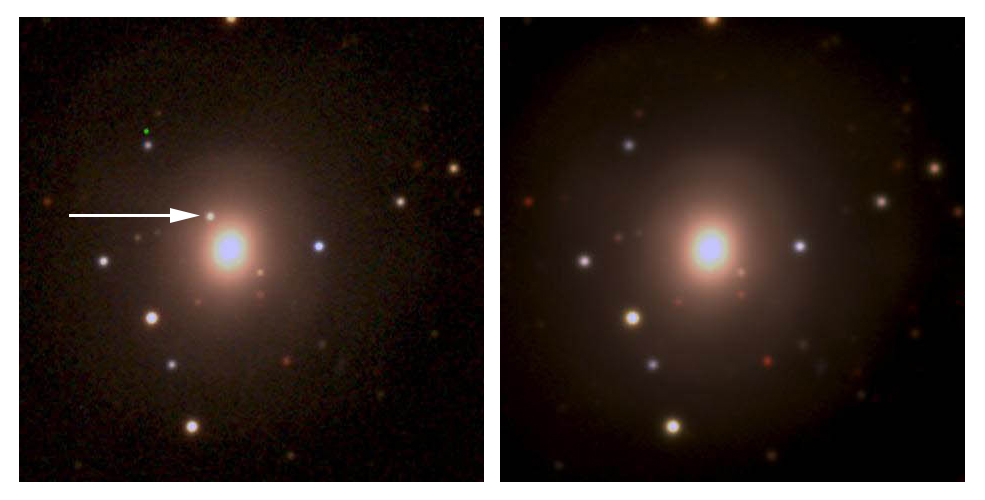
Composite of detection images, including the discovery z image taken on August 18th and the g and r images taken 1 day later. Right: The same area two weeks later. Credit: Soares-Santos et al. and DES Collaboration.
“Because of its large field of view, the Dark Energy Camera was able to search almost the entire region where LIGO/VIRGO expected the gravitational wave source to be, and its exquisite sensitivity allowed us to make detailed measurements of the kilonova – the extremely energetic outburst created by the merging neutron stars,” AAO Instrument Scientist and DES Collaboration member Dr Kyler Kuehn stated.
A kilonova is similar to a supernova in some aspects, but it is different in others. It occurs when two neutron stars crash into each other. These events are thought to be the mechanism by which many of the elements heavier than iron, such as gold, are formed.
“But as impressive as it is, the Dark Energy Camera is only one of many instruments with a front row seat to this celestial spectacle. A lot of effort has gone into preparing dozens of telescopes around the world to search for electromagnetic counterparts to gravitational waves”, Dr Kuehn added.
Simultaneously to the DES study, a large group of Australian astronomers obtained follow up observations of the kilonova AT2017gfo at optical, infrared and radio wavelengths, using 14 Australian telescopes as part of the ARC Centre of Excellence for Gravitational Wave Discovery (OzGrav) and other Australian programs.
Their data are consistent with the expected outburst and subsequent merger of two neutron stars, in agreement with the results derived for GW170817 by the LIGO/Virgo collaboration.
“Before this event, it was like we were sitting in an IMAX theatre with blindfolds on. The gravitational wave detectors let us ‘hear’ the movies of black hole collisions, but we couldn’t see anything. This event lifted the blindfolds and, wow, what an amazing show!!”, A/Professor Jeff Cooke, astronomer at Swinburne University who led many of the observations said.
The Australia team also conducted observations at the 3.9m Anglo-Australian Telescope (AAT), that is managed by the Australian Astronomical Observatory (AAO). Additional archive data from the 6dF survey obtained at the AAO’s 1.2m UK Schmidt Telescope were also used.
“The observations undertaken at the AAT place important constraints on the nature of the environment in which the kilonova occurred”, AAO astronomer Dr Chris Lidman said.
The follow up observations were not scheduled, but the excitement that this event generated in the astronomical community was so large that regular programs were placed on hold.
“Many astronomers dropped any other planned observation and used all the available resources to study this rare event”, said PhD candidate Igor Andreoni (Swinburne University and Australian Astronomical Observatory), first author of the scientific paper that will be published in the science journal “Publications of the Astronomical Society of Australia” (PASA).
The study also reveals that the host galaxy has not experienced significant star-formation during the last billion years. However, there is some evidence that indicates that NGC 4993 experienced a collision with a smaller galaxy not long time ago.
The position of the kilonova AT2017gfo, found in the external parts of NGC 4993, may suggest that the binary neutron star could have been part of the smaller galaxy.
Australian astronomers were thrilled to contribute to both the detection and the ongoing observations of the kilonova AT2017gfo, the electromagnetic counterpart to the gravitational wave event GW170817.
“We have been waiting and preparing for an event like this, but didn’t think it would happen so soon and in a galaxy that is so near to us. Once we were alerted of the gravitational wave detection, we immediately contacted a dozen telescopes and joined the worldwide effort to study this historic event. It didn’t let us down!”, A/Professor Jeff Cooke said.
“It was crucial to have telescopes placed in every continent, including Australia, to keep this rare event continuously monitored”, PhD candidate Igor Andreoni said.
“To me, this gravitational + electromagnetic wave combined detection is even more important than the initial detection that resulted in the Nobel Prize. This has changed the way the entire astronomical community operates”, AAO Instrument Scientist Dr Kyler Kuehn stated.
The first identification of the electromagnetic counterpart to a gravitational wave event is a milestone in the history of modern Astronomy, and opens a new era of multi-messenger astronomy.
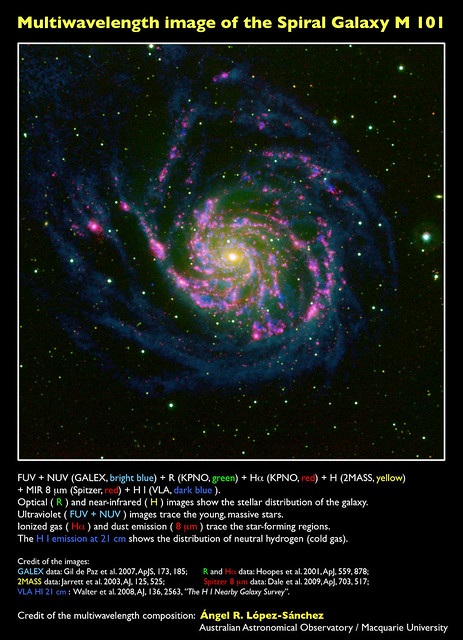
Multiwavelength image of nearby spiral galaxy M 101 combining ultraviolet (light blue), optical (green), near infrared (yellow), H-alpha and 8 microns mid-infrared (red) and 21 cm HI emission (dark blue). Each colour prepresents an important component of the galaxy: massive stars (light blue), stars (green and yellow), star-forming gas and dust (red) and neutral hydrogen (dark blue)
Data credit: UV data (GALEX): Gil de Paz et al. 2007, ApJS, 173, 185; R and Hα data (KPNO): Hoopes et al. 2001, ApJ, 559, 878; Near-Infrared data (2MASS): Jarrett et al. 2003, AJ, 125, 525, 8 microns data (Spitzer): Dale et al. 2009, ApJ, 703, 517; 21cm HI data (VLA): Walter et al. 2008, AJ, 136, 2563, ”The H I Nearby Galaxy Survey”.
Credit of the composition: Ángel R. López-Sánchez (AAO/MQ).
More sizes and high resolution image in My Flickr.
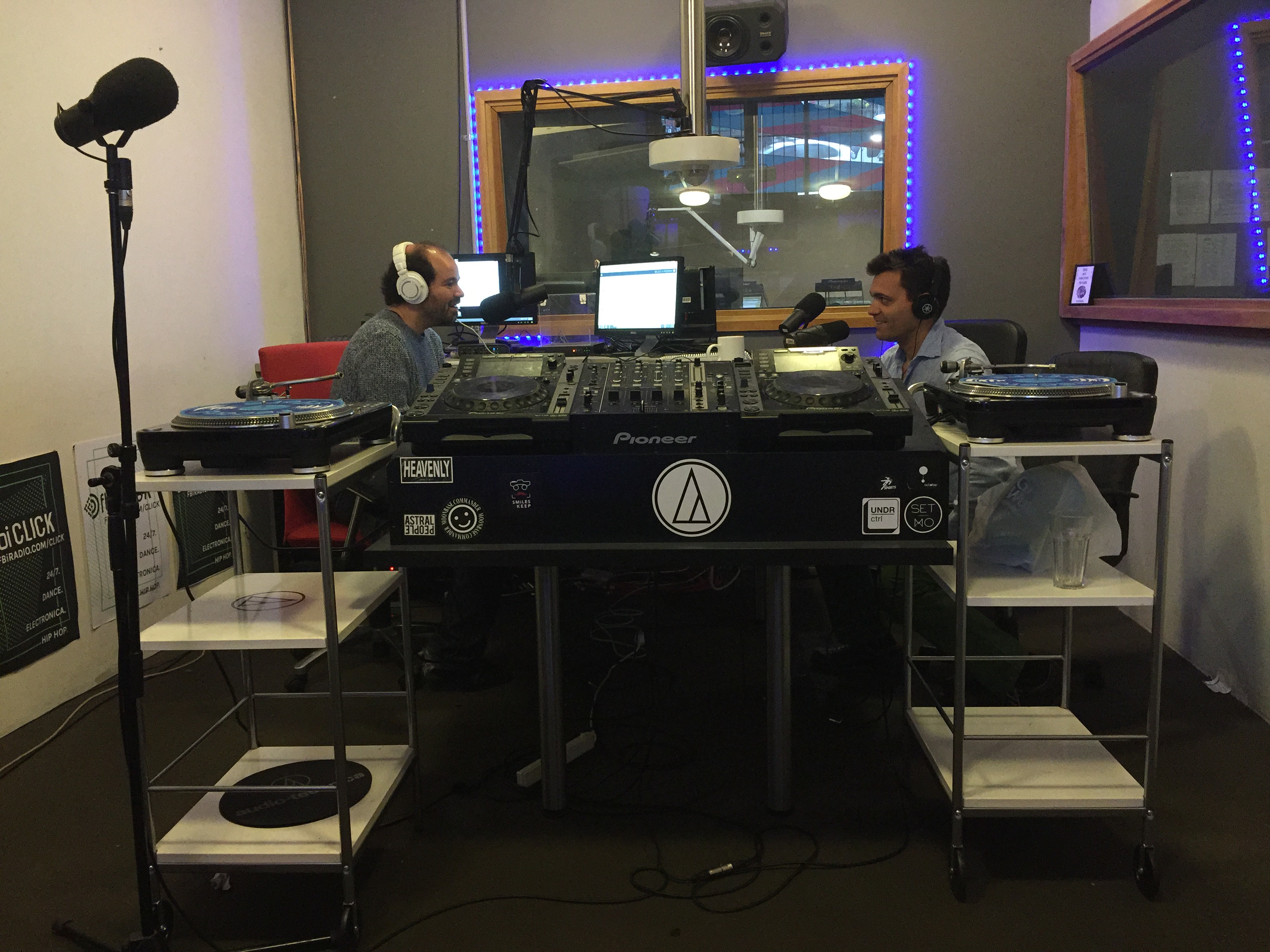
Some few months ago I was interviewed by Zacha Rosen in the FBi’s Not What You Think radio show. I was talking about what a galaxy is, the feeling of seeing the center of the Milky Way close to the zenith for the first time, and the problem of the light pollution.
The show was broadcasted on FBI 94.5 FM at 10:30am Saturday October 22nd, Sydney time. It is also available as podcast from the Not What You Think webpage or using iTunes.
You can also listen to the 18 minutes interview here:
Thanks Zacha for this wonderful experience I hope to repeat in the future!







 A/Prof. Ángel R. López-Sánchez