DPESPAÑOL: Esta historia entra en la categoría “Doble Post” donde indico artículos que han sido escritos tanto en español en El Lobo Rayado como en inglés en The Lined Wolf.
DPENGLISH: This story belongs to the series “Double Post” which indicates posts that have been written both in English in The Lined Wolf and in Spanish in El Lobo Rayado.
My friend Rubén García-Benito (IAA-CSIC) has prepared the following “teaser” of the CALIFA DR3, which uses a 3D movie he has prepared using the CALIFA data. The teaser, entitled “CALIFA: City of Light”, is available in Youtube and in YouKu (for Chinese astronomers):
“CALIFA: City of Light”, teaser announcing the release of CALIFA DR3 in April 2016, that will make publish the 3D data of 600 galaxies observed for this survey. Credit: Rubén García-Benito (IAA-CSIC)
I think it is a quite original idea for giving a bit of extra publicity to the CALIFA DR3, don’t you think so?
DPENGLISH: This story belongs to the series “Double Post” which indicates posts that have been written both in English in The Lined Wolf and in Spanish in El Lobo Rayado.
DPESPAÑOL: Esta historia entra en la categoría “Doble Post” donde indico artículos que han sido escritos tanto en español en El Lobo Rayado como en inglés en The Lined Wolf.
Last month the prestigious journal Nature published a letter led by PhD student (and friend) Louise Howes (@Lousie, ANU/RSAA, Australia). This scientific paper, with title Extremely metal-poor stars from the cosmic dawn in the bulge of the Milky Way, uses data from the 1.2m Skymapper Telescope, the 3.9m Anglo-Australian Telescope (both at Siding Spring Observatory, NSW, Australia) and the 6.5m Magellan Clay telescope (Las Campanas Observatory, Chile) to study very old stars in the Milky Way bulge.
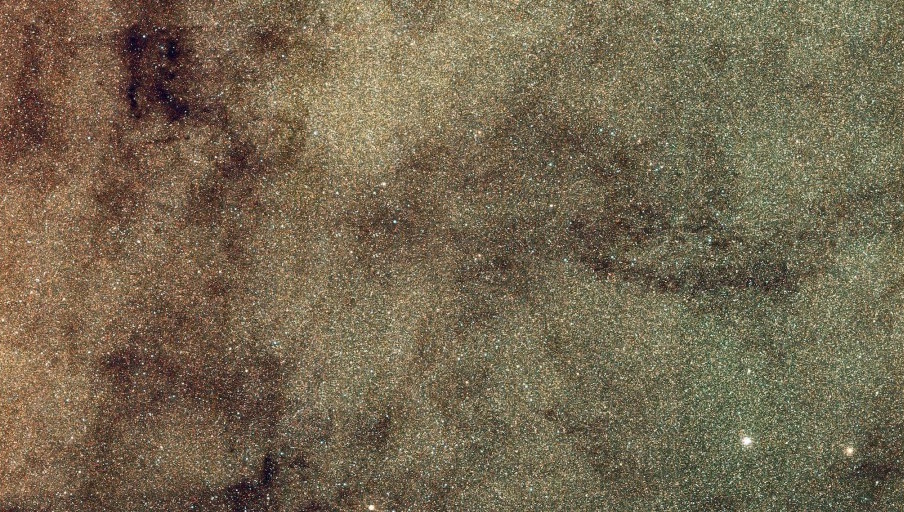
Image of the Galactic centre obtained using Skymapper data. Credit: Chris Owen (ANU/RSAA).
The aim of the research was to look for signatures of really old stars: stars that old that perhaps the Milky Was was not even born when they were created! How do astronomers know that? Just studying the chemical composition of the stars via deep spectral analysis. Only hydrogen and helium (and just a bit of litium) were formed in the Big Bang: the rest of elements have been created or inside the stars (oxygen, carbon, nitrogen, iron) or because of processes happening to the stars (e.g., supernova explosions, that create heavy elements such as gold, silver, copper or uranium). As time goes by and new generations of stars are born, the amount of metals (for astronomers, metals are all elements which are not hydrogen and helium) increases. Therefore if we discover a star with very few amount of metals, we will quite sure we are observing a very old object.
Loiuse has been using the 2dF instrument at the Anglo-Australian Telescope and the MIKE spectrograph at the Magellan Clay Telescope (Chile) to get deep, high-resolution spectra of candidate old stars in the Galactic bulge. The candidate stars were identified using optical images provided by the 1.2m Skymapper Telescope. With these observations, Louise Howes and collaborators have detected 23 stars that are extremely metal-poor. These stars have surprisingly low levels of carbon, iron and other heavy elements. Indeed, they report the discovery of a star that has an abundance of iron which is 10,000 times lower than that found in the Sun! These stars were formed at redshift greater than 15, that is, we are observing in our own Milky Way stars that were formed just ~300 million years after the Big Bang!
On top of that, the study suggests that these first stars didn’t explode as normal supernova but as hypernova: poorly understood explosions of probably rapidly rotating stars producing 10 times as much energy as normal supernovae. The high-resolution spectroscopic data have been also used to study the kinematics of these very old stars, that are found on tight orbits around the Galactic centre rather that being halo stars passing through the bulge. This is also characteristic of stars that were formed at redshifts greater than 15.
Short 3 minutes video discussing the results found in this study. Credit: ANU.
I’m happy to say here that I’ve been the support astronomer for many of her nights at the AAT the last couple of years. And I’m extremely happy to see that, even because of the bad weather we have had sometimes, they managed to get these observations published in Nature! Well done, Louise!
The majority of the galaxies in the Universe can be classified into two well-distinguished classes: spiral galaxies (as our own Milky Way Galaxy) or elliptical galaxies. Spiral galaxies have on-going star-formation activity, possess a lot of young, blue stars, and are rich in gas and dust. However elliptical galaxies are just made up of old stars, with no signs of star formation, gas and dust. Besides these two large galaxy classes, some galaxies are found to have irregular or disturbed morphologies. That is certainly the case of many dwarf galaxies. A disturbed morphology is typically indicating a galaxy that has experienced an interaction with a nearby companion object. Indeed, all galaxies are experiencing interactions and mergers with other galaxies during their life time: the theory currently accepted about how galaxies grow and evolve naturally explains the building of spiral galaxies as mergers of dwarf galaxies, and the birth of an elliptical galaxy after the merger of two spiral galaxies. This will actually be the final destiny of our Milky Way, when it is colliding and merging with the Andromeda galaxy in around 4.5 billions years from now.
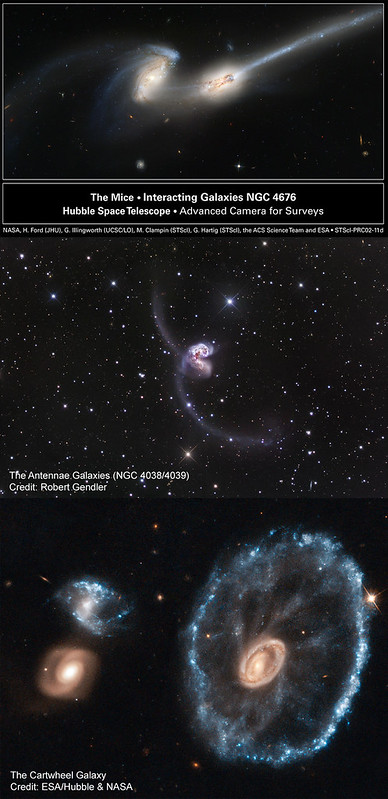
When galaxies collide, stars and gas are pulled out from them by gravity, and long tails of material stripped from the parent galaxies are formed. Famous galaxies in interaction developing these long “tidal tails” are the Mice Galaxies (NGC 4676) and the Antennae Galaxies (NGC 4038/4039). Very rarely, the geometry of the galaxy encounter is such that a small galaxy passes through the centre of a spiral galaxy creating a collisional ring galaxy. The ring structure is created by a powerful shock wave that sweeps up gas and dust, triggering the formation of new stars as the shock wave moves outwards. The most famous ring galaxy is the Cartwheel (ESO 350-40) galaxy, which is located at 500 million light-years away in the Southern constellation of the Sculptor. However complete ring galaxies are extremely rare in the Universe, only 20 of these objects are known.
Images of the interacting galaxies The Mice (NGC 4676), the Antennae Galaxies (NGC 4038/4039), and the Cartwheel (ESO 350-40) galaxy. Credit: The Mice: NASA, H. Ford (JHU), G. Illingworth (UCSC/LO), M.Clampin (STScI), G. Hartig (STScI), the ACS Science Team, and ESA, Antennae Galaxies: Robert Gendler, The Cartwheel: ESA/Hubble & NASA.
An international team of astronomers led by Prof. Quentin Parker (The University of Hong Kong / Australian Astronomical Observatory) has discovered a nearby ring galaxy which in some ways is similar to the Cartwheel galaxy but 40 times closer. The system was discovered as part of the observations of the AAO/UK Schmidt Telescope (UKST) Survey for Galactic H-alpha emission. Completed in late 2003, this survey used the 1.2m UKST at Siding Spring Observatory (NSW, Australia) to get wide-field photographic data of the Southern Galactic Plane and the Magellanic Clouds using a H-alpha filter. This special filter is able to trace the gaseous hydrogen (and not the stellar emission) within galaxies, allowing astronomers to detect the ionized gas from nebulae. The survey films were scanned by the SuperCosmos measuring machine at the Royal Observatory, Edinburgh (UK), to provide the online digital atlas “SuperCOSMOS H-alpha Survey” (SHS). When using this survey to search for new, undiscovered planetary nebulae (dying stars which often show ring morphologies in nebular emission) in the Milky Way, the team realised that a very peculiar of these structures was actually found around a nearby galaxy, ESO 179-13, located in the Ara (the Altar) constellation. The reason why this magnificent collisional ring structure has been unknown by astronomers is that it is located behind a dense star field (this area of the sky is very close to the Galactic plane, where the majority of the Milky Way stars are located) and very close to a bright foreground star.
Discovery images of the “Kathryn’s Wheel” using the data obtained at the 1.2m UKST by the “SuperCOSMOS H-alpha Survey” (SHS). The left panel (SR) shows the red image tracing mainly the stars. The three main components of the system are labelled. The central panel shows the image using the H-alpha filter (Hα), which sees both the diffuse ionized gas and the stars. The right panel (Hα-SR) shows the continuum-substracted image of the system, revealing for the very first time the intense collisional star-forming ring. Image credit: Quentin Parker / the research team.
The discovery SHS images of the system reveal 3 main structures (A, B and C) plus tens of H-alpha emitting knots making the ring. Component A is the remnant of the main galaxy, the collisional ring is centered on it. Component A does not possess ionized gas (that is, it does not have star-formation at the moment). On the other hand, component B seems to be the irregular, dwarf galaxy (“the bullet”) that impacted with the main galaxy. Component B does possess a clumpy and intense H-alpha emission.
Astronomers have dubbed this ring galaxy as “Kathryn’s Wheel” in honour of the wife of one of the discoverers, Prof. Albert Zijlstra, (University of Manchester, UK). Kathryn’s Wheel lies at a distance of 30 million light years away, and therefore it is an ideal target for detailed studies aiming to understand how these rare collisional ring galaxies are formed, the physics behind these structures, and their role in galaxy evolution. Interestingly, the collisional ring is not very massive: its mass is only a few thousand million Suns. This is less than ~1% of the Milky Way mass, indicating that ring galaxies can be formed around small galaxies, something that was not considered so far.
(Left) Colour image of the collision, made by combining data obtained at the Cerro-Tololo InterAmerican Observatory (CTIO) 4-metre telescope in Chile. The H-alpha image is shown in red and reveals the star-forming ring around the galaxy ESO 179-13, that has been dubbed “Kathryn’s Wheel”. Image credit: Ivan Bojicic / the research team. (Right) Image showing only the pure H-alpha emission of the system highlighting just the areas of active star formation. For clarity any remaining stellar residuals have been removed. Image credit: Quentin Parker / the research team.
Furthermore, the galaxy possesses a lot of diffuse, neutral hydrogen in its surroundings. This cold gas is the raw fuel that galaxies need to create new stars. Observations using the 64-m Parkes radiotelescope (“The Dish”, Parkes, NSW) as part of the “HI Parkes All-Sky Survey” (HIPASS) revealed that the amount of neutral gas around Kathryn’s Wheel is similar to the amount of mass found in stars in the system. Astronomers are unsure about from where this cold gas is coming from, although they suspect it mainly belonged to the main galaxy before the collision started. However, as the remnant of the galaxy (component A) does not have star-formation at the moment, it seems that the diffuse gas has been expelled from the centre of the system to the outskirts of the galaxy.
How do galaxies grow and evolve? Galaxies are made of gas and stars, which interact in very complex ways: gas form stars, stars die and release chemical elements into the galaxy, some stars and gas can be lost from the galaxy, some gas and stars can be accreted from the intergalactic medium. The current accepted theory is that galaxies build their stellar component using their available gas while they increase their amount of chemical elements in the process. But how do they do this?
That is part of my current astrophysical research: how gas is processed inside galaxies? What is the chemical composition of the gas? How does star-formation happen in galaxies? How galaxies evolve? Today, 21st May 2015, the prestigious journal “Monthly Notices of the Royal Astronomical Society”, publishes my most recent scientific paper, that tries to provide some answers to these questions. This study has been performed with my friends and colleagues Tobias Westmeier (ICRAR), Baerbel Koribalski (CSIRO), and César Esteban (IAC, Spain). We present new, unique observations using the 2dF instrument at the 3.9m Anglo-Australian Telescope (AAT), in combination with radio data obtained with the Australian Telescope Compact Array (ATCA) radio-interferometer, to study how the gas in processed into stars and how much chemical enrichment has this gas experienced in a nearby galaxy, NGC 1512.
Deep images of the galaxy pair NGC 1512 and NGC 1510 using optical light (left) and ultraviolet light (right).Credit: Optical image: David Malin (AAO) using photographic plates obtained in 1975 using de 1.2m UK Schmidt Telescope (Siding Spring Observatory, Australia). UV image: GALEX satellite (NASA), image combining data in far-ultraviolet (blue) and near-ultraviolet (red) filters.
NGC 1512 and NGC 1510 is an interacting galaxy pair composed by a spiral galaxy (NGC 1512) and a Blue Compact Dwarf Galaxy (NGC 1510) located at 9.5 Mpc (=31 million light years). The system possesses hundreds of star-forming regions in the outer areas, as it was revealed using ultraviolet (UV) data provided by the GALEX satellite (NASA). Indeed, the UV-bright regions in the outskirts of NGC 1512 build an “eXtended UV disc” (XUV-disc), a feature that has been observed around the 15% of the nearby spiral galaxies. However these regions were firstly detected by famous astronomer David Malin (AAO) in 1975 (that is before I was born!) using photographic plates obtained with the 1.2m UK Schmidt Telescope (AAO), at Siding Spring Observatory (NSW, Australia).
The system has a lot of diffuse gas, as revealed by radio observations in the 21 cm HI line conducted at the Australian Telescope Compact Array (ATCA) as part of the “Local Volume HI Survey” (LVHIS) and presented by Koribalski & López-Sánchez (2009). The gas follows two long spiral structures up to more than 250 000 light years from the centre of NGC 1512. That is ~2.5 times the size of the Milky Way, but NGC 1512 is ~3 times smaller than our Galaxy! One of these structures has been somehow disrupted recently because of the interaction between NGC 1512 and NGC 1510, that it is estimated started around 400 million years ago.
Multiwavelength image of the NGC 1512 and NGC 1510 system combining optical and near-infrared data (light blue, yellow, orange), ultraviolet data from GALEX (dark blue), mid-infrared data from the Spitzer satellite (red) and radio data from the ATCA (green). The blue compact dwarf galaxy NGC 1510 is the bright point-like object located at the bottom right of the spiral galaxy NGC 1512. Credit: Ángel R. López-Sánchez (AAO/MQ) & Baerbel Koribalski (CSIRO).
2dF/AAOmega is generally used by astronomers to observe simultaneously hundreds of individual stars in the Milky Way or hundreds of galaxies. Without considering observations in the Magellanic Clouds, it is the first time that 2dF/AAOmega is used to trace individual star-forming regions within the same galaxy, in some way forming a huge “Integral-Field Unit” (IFU) to observe all the important parts of the galaxy.
Two examples of the high-quality spectra obtained using the AAT. Top: spectrum of the BCDG NGC 1510. Bottom: spectrum of one of the brightest UV-bright regions in the system. The important emission lines are labelled. Credit: Ángel R. López-Sánchez (AAO/MQ), Tobias Westmeier (ICRAR), César Esteban (IAC) & Baerbel Koribalski (CSIRO).
The AAT observations confirm that the majority of the UV-bright regions are star-forming regions. Some of the bright knots (those which are usually not coincident with the neutral gas) are actually background galaxies (i.e., objects much further than NGC 1512 and not physically related to it) showing strong star-formation activity. Observations also revealed a knot to be a very blue young star within our Galaxy.
Using the peak of the H-alpha emission, the AAT data allow to trace how the gas is moving in each of the observed UV-rich region (their “kinematics”), and compare with the movement of the diffuse gas as provided using the ATCA data. The two kinematics maps provide basically the same results, except for one region (black circle) that shows a very different behaviour. This object might be an independent, dwarf, low-luminosity galaxy (as seen from the H-alpha emission) that is in process of accretion into NGC 1512.
Map showing the velocity field of the galaxy pair NGC 1512 / NGC 1510 as determined using the H-alpha emission provided by the AAT data. This kinematic map is almost identical to that obtained from the neutras gas (HI) data using the ATCA, except for a particular region (noted by a black circle) that shows very different kinematics when comparing the maps. Credit: Ángel R. López-Sánchez (AAO/MQ), Tobias Westmeier (ICRAR), César Esteban (IAC) & Baerbel Koribalski (CSIRO).
The H-alpha map shows how the gas is moving following the optical emission lines up to 250 000 light years from the centre of NGC 1512, that is 6.6 times the optical size of the galaxy. No other IFU map has been obtained before with such characteristics.
Using the emission lines detected in the optical spectra, which includes H I, [O II], [O III], [N II], [S II] lines (lines of hydrogen, oxygen, nitrogen and sulphur), we are able to trace the chemical composition -the “metallicity”, as in Astronomy all elements which are not hydrogen or helium as defined as “metals”- of the gas within this UV-bright regions. Only hydrogen and helium were created in the Big Bang. All the other elements have been formed inside the stars as a consequence of nuclear reactions or by the actions of the stars (e.g., supernovae). The new elements created by the stars are released into the interstellar medium of the galaxies when they die, and mix with the diffuse gas to form new stars, that now will have a richer chemical composition than the previous generation of stars. Hence, tracing the amount of metals (usually oxygen) within galaxies indicate how much the gas has been re-processed into stars.
Metallicity map of the NGC 1512 and NGC 1510 system, as given by the amount of oxygen in the star-forming regions (oxygen abundance, O/H). The colours indicate how much oxygen (blue: few, green: intermediate, red: many) each region has. Red diamonds indicate the central, metal rich regions of NGC 1512. Circles trace a long, undisturbed, metal-poor arm. Triangles and squares follow the other spiral arms, which is been broken and disturbed as a consequence of the interaction between NGC 1512 and NGC 1510 (blue star). The blue pentagon within the box in the bottom right corner represents the farthest region of the system, located at 250 000 light years from the centre. Credit: Ángel R. López-Sánchez (AAO/MQ), Tobias Westmeier (ICRAR), César Esteban (IAC) & Baerbel Koribalski (CSIRO).
The “chemical composition map” or “metallicity map” of the system reveals that indeed the centre of NGC 1512 has a lot of metals (red diamonds in the figure), in a proportion similar to those found around the centre of our Milky Way galaxy. However the external areas show two different behaviours: regions located along one spiral arm (left in the map) have low amount of metals (blue circles), while regions located in other spiral arm (right) have a chemical composition which is intermediate between those found in the centre and in the other arm (green squares and green triangles). Furthermore, all regions along the extended “blue arm” show very similar metallicities, while the “green arm” also has some regions with low (blue) and high (orange and red) metallicities. The reason of this behaviour is that the gas along the “green arm” has been very recently enriched by star-formation activity, which was triggered by the interaction with the Blue Compact Dwarf galaxy NGC 1510 (blue star in the map).
When combining the available ultraviolet and radio data with the new AAT optical data it is possible to estimate the amount of chemical enrichment that the system has experienced. This analysis allows to conclude that the diffuse gas located in the external regions of NGC 1512 was already chemically rich before the interaction with NGC 1510 started about 400 million years ago. That is, the diffuse gas that NGC 1512 possesses in its outer regions is not pristine (formed in the Big Bang) but it has been already processed by previous generations of stars. The data suggest that the metals within the diffuse gas are not coming from the inner regions of the galaxy but very probably they have been accreted during the life of the galaxy either by absorbing low-mass, gas-rich galaxies or by accreting diffuse intergalactic gas that was previously enriched by metals lost by other galaxies.
In any case this result constrains our models of galaxy evolution. When used together, the analysis of the diffuse gas (as seen using radio telescopes) and the study of the metal distribution within galaxies (as given by optical telescopes) provide a very powerful tool to disentangle the nature and evolution of the galaxies we now observe in the Local Universe.
More information
– Scientific Paper in MNRAS: “Ionized gas in the XUV disc of the NGC 1512/1510 system”. Á. R. López-Sánchez, T. Westmeier, C. Esteban, and B. S. Koribalski.“Ionized gas in the XUV disc of the NGC1512/1510 system”, 2015, MNRAS, 450, 3381. Published in Monthly Notices of the Royal Astronomical Society (MNRAS) through Oxford University Press.
DPENGLISH: This story belongs to the series “Double Post” which indicates posts that have been written both in English in The Lined Wolf and in Spanish in El Lobo Rayado.
DPESPAÑOL: Esta historia entra en la categoría “Doble Post” donde indico artículos que han sido escritos tanto en español en El Lobo Rayado como en inglés en The Lined Wolf.
Unlike the rest of sciences, Astrophysics is not based on carefully experiments designed in a laboratory but in the direct observation of the Universe. Astrophysicists get their data via the analysis of the light we receive from the Cosmos. For achieving this we use extremely sensitive instruments that collect the light emitted by planets, stars, nebulae and galaxies. Certainly, there are some alternative ways to study the Universe besides using the light, as analyzing meteorites or moon rocks, detecting energetic particles such as cosmic rays and neutrinos, or perhaps even using gravitational waves if they actually exist. But the main tool astrophysicists have today to investigate the Cosmos is the study of the radiation we receive from the outer space. Light is the key piece of the Astrophysics we make today.
As the aim is to observe the very faint light coming from objects located even billions of light years away, astronomical observatories are built in relatively isolated places, which are typically located high over the sea level. To observe the Universe, we astrophysicists need dark skies that are not affected by the nasty light pollution created by our society. The inadequate use of the artificial light emitted by streetlight of the cities induces an increasing of the brightness of the night sky. This happens as a consequence of the reflection and diffusion of the artificial light in the gases and particles of dust of the atmosphere. Besides the huge economic waste that it means, light pollution also has a very negative impact on the ecosystem, increases the amount of greenhouse gases in the atmosphere, and drastically diminishes the visibility of the celestial bodies. Unfortunately the light pollution is the reason that a large part of the mankind cannot enjoy a dark starry sky. How is the firmament when we observe it from a dark place? This time-lapse video shows as an example the sky over Siding Spring Observatory (Australia), where the Anglo-Australian Telescope (AAT), managed by the Australian Astronomical Observatory (AAO) and where I work, is located. The darkness of the sky in this observatory allows us to clearly see with our own eyes the Milky Way (the diffuse band of stars that crosses the sky) and many other celestial bodies such as the Magellanic Clouds, the Orion and Carina nebulae, or the Pleiades and Hyades star clusters.
Movie: Time-lapse video “The Sky over the Siding Spring Observatory”. More information about this video in this post in the blog. Credit: Ángel R. López-Sánchez (AAO/MQ).
On the other hand, after traveling during hundreds, millions, or billions of years throughout the deep space, the information codified in the light that reaches us is disrupted by the atmosphere of the Earth in the last millionth of a second of its trip. Hence professional telescopes are built on the top of the mountains, where the atmosphere is more stable than a sea level. Even though, many times this is not enough: our atmosphere distorts the light coming from space and prevents the identification of objects located very close in the sky. New techniques have been developed for compensating the effect of the atmosphere in the quality of the light we receive from the Cosmos. In particular, the adaptive optics technique induces in real time slight modifications to the shape of the primary mirror of the telescope, and therefore they counteract the distortion created by the atmosphere. In any case, astrophysicists need to direct the light received by the telescope to a detector, which transforms light energy into electric energy. This has been the purpose of the CCD (Charge-Couple Device) chips, firstly used by astronomers, and later popularized in smartphones and digital cameras. Very sophisticated optical systems are built to direct the light from the telescope to the detectors. Some of the systems created to manipulate our collection and processing of light are based on optical fibres. This new technology has created the branch of Astrophotonic. Indeed, the AAO, together with the University of Sydney and Macquarie University (Australia), are pioneers in the field of Astrophotonic. The next video shows how the light from the Cosmos is studied at the AAT. First it is collected using the primary mirror of the telescope, which has a diameter of 4 meters, and then it is sent using optical fibres to a dark room where the AAOmega spectrograph is located. This spectrograph, which is a series of special optics, separates the light into its rainbow spectrum, in a similar way a prism separates white light into a rainbow. The separated light is later focussed onto the CCD detector.
Movie: Rainbow Fingerprints, showing how the light of distant galaxies in collected by the Anglo-Australian Telescope and directed to the AAOmega spectrograph using optical fibres. More information: at the AAO webpages. Credit: Australian Astronomical Observatory (AAO), Movie produced by Amanda Bauer (AAO).
Specifically, this video shows how astrophysicists analyse the light coming from distant galaxies to understand their nature and properties. In particular, the video reveals the final science quality spectra for two different types of galaxies, one spiral (top panel) and one elliptical (bottom panel), using actual data obtained with the AAT and the AAOmega spectrograph. The information codified in the rainbow fingerprint identifies each galaxy unambiguously: distance, star formation history, chemical composition, age, physical properties as the temperature or the density of the diffuse gas, and many more. All this information has been captured within a single ray of light that has travelled hundred of millions of years to reach us. Similarly, the properties of stars (luminosity, mass, temperature, chemical composition, kinematics, …), nebulae, and any other celestial body (planets, comets, asteroids, quasars, …) are analyzed through its light. And studying tiny changes in the amount of light we receive from nearby stars we are now finding thousands of exoplanets in the Milky Way.
The “rainbow fingerprints” video shown before includes only the observations of two galaxies, but actually the AAT is able to observe around 350 objects at the same time. This is achieved using the 2dF robot, which can configure 400 optical fibres within a circular field of view with a diameter of 4 full moons. The majority of the optical fibres are allocated to observe galaxies (or stars), but some few optical fibres are used to get an accurate guiding of the telescope or to obtain important calibration data. With this technology the AAT is a survey machine, and indeed it is a pioneer of galaxy surveys. Around 1/3 of all the galaxy distances known today have been obtained using the AAT. The most recent galaxy survey completed at the AAT is the “Galaxy And Mass Assembly” (GAMA) survey, that has collected the light of more than 300 thousand galaxies located in some particular areas of the sky. The next movie shows the 3D distribution of galaxies in one of the sky areas observed by GAMA. This simulated fly through shows the real positions and images of the galaxies that have been mapped by GAMA. Distances are to scale, but the galaxy images have been enlarged for a viewing pleasure.
Movie: “Fly through of the GAMA Galaxy Catalogue”, showing a detailed map of the Universe where galaxies are in 3D. More information in the Vimeo webpage of the video. Crédito: Made by Will Parr, Dr. Mark Swinbank and Dr. Peder Norberg (Durham University) using data from the SDSS (Sloan Digital Sky Survey) and the GAMA (Galaxy And Mass Assembly) surveys.
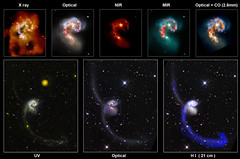
However, to really understand what happens in the Universe, astrophysicists use not only the light that our eyes can see (the optical range) but all the other “lights” that make up the electromagnetic spectrum, from the very energetic gamma rays to the radio waves. The light codified in the radio waves is studied using radiotelescopes, many of them located in the surface of the Earth. The study of the light in radio frequencies allows us to detect the diffuse, cold gas existing in and around galaxies, the coldest regions of the interstellar medium and where the stars are formed, and energetic phenomena associated to galaxy nuclei hosting an active super-massive black hole in its centre. Many technological achievements, including the invention of the Wi-Fi, come from Radioastronomy. The study of the infrared, ultraviolet, X ray and gamma ray lights must be done using space telescopes, as the atmosphere of the Earth completely blocks these kinds of radiation. As an example, the next image shows how the nearby spiral galaxy M 101 is seen when we use all the lights of the electromagnetic spectrum. Light in X rays traces the most violent phenomena in the galaxy, which are regions associated to supernova remnants and black holes. The ultraviolet (UV) light marks where the youngest stars (those born less than 100 million years ago) are located. Optical (R band) and near-infrared (H band) lights indicate where the sun-like and the old stars are found. The emission coming from ionized hydrogen (H-alpha) reveals the star-forming regions, that is, the nebulae, in M 101. Mid-infrared (MIR) light comes from the thermal emission of the dust, which has been heated up by the young stars. Finally, the image in radio light (neutral atomic hydrogen, HI, at 21 cm) maps the diffuse, cold, gas in the galaxy.
Imagen: Mosaic showing six different views of the galaxy M 101, each one using a different wavelength. Images credit: X ray data (Chandra): NASA/CXC/JHU/K.Kuntz et al,; UV data(GALEX): Gil de Paz et al. 2007, ApJS, 173, 185; R and Hα data (KPNO): Hoopes et al. 2001, ApJ, 559, 878; Near-Infrared data (2MASS): Jarrett et al. 2003, AJ, 125, 525, 8 microns data (Spitzer): Dale et al. 2009, ApJ, 703, 517; 21cm HI data (VLA): Walter et al. 2008, AJ, 136, 2563, ”The H I Nearby Galaxy Survey”. Credit of the composition: Ángel R. López-Sánchez (AAO/MQ).
In any case, today Astrophysics does not only use observations of the light we collect from the Cosmos, but also includes a prominent theoretical framework. “Experiments” in Astrophysics are somewhat performed using computer simulations, where the laws of Physics, together with some initial conditions, are taken into account. When the computer runs, the simulated system evolves and from there general or particular trends are obtained. These predictions must be later compared with the real data obtained using telescopes. Just to name some few cases, stellar interiors, supernova explosions, and galaxy evolution are modeled through careful and sometimes expensive computer simulations. As an example, the next movie shows a cosmological simulation that follows the development of a spiral galaxy similar to the Milky Way from shortly after the Big Bang to the present time. This computer simulation, that required about 1 million CPU hours to be completed, assumes that the Universe is dominated by dark energy and dark matter. The simulation distinguishes old stars (red colour), young stars (blue colour) and the diffuse gas available to form new stars (pale blue), which is the gas we observe using radiotelescopes. This kind of cosmological simulations are later compared with observations obtained using professional telescopes to progress in our understanding of the Cosmos.
Movie: Computer simulation showing the evolution of a spiral galaxy over about 13.5 billion years, from shortly after the Big Bang to the present time. Colors indicate old stars (red), young stars (white and bright blue) and the distribution of gas density (pale blue); the view is 300,000 light-years across. The simulation ran on the Pleiades supercomputer at NASA’s Ames Research Center in Moffett Field, Calif., and required about 1 million CPU hours. It assumes a universe dominated by dark energy and dark matter. More information about this animation in this NASA website. Credit: F. Governato and T. Quinn (Univ. of Washington), A. Brooks (Univ. of Wisconsin, Madison), and J. Wadsley (McMaster Univ.).
In summary, thanks to the analysis of the light we know where stars, galaxies, and all the other celestial bodies are, what are they made of, how do the move, and more. Actually, much of the research that we astrophysicists do today combines observing and analyzing light coming from very different spectral ranges, X rays, ultraviolet, optical, infrared and radio waves. In many cases, we are using techniques that have been known for only few decades and that are still waiting to be fully exploited. The detailed study of the light coming from the Cosmos will provide new important astronomical discoveries in the nearby future and, at the same time, will impulse new technologies; many of them will be applied in medicine and communications. The light techniques we are developing for Astrophysics will have a direct application to our everyday life and will improve the welfare state of our society, besides deepens the understanding of the vast Universe we all live in.







 A/Prof. Ángel R. López-Sánchez