Category Archives: Emission Nebula

My first H-alpha test of the Horsehead and Flame nebulae

H-alpha image of the Horsehead (left) and Flame (right) nebulae in Orion obtained from my backyard, 15 km from Sydney’s city centre.

This image combines 24 frames I got during some few nights in early October using the ZWO ASI1600MM Pro and the H-alpha Baader 3.5nm ultra-narrow filter.

All frames had an exposition time of 900s (15 minutes), hence this image combines a total of 6 hours of telescope time!

Telescope: Skywatcher Black Diamond 80, f=600mm (f/7.5)

Equipment: I used the ZWO ASIAir to control the camera, the mount (Skywatcher AZ-EQ6) and the guiding system (ASI120MM + Orion 50mm finderscope). The H-alpha filter was in the ZWO filter drawer.

Processing: Data processed with Siril software. FITS converted on TIFF using NASA’s Fits Liberator considering a logarithmic function. Color / saturation / levels / contrast / smart sharpen with Photoshop.

For this image I decided to give some false colour instead of just the greyscale image, I used Photoshop to get the kind of “fire” aspect to the gas in the nebulae.

I was expecting to get more data to get the image deeper, unfortunately the weather, following “La Niña”, is not cooperating in Eastern Australia in late 2020.

Credit: Ángel R. López-Sánchez (AAO-MQ).

Full resolution image available in my Flickr.
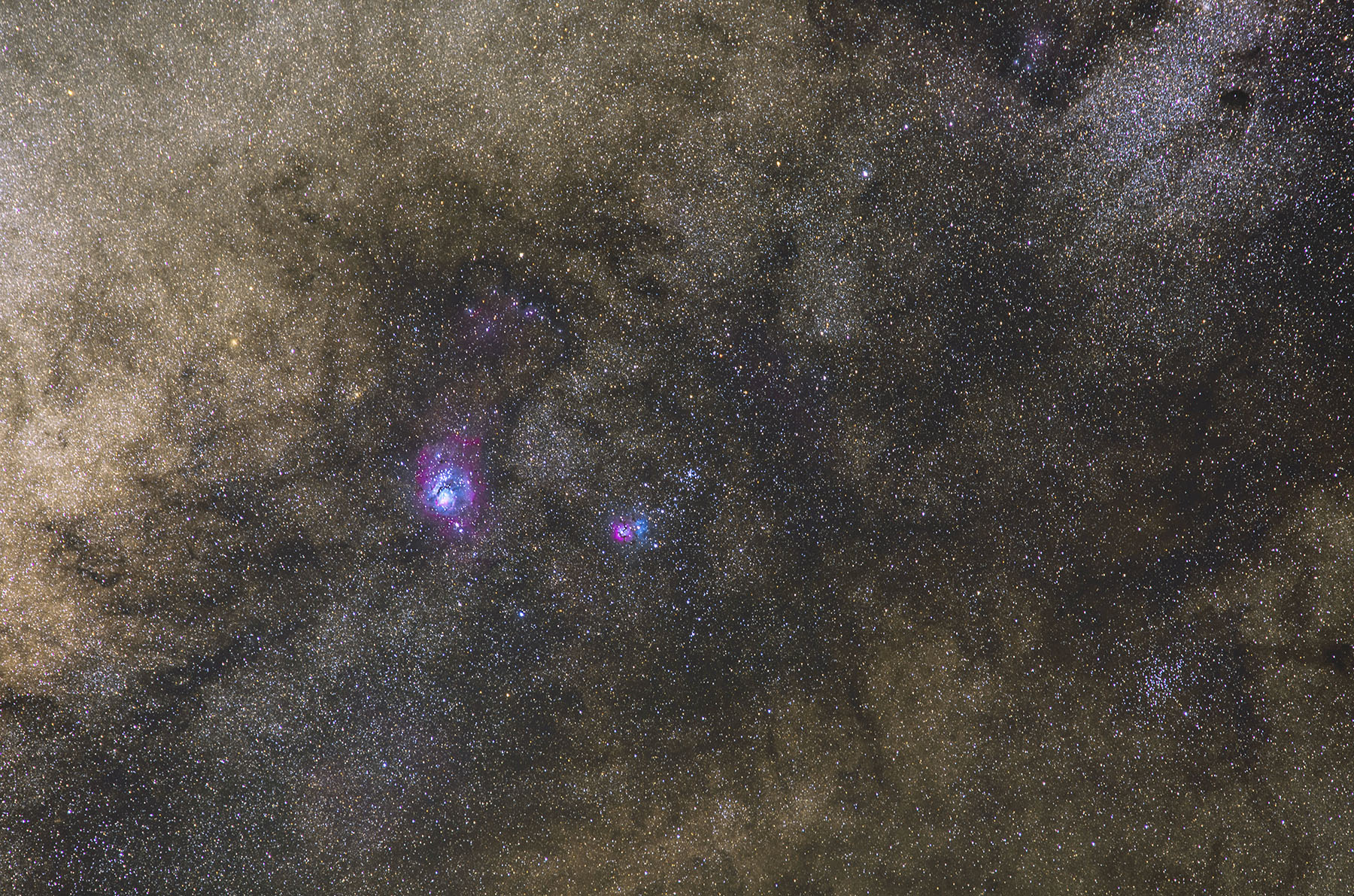
Wide field view around the Lagoon and the Trifid nebulae

2017_09_19_M20+M8_cboost_trim_small

The Trifid Nebula (M20), with its pink (left) and blue (right) colours, is at the center. The Lagoon Nebula (M 8) is at its left. Very close to M20 is the open cluster M21, almost in the very center of the image. The faint nebula IC 4685 is also seen over M 8. The open cluster M23 is located at the bottom right corner (this cluster has a similar size to the full moon in the sky). The diffuse nebula IC 1283 is located at the top right, in the middle of a dark cloud.

CANON EOS 5D Mark III with a Tamrom 200mm lens, 15 x 5 minutes exposure at f/2.8 and ISO 800.

Piggyback using my old mount, battery powered but very well polar-aligned, no autoguiding.

Full processed with Photoshop.

Siding Spring Observatory, Coonabarabran (NSW, Australia), 19 September 2017.

Full resolution image in my Flickr.

Credit: Ángel R. López-Sánchez (AAO-MQ).

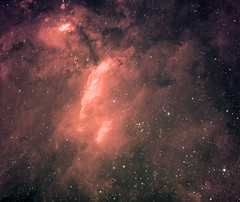
A test of the Eagle Nebula from Sydney

A test of the Eagle Nebula from Sydney

This is my first test image of the Eagle Nebula (M 16) using my amateur equipment from my backyard, 15 km North from Sydney’s city center, on 1st July 2020.

This image compiles 32 x 300s images (2 hours 40 minutes total integration time) obtained with my Skywatcher Black Diamond 80, an Orion X0.8 focal reducer (f/6), the ZWO ASI178MC camera and an OPTOLONG L-Pro filter.

I used the ZWO ASIAir to control the camera, the mount (Skywatcher AZ-EQ6) and the guiding system (ASI120MM + Orion 50mm finderscope).

Flats and darks included. Data processed with Siril software. Color / saturation / levels / contrast / smart sharpen with Photoshop.

Full resolution image in my Flickr.

Credit: Ángel R. López-Sánchez (AAO-MQ).

Video: Understanding the colours of nebulae

Today I’ve released in my YouTube Channel the very first video of a series that seeks to connect professional astrophysics with amateur astronomy and outreach. This video, is entitled “Understanding the colours of the nebulae“, or why square brackets are important when naming metallic transitions in nebulae.

Do you know how profesional astrophysicists and amateur astronomers get vibrant colour images of nebulae? In this video I provide insights of the Physics behind these images. I emphasise why the ionic transitions of metallic elements (i.e., any element that is not hydrogen or helium) in nebulae must be written with brackets, as they are not recombination lines but collisional excited lines, that is, a kind of forbidden lines that only appear in extreme low-density gases because of the collision of ions with free electrons in the gas.

The video includes my subtitles in both English and Spanish.

An extended article about the video will be added here soon.

I hope you like it! And remember:

Image

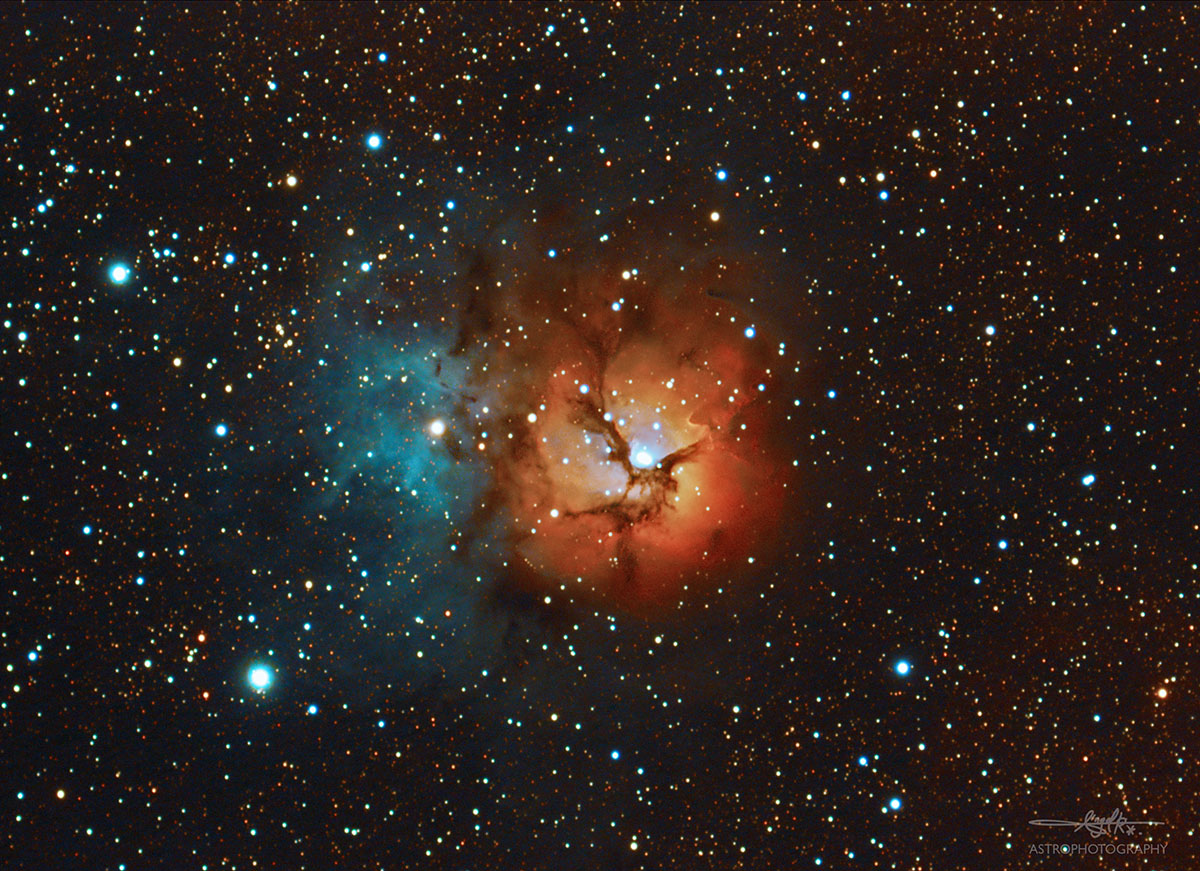
The Trifid Nebula from Sydney

The Trifid Nebula, M 20, from my backyard, 15 km North from Sydney’s city center, on 15th June 2020.

This image compiles 40 x 300s images (3.3 hours total integration time) obtained with my Skywatcher Black Diamond 80, an Orion X0.8 focal reducer (f/6), the ZWO ASI178MC camera and an OPTOLONG L-Pro filter.

I used the ZWO ASIAir to control the camera, the mount (Skywatcher AZ-EQ6) and the guiding system (ASI120MM + Orion 50mm finderscope).

Flats and darks included. Data processed with Siril software. Color / saturation / levels / contrast / smart sharpen with Photoshop.

Full resolution image in my Flickr.

Credit: Ángel R. López-Sánchez (AAO-MQ).