Category Archives: Observation

Timelapse of the Total Solar Eclipse

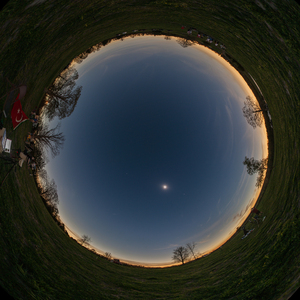
Last week I shared some of the images I obtained during the Total Solar Eclipse on 13 / 14 November 2012. It was observed from the Mulligan Highway, 44 km south of Lakeland, Queensland Australia. After spending a weekend playing with the raw frames, I ended up with this timelapse video, which shows all the sequence of the eclipse.

Timelapse video of the Total Solar Eclipse on 13 / 14 Nov 2012. The direct link to YouTube is here. Credit: Ángel R. López-Sánchez (Australian Astronomical Observatory / Macquarie University, Agrupación Astronómica de Córdoba / Red Andaluza de Astronomía).

The video combines 1203 individual frames obtained while the eclipse was happening. As before, I used my refractor Skywatcher telescope, 80 mm aperture and 600 mm focal, and my digital camera CANON EOS 600D at primary focus. For all partial phases but the totality I used a solar filter which blocks the 99.9997% of the incident light. The approximate field of view of the video is 2ºx1º. I usually took a frame each 6 seconds, but sometimes I triggered many consecutive images to improve the quality of the final photo of that moment. The music is the theme “WorldBuilder” written by Fran Solo and included in Epic Soul Factory Xpansion Edition.

Total Solar Eclipse 13 / 14 Nov 2012

After many years waiting for it, I have finally observed (and enjoyed!) my very first Total Solar Eclipse. It was on 14 November 2012 (still 13 November following time in UT) and I was 45 km south of Lakeland, Queensland Australia (I had to drive during the night trying to escape from the clouds in the coast near Port Douglas). Here you have some of the images I have obtained of this rare phenomenon.

My sequence of the Total Solar Eclipse on 13 / 14 November 2012, 50 km south from Lakeland, Queensland, Australia. I used a Skywatcher D 80mm, F 600mm, primary focus using CANON EOS 600D. All times given in UT and correspond to 13 Nov 2012. Credit: Ángel R. López-Sánchez (Australian Astronomical Observatory / Macquarie University, Agrupación Astronómica de Córdoba / Red Andaluza de Astronomía).

Some more pictures:

The sun rises, but the eclipse did already start. Credit: Ángel R. López-Sánchez (Australian Astronomical Observatory / Macquarie University, Agrupación Astronómica de Córdoba / Red Andaluza de Astronomía).

Image of the totality showing the brightest areas of the solar corona and some solar prominences close to the lunar limb (in red). Credit: Ángel R. López-Sánchez (Australian Astronomical Observatory / Macquarie University, Agrupación Astronómica de Córdoba / Red Andaluza de Astronomía).

Image of the totality showing the diffuse solar corona, but the brightest areas are overexposed. Credit: Ángel R. López-Sánchez (Australian Astronomical Observatory / Macquarie University, Agrupación Astronómica de Córdoba / Red Andaluza de Astronomía).

Diamond ring, the first light of the Sun coming after the totality. Credit: Ángel R. López-Sánchez (Australian Astronomical Observatory / Macquarie University, Agrupación Astronómica de Córdoba / Red Andaluza de Astronomía).

HDR (High Dynamic Range) image combining 20 individual frames with different exposition times. Credit: Ángel R. López-Sánchez (Australian Astronomical Observatory / Macquarie University, Agrupación Astronómica de Córdoba / Red Andaluza de Astronomía).

The Crescent Nebula

A very nice example of a nebula surrounding a Wolf-Rayet star is the so-called Crescent Nebula (NGC 6888, Caldwell 27, Sharpless 105). Located in the northern constellation of Gygnus, The Swan, it lies at around 5000 light years from us. The Crescent Nebula has been formed by the strong stellar winds of the Wolf-Rayet star WR 136 (HD 192163), which is located in the center of the nebula. This is an image of the Crescent Nebula I took in 2004 using the 2.5m Isaac Newton Telescope (INT) at the Roque de los Muchachos Observatory (La Palma, Spain) while I was still preparing my PhD Thesis at the Instituto de Astrofísica de Canarias (IAC, Tenerife, Spain) about the properties of dwarf galaxies hosting Wolf-Rayet stars. Actually, the image was taken during the twilight, when sky is still dark enough the get details in the narrow-band filters.

Crescent Nebula using narrow-band filters, by Angel R. Lopez-Sanchez

Image of the Crescent Nebula (NGC 6888) obtained by the author combining data using the broad-band optical B filter (blue) and the narrow-band optical filters [O III] (green) and Hα (red) obtained using the Wide Field Camera (WFC) attached at the 2.5m Isaac Newton Telescope (INT) at the Roque de los Muchachos Observatory (La Palma, Spain). The size of the image is around 22 x 22 arcminutes, just slightly smaller than the field of view of the full moon in the sky (30 arcminutes in diameter). Credit: Ángel R. López-Sánchez

The complex structure of the Crescent Nebula is a consequence of the interaction of the strong wind of the Wolf-Rayet star with material ejected by the star in an earlier phase, probably while it was a red supergiant. The actual loss-mass rate of the WR136 is around 0.00001 solar masses per year, which means the star losses the equivalent of the Sun’s mass every 10,000 years.

The image clearly shows ionized gas (nebular emission) with very different conditions: while red-color (Hα emission) is tracing the normal, emitting ionized gas, the green colour ([O III] emission) indicates regions with high excitation of the gas, meaning higher temperatures probably because of shocks. In just some few hundreds of years the star will explode as type-II supernova and destroy all the nebula, although it will create a new object: a supernova remnant.