Category Archives: Optical

Back observing at the Anglo-Australian Telescope

On 13th January 2013 the Siding Spring Observatory and the beautiful Warrumbungle National Park near Coonabarabran (NSW, Australia) were terribly affected by the worst bushfire in NSW in the last decade. Although the astronomical facilities have not experienced any severe damage, the bushfire has destroyed some houses at the Observatory (including the Lodge), burnt tens of houses and destroyed the majority of the trees in the National Park.

However, tonight Thursday 14 February, after a month and a day since the bushfire, astronomers are recommencing observing with the 3.9-m Anglo-Australian Telescope at Siding Spring Observatory. I’m one of these astronomers who are now performing the observations remotely from the Australian Astronomical Observatory (AAO) headquarters in North Ryde, Sydney, supported by technical staff at the telescope. The AAO has made public today a press release informing that astronomers are back to work at the AAT!.

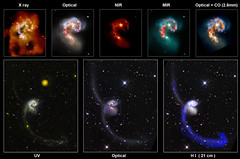
The Spindle Galaxy with the AAT. It is an edge-on lenticular galaxy classified as NGC 3155 or Caldwell 53. The data were obtained on 14 February 2013 using the FPI camera of the 2dF instrument at the 3.9m Anglo-Australian Telescope located at Siding Spring Observatory. 8 x 20 s + 5 x 40 s + 1 x 60 s integration time (460 s), combined with IRAF. Colours derived using U, V and I images obtained at the 2.5m Cerro Tololo International Observatory by Kuchinski et al. (2000).
First astronomical observations after the bushfires on 13 January 2013.
Credit: Ángel R. López-Sánchez (AAO/MQ) & Lee Spitler (MQ/AAO),
Night Assistant at the AAT: Steve Chapman (AAO)
.

Although we are using tonight the Two Degrees Field (2dF) instrument with the AAOmega spectrograph, which allows the acquisition of up to 392 simultaneous spectra of objects anywhere within a two degree field on the sky, we have also used the auxiliary camera that 2dF possesses, the Focal Plane Imager, to take some images of the Spindle galaxy, also known NGC 3115 or Caldwell 53, a lenticular (S0) galaxy located at around 32 million light years from Earth.

However, tonight’s observations are having the AAT looking up to a billion light-years out into space to test our ideas about the still mysterious Dark Energy.

Total Solar Eclipse 13 / 14 Nov 2012

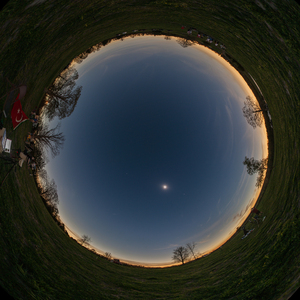
After many years waiting for it, I have finally observed (and enjoyed!) my very first Total Solar Eclipse. It was on 14 November 2012 (still 13 November following time in UT) and I was 45 km south of Lakeland, Queensland Australia (I had to drive during the night trying to escape from the clouds in the coast near Port Douglas). Here you have some of the images I have obtained of this rare phenomenon.

My sequence of the Total Solar Eclipse on 13 / 14 November 2012, 50 km south from Lakeland, Queensland, Australia. I used a Skywatcher D 80mm, F 600mm, primary focus using CANON EOS 600D. All times given in UT and correspond to 13 Nov 2012. Credit: Ángel R. López-Sánchez (Australian Astronomical Observatory / Macquarie University, Agrupación Astronómica de Córdoba / Red Andaluza de Astronomía).

Some more pictures:

The sun rises, but the eclipse did already start. Credit: Ángel R. López-Sánchez (Australian Astronomical Observatory / Macquarie University, Agrupación Astronómica de Córdoba / Red Andaluza de Astronomía).

Image of the totality showing the brightest areas of the solar corona and some solar prominences close to the lunar limb (in red). Credit: Ángel R. López-Sánchez (Australian Astronomical Observatory / Macquarie University, Agrupación Astronómica de Córdoba / Red Andaluza de Astronomía).

Image of the totality showing the diffuse solar corona, but the brightest areas are overexposed. Credit: Ángel R. López-Sánchez (Australian Astronomical Observatory / Macquarie University, Agrupación Astronómica de Córdoba / Red Andaluza de Astronomía).

Diamond ring, the first light of the Sun coming after the totality. Credit: Ángel R. López-Sánchez (Australian Astronomical Observatory / Macquarie University, Agrupación Astronómica de Córdoba / Red Andaluza de Astronomía).

HDR (High Dynamic Range) image combining 20 individual frames with different exposition times. Credit: Ángel R. López-Sánchez (Australian Astronomical Observatory / Macquarie University, Agrupación Astronómica de Córdoba / Red Andaluza de Astronomía).

The Crescent Nebula

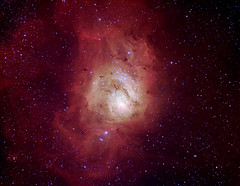
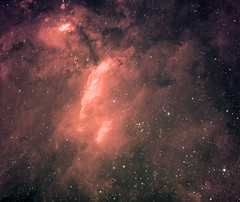
A very nice example of a nebula surrounding a Wolf-Rayet star is the so-called Crescent Nebula (NGC 6888, Caldwell 27, Sharpless 105). Located in the northern constellation of Gygnus, The Swan, it lies at around 5000 light years from us. The Crescent Nebula has been formed by the strong stellar winds of the Wolf-Rayet star WR 136 (HD 192163), which is located in the center of the nebula. This is an image of the Crescent Nebula I took in 2004 using the 2.5m Isaac Newton Telescope (INT) at the Roque de los Muchachos Observatory (La Palma, Spain) while I was still preparing my PhD Thesis at the Instituto de Astrofísica de Canarias (IAC, Tenerife, Spain) about the properties of dwarf galaxies hosting Wolf-Rayet stars. Actually, the image was taken during the twilight, when sky is still dark enough the get details in the narrow-band filters.

Crescent Nebula using narrow-band filters, by Angel R. Lopez-Sanchez

Image of the Crescent Nebula (NGC 6888) obtained by the author combining data using the broad-band optical B filter (blue) and the narrow-band optical filters [O III] (green) and Hα (red) obtained using the Wide Field Camera (WFC) attached at the 2.5m Isaac Newton Telescope (INT) at the Roque de los Muchachos Observatory (La Palma, Spain). The size of the image is around 22 x 22 arcminutes, just slightly smaller than the field of view of the full moon in the sky (30 arcminutes in diameter). Credit: Ángel R. López-Sánchez

The complex structure of the Crescent Nebula is a consequence of the interaction of the strong wind of the Wolf-Rayet star with material ejected by the star in an earlier phase, probably while it was a red supergiant. The actual loss-mass rate of the WR136 is around 0.00001 solar masses per year, which means the star losses the equivalent of the Sun’s mass every 10,000 years.

The image clearly shows ionized gas (nebular emission) with very different conditions: while red-color (Hα emission) is tracing the normal, emitting ionized gas, the green colour ([O III] emission) indicates regions with high excitation of the gas, meaning higher temperatures probably because of shocks. In just some few hundreds of years the star will explode as type-II supernova and destroy all the nebula, although it will create a new object: a supernova remnant.

What are Wolf-Rayet stars?

Wolf-Rayet (WR) stars are the evolved descents of the most massive, extremely hot (temperatures up to 200,000 K) and very luminous (105  to 106 solar luminosities, L) O stars, with masses 25 – 30 solar masses (M) for solar metallicity. WR stars possess very strong stellar winds, which reach velocities up to 3,000 km/s. These winds are observed in the broad emission line profiles (sometimes, even P-Cygni profiles) of WR spectra in the optical and UV ranges. These strong winds are also attributed to atmospheres in expansion. Actually, these winds are so strong that they are peeling the star and converting it in a nude nucleus without envelope. Indeed, WR stars have ejected their unprocessed outer Hydrogen-rich layers. WR stars typically lose 10−5 M a year; in comparison the Sun only loses  10−14  M⊙  per year.

Hα image of the Population I Wolf-Rayet star WR 124 (WN8) showing a young circunstelar envelope that is ejected at velocities highest than 300 km/s. The chaotic and filamentary structure created forms the M 1-67 nebula. The star is located at about 4.6 kpc from the Sun. At the left, image obtained by the author using the IAC-80 telescope, combining filters Hα (red) Hα continuum (green) and [O III] (blue). The right Hα image was obtained by the Hubble Space Telescope WFPC2 (Grosdidier et al. 1998). Note that the large arcs of nebulosity extend around the central star yet with not overall global shell structure. Furthermore, numerous bright knots of emission occur in the inner part of the nebula, often surrounded by what appear to be their own local wind diffuse bubbles. The dashed square in the IAC-80 image indicates the size of the HST image.

This is Figure 2.1 in my PhD Thesis.

WR stars were discovered by French astronomers Charles Wolf and Georges Rayet in 1867. They found that three bright galactic stars located at Cygnus region have, rather than absorptions lines, broad strong emission bands superposed to the typical continuum of hot stars. In 1930 C.S Beals correctly identified these features as emission lines produced by high ionized elements as helium, carbon, nitrogen and oxygen.  The intriguing spectral appearance of WR stars is due both their strong stellar winds and highly evolved surface chemical abundance. In 1938, WR stars were subdivided into WN (nitrogen-rich) and WC (carbon-rich) depending on whether the spectrum was dominated by lines of nitrogen or carbon-oxygen , respectively. Not until the 1980s did it became clear that WR stars represent an evolutionary phase in the lives of massive stars during which they undergo heavy mass loss. 

The mass-loss occurs via a continuous stellar wind which accelerated from low velocities near the surface of the star to velocities that exceed the surface escape speed. Their spectra, originated over a range of radii with the optical continuum forming close the stellar core and the emission lines in the more external areas (even beyond 10 stellar radii), indicate that the WR stars are embedded in luminous and turbulent shells of ejecta owing outwards at speeds comparable to the expansion velocities of novae although, in the case of WR stars, the expanding shell is being constantly fed with material from the main body of the star.

WR stars are extremely rare, reflecting their short lifespan. Indeed, they live for only some few hundred of thousands years, and hence only few WR stars are known: about 500 in our Milky Way and 100 in the Large Magellanic Cloud. Indeed, because of their peculiarities (brightness and broad emission lines), WR stars can be detected in distant galaxies. A galaxy showing features of WR stars in its spectrum is known as a Wolf-Rayet galaxy.

I compiled the main characteristics of WR stars in Chapter 2 of my PhD Thesis. A recent review about the properties of WR stars was presented by Crowther (2007).