Category Archives: Wavelengths

Partial solar eclipse from Sydney

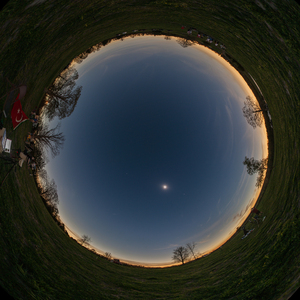
Today, 10th May 2013, the combined movements of the Sun, Earth and Moon gave us a very nice Annular Solar Eclipse. Following a similar path to the Total Solar Eclipse we enjoyed last November, the shadow of the Moon over the Earth moved from North Australia to the Pacific. However, today the Moon was close to its maximum distance to the Earth (planets and satellites move following elliptical orbits) and hence its apparent size on the sky was not big enough to completely cover the disc of the Sun. This is indeed the reason the eclipse was an annular solar eclipse.

In this occasion I couldn’t travel to North Australia to enjoy the annular eclipse (actually, I have seen 2 of these in the past, the most recent one was on 3rd October 2005 from Madrid), and even last night I didn’t expect to do anything special about this today. But this morning, while watching it from my backyard using my solar glasses, I decided just to take some few shots using not the telescope but only the tele lens. This is the result:

Partial Solar Eclipse from Sydney. Data obtained using a CANON EOS 600D, a 250mm Tele Lens and a Solar filter (which I hold by hand). I stacked 12 individual frames obtained at ISO 100, f10, 1/80 s using the Lynkeos software. The final processing was achieved using Photoshop. 10 May 2013 @ 09: 10 AEST ( 00:10 UT ), Sydney, Australia.
Credit: Ángel R. López-Sánchez (Australian Astronomical Observatory / Macquarie University, Agrupación Astronómica de Córdoba / Red Andaluza de Astronomía)

I hope you like it.

NEA 2012 DA14 observed from the AAT

Yesterday I explained we are resuming the scientific observations at Siding Spring Observatory (NSW, Australia) since the recent bushfires on 13 January 2013. Today we have used this telescope to observe the Near Earth Asteroid (NEA) 2012 DA14, which is getting its closest encounter to our planet today (it will be at only 27000 km from the surface of the Earth). Here you have the details:


The path of the NEA 2012 DA14 from the AAT. Observed during the evening twilight on the 15 February 2013 using the FPI camera of the 2dF instrument at the 3.9m Anglo-Australian Telescope located at Siding Spring Observatory (NSW, Australia). 25 frames, 2 seconds exposure each, 5 seconds between frames. First frame obtained at 09:53:54 UT, last one at 09:56:22.
Support Astronomers: Lee Spitler (MQ/AAO) & Andy Green (AAO).
Night Assistant at the AAT: Steve Chapman (AAO).
Edition of the data and movie: Ángel R. López-Sánchez (AAO/MQ).
Link to the video in my Flick.

The data were obtained by Lee Spitler (MQ/AAO), Andy Green (AAO) and Steve Chapman (AAO) during the evening twilight while waiting the sky was dark enough to start the scheduled scientific observations. We will try to get more data of this object during the morning twilight. More to come soon!

Update at 14:45 AEST, 16th Feb 2013

I’ve checked there are some problems to watch the video using smartphones and tablets such iPhones and iPad. Just try this link and it should work, although you may get a low resolution version of it. I’m creating a new video to be uploaded to YouTube. At the same time, I’ve just finished this image showing a mosaic with 13 of the frames obtained for the video.

Mosaic with the path of the NEA 2012 DA14 from the AAT. Observed during the evening twilight on the 15 February 2013 using the FPI camera of the 2dF instrument at the 3.9m Anglo-Australian Telescope located at Siding Spring Observatory (NSW, Australia). Each frame has an exposition time of 2 seconds.Times are shown in Universal Time (UT), add +11 hours to get the local time in NSW.
Support Astronomers: Lee Spitler (MQ/AAO) & Andy Green (AAO).
Night Assistant at the AAT: Steve Chapman (AAO).
Edition of the data and movie: Ángel R. López-Sánchez (AAO/MQ).


Finally, I confirm we also observed the NEA at the AAT during the morning twilight.

Update at 16:55 AEST, 18th Feb 2013

An updated version of the video, which is now in HD and includes the celestial coordinates, has been included in this excellent article published today in The Conversation by Simon O’Toole (AAO).


The path of the NEA 2012 DA14 from the AAT. Observed during the evening twilight on the 15 February 2013 using the FPI camera of the 2dF instrument at the 3.9m Anglo-Australian Telescope located at Siding Spring Observatory (NSW, Australia). 25 frames, 2 seconds exposure each, 5 seconds between frames. First frame obtained at 09:53:54 UT, last one at 09:56:22.
Support Astronomers: Lee Spitler (MQ/AAO) & Andy Green (AAO).
Night Assistant at the AAT: Steve Chapman (AAO).
Edition of the data and movie: Ángel R. López-Sánchez (AAO/MQ).

Back observing at the Anglo-Australian Telescope

On 13th January 2013 the Siding Spring Observatory and the beautiful Warrumbungle National Park near Coonabarabran (NSW, Australia) were terribly affected by the worst bushfire in NSW in the last decade. Although the astronomical facilities have not experienced any severe damage, the bushfire has destroyed some houses at the Observatory (including the Lodge), burnt tens of houses and destroyed the majority of the trees in the National Park.

However, tonight Thursday 14 February, after a month and a day since the bushfire, astronomers are recommencing observing with the 3.9-m Anglo-Australian Telescope at Siding Spring Observatory. I’m one of these astronomers who are now performing the observations remotely from the Australian Astronomical Observatory (AAO) headquarters in North Ryde, Sydney, supported by technical staff at the telescope. The AAO has made public today a press release informing that astronomers are back to work at the AAT!.

The Spindle Galaxy with the AAT. It is an edge-on lenticular galaxy classified as NGC 3155 or Caldwell 53. The data were obtained on 14 February 2013 using the FPI camera of the 2dF instrument at the 3.9m Anglo-Australian Telescope located at Siding Spring Observatory. 8 x 20 s + 5 x 40 s + 1 x 60 s integration time (460 s), combined with IRAF. Colours derived using U, V and I images obtained at the 2.5m Cerro Tololo International Observatory by Kuchinski et al. (2000).
First astronomical observations after the bushfires on 13 January 2013.
Credit: Ángel R. López-Sánchez (AAO/MQ) & Lee Spitler (MQ/AAO),
Night Assistant at the AAT: Steve Chapman (AAO)
.

Although we are using tonight the Two Degrees Field (2dF) instrument with the AAOmega spectrograph, which allows the acquisition of up to 392 simultaneous spectra of objects anywhere within a two degree field on the sky, we have also used the auxiliary camera that 2dF possesses, the Focal Plane Imager, to take some images of the Spindle galaxy, also known NGC 3115 or Caldwell 53, a lenticular (S0) galaxy located at around 32 million light years from Earth.

However, tonight’s observations are having the AAT looking up to a billion light-years out into space to test our ideas about the still mysterious Dark Energy.

Total Solar Eclipse 13 / 14 Nov 2012

After many years waiting for it, I have finally observed (and enjoyed!) my very first Total Solar Eclipse. It was on 14 November 2012 (still 13 November following time in UT) and I was 45 km south of Lakeland, Queensland Australia (I had to drive during the night trying to escape from the clouds in the coast near Port Douglas). Here you have some of the images I have obtained of this rare phenomenon.

My sequence of the Total Solar Eclipse on 13 / 14 November 2012, 50 km south from Lakeland, Queensland, Australia. I used a Skywatcher D 80mm, F 600mm, primary focus using CANON EOS 600D. All times given in UT and correspond to 13 Nov 2012. Credit: Ángel R. López-Sánchez (Australian Astronomical Observatory / Macquarie University, Agrupación Astronómica de Córdoba / Red Andaluza de Astronomía).

Some more pictures:

The sun rises, but the eclipse did already start. Credit: Ángel R. López-Sánchez (Australian Astronomical Observatory / Macquarie University, Agrupación Astronómica de Córdoba / Red Andaluza de Astronomía).

Image of the totality showing the brightest areas of the solar corona and some solar prominences close to the lunar limb (in red). Credit: Ángel R. López-Sánchez (Australian Astronomical Observatory / Macquarie University, Agrupación Astronómica de Córdoba / Red Andaluza de Astronomía).

Image of the totality showing the diffuse solar corona, but the brightest areas are overexposed. Credit: Ángel R. López-Sánchez (Australian Astronomical Observatory / Macquarie University, Agrupación Astronómica de Córdoba / Red Andaluza de Astronomía).

Diamond ring, the first light of the Sun coming after the totality. Credit: Ángel R. López-Sánchez (Australian Astronomical Observatory / Macquarie University, Agrupación Astronómica de Córdoba / Red Andaluza de Astronomía).

HDR (High Dynamic Range) image combining 20 individual frames with different exposition times. Credit: Ángel R. López-Sánchez (Australian Astronomical Observatory / Macquarie University, Agrupación Astronómica de Córdoba / Red Andaluza de Astronomía).

The Crescent Nebula

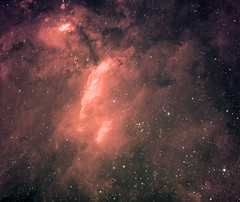
A very nice example of a nebula surrounding a Wolf-Rayet star is the so-called Crescent Nebula (NGC 6888, Caldwell 27, Sharpless 105). Located in the northern constellation of Gygnus, The Swan, it lies at around 5000 light years from us. The Crescent Nebula has been formed by the strong stellar winds of the Wolf-Rayet star WR 136 (HD 192163), which is located in the center of the nebula. This is an image of the Crescent Nebula I took in 2004 using the 2.5m Isaac Newton Telescope (INT) at the Roque de los Muchachos Observatory (La Palma, Spain) while I was still preparing my PhD Thesis at the Instituto de Astrofísica de Canarias (IAC, Tenerife, Spain) about the properties of dwarf galaxies hosting Wolf-Rayet stars. Actually, the image was taken during the twilight, when sky is still dark enough the get details in the narrow-band filters.

Crescent Nebula using narrow-band filters, by Angel R. Lopez-Sanchez

Image of the Crescent Nebula (NGC 6888) obtained by the author combining data using the broad-band optical B filter (blue) and the narrow-band optical filters [O III] (green) and Hα (red) obtained using the Wide Field Camera (WFC) attached at the 2.5m Isaac Newton Telescope (INT) at the Roque de los Muchachos Observatory (La Palma, Spain). The size of the image is around 22 x 22 arcminutes, just slightly smaller than the field of view of the full moon in the sky (30 arcminutes in diameter). Credit: Ángel R. López-Sánchez

The complex structure of the Crescent Nebula is a consequence of the interaction of the strong wind of the Wolf-Rayet star with material ejected by the star in an earlier phase, probably while it was a red supergiant. The actual loss-mass rate of the WR136 is around 0.00001 solar masses per year, which means the star losses the equivalent of the Sun’s mass every 10,000 years.

The image clearly shows ionized gas (nebular emission) with very different conditions: while red-color (Hα emission) is tracing the normal, emitting ionized gas, the green colour ([O III] emission) indicates regions with high excitation of the gas, meaning higher temperatures probably because of shocks. In just some few hundreds of years the star will explode as type-II supernova and destroy all the nebula, although it will create a new object: a supernova remnant.