Category Archives: Radio

The first detection of an electromagnetic counterpart to a gravitational wave event

Full AAO Media Release, published at 01:00am Sydney time, 17 October 2017, that I coordinated.

For the first time, astronomers have observed the afterglow of an event that was also detected in gravitational waves. The object, dubbed AT2017gfo, was a pair of in-spiralling neutron stars in a galaxy 130 million light years away. The death spiral was detected in gravitational waves, and the resulting explosion was followed by over 50 observatories world wide, including the AAO and other observatories here in Australia.

On August 17, the Advanced Laser Interferometer Gravitational-Wave Observatory (LIGO), based in the United States, detected a new gravitational wave event, called GW170817.

GW170817 is the fifth source of gravitational waves ever recorded. The first one was discovered in September 2015, for which three founding members of the LIGO collaboration were awarded the 2017 Nobel Prize in Physics.

The GW170817 data are consistent with the merging of two neutron stars and are unlike the four previous events, which were merging black holes.

Artist’s illustration of two merging neutron stars. The narrow beams represent the gamma-ray burst while the rippling space-time grid indicates the gravitational waves that characterize the merger. Swirling clouds of material ejected from the merging stars are a possible source of the light that was seen at lower energies. Credit: National Science Foundation/LIGO/Sonoma State University/A. Simonnet.

The Advanced-Virgo interferometer, based in Italy, was online at the time of the discovery and contributed to the localization of the new gravitational wave burst.

Based on information from LIGO and VIRGO, numerous telescopes immediately sprang into action to determine if an electromagnetic counterpart to the gravitational waves could be detected.

Meanwhile, NASA’s Fermi satellite independently reported a short burst of gamma-rays within 2 seconds of the merger event associated with GW170817, consistent with the area of sky from which LIGO and VIRGO detected their gravitational waves.

This gamma-ray detection at the same time and place triggered even greater interest from the astronomical community and resulted in more intense follow up observations in optical, infrared and radio wavelengths.

A team of scientists within the Dark Energy Survey (DES) collaboration, which includes researchers from the Australian Astronomical Observatory and other Australian institutions, working with astronomers at the Harvard-Smithsonian Center for Astrophysics (CfA) in the U.S., were among the first astronomers to observe the electromagnetic counterpart of GW170817 in optical wavelengths.

Using the 570-megapixel Dark Energy Camera (DECam) mounted at the 4m Blanco Telescope at Cerro Tololo Inter-American Observatory in Chile, DES identified the kilonova AT2017gfo in the nearby galaxy NGC 4993, located only 130 million light years from us, as the optical counterpart of GW170817.
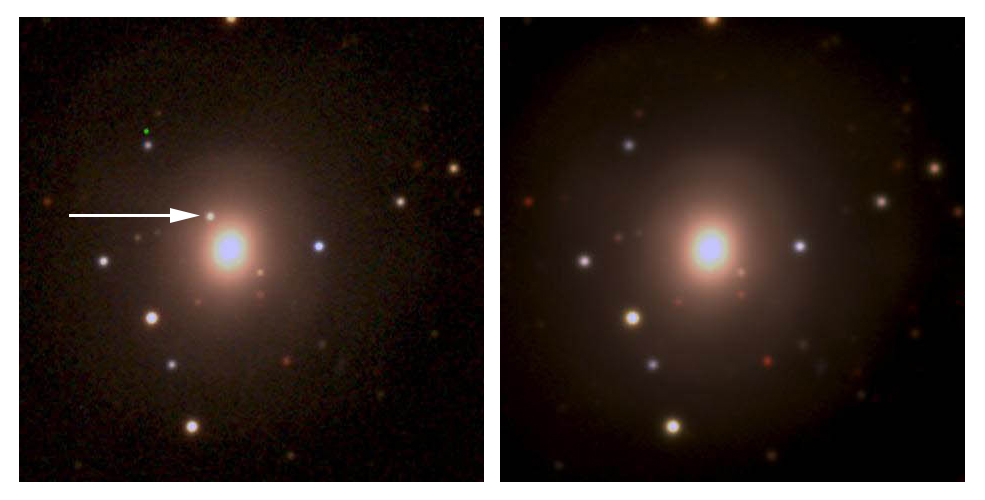
Composite of detection images, including the discovery z image taken on August 18th and the g and r images taken 1 day later. Right: The same area two weeks later. Credit: Soares-Santos et al. and DES Collaboration.

“Because of its large field of view, the Dark Energy Camera was able to search almost the entire region where LIGO/VIRGO expected the gravitational wave source to be, and its exquisite sensitivity allowed us to make detailed measurements of the kilonova – the extremely energetic outburst created by the merging neutron stars,” AAO Instrument Scientist and DES Collaboration member Dr Kyler Kuehn stated.

A kilonova is similar to a supernova in some aspects, but it is different in others. It occurs when two neutron stars crash into each other. These events are thought to be the mechanism by which many of the elements heavier than iron, such as gold, are formed.

“But as impressive as it is, the Dark Energy Camera is only one of many instruments with a front row seat to this celestial spectacle. A lot of effort has gone into preparing dozens of telescopes around the world to search for electromagnetic counterparts to gravitational waves”, Dr Kuehn added.

Simultaneously to the DES study, a large group of Australian astronomers obtained follow up observations of the kilonova AT2017gfo at optical, infrared and radio wavelengths, using 14 Australian telescopes as part of the ARC Centre of Excellence for Gravitational Wave Discovery (OzGrav) and other Australian programs.

Their data are consistent with the expected outburst and subsequent merger of two neutron stars, in agreement with the results derived for GW170817 by the LIGO/Virgo collaboration.

“Before this event, it was like we were sitting in an IMAX theatre with blindfolds on. The gravitational wave detectors let us ‘hear’ the movies of black hole collisions, but we couldn’t see anything. This event lifted the blindfolds and, wow, what an amazing show!!”, A/Professor Jeff Cooke, astronomer at Swinburne University who led many of the observations said.

The Australia team also conducted observations at the 3.9m Anglo-Australian Telescope (AAT), that is managed by the Australian Astronomical Observatory (AAO). Additional archive data from the 6dF survey obtained at the AAO’s 1.2m UK Schmidt Telescope were also used.

“The observations undertaken at the AAT place important constraints on the nature of the environment in which the kilonova occurred”, AAO astronomer Dr Chris Lidman said.

The follow up observations were not scheduled, but the excitement that this event generated in the astronomical community was so large that regular programs were placed on hold.

“Many astronomers dropped any other planned observation and used all the available resources to study this rare event”, said PhD candidate Igor Andreoni (Swinburne University and Australian Astronomical Observatory), first author of the scientific paper that will be published in the science journal “Publications of the Astronomical Society of Australia” (PASA).

The study also reveals that the host galaxy has not experienced significant star-formation during the last billion years. However, there is some evidence that indicates that NGC 4993 experienced a collision with a smaller galaxy not long time ago.

The position of the kilonova AT2017gfo, found in the external parts of NGC 4993, may suggest that the binary neutron star could have been part of the smaller galaxy.

Australian astronomers were thrilled to contribute to both the detection and the ongoing observations of the kilonova AT2017gfo, the electromagnetic counterpart to the gravitational wave event GW170817.

“We have been waiting and preparing for an event like this, but didn’t think it would happen so soon and in a galaxy that is so near to us. Once we were alerted of the gravitational wave detection, we immediately contacted a dozen telescopes and joined the worldwide effort to study this historic event. It didn’t let us down!”, A/Professor Jeff Cooke said.

“It was crucial to have telescopes placed in every continent, including Australia, to keep this rare event continuously monitored”, PhD candidate Igor Andreoni said.

“To me, this gravitational + electromagnetic wave combined detection is even more important than the initial detection that resulted in the Nobel Prize. This has changed the way the entire astronomical community operates”, AAO Instrument Scientist Dr Kyler Kuehn stated.

The first identification of the electromagnetic counterpart to a gravitational wave event is a milestone in the history of modern Astronomy, and opens a new era of multi-messenger astronomy.

More information:

AAO Media Release

AAO Media Release in Spanish / Nota de prensa del AAO en español

LIGO Media Release

DES Media Release

OzGrav Media Release

ESO Media Release

NASA Media Release

Article in The Conversation: “After the alert: radio ‘eyes’ hunt the source of the gravitational waves”, by Tara Murphy and David Kaplan

Article in The Conversation: “At last, we’ve found gravitational waves from a collapsing pair of neutron stars”, by David Blair

Multimedia, videos and animations:

Although there are many videos around there talking about this huge announcement, I particularly like this one by Derek Muller (Veritasium):
Image

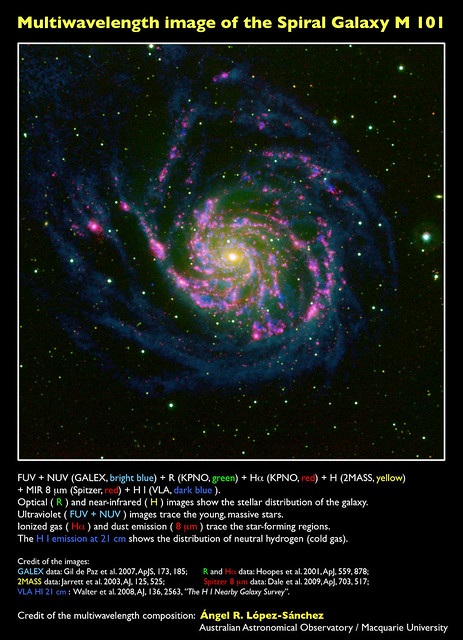
Multiwavelength image of the spiral galaxy M 101

Multiwavelength image of nearby spiral galaxy M 101 combining ultraviolet (light blue), optical (green), near infrared (yellow), H-alpha and 8 microns mid-infrared (red) and 21 cm HI emission (dark blue). Each colour prepresents an important component of the galaxy: massive stars (light blue), stars (green and yellow), star-forming gas and dust (red) and neutral hydrogen (dark blue)

Compare with the Astronomical Picture of the Day on 13 July 2012 apod.nasa.gov/apod/ap120713.html

Data credit: UV data (GALEX): Gil de Paz et al. 2007, ApJS, 173, 185; R and Hα data (KPNO): Hoopes et al. 2001, ApJ, 559, 878; Near-Infrared data (2MASS): Jarrett et al. 2003, AJ, 125, 525, 8 microns data (Spitzer): Dale et al. 2009, ApJ, 703, 517; 21cm HI data (VLA): Walter et al. 2008, AJ, 136, 2563, ”The H I Nearby Galaxy Survey”.

Credit of the composition: Ángel R. López-Sánchez (AAO/MQ).

More sizes and high resolution image in My Flickr.

Video of the “Story of Light” in Vivid Sydney 2016

Following the success of our sold-out Event “The Story of Light – The Astronomer’s Perspective” for ViVID Sydney Ideas 2015, the Australian Astronomical Observatory (AAO) continued its collaboration with ViVID Sydney 2016 organizing “The Story of Light – Deciphering the data encoded on the cosmic light”. But actually it was me who was in charge of the organization.

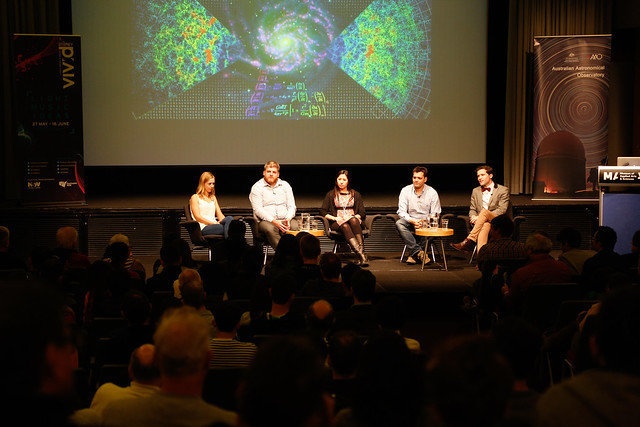
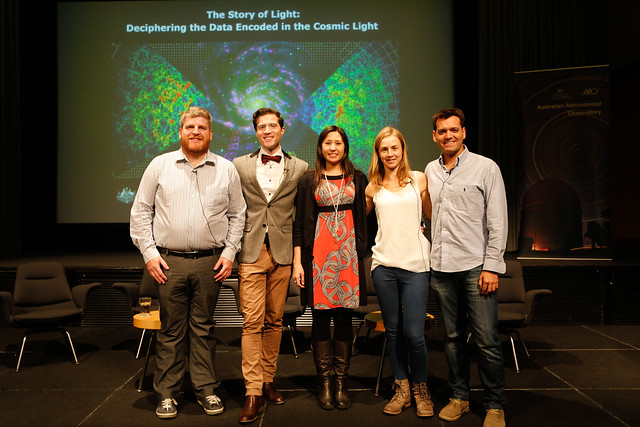
The five astronomers speaking during our “Sydney Vivid Ideas: The Story of Light” started at the Powerhouse Museum, Sydney, 29th May 2016. From left to right: Luke Barnes, Alan Duffy, Vanessa Moss, Liz Mannering and Ángel López-Sánchez. Photo credit: Jenny Ghabache (AAO).

The event was held at the PowerHouse Museum in Sydney on Sunday 29th May 2016. More than 160 people attended this special event. Five young astronomers (me included) talked about Astronomy and Big Data: the light and light-based technologies developed in Australian astronomy for both optical and radio telescopes; the tools, platforms, and techniques used for data analysis and visualization; how astronomers create simulation data; how some of these techniques are being used in other research areas; and the major scientific contributions toward our understanding of the Universe. Indeed, astronomers have been pioneers in developing “Data Science” techniques to make sense of this huge data deluge, many of which are now used in other areas.

We recorded all the event in video, and it is now publicly available  in the AAO YouTube channel. Some photos of the event are also compiled below. I want to thank AAO/ITSO Research Astronomer Caroline Foster for helping recording and editing the video and Jenny Ghabache (AAO) for taking the photos of the event.

Full recording of the event “The Story of Light 2016: Deciphering the data encoded on the cosmic light” organised by the AAO for Vivid Sydney Ideas 2016. Credit: AAO. Acknowledgment: Caroline Foster (AAO).

The event was hosted by Alan Duffy (Swinburne University). I was in charge of explaining optical astronomy, the AAO, optical surveys and big data. Then my colleagues  Vanessa Moss (Univ of Sydney/CAASTRO), Luke Barnes (Univ. of Sydney) and Liz Mannering (AAO/ICRAR) discussed radio astronomy, the ASKAP and big data (Vanessa), simulating, analysing and visualizing astronomy data (Luke) and astronomy data archive, the All-Sky Virtual Observatory (ASVO) and other virtual observatories (Liz ). After the short 12-15 minutes talks (well, as usual I took a bit more time), the panel welcomed questions from the audience (and even from Twitter using #SoLSydneyIdeas) for a discussion session about Light and Astronomy and the Australian contribution to the improvement of our understanding of the Universe.

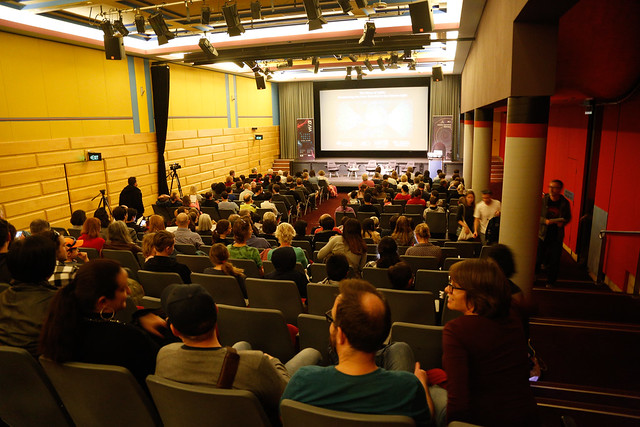
The Lecture Theatre a few minutes before our “Sydney Vivid Ideas: The Story of Light” started at the Powerhouse Museum, Sydney, 29th May 2016. Photo credit: Jenny Ghabache (AAO).

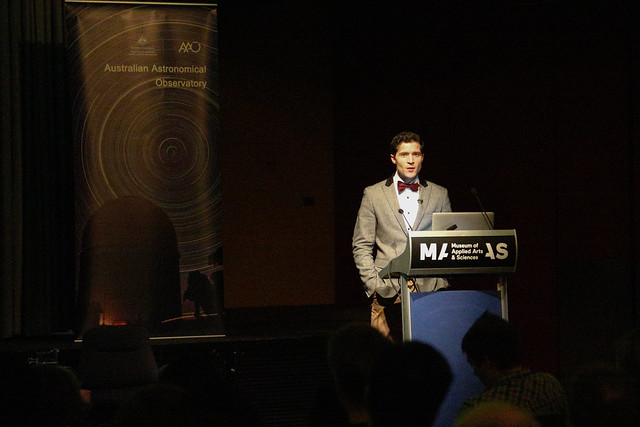
Our host, Alan Duffy, introducing the event. Photo credit: Jenny Ghabache (AAO).

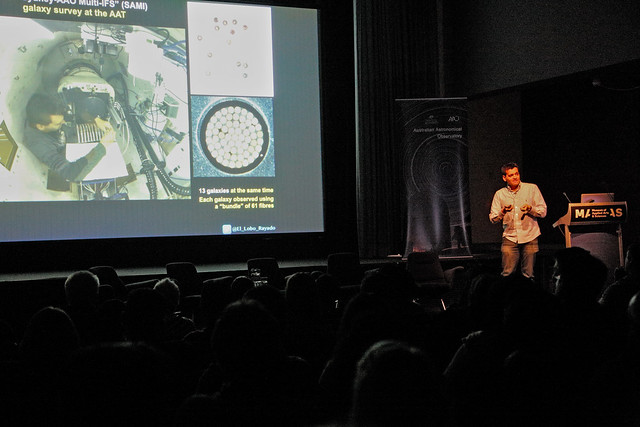
AAO/MQU Research Astronomer Ángel R. López-Sánchez talking about optical astronomy, the AAO and big data. Photo credit: Jenny Ghabache (AAO).

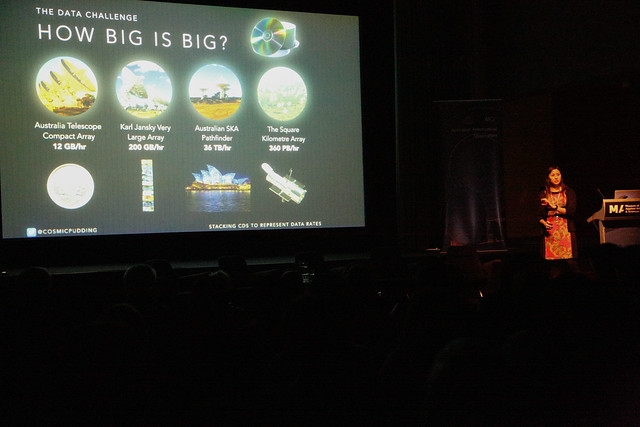
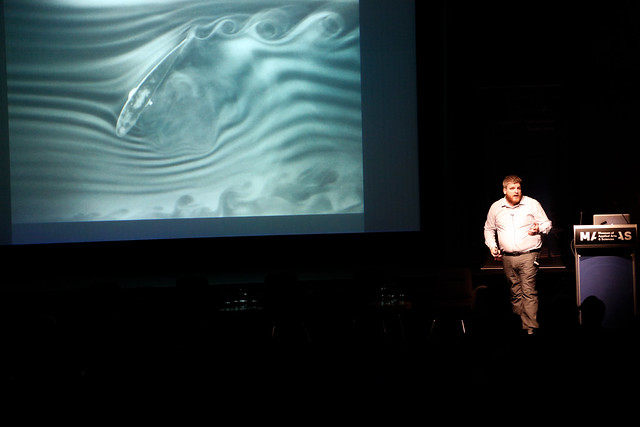
Vanessa Moss (Univ. of Sydney/CAASTRO) talking about radioastronomy, the ASKAP and big data. Photo credit: Jenny Ghabache (AAO).

Luke Barnes (Univ. of Sydney) talking about simulating, analysing and visualizing astronomy data. Photo credit: Jenny Ghabache (AAO).

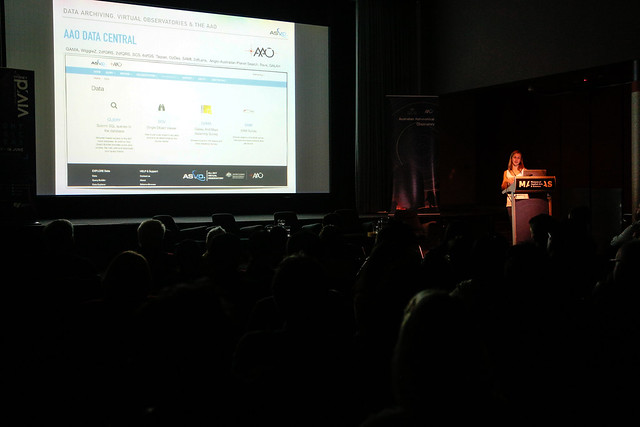
Liz Mannering (Univ. of Sydney) discussed astronomy data archive, the All-Sky Virtual Observatory (ASVO) and other virtual observatories. Photo credit: Jenny Ghabache (AAO).

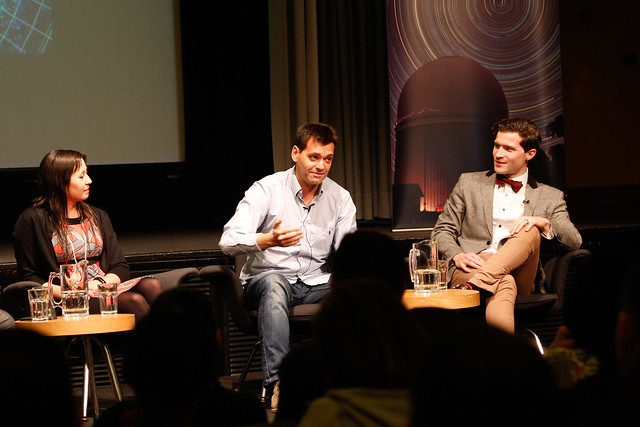
Panel discussion with all participants answering questions from the audience. Photo credit: Jenny Ghabache (AAO).

Angel Lopez-Sanchez answering a question from the audience. Photo credit: Jenny Ghabache (AAO).

And last… Well, if you want to see only my talk, here it is:

Citizen scientists discover huge galaxy cluster

One of the scientific projects I’m involved actually is a citizen science program: Radio Galaxy Zoo. Using images from NASA’s Wide-Field Infrared Survey Explorer telescope (WISE) and the NRAO Very Large Array (VLA) in New Mexico, USA,  Radio Galaxy Zoo requests participants to associate radio emission (which is related to the relativistic electrons ejected from a massive black hole) with galaxies as seen in infrared light. The aim is to get a better understanding of the super-massive black holes that are located in the center of the galaxies and quantify their importance in galaxy evolution.

My colleagues Julie Banfield (Australian National University) and Ivy Wong  (ICRAR and University of Western Australia) lead the Radio Galaxy Zoo (RGZ) team, that was launched on December 2013. Since then, more than 10,000 volunteers have joined in with Radio Galaxy Zoo, classifying over 1.6 million images.

The wide-angle tail galaxy discovered by Terentev and Matorny is one of the largest known, and its host cluster is now known as the Matorny-Terentev cluster. Credit: Radio Galaxy Zoo.

The wide-angle tail galaxy discovered by Terentev and Matorny is one of the largest known, and its host cluster is now known as the Matorny-Terentev cluster. Credit: Radio Galaxy Zoo.

Well, the news is that two RGZ volunteer participants from Russia, Ivan Terentev and Tim Matorny, have discovered a rare galaxy cluster. They found that one particular radio-source had just one of a line of radio blobs that delineate a C-shaped “wide angle tail galaxy” (WAT). The C-shaped was formed because the massive galaxy hosting the super-massive black hole and its associated jets are moving through intergalactic gas, indicating the existence of a cluster of galaxies. The new wide-angle tail galaxy is one of the largest known, and its host cluster is now known as the Matorny-Terentev cluster.

The details of this discovery has been published this week in the prestigious scientific journal MNRAS, the paper “Radio Galaxy Zoo: discovery of a poor cluster through a giant wide-angle tail radio galaxy” was lead by Julie Banfield (ANU).

There is plenty of information in the Radio Galaxy Zoo webpage, the  CAASTRO Press Release and in this nice Article in “The Conversation” by Ray Norris (CSIRO/Western Sydney University and PI of the EMU project to be conducted in the ASKAP), so I’ll just add here the nice interview to Ivy Wong  (ICRAR and University of Western Australia) in Ten News Australia yesterday.

More information:

Gas, star-formation and chemical enrichment in the spiral galaxy NGC 1512

How do galaxies grow and evolve? Galaxies are made of gas and stars, which interact in very complex ways: gas form stars, stars die and release chemical elements into the galaxy, some stars and gas can be lost from the galaxy, some gas and stars can be accreted from the intergalactic medium. The current accepted theory is that galaxies build their stellar component using their available gas while they increase their amount of chemical elements in the process. But how do they do this?

That is part of my current astrophysical research: how gas is processed inside galaxies? What is the chemical composition of the gas? How does star-formation happen in galaxies? How galaxies evolve? Today, 21st May 2015, the prestigious journal “Monthly Notices of the Royal Astronomical Society”, publishes my most recent scientific paper, that tries to provide some answers to these questions. This study has been performed with my friends and colleagues Tobias Westmeier (ICRAR), Baerbel Koribalski (CSIRO), and César Esteban (IAC, Spain). We present new, unique observations using the 2dF instrument at the 3.9m Anglo-Australian Telescope (AAT), in combination with radio data obtained with the Australian Telescope Compact Array (ATCA) radio-interferometer, to study how the gas in processed into stars and how much chemical enrichment has this gas experienced in a nearby galaxy, NGC 1512.

Deep images of the galaxy pair NGC 1512 and NGC 1510 using optical light (left) and ultraviolet light (right).Credit: Optical image: David Malin (AAO) using photographic plates obtained in 1975 using de 1.2m UK Schmidt Telescope (Siding Spring Observatory, Australia). UV image: GALEX satellite (NASA), image combining data in far-ultraviolet (blue) and near-ultraviolet (red) filters.

NGC 1512 and NGC 1510 is an interacting galaxy pair composed by a spiral galaxy (NGC 1512) and a Blue Compact Dwarf Galaxy (NGC 1510) located at 9.5 Mpc (=31 million light years). The system possesses hundreds of star-forming regions in the outer areas, as it was revealed using ultraviolet (UV) data provided by the GALEX satellite (NASA). Indeed, the UV-bright regions in the outskirts of NGC 1512 build an “eXtended UV disc” (XUV-disc), a feature that has been observed around the 15% of the nearby spiral galaxies. However these regions were firstly detected by famous astronomer David Malin (AAO) in 1975 (that is before I was born!) using photographic plates obtained with the 1.2m UK Schmidt Telescope (AAO), at Siding Spring Observatory (NSW, Australia).

The system has a lot of diffuse gas, as revealed by radio observations in the 21 cm HI line conducted at the Australian Telescope Compact Array (ATCA) as part of the “Local Volume HI Survey” (LVHIS) and presented by Koribalski & López-Sánchez (2009). The gas follows two long spiral structures up to more than 250 000 light years from the centre of NGC 1512. That is ~2.5 times the size of the Milky Way, but NGC 1512 is ~3 times smaller than our Galaxy! One of these structures has been somehow disrupted recently because of the interaction between NGC 1512 and NGC 1510, that it is estimated started around 400 million years ago.

Multiwavelength image of the NGC 1512 and NGC 1510 system combining optical and near-infrared data (light blue, yellow, orange), ultraviolet data from GALEX (dark blue), mid-infrared data from the Spitzer satellite (red) and radio data from the ATCA (green). The blue compact dwarf galaxy NGC 1510 is the bright point-like object located at the bottom right of the spiral galaxy NGC 1512.
Credit: Ángel R. López-Sánchez (AAO/MQ) & Baerbel Koribalski (CSIRO).

Our study presents new, deep spectroscopical observations of 136 genuine UV-bright knots in the NGC 1512/1510 system using the powerful multi-fibre instrument 2dF and the spectrograph AAOmega, installed at the 3.9m Anglo-Australian Telescope (AAT).

2dF/AAOmega is generally used by astronomers to observe simultaneously hundreds of individual stars in the Milky Way or hundreds of galaxies. Without considering observations in the Magellanic Clouds, it is the first time that 2dF/AAOmega is used to trace individual star-forming regions within the same galaxy, in some way forming a huge “Integral-Field Unit” (IFU) to observe all the important parts of the galaxy.

Two examples of the high-quality spectra obtained using the AAT. Top: spectrum of the BCDG NGC 1510. Bottom: spectrum of one of the brightest UV-bright regions in the system. The important emission lines are labelled.
Credit: Ángel R. López-Sánchez (AAO/MQ), Tobias Westmeier (ICRAR), César Esteban (IAC) & Baerbel Koribalski (CSIRO).


The AAT observations confirm that the majority of the UV-bright regions are star-forming regions. Some of the bright knots (those which are usually not coincident with the neutral gas) are actually background galaxies (i.e., objects much further than NGC 1512 and not physically related to it) showing strong star-formation activity. Observations also revealed a knot to be a very blue young star within our Galaxy.

Using the peak of the H-alpha emission, the AAT data allow to trace how the gas is moving in each of the observed UV-rich region (their “kinematics”), and compare with the movement of the diffuse gas as provided using the ATCA data. The two kinematics maps provide basically the same results, except for one region (black circle) that shows a very different behaviour. This object might be an independent, dwarf, low-luminosity galaxy (as seen from the H-alpha emission) that is in process of accretion into NGC 1512.

Map showing the velocity field of the galaxy pair NGC 1512 / NGC 1510 as determined using the H-alpha emission provided by the AAT data. This kinematic map is almost identical to that obtained from the neutras gas (HI) data using the ATCA, except for a particular region (noted by a black circle) that shows very different kinematics when comparing the maps.
Credit: Ángel R. López-Sánchez (AAO/MQ), Tobias Westmeier (ICRAR), César Esteban (IAC) & Baerbel Koribalski (CSIRO).

The H-alpha map shows how the gas is moving following the optical emission lines up to 250 000 light years from the centre of NGC 1512, that is 6.6 times the optical size of the galaxy. No other IFU map has been obtained before with such characteristics.

Using the emission lines detected in the optical spectra, which includes H I, [O II], [O III], [N II], [S II] lines (lines of hydrogen, oxygen, nitrogen and sulphur), we are able to trace the chemical composition -the “metallicity”, as in Astronomy all elements which are not hydrogen or helium as defined as “metals”- of the gas within this UV-bright regions. Only hydrogen and helium were created in the Big Bang. All the other elements have been formed inside the stars as a consequence of nuclear reactions or by the actions of the stars (e.g., supernovae). The new elements created by the stars are released into the interstellar medium of the galaxies when they die, and mix with the diffuse gas to form new stars, that now will have a richer chemical composition than the previous generation of stars. Hence, tracing the amount of metals (usually oxygen) within galaxies indicate how much the gas has been re-processed into stars.


Metallicity map of the NGC 1512 and NGC 1510 system, as given by the amount of oxygen in the star-forming regions (oxygen abundance, O/H). The colours indicate how much oxygen (blue: few, green: intermediate, red: many) each region has. Red diamonds indicate the central, metal rich regions of NGC 1512. Circles trace a long, undisturbed, metal-poor arm. Triangles and squares follow the other spiral arms, which is been broken and disturbed as a consequence of the interaction between NGC 1512 and NGC 1510 (blue star). The blue pentagon within the box in the bottom right corner represents the farthest region of the system, located at 250 000 light years from the centre.
Credit: Ángel R. López-Sánchez (AAO/MQ), Tobias Westmeier (ICRAR), César Esteban (IAC) & Baerbel Koribalski (CSIRO).


The “chemical composition map” or “metallicity map” of the system reveals that indeed the centre of NGC 1512 has a lot of metals (red diamonds in the figure), in a proportion similar to those found around the centre of our Milky Way galaxy. However the external areas show two different behaviours: regions located along one spiral arm (left in the map) have low amount of metals (blue circles), while regions located in other spiral arm (right) have a chemical composition which is intermediate between those found in the centre and in the other arm (green squares and green triangles). Furthermore, all regions along the extended “blue arm” show very similar metallicities, while the “green arm” also has some regions with low (blue) and high (orange and red) metallicities. The reason of this behaviour is that the gas along the “green arm” has been very recently enriched by star-formation activity, which was triggered by the interaction with the Blue Compact Dwarf galaxy NGC 1510 (blue star in the map).

When combining the available ultraviolet and radio data with the new AAT optical data it is possible to estimate the amount of chemical enrichment that the system has experienced. This analysis allows to conclude that the diffuse gas located in the external regions of NGC 1512 was already chemically rich before the interaction with NGC 1510 started about 400 million years ago. That is, the diffuse gas that NGC 1512 possesses in its outer regions is not pristine (formed in the Big Bang) but it has been already processed by previous generations of stars. The data suggest that the metals within the diffuse gas are not coming from the inner regions of the galaxy but very probably they have been accreted during the life of the galaxy either by absorbing low-mass, gas-rich galaxies or by accreting diffuse intergalactic gas that was previously enriched by metals lost by other galaxies.

In any case this result constrains our models of galaxy evolution. When used together, the analysis of the diffuse gas (as seen using radio telescopes) and the study of the metal distribution within galaxies (as given by optical telescopes) provide a very powerful tool to disentangle the nature and evolution of the galaxies we now observe in the Local Universe.

More information

Scientific Paper in MNRAS: “Ionized gas in the XUV disc of the NGC 1512/1510 system”. Á. R. López-Sánchez, T. Westmeier, C. Esteban, and B. S. Koribalski.“Ionized gas in the XUV disc of the NGC1512/1510 system”, 2015, MNRAS, 450, 3381. Published in Monthly Notices of the Royal Astronomical Society (MNRAS) through Oxford University Press.

AAO/CSIRO/ICRAR Press Release (AAO): Galaxy’s snacking habits revealed

AAO/CSIRO/ICRAR Press Release (ICRAR): Galaxy’s snacking habits revealed

Royal Astronomical Society (RAS) Press Release: Galaxy’s snacking habits revealed

Article in Phys.org: Galaxy’s snacking habits revealed

Article in EurekAlert!: Galaxy’s snacking habits revealed

Article in Press-News.org: Galaxy’s snacking habits revealed

Article in Open Science World: Galaxy’s snacking habits revealed

ATNF Daily Astronomy Picture on 21st May 2015.