Category Archives: My Research

Gas, star-formation and chemical enrichment in the spiral galaxy NGC 1512

How do galaxies grow and evolve? Galaxies are made of gas and stars, which interact in very complex ways: gas form stars, stars die and release chemical elements into the galaxy, some stars and gas can be lost from the galaxy, some gas and stars can be accreted from the intergalactic medium. The current accepted theory is that galaxies build their stellar component using their available gas while they increase their amount of chemical elements in the process. But how do they do this?

That is part of my current astrophysical research: how gas is processed inside galaxies? What is the chemical composition of the gas? How does star-formation happen in galaxies? How galaxies evolve? Today, 21st May 2015, the prestigious journal “Monthly Notices of the Royal Astronomical Society”, publishes my most recent scientific paper, that tries to provide some answers to these questions. This study has been performed with my friends and colleagues Tobias Westmeier (ICRAR), Baerbel Koribalski (CSIRO), and César Esteban (IAC, Spain). We present new, unique observations using the 2dF instrument at the 3.9m Anglo-Australian Telescope (AAT), in combination with radio data obtained with the Australian Telescope Compact Array (ATCA) radio-interferometer, to study how the gas in processed into stars and how much chemical enrichment has this gas experienced in a nearby galaxy, NGC 1512.

Deep images of the galaxy pair NGC 1512 and NGC 1510 using optical light (left) and ultraviolet light (right).Credit: Optical image: David Malin (AAO) using photographic plates obtained in 1975 using de 1.2m UK Schmidt Telescope (Siding Spring Observatory, Australia). UV image: GALEX satellite (NASA), image combining data in far-ultraviolet (blue) and near-ultraviolet (red) filters.

NGC 1512 and NGC 1510 is an interacting galaxy pair composed by a spiral galaxy (NGC 1512) and a Blue Compact Dwarf Galaxy (NGC 1510) located at 9.5 Mpc (=31 million light years). The system possesses hundreds of star-forming regions in the outer areas, as it was revealed using ultraviolet (UV) data provided by the GALEX satellite (NASA). Indeed, the UV-bright regions in the outskirts of NGC 1512 build an “eXtended UV disc” (XUV-disc), a feature that has been observed around the 15% of the nearby spiral galaxies. However these regions were firstly detected by famous astronomer David Malin (AAO) in 1975 (that is before I was born!) using photographic plates obtained with the 1.2m UK Schmidt Telescope (AAO), at Siding Spring Observatory (NSW, Australia).

The system has a lot of diffuse gas, as revealed by radio observations in the 21 cm HI line conducted at the Australian Telescope Compact Array (ATCA) as part of the “Local Volume HI Survey” (LVHIS) and presented by Koribalski & López-Sánchez (2009). The gas follows two long spiral structures up to more than 250 000 light years from the centre of NGC 1512. That is ~2.5 times the size of the Milky Way, but NGC 1512 is ~3 times smaller than our Galaxy! One of these structures has been somehow disrupted recently because of the interaction between NGC 1512 and NGC 1510, that it is estimated started around 400 million years ago.

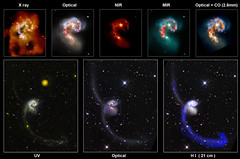
Multiwavelength image of the NGC 1512 and NGC 1510 system combining optical and near-infrared data (light blue, yellow, orange), ultraviolet data from GALEX (dark blue), mid-infrared data from the Spitzer satellite (red) and radio data from the ATCA (green). The blue compact dwarf galaxy NGC 1510 is the bright point-like object located at the bottom right of the spiral galaxy NGC 1512.
Credit: Ángel R. López-Sánchez (AAO/MQ) & Baerbel Koribalski (CSIRO).

Our study presents new, deep spectroscopical observations of 136 genuine UV-bright knots in the NGC 1512/1510 system using the powerful multi-fibre instrument 2dF and the spectrograph AAOmega, installed at the 3.9m Anglo-Australian Telescope (AAT).

2dF/AAOmega is generally used by astronomers to observe simultaneously hundreds of individual stars in the Milky Way or hundreds of galaxies. Without considering observations in the Magellanic Clouds, it is the first time that 2dF/AAOmega is used to trace individual star-forming regions within the same galaxy, in some way forming a huge “Integral-Field Unit” (IFU) to observe all the important parts of the galaxy.

Two examples of the high-quality spectra obtained using the AAT. Top: spectrum of the BCDG NGC 1510. Bottom: spectrum of one of the brightest UV-bright regions in the system. The important emission lines are labelled.
Credit: Ángel R. López-Sánchez (AAO/MQ), Tobias Westmeier (ICRAR), César Esteban (IAC) & Baerbel Koribalski (CSIRO).


The AAT observations confirm that the majority of the UV-bright regions are star-forming regions. Some of the bright knots (those which are usually not coincident with the neutral gas) are actually background galaxies (i.e., objects much further than NGC 1512 and not physically related to it) showing strong star-formation activity. Observations also revealed a knot to be a very blue young star within our Galaxy.

Using the peak of the H-alpha emission, the AAT data allow to trace how the gas is moving in each of the observed UV-rich region (their “kinematics”), and compare with the movement of the diffuse gas as provided using the ATCA data. The two kinematics maps provide basically the same results, except for one region (black circle) that shows a very different behaviour. This object might be an independent, dwarf, low-luminosity galaxy (as seen from the H-alpha emission) that is in process of accretion into NGC 1512.

Map showing the velocity field of the galaxy pair NGC 1512 / NGC 1510 as determined using the H-alpha emission provided by the AAT data. This kinematic map is almost identical to that obtained from the neutras gas (HI) data using the ATCA, except for a particular region (noted by a black circle) that shows very different kinematics when comparing the maps.
Credit: Ángel R. López-Sánchez (AAO/MQ), Tobias Westmeier (ICRAR), César Esteban (IAC) & Baerbel Koribalski (CSIRO).

The H-alpha map shows how the gas is moving following the optical emission lines up to 250 000 light years from the centre of NGC 1512, that is 6.6 times the optical size of the galaxy. No other IFU map has been obtained before with such characteristics.

Using the emission lines detected in the optical spectra, which includes H I, [O II], [O III], [N II], [S II] lines (lines of hydrogen, oxygen, nitrogen and sulphur), we are able to trace the chemical composition -the “metallicity”, as in Astronomy all elements which are not hydrogen or helium as defined as “metals”- of the gas within this UV-bright regions. Only hydrogen and helium were created in the Big Bang. All the other elements have been formed inside the stars as a consequence of nuclear reactions or by the actions of the stars (e.g., supernovae). The new elements created by the stars are released into the interstellar medium of the galaxies when they die, and mix with the diffuse gas to form new stars, that now will have a richer chemical composition than the previous generation of stars. Hence, tracing the amount of metals (usually oxygen) within galaxies indicate how much the gas has been re-processed into stars.


Metallicity map of the NGC 1512 and NGC 1510 system, as given by the amount of oxygen in the star-forming regions (oxygen abundance, O/H). The colours indicate how much oxygen (blue: few, green: intermediate, red: many) each region has. Red diamonds indicate the central, metal rich regions of NGC 1512. Circles trace a long, undisturbed, metal-poor arm. Triangles and squares follow the other spiral arms, which is been broken and disturbed as a consequence of the interaction between NGC 1512 and NGC 1510 (blue star). The blue pentagon within the box in the bottom right corner represents the farthest region of the system, located at 250 000 light years from the centre.
Credit: Ángel R. López-Sánchez (AAO/MQ), Tobias Westmeier (ICRAR), César Esteban (IAC) & Baerbel Koribalski (CSIRO).


The “chemical composition map” or “metallicity map” of the system reveals that indeed the centre of NGC 1512 has a lot of metals (red diamonds in the figure), in a proportion similar to those found around the centre of our Milky Way galaxy. However the external areas show two different behaviours: regions located along one spiral arm (left in the map) have low amount of metals (blue circles), while regions located in other spiral arm (right) have a chemical composition which is intermediate between those found in the centre and in the other arm (green squares and green triangles). Furthermore, all regions along the extended “blue arm” show very similar metallicities, while the “green arm” also has some regions with low (blue) and high (orange and red) metallicities. The reason of this behaviour is that the gas along the “green arm” has been very recently enriched by star-formation activity, which was triggered by the interaction with the Blue Compact Dwarf galaxy NGC 1510 (blue star in the map).

When combining the available ultraviolet and radio data with the new AAT optical data it is possible to estimate the amount of chemical enrichment that the system has experienced. This analysis allows to conclude that the diffuse gas located in the external regions of NGC 1512 was already chemically rich before the interaction with NGC 1510 started about 400 million years ago. That is, the diffuse gas that NGC 1512 possesses in its outer regions is not pristine (formed in the Big Bang) but it has been already processed by previous generations of stars. The data suggest that the metals within the diffuse gas are not coming from the inner regions of the galaxy but very probably they have been accreted during the life of the galaxy either by absorbing low-mass, gas-rich galaxies or by accreting diffuse intergalactic gas that was previously enriched by metals lost by other galaxies.

In any case this result constrains our models of galaxy evolution. When used together, the analysis of the diffuse gas (as seen using radio telescopes) and the study of the metal distribution within galaxies (as given by optical telescopes) provide a very powerful tool to disentangle the nature and evolution of the galaxies we now observe in the Local Universe.

More information

Scientific Paper in MNRAS: “Ionized gas in the XUV disc of the NGC 1512/1510 system”. Á. R. López-Sánchez, T. Westmeier, C. Esteban, and B. S. Koribalski.“Ionized gas in the XUV disc of the NGC1512/1510 system”, 2015, MNRAS, 450, 3381. Published in Monthly Notices of the Royal Astronomical Society (MNRAS) through Oxford University Press.

AAO/CSIRO/ICRAR Press Release (AAO): Galaxy’s snacking habits revealed

AAO/CSIRO/ICRAR Press Release (ICRAR): Galaxy’s snacking habits revealed

Royal Astronomical Society (RAS) Press Release: Galaxy’s snacking habits revealed

Article in Phys.org: Galaxy’s snacking habits revealed

Article in EurekAlert!: Galaxy’s snacking habits revealed

Article in Press-News.org: Galaxy’s snacking habits revealed

Article in Open Science World: Galaxy’s snacking habits revealed

ATNF Daily Astronomy Picture on 21st May 2015.

Dissecting galaxies of the Local Universe with the CALIFA survey

DP ENGLISH: This story belongs to the series “Double Post” which indicates posts that have been written both in English in The Lined Wolf and in Spanish in El Lobo Rayado.

DP ESPAÑOL: Esta historia entra en la categoría “Doble Post” donde indico artículos que han sido escritos tanto en español en El Lobo Rayado como en inglés en The Lined Wolf.

The Calar Alto Legacy Integral Field spectroscopy Area (CALIFA) survey is a project that aims to obtain data of around 600 nearby galaxies using the PMAS (Potsdam Multi Aperture Spectrophotometer) instrument of the 3.5m Telescope at the Calar Alto Observatory (Almería, Spain). The CALIFA survey combines the advantages of two observational techniques: imaging (that provides detailed information on galactic structure) and spectroscopy (that reveals the physical properties of galaxies, such as their kinematics, mass, chemical composition or age). The CALIFA survey makes use of the Integral Field Spectroscopy (IFS) technique, that allows obtaining at the same time around a thousand of spectra per galaxy, hence getting simultaneously imaging and spectra of astronomical objects.

A galaxy is “dissected” in thousands small regions, each one having its particular spectrum (wavelength) when using Integral Field Spectroscopy (IFS) techniques. The result is getting a datacube: two axes (x and y) possess the spatial information (the image of the galaxy, which can also be separated in several colours) and the third axis (wavelength) keep the spectroscopic information. Credit: Marc White (RSAA-ANU).

The CALIFA Project allows not only to inspect the galaxies in detail, but it also provides with data on the evolution of each particular galaxy with time: how much gas and when was it converted into stars along each phase of the galaxy’s life, and how did each region of the galaxies evolve along the more than ten thousand million years of cosmic evolution

Thanks to these data, astronomers of the CALIFA team have been able to deduce the history of the mass, luminosity and chemical evolution of the CALIFA sample of galaxies, and thus they have found that more massive galaxies grow faster than less massive ones, and that they form their central regions before the external ones (inside-out mass assembly). CALIFA has also shed light on how chemical elements needed for file are produced within the galaxies or on the physical processes involved on galactic collisions, and it has even observed the last generation of stars still in their birth cocoon.

CALIFA “panoramic view” (also CALIFA’s “Mandala”) representation, consisting of the basic physical properties (all of them derived from the CALIFA datacubes) of a subsample of 169 galaxies extracted randomly from the 2nd Data Release. It shows 1) broad band images (top center), 2) stellar mass surface densities (upper right), 3) ages (lower right), 4) narrow band images (bottom center; emission lines: Hα [N II] 6584 Å, and [O III] 5007 Å), 5) Hα emission (lower left) and 6) Hα kinematics (upper left). The CALIFA logo is placed at the central hexagon. Credit: R. García-Benito, F. Rosales-Ortega, E. Pérez, C.J. Walcher, S. F. Sánchez & the CALIFA team.

Today, Oct 1st, the CALIFA Team (and I’m part of it) has released 400 IFS datacubes for 200 nearby galaxies, the 2nd Data Release (DR2). The data are publically available and can now be used by astronomers around the world. The second CALIFA Data Release provides the fully reduced and quality control tested datacubes of 200 objects in two different spectral configurations. Each datacube contains ~1000 independent spectra, thus in total the CALIFA DR2 comprises ~400,000 independent spectra (~1.5 millon after cube reconstruction). The scientific details of the data included in the CALIFA DR2 are described in this scientific paper lead by the Spanish astronomer Rubén García-Benito.

More information about the CALIFA survey and its DR2:

– Calar Alto Observatory Press Release: http://www.caha.es/an-unprecedented-view-of-two-hundred-galaxies-of-the-local-universe.html

– Scientific paper about CALIFA DR2: García-Benito et al. (2014): http://arxiv.org/abs/1409.8302

– CALIFA webpage: http://www.caha.es/CALIFA/public_html

– CALIFA DR2 webpage: http://califa.caha.es/DR2

SN2014J in M82 observed at the William Herschel Telescope

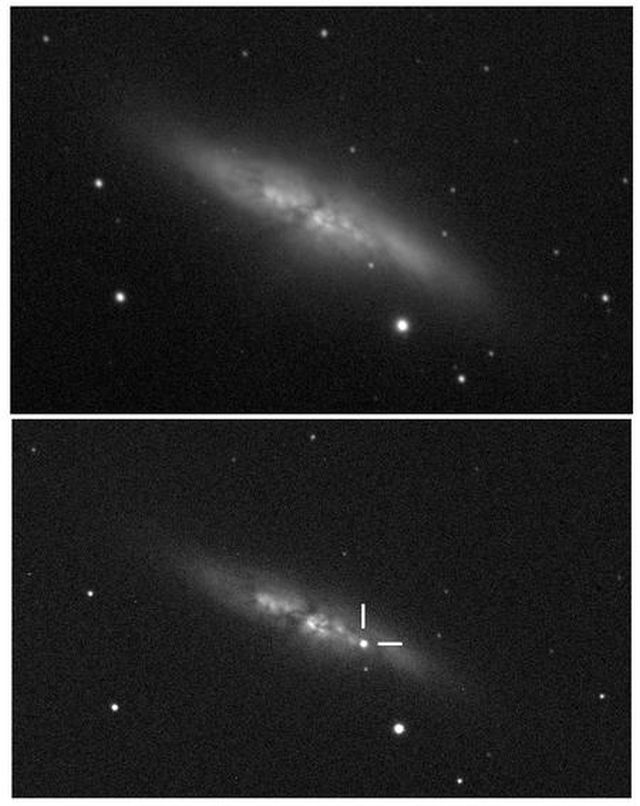
A week ago, on January 21st, the English astrophysicist Steve Fossey gave a telescope workshop for a group of undergraduate students (Ben Cooke, Tom Wright, Matthew Wilde and Guy Pollack) belonging to the University College of London (UCL). As usually happens in the British capital, the sky was practically covered by clouds. However, Fossey and his students used the automatic 35 cm telescope of the University of London Observatory to spot the famous starburst galaxy M 82. Located at 12 million light-years away in the constellation of Ursa Major (The Big Dipper), the galaxy M 82 hosts an intense star-formation burst, being its light dominated by young, hot, massive, blue stars. As consequence of this frenetic activity, M 82 possesses long jets of hot gas that has been expelled from the center of the galaxy. Therefore, it is not casual that the students chose this galaxy as a target for their assignment. While Fossey was centering the galaxy in the field of the telescope he realized that there was a bright star which should not be there. They checked that this new star was real using another telescope of the Observatory. As clouds were approaching, they quickly took some few images in different filters. The first analysis was doubtless: they had just discovered a supernova in the galaxy M 82.

Discovery image of type Ia SN2014J in the starburst galaxy M82 (below) compared with an older image of the galaxy before the supernova exploded (top). The discovery image was obtained at 19:20 UT, 21st January 2014 using the automatic 35 cm telescope of the University of London Observatory. Credit: UCL/University of London Observatory/Steve Fossey/Ben Cooke/Guy Pollack/Matthew Wilde/Thomas Wright.

In just one day, amateur astronomers and professional astrophysicists used their telescopes to study M 82. These observations soon confirmed the discovery made by Fossey and his students. Actually, some astronomers even found that they had taken data of the galaxy and the supernova a week before the official discovery, but the new exploding stars was unnoticed by them. A couple of days after the discovery, a group of astrophysicists led by Yi Cao (Caltech) got the first optical spectrum of the supernova using the 3.5m ARC Telescope at Apache Point Observatory (New Mexico, USA). The analysis of this spectrum showed that the progenitor of the supernova was a white dwarf, and hence the explosion was classified as a type Ia supernova. The official name of this exploding star is SN 2014J. It has not reached its maximum brightness yet: when Fossey and his students discovered the supernova, it was 2 weeks before when we expect this happens. Right now it is so bright (around 10th magnitude) it is very easy to spot using a small amateur telescope. Perhaps even it can be seen using binoculars when the supernova reaches its maximum brightness in a week or so!

Hence, it is not difficult to understand that SN 2014J and M 82 have been the main astronomical news in the last week. Using the 4.2m William Herschel Telescope (WHT), which is part of the Isaac Newton Group, located at the Roque de los Muchachos Observatory in the beautiful island of La Palma (Canary Islands, Spain), the astrophysicists Manuel Moreno-Raya (CIEMAT, Spain) and Lluís Galbany (DAS/UC, Chile) have observed with great detail both the supernova and the galaxy. Between Thursday 23rd and Sunday 26th January they used the ISIS spectrograph, as well as the ACAM instrument (Auxiliary-Port Camera), of the WHT to get images and spectra of the supernova. I was continuously in touch with them as I’m part of their research team (actually, I’m co-supervising the PhD thesis which is conducted by Manu). I originally planned to travel to La Palma to be helping on these observations, however this was colliding with my support activities at the Anglo-Australian Telescope (Siding Spring Observatory, NSW, Australia). Manu and Lluís sent me the data as they were coming from the WHT, and I was reducing, combining, and getting the preliminary images and spectra of this object!

The image below shows the supernova SN 2014J and the galaxy M 82 using the data obtained with ACAM. I tried to get all the important details of this puzzling object: the dust lanes crossing the disc (dark-yellow), the strong star-formating bursts (blue) and even the filamentary structure of the super-galactic wind that M 82 possesses (in red). This feature is hot, ionized gas which has been expelled from the center of the galaxy and here it is seems perpendicular to the galactic disc. SN 2014J very brightly shines at the west (right) of M 82 galactic center.


Colour image of starburst galaxy M 82 with the type Ia supernova SN 2014J. M 82 lies at 12 million light years from us, in the Ursa Major constellation. The supernova is marked with two white lines. The data needed to get this image were taken using the ACAM instrument located at the Cassegrain focus of the 4.2m William Herschel Telescope (WHT) (Roque de los Muchachos Observatory, La Palma, Canary Islands, Spain). We got data in u, g, i, r, and Hα filters. Data coming from the u filter (2 x 200 seconds exposures) are colour-coded in blue; data in the g filter (3 x 100 seconds exposures) are colour-coded in cyan; data in the i filter (3 x 100 seconds exposures) are colour-coded in green; data in r filter (3 x 300 seconds exposures) are colour-coded in red. The majority of the data were obtained last 24th January, at 04:40 UT. Data in r and u filter were taken on 25th January, at around 06:00 UT. The Hα data (4 x 300 seconds exposures), which are colour-coded in red, were taken on 26th January at 06:30 UT. Data coming from the Hα filter clearly reveals the super-galactic wind of M 82. All data were reduced and combined using standard IRAF routines. The colour composition was obtained using Photoshop. The field of view is 8 arcminutes and the resolution 0.25 arcsec/pixels. However, the seeing was not too good, between 2 and 5 arcsec.
Credit: Observers: Manuel E. Moreno-Raya (CIEMAT, Spain) & Lluís Galbany (DAS / UC, Chile). Data processing and color image composition: Ángel R. López-Sánchez (AAO / MQ, Australia). Support astronomer: Chris Benn (ING, UK), Telescope Operator: José Norberto González (ING, UK). Research Team: Manuel E. Moreno-Raya (CIEMAT, Spain), Mercedes Mollá (CIEMAT, Spain), Ángel R. López-Sánchez (AAO / MQ, Australia), Lluís Galbany (DAS / UC, Chile),Aurelio Carnero (ON, Brazil), Inma Domínguez (UGR, Spain), & Pepe Vílchez (CSIC / IAA, Spain).

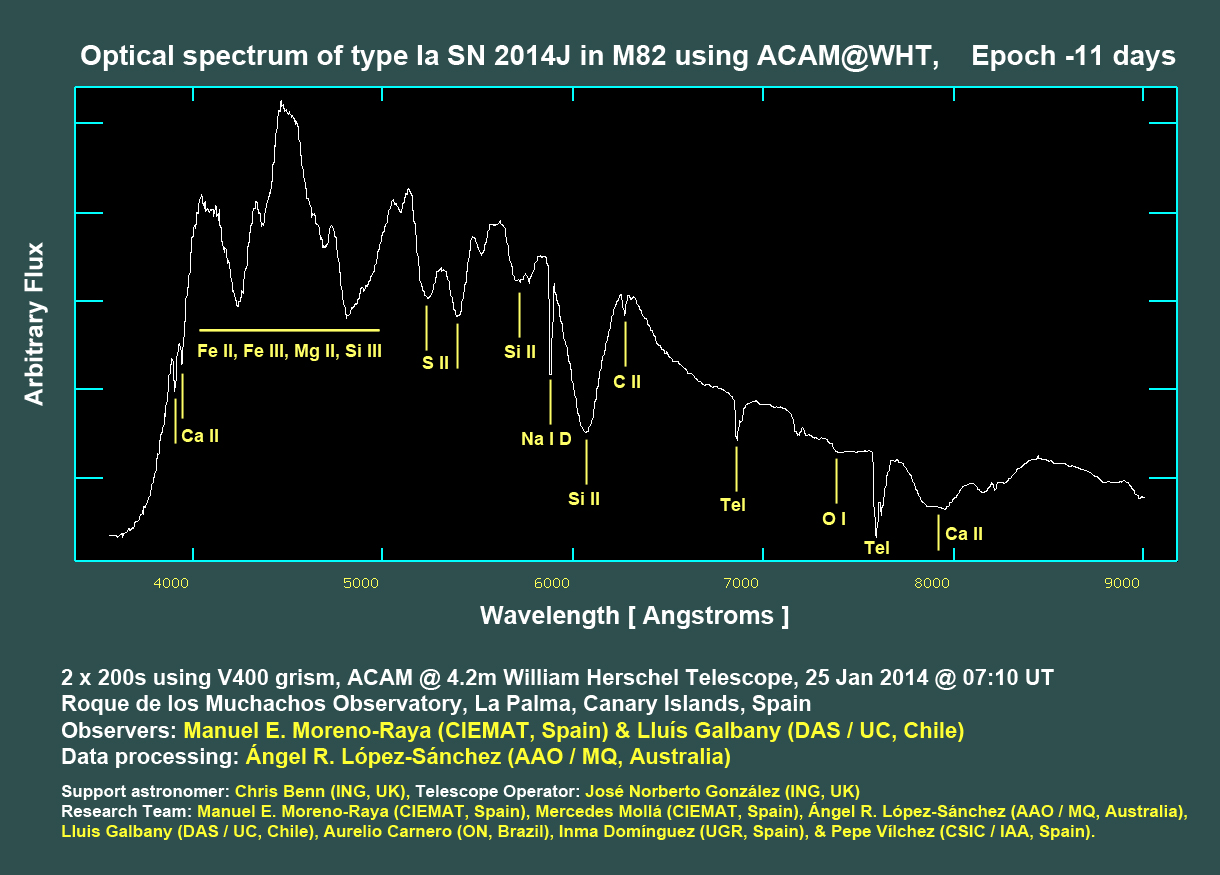
In addition, we have already analyzed the low-resolution spectrum of the SN 2014J obtained using ACAM. This spectrum gets all the optical range, between 3500 and 9500 Angstroms, and clearly identifies the object as a type Ia supernova. The main features are absorption bands of iron (Fe II and Fe III), magnesium (Mg II) and silicon (Si II) between 4000 and 5000 A. These bands actually are blends of absorptions due to these metallic elements. Indeed, astrophysicists expect the intensity of these bands will be changing as the supernova evolves, as the chemical abundances and ionization of each species vary as some elements are converted into others and more material coming from the center of the dead star is observed. Even so, it is a surprise to find these absorption bands almost 10 days before the supernova reaches its maximum brightness. The spectrum also shows absorptions of sulfur (S II) at 5240 and 5450 A, a strong absorption by silicon (Si II) at 6150 A, and absorptions of calcium (Ca II), sodium (Na I) and oxygen (O I). Some features are actually created in the Earth atmosphere and hence they do not belong to the supernova, these are labelled as “Tel” (from “Teluric lines”). However, the feature which interested us most was the carbon absorption (C II) at 6580. This line indicates that the progenitor of the supernova was a white dwarf composed by carbon and oxygen (as it happens in the majority of the white dwarf). However, it is uncommon to observe this line in type Ia spectra. This suggests that the surface of the white dwarf has not been completely burnt during the explosion. All absorption lines are found “blue-shifted”, that is, at shorter wavelengths that those expected. That is a consequence of the high speed at which the material is moving, expanding fast away from the dead star. The measurement of the C II and S II lines observed in our ACAM optical spectrum indicates that this material is moving at around 15 000 km/s!


Low-resolution optical spectrum of the type Ia supernova SN 2014J discovered in the galaxy M 82 obtained using the ACAM instrument at the Cassegrain focus of the 4.2m William Herschel Telescope (WHT) (Roque de los Muchachos Observatory, La Palma, Canary Islands, Spain). The intensity or relative flux (“Arbitrary Flux”, vertical axis) is plotted versus wavelength (“colour”, horizontal axis). The main features, which includes absorption lines of iron, magnesium, silicon, sodium, calcium, oxygen and carbon, are labelled. The spectrum combines two expositions of 200 seconds each using the ACAM V400 grism. The data were obtained last 25th January at 7:10 UT, which approximately corresponds to Epoch -11 days. It is expected the supernova reaches its maximum brightness in that time. The reduction of the data and the wavelength calibration was performed using standard IRAF routines.
Credit: Observers: Manuel E. Moreno-Raya (CIEMAT, Spain) & Lluís Galbany (DAS / UC, Chile). Data processing and color image composition: Ángel R. López-Sánchez (AAO / MQ, Australia). Support astronomer: Chris Benn (ING, UK), Telescope Operator: José Norberto González (ING, UK). Research Team: Manuel E. Moreno-Raya (CIEMAT, Spain), Mercedes Mollá (CIEMAT, Spain), Ángel R. López-Sánchez (AAO / MQ, Australia), Lluís Galbany (DAS / UC, Chile),Aurelio Carnero (ON, Brazil), Inma Domínguez (UGR, Spain), & Pepe Vílchez (CSIC / IAA, Spain).

Interestingly, the project that Manuel Moreno-Raya (CIEMAT, Spain) and his research team, composed by Mercedes Mollá (CIEMAT, Spain), Lluís Galbany (DAS / UC, Chile), Aurelio Carnero (ON, Brazil), Inma Domínguez (UGR, Spain), Pepe Vílchez (CSIC / IAA, Spain) and myself, was observing at the WHT was focused in obtaining deep, high-quality data of galaxies hosting type-Ia supernova. The idea is to quantify the physical and chemical properties of these host galaxies with the final aim of getting a better understanding of the parameters which control the brightness of these supernovae and apply these new measurements to improve the accuracy to very distant galaxies. This research is the main part of the PhD thesis project that Manu is conducting. Besides the observations of M 82 and the SN 2014J, we also got deep intermediate-resolution optical spectroscopy data of around 20 galaxies. These data still have to be analyzed in detail, something that will take months.

SN 2014J is the type-Ia supernova closest to the Earth since that Johannes Kepler observed in 1604. The Kepler’s Supernova actually exploded in our Galaxy, at just 20 thousands light-years from us, and it was so bright it was seen with the naked eye, being the brightest object in the sky after the Sun and the Moon. The type Ia supernova SN 1972e was also very close to us, as it exploded in the dwarf galaxy NGC 5253 (*). NGC 5253, which lies at a distance of 13 million light years, is in some way a similar object to M 82, as it also hosts a very powerful star-formation event. SN 1972e became the prototype object for the development of theoretical understanding of Type Ia supernovae, but this position may change with all the data that are coming from SN 2014J. What surprises will provide this new supernova? Can the new data be used to get a better understanding of the type Ia supernovae as a cosmological distance estimators and help to discover the nature of the mysterious dark energy which induces the expansion of the Universe? This research has just started.

UPDATE: Part of the information included in this post was used to prepare a telegram for ATel, The Astronomer’s Telegram, number 5827, Broad and narrow band imaging and spectroscopic follow up of SN2014J in M82, published on 28 Jan 2014; 18:30 UT.

(*) I should tell you many more things about the dwarf galaxy NGC 5253… It was my nightmare for some few years and after performing a very complete and detailed multi-wavelength analysis of this weird object I’m still not sure what is happening in there!

Colossal star formation in a dwarf galaxy

Text and photo published in a Calar Alto Photo Release, February 2008.

NGC 2366 is a dwarf galaxy placed at a distance of 11 millions of light-years (3.4 millions of parsecs). Its irregular shape and stellar content make it similar to the Magellanic Clouds, the two irregular dwarf galaxies very close to our own. For scale, NGC 2366 is about 20 000 light-years wide, what makes it twice as large as the Large Magellanic Cloud, and four times larger than the Small Magellanic Cloud, but still classified as a dwarf galaxy.

Astronomers deduced that NGC 2366 underwent a massive starburst episode only 50 million years ago and find that intense star formation is still taking place at several areas of this galaxy.  This image beautifully displays the regions where young stars are being formed (red nebulae) because the surrounding hydrogen gas (the raw material from which stars form) has already been ionised by ultraviolet radiation from young stars. This ionised hydrogen is seen also as large filaments and shell structures shining in red throughout the this galaxy. The most outstanding star forming regions are seen towards the upper-right side of the image. The telltale youth of the stars that constitute this galaxy can be seen in the bluish colours of its elongated main body.

Dwarf galaxy NGC 2366 with the 3.5m CAHA telescope. Images in B (blue), R (green) y Hα (red). Credit: Janine van Eymeren & Ángel R. López-Sánchez.

The researchers performed these observations with the aim of tracing the ionised gas structures shining in the red light that astronomers call “H-alpha” (Hα). To do this they obtained deep (one hour integration) H-alpha images of this galaxy. The energy needed to make all this gas shine in red light is related to the energy coming from the young massive blue stars just formed, and astronomers can even deduce if these young stars are, or are not, the only energy source powering the reddish nebulae. The starburst mode of forming stars, astronomers believe, is an important one throughout the Universe but there is much to understand on why a galaxy chooses to suddenly transform its gas into stars at a colossal rate and with magnificent fireworks.

The image was obtained by Janine van Eymeren (AIRUB, ATNF) and Ángel R. López-Sánchez (CSIRO/ATNF) with the MOSCA camera attached to the 3.5 m telescope of Calar Alto Observatory.  It was composed from individual frames taken in the B, Rand H-alpha bands. North is left, and East is down. The width of the image spans one third of the apparent size of the full Moon (approx. 10 arcminutes).

  • Link to the CAHA Photo Release: here
  • Link to the high-resolution image in my Flickr here.

Feeding, Feedback and Fireworks in galaxies

During this week (23 – 28 June 2013), I’m participating in the international astrophysics conference “Feeding, Feedback, and Fireworks: Celebrating Our Cosmic Landscape”, which is hosted in the tropical paradise of Hamilton Island, one of the most important islands of the Whitsundays (Queensland, Australia). The conference is jointly supported by the Australian Astronomical Observatory (AAO) and the CSIRO Astronomy and Space Science (CASS) and it is the 6th of the Southern Cross Conference Series.

Poster of the “Feeding, Feedback, and Fireworks: Celebrating Our Cosmic Landscape”, jointly supported by the Australian Astronomical Observatory (AAO) and the CSIRO Astronomy and Space Science (CASS), being the 6th of the Southern Cross Conference Series. The Heart Reef near Hamilton Island appears in the foreground, while the Hubble Ultra-Deep Field image is the background image.
Credit: Heart Reef Photo and Fireworks: Ángel R. López-Sánchez (Australian Astronomical Observatory / Macquarie University); Hubble Ultra-Deep Field: NASA, ESA and R. Thompson (Univ. Arizona).

It has been a very intense and fruitful conference, with almost 100 participants (the majority coming from Australia, but many others from America, Europe, Asia and Africa), and we are discussing hot topics about how the diffuse gas is moved inside the galaxies (Feeding), how stars form in galaxies (Fireworks) and how these newborn stars alter the properties of their host galaxies and their surroundings (Feedback). We are also investigating the role of the Active Galactic Nuclei (AGN) in galaxy evolution: how are they triggered (Feeding) and how they affect their host galaxies and even the galaxy cluster their host galaxies reside (Feedback). All in the context of the cosmological evolution of the Universe, constraining theoretical models using observations, and trying to put all the pieces together to understand the evolution of the galaxies.

In my case I presented part of my multi-wavelength work in Blue Compact Dwarf Galaxies, which are small galaxies (smaller than 1/100 times the size and mass of the Milky Way) which are experiencing a very intense star-formation event. Hence, it seems all the dwarf galaxy is a giant nebula! I’ll describe these interesting objects in a future post.

I’m part of the “LOC”, the Local Organizing Committee, which is chaired by Amanda Bauer (AAO), aka @astropixie, and hence in the last months I have actively participate to get the conference smoothly running (conference booklet, schedule of the talks, helping in registration and photos). One of my tasks during this week was to get the “Conference Photo” which, as Amanda suggested, includes not only the beach and palm trees of the beautiful beach at Hamilton Island but also a nice night-sky photo showing the Southern Cross. The result is this:

Conference Photo of the “Feeding, Feedback, and Fireworks: Celebrating Our Cosmic Landscape” conference.
Photo Credit and composition: Ángel R. López-Sánchez (Australian Astronomical Observatory / Macquarie University).

The talks and more information about this exciting conference will be posted in the conference webpage soon.