
Ángel R. López-Sánchez and the 2dF instrument at the 3.9m Anglo-Australian Telescope. Credit: Ella Pellegrini (Daily Telegraph).
My name is Ángel R. López-Sánchez. I’m a Spanish astrophysicist working at the Australian Astronomical Observatory (AAO) and in the Department of Astronomy, Astrophysics and Astrophotonics of the Macquarie University (Sydney, NSW, Australia). My research in Astrophysics is focused in the analysis of star formation phenomena in galaxies of the local Universe, especially in dwarf starbursts and spiral galaxies, but using a multiwavelength approach.
In 2003, while starting my PhD thesis at the Instituto de Astrofísica de Canarias (IAC, Canary Islands Institute for Astronomy, Spain) I decided to create a blog about Astronomy to share with Spanish speakers my interests about this fascinating science. That was the birth of my blog El Lobo Rayado. I chose this title because in that moment I was analyzing a very interesting class of starburst galaxies, the so-called Wolf-Rayet galaxies. A bad translation from English to Spanish of Wolf (which means Lobo) and Rayet (which does not have a translation into Spanish, but it sounds like Lined) seemed a very original title for a blog about Astronomy, furthermore considering that then I was spending a lot of time analyzing optical spectra of galaxies showing many emission lines. In 2003 blogs were not as common as they are today, and I can say that El Lobo Rayado was one of the very first (if not the first) Spanish blogs fully dedicated to Astronomy and Astrophysics written by a Spanish astrophysicist.
I got my PhD in Astrophysics in December 2006. I presented a detailed analysis of a sample of Wolf-Rayet galaxies, the majority of the optical and near-infrared observations were obtained by myself using the telescopes available at the Spanish astronomical observatories of El Roque de los Muchachos (La Palma), Izaña (Tenerife) and Calar Alto (Almeria).
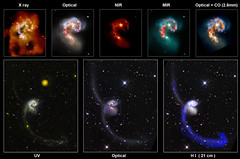
In 2007 I moved to Australia to work at the CSIRO Astronomy and Space Science (then just known as Australia Telescope National Facility) as radio-astronomer. Actually, I’m a weird mix between an optical and a radio astronomer, although I’m also using data from other wavelenghts. Indeed, I’m combining ultraviolet, optical, infrared and radio data to characterise the physical and chemical properties of galaxies and get clues about their nature and evolution. Since January 2011 I’m working at the Australian Astronomical Observatory (AAO) and Macquarie University (MQ) in Sydney (NSW, Australia).
My passion for Astronomy actually started when I was a kid, in the mountain ranges near my natal city, Córdoba (Spain), when I became an active amateur astronomer. Since 1991 I belong to the Agrupación Astronómica de Córdoba (AAC, Córdoba Astronomical Association). Besides being now a professional astronomer, I still feel like an amateur astronomer and indeed I enjoy a lot observing the sky with my eyes, binoculars or small telescopes and taking astronomical pictures using my own equipment.
I consider that outreach and publicizing Astronomy to the general public is very important and I’m usually involved in these activities. That is the reason I created both El Lobo Rayado and The Lined Wolf.
However, The Lined Wolf is not just a translation of El Lobo Rayado. Actually, I’m NOT going to translate a single post from one blog to the other. They will be complementary tools: I’ll continue writing in Spanish in El Lobo Rayado, as I consider it is very important to reach non-English speakers: the majority of the astronomical information, including press releases and hot news, is in English, and hence non-English speakers can still found some extra information about the most recent news about Astronomy in El Lobo Rayado. On the other hand, in the last few years I’ve been thinking it is also important for me to create my own blog about Astronomy in English. However, in this case my idea is to publicize my own research and explain the scientific papers I’m publishing, together with some of the adventures which involves to be a professional astronomer (observations in remote telescopes, conferences, workshops…). That is the aim that the blog The Lined Wolf has.
That also means I have to start from the beginning. There are many posts I still have to write here, just considering I’ll need at least a post per paper published in a refereed journal, plus posts showing some of my beautiful multiwavelength images. Shall we begin?






 A/Prof. Ángel R. López-Sánchez