Category Archives: Personal

Timelapse of World Record Stargazing 2015

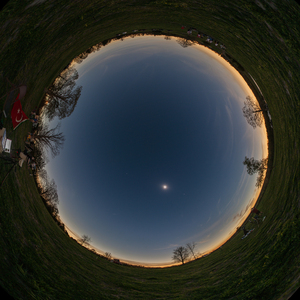
On Friday 21st August 2015, during the Australian National Science Week, the AAO and Centennial Parklands organized a public stargazing event in Centennial Park in Sydney. This event was part of an attempt to break the Guinness World Record for the “Most People Stargazing across Multiples sites in a Country,” organized by Mt Stromlo Observatory, RSAA/ANU, Canberra.

I helped in the organization of the event jointly organized by the Australian Astronomical Observatory and Centennial Parklands at Centennial Park. During a 10 minute period between 8:30 and 8:40 pm, 400 participants used small telescopes and binoculars to look at various objects in the night sky. I also prepared this time-lapse video, which compiles 2500 photos taken between 6pm and 9:30pm, shows people assembling in the field to listen to presentations by Prof. Fred Watson and Dr. Amanda Bauer before the official stargazing event began. A timeline of events are included in the video.

Time-lapse video of the Stargazing event jointly organized by the Australian Astronomical Observatory and Centennial Parklands at Centennial Park with the aim of break the Guinness World Record for the “Most People Stargazing across Multiples sites in a Country. The video compiles 2500 photos taken every 5 seconds between 6pm and 9:30pm. A Full HD version of the video is available in the AAO YouTube Channel.Credit of the video: Ángel R. López-Sánchez (AAO/MQ); Credit of the music: “Space Guardians”, by Fran Soto, Epic Soul Factory.

In total, 37 sites across Australia participated in achieving the Guinness Record World, including 7960 individual stargazers. The Guinness World Record for the “Most People Stargazing across Multiples sites in a Country” was confirmed on 15th October 2015. Congratulations to all involved!

More info: AAO Webpage: World Record Stargazing 2015

Letter to Aylan from an Astrophysicist and Science Communicator

Post originally written in Spanish in my blog El Lobo Rayado, with the title Carta a Aylan de un astrofísico divulgador.

Hi Aylan,

I’ve spent the last two days just thinking about you, your brother and your parents. It is hard to me to be concentrated on other things, I’m much more sensitive than usual, I cannot sleep well and I feel bad and also responsible for your destiny as a part of that huge silent mass of people who happily live in what some call the first world. Our everyday concerns are a trifle compared with those of your family and countrymen. We continuously complain if our football team does not win, if the price of the movie tickets (or the petrol, gas or electricity, just name it) raises, if the internet connection is too slow to read our favorite websites or, in my case, if the bad weather does not allow me to use the telescope or a committee of wise academics has not valued my science project for a new grant. But all these problems are just a very tiny thing when compared with a sea even bigger than the Mediterranean.

Do you know I have a son who is almost your same age? Sometimes he is a bit stubborn but he is still learning everything. I do not want to impose him any religion or any class separation by culture, race or sex. I just want him to know that all humans beings, whether Christians, Arabs, Jews, Indians, Chinese, Australian Aborigines, blacks, gays, straights, or any mix of any of these, have the same rights and responsibilities. They all have to respect and be respected for who and what they are. Unfortunately I think there are still few people on Earth who think like me. Otherwise I would not understand what is going on in this crazy world, very globalized for some things, but so separated for the things that really matter.

My son Luke speaks little yet, but he understands and is able to communicate in two different languages. I wish he will learn more languages ​​throughout his life. I consider that learning languages ​​and traveling open your mind and help a lot to understand our world. You’ve also traveled, but you have been forced to do so by the cruel circumstances that are destroying your native country. As in so many other wars, it is the lack of respect for those who do not have their same god or school of thought what is devastating your society. I hope that Luke also travels around the world when he grows up, but not as a “tourist” taking photos of everything he sees and does to post them into Facebook to show friends and (ex)girlfriends how cool he is, but to acquire a better understanding of our species and our planet. Thanks to his Spanish-English bilingualism he will be able to communicate with billions of people, with whom he will share experiences, ideas and adventures. All of this, I hope, will induce in him a better comprehension and appreciation of this small, pale blue dot in which we all live in.

There are many other worlds out there, Aylan, and it is very probable that during our generation we will be able to point a specific star in the night knowing that it has extraterrestrial life on it. I wish I could show you the sky and how to recognize the brightest stars, the constellations and the planets of our Solar System. You do not need a telescope or even binoculars to enjoy a starry sky. All countries on Earth are hung under the same sky, but not all stars can be seen at all points of the globe. The sky does not have any borders as it happens to the countries of the Earth (except the constellations, which were also artificially created by us), so you can freely jump from one star to another only guided by your imagination. Imagination can take you very far, if you have the ability and opportunity to use it.

Unfortunately I will never meet you, Aylan, or be with you and your brother, Galip, in an astronomical observation, I will never listen to your questions and ideas, and I will never share with you these scientists and philosophical thoughts. However, and besides teaching my son Luke, I still hope to show the majesty and beauty of the Nature to more children like you, whether they are in Spain, Australia or elsewhere I’m asked to go. I hope I’ll help them to understand how tiny and fragile our planet is and how beautiful is that the matter of the Cosmos has been recycled in a so complex way that it is able to think about their own origins.

Life, Aylan, is what must be protected first and before anything else. Life is the most precious thing that exists throughout the entire Universe, but our society still has to learn this. Perhaps through Science, and in particular Astronomy, I can help a little to move all those pebbles of sand that are needed to build a mountain. Just because of all of this all the worries and concerns I have recently had about the usefulness of my popular science and outreach activities and how to reach more people are even more important that what I originally thought. On the education and the teaching of the mutual respect to people who are not exactly like you are the keys to the success, and ultimately the survival, of the intelligent species that dominates the third planet orbiting around a star named Sun.

Your life, Aylan, and the life of your brother is what should have been protected first. As the lives of all the children in the world who, both innocent and curious by nature, embark on the adventure of life. I feel I’m also guilty of your tragedy, perhaps indirectly, but guilty because of my silence and inaction.

I have also failed, Aylan. And I’ll never forgive me.

Dr. Ángel R. López-Sánchez
Astrophysicist and Science Communicator
Friday, 4th September, 2015.

NOTE: It had never impacted me so hard a photography or a story as the final destiny of Aylan. Between the impotence, the complicity of belonging to the “society that allows these things happen”, and my sustained tears for the last couple of days, I could not help myself and write these notes, which are more for me than for my followers (that is why I originally wrote this in Spanish first, but I have felt the need of translating it into English too). Certainly, the fact of having a child with similar age to Aylan’s means that all of this is effecting me more deeply than usual. Putting me in the skin of Aylan’s father, who has not only lost his two small sons but also his wife, destroys my soul. Every few minutes I have to erase from my mind the photos at the beach and put in their place that picture in which Aylan and his older brother (who also died in this tragedy) are laughing together on a couch next to a stuffed animal. Therefore I must act accordingly to try that something like this will never happen again. Unfortunately, behind this terrible catastrophe there are also thousands, millions of other cases that are not made public and do not get the attention of the media. What a feeling of emptiness and selfishness! Is this what awaits us in the coming years? What a simple astrophysicist and science communicator could do about it? Apart from donations and sending letters to insensitive politicians, like many other citizens do, the only action I see, as I said in my letter, is to help in the education of the young people, who will be the citizen and leaders of our next generation. I will be here to do so.

Gas, star-formation and chemical enrichment in the spiral galaxy NGC 1512

How do galaxies grow and evolve? Galaxies are made of gas and stars, which interact in very complex ways: gas form stars, stars die and release chemical elements into the galaxy, some stars and gas can be lost from the galaxy, some gas and stars can be accreted from the intergalactic medium. The current accepted theory is that galaxies build their stellar component using their available gas while they increase their amount of chemical elements in the process. But how do they do this?

That is part of my current astrophysical research: how gas is processed inside galaxies? What is the chemical composition of the gas? How does star-formation happen in galaxies? How galaxies evolve? Today, 21st May 2015, the prestigious journal “Monthly Notices of the Royal Astronomical Society”, publishes my most recent scientific paper, that tries to provide some answers to these questions. This study has been performed with my friends and colleagues Tobias Westmeier (ICRAR), Baerbel Koribalski (CSIRO), and César Esteban (IAC, Spain). We present new, unique observations using the 2dF instrument at the 3.9m Anglo-Australian Telescope (AAT), in combination with radio data obtained with the Australian Telescope Compact Array (ATCA) radio-interferometer, to study how the gas in processed into stars and how much chemical enrichment has this gas experienced in a nearby galaxy, NGC 1512.

Deep images of the galaxy pair NGC 1512 and NGC 1510 using optical light (left) and ultraviolet light (right).Credit: Optical image: David Malin (AAO) using photographic plates obtained in 1975 using de 1.2m UK Schmidt Telescope (Siding Spring Observatory, Australia). UV image: GALEX satellite (NASA), image combining data in far-ultraviolet (blue) and near-ultraviolet (red) filters.

NGC 1512 and NGC 1510 is an interacting galaxy pair composed by a spiral galaxy (NGC 1512) and a Blue Compact Dwarf Galaxy (NGC 1510) located at 9.5 Mpc (=31 million light years). The system possesses hundreds of star-forming regions in the outer areas, as it was revealed using ultraviolet (UV) data provided by the GALEX satellite (NASA). Indeed, the UV-bright regions in the outskirts of NGC 1512 build an “eXtended UV disc” (XUV-disc), a feature that has been observed around the 15% of the nearby spiral galaxies. However these regions were firstly detected by famous astronomer David Malin (AAO) in 1975 (that is before I was born!) using photographic plates obtained with the 1.2m UK Schmidt Telescope (AAO), at Siding Spring Observatory (NSW, Australia).

The system has a lot of diffuse gas, as revealed by radio observations in the 21 cm HI line conducted at the Australian Telescope Compact Array (ATCA) as part of the “Local Volume HI Survey” (LVHIS) and presented by Koribalski & López-Sánchez (2009). The gas follows two long spiral structures up to more than 250 000 light years from the centre of NGC 1512. That is ~2.5 times the size of the Milky Way, but NGC 1512 is ~3 times smaller than our Galaxy! One of these structures has been somehow disrupted recently because of the interaction between NGC 1512 and NGC 1510, that it is estimated started around 400 million years ago.

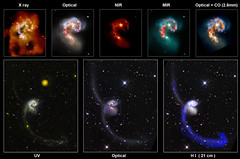
Multiwavelength image of the NGC 1512 and NGC 1510 system combining optical and near-infrared data (light blue, yellow, orange), ultraviolet data from GALEX (dark blue), mid-infrared data from the Spitzer satellite (red) and radio data from the ATCA (green). The blue compact dwarf galaxy NGC 1510 is the bright point-like object located at the bottom right of the spiral galaxy NGC 1512.
Credit: Ángel R. López-Sánchez (AAO/MQ) & Baerbel Koribalski (CSIRO).

Our study presents new, deep spectroscopical observations of 136 genuine UV-bright knots in the NGC 1512/1510 system using the powerful multi-fibre instrument 2dF and the spectrograph AAOmega, installed at the 3.9m Anglo-Australian Telescope (AAT).

2dF/AAOmega is generally used by astronomers to observe simultaneously hundreds of individual stars in the Milky Way or hundreds of galaxies. Without considering observations in the Magellanic Clouds, it is the first time that 2dF/AAOmega is used to trace individual star-forming regions within the same galaxy, in some way forming a huge “Integral-Field Unit” (IFU) to observe all the important parts of the galaxy.

Two examples of the high-quality spectra obtained using the AAT. Top: spectrum of the BCDG NGC 1510. Bottom: spectrum of one of the brightest UV-bright regions in the system. The important emission lines are labelled.
Credit: Ángel R. López-Sánchez (AAO/MQ), Tobias Westmeier (ICRAR), César Esteban (IAC) & Baerbel Koribalski (CSIRO).


The AAT observations confirm that the majority of the UV-bright regions are star-forming regions. Some of the bright knots (those which are usually not coincident with the neutral gas) are actually background galaxies (i.e., objects much further than NGC 1512 and not physically related to it) showing strong star-formation activity. Observations also revealed a knot to be a very blue young star within our Galaxy.

Using the peak of the H-alpha emission, the AAT data allow to trace how the gas is moving in each of the observed UV-rich region (their “kinematics”), and compare with the movement of the diffuse gas as provided using the ATCA data. The two kinematics maps provide basically the same results, except for one region (black circle) that shows a very different behaviour. This object might be an independent, dwarf, low-luminosity galaxy (as seen from the H-alpha emission) that is in process of accretion into NGC 1512.

Map showing the velocity field of the galaxy pair NGC 1512 / NGC 1510 as determined using the H-alpha emission provided by the AAT data. This kinematic map is almost identical to that obtained from the neutras gas (HI) data using the ATCA, except for a particular region (noted by a black circle) that shows very different kinematics when comparing the maps.
Credit: Ángel R. López-Sánchez (AAO/MQ), Tobias Westmeier (ICRAR), César Esteban (IAC) & Baerbel Koribalski (CSIRO).

The H-alpha map shows how the gas is moving following the optical emission lines up to 250 000 light years from the centre of NGC 1512, that is 6.6 times the optical size of the galaxy. No other IFU map has been obtained before with such characteristics.

Using the emission lines detected in the optical spectra, which includes H I, [O II], [O III], [N II], [S II] lines (lines of hydrogen, oxygen, nitrogen and sulphur), we are able to trace the chemical composition -the “metallicity”, as in Astronomy all elements which are not hydrogen or helium as defined as “metals”- of the gas within this UV-bright regions. Only hydrogen and helium were created in the Big Bang. All the other elements have been formed inside the stars as a consequence of nuclear reactions or by the actions of the stars (e.g., supernovae). The new elements created by the stars are released into the interstellar medium of the galaxies when they die, and mix with the diffuse gas to form new stars, that now will have a richer chemical composition than the previous generation of stars. Hence, tracing the amount of metals (usually oxygen) within galaxies indicate how much the gas has been re-processed into stars.


Metallicity map of the NGC 1512 and NGC 1510 system, as given by the amount of oxygen in the star-forming regions (oxygen abundance, O/H). The colours indicate how much oxygen (blue: few, green: intermediate, red: many) each region has. Red diamonds indicate the central, metal rich regions of NGC 1512. Circles trace a long, undisturbed, metal-poor arm. Triangles and squares follow the other spiral arms, which is been broken and disturbed as a consequence of the interaction between NGC 1512 and NGC 1510 (blue star). The blue pentagon within the box in the bottom right corner represents the farthest region of the system, located at 250 000 light years from the centre.
Credit: Ángel R. López-Sánchez (AAO/MQ), Tobias Westmeier (ICRAR), César Esteban (IAC) & Baerbel Koribalski (CSIRO).


The “chemical composition map” or “metallicity map” of the system reveals that indeed the centre of NGC 1512 has a lot of metals (red diamonds in the figure), in a proportion similar to those found around the centre of our Milky Way galaxy. However the external areas show two different behaviours: regions located along one spiral arm (left in the map) have low amount of metals (blue circles), while regions located in other spiral arm (right) have a chemical composition which is intermediate between those found in the centre and in the other arm (green squares and green triangles). Furthermore, all regions along the extended “blue arm” show very similar metallicities, while the “green arm” also has some regions with low (blue) and high (orange and red) metallicities. The reason of this behaviour is that the gas along the “green arm” has been very recently enriched by star-formation activity, which was triggered by the interaction with the Blue Compact Dwarf galaxy NGC 1510 (blue star in the map).

When combining the available ultraviolet and radio data with the new AAT optical data it is possible to estimate the amount of chemical enrichment that the system has experienced. This analysis allows to conclude that the diffuse gas located in the external regions of NGC 1512 was already chemically rich before the interaction with NGC 1510 started about 400 million years ago. That is, the diffuse gas that NGC 1512 possesses in its outer regions is not pristine (formed in the Big Bang) but it has been already processed by previous generations of stars. The data suggest that the metals within the diffuse gas are not coming from the inner regions of the galaxy but very probably they have been accreted during the life of the galaxy either by absorbing low-mass, gas-rich galaxies or by accreting diffuse intergalactic gas that was previously enriched by metals lost by other galaxies.

In any case this result constrains our models of galaxy evolution. When used together, the analysis of the diffuse gas (as seen using radio telescopes) and the study of the metal distribution within galaxies (as given by optical telescopes) provide a very powerful tool to disentangle the nature and evolution of the galaxies we now observe in the Local Universe.

More information

Scientific Paper in MNRAS: “Ionized gas in the XUV disc of the NGC 1512/1510 system”. Á. R. López-Sánchez, T. Westmeier, C. Esteban, and B. S. Koribalski.“Ionized gas in the XUV disc of the NGC1512/1510 system”, 2015, MNRAS, 450, 3381. Published in Monthly Notices of the Royal Astronomical Society (MNRAS) through Oxford University Press.

AAO/CSIRO/ICRAR Press Release (AAO): Galaxy’s snacking habits revealed

AAO/CSIRO/ICRAR Press Release (ICRAR): Galaxy’s snacking habits revealed

Royal Astronomical Society (RAS) Press Release: Galaxy’s snacking habits revealed

Article in Phys.org: Galaxy’s snacking habits revealed

Article in EurekAlert!: Galaxy’s snacking habits revealed

Article in Press-News.org: Galaxy’s snacking habits revealed

Article in Open Science World: Galaxy’s snacking habits revealed

ATNF Daily Astronomy Picture on 21st May 2015.

Time-lapse: The Sky over Siding Spring Observatory

DP ENGLISH: This story belongs to the series “Double Post” which indicates posts that have been written both in English in The Lined Wolf and in Spanish in El Lobo Rayado.

DP ESPAÑOL: Esta historia entra en la categoría “Doble Post” donde indico artículos que han sido escritos tanto en español en El Lobo Rayado como en inglés en The Lined Wolf.

I’ve been waiting year and a half to finally see this happening. One of the displays I prepared for the Stories from Siding Spring Observatory Photo Exhibition (that was organized by staff of the Australian Astronomical Observatory (AAO) and originally released on 17th April 2013 at the Sydney Observatory), was a new time-lapse video compiling scenes showing all the telescopes at the Siding Spring Observatory (Coonabarabran, NSW, Australia) before the terrible bushfires that destroyed the Warrumbungle National Park and seriously affected the very same Observatory on 13th January 2013. However I couldn’t do this time-lapse video public until today, as it is the very first video to be included in the AAO Youtube channel. So here it is the time-lapse video “The Sky over Siding Spring Observatory:

Video time-lapse The Sky over Siding Spring Observatory. To enjoy it as its best, I strongly recommend you to see it at its highest resolution (FullHD) and full screen in a dark room. Credit: Video Credit: Ángel R. López-Sanchez (AAO/MQ), Music: Point of no return (Rogert Subirana).

I think this is the best time-lapse video I have created so far. It last 4:30 minutes and it compiles the best time-lapse sequences I obtained at Siding Spring Observatory between August 2011 and March 2013, during my support astronomer duties for the 4-metre Anglo-Australian Telescope (AAT). Telescopes at Siding Spring Observatory featured include the Uppsala Near Earth Object Survey Telescope, the UNSW Automated Patrol Telescope, the 2.3m ANU Telescope, 1.2m Skymapper ANU, the 1.2m UK Schmidt Telescope (AAO) and the very own Anglo-Australian Telescope (AAT).

Throughout the video, watch for several astronomical objects: our Milky Way Galaxy, the Large and Small Magellanic Clouds, the Moon rising and setting, the planets Venus, Mars, Jupiter and Saturn, Zodiacal Light, Earth-orbiting satellites, airplanes crossing the sky, the Pleiades and Hyades star clusters, the Coalsack and the Carina nebulae, and famous constellations like the Southern Cross, Taurus, Orion, and Scorpio.

The time-lapse technique consists of taking many images and then adding all to get a movie with a very high resolution. In particular, the camera CANON EOS 600D and two lenses (a 10-20 mm wide-angle lens and a standard 35-80 mm lens) were used to get the frames of this time-lapse video. Except for those frames taken during the sunset in the first scene, frames usually have a 30 seconds exposure time, with a ISO speed of 1600. Some few scenes were shot using 15 or 20 seconds exposure time. All sequences were created at 24 fps (frames per second), and hence a second in the movie corresponds to 12 minutes in real time for the majority of the scenes. In total, the video combines around 5800 individual frames. Processing each 10 – 20 seconds sequence took between five and six hours of computer time. Care was taken to remove artifacts and hot pixels from individual frames, minimize background noise, and get an appropriate colour/contrast balance.

I hope you like it. Comments and posting about it in social media are very welcome.

More information and previous time-lapses

Video in the AAO YouTube Channel.

AAO Webpage: Timelapse Video: The Sky Over Siding Spring Observatory (25th Sep 2014)

Timelapse video: The Sky over the Anglo-Australian Telescope (3rd May 2013).

Timelapse video: A 2dF night at the Anglo-Australian Telescope (7th May 2014).

Partial solar eclipse from Sydney

Today, 10th May 2013, the combined movements of the Sun, Earth and Moon gave us a very nice Annular Solar Eclipse. Following a similar path to the Total Solar Eclipse we enjoyed last November, the shadow of the Moon over the Earth moved from North Australia to the Pacific. However, today the Moon was close to its maximum distance to the Earth (planets and satellites move following elliptical orbits) and hence its apparent size on the sky was not big enough to completely cover the disc of the Sun. This is indeed the reason the eclipse was an annular solar eclipse.

In this occasion I couldn’t travel to North Australia to enjoy the annular eclipse (actually, I have seen 2 of these in the past, the most recent one was on 3rd October 2005 from Madrid), and even last night I didn’t expect to do anything special about this today. But this morning, while watching it from my backyard using my solar glasses, I decided just to take some few shots using not the telescope but only the tele lens. This is the result:

Partial Solar Eclipse from Sydney. Data obtained using a CANON EOS 600D, a 250mm Tele Lens and a Solar filter (which I hold by hand). I stacked 12 individual frames obtained at ISO 100, f10, 1/80 s using the Lynkeos software. The final processing was achieved using Photoshop. 10 May 2013 @ 09: 10 AEST ( 00:10 UT ), Sydney, Australia.
Credit: Ángel R. López-Sánchez (Australian Astronomical Observatory / Macquarie University, Agrupación Astronómica de Córdoba / Red Andaluza de Astronomía)

I hope you like it.