Tag Archives: 2020

My first H-alpha test of the Horsehead and Flame nebulae

H-alpha image of the Horsehead (left) and Flame (right) nebulae in Orion obtained from my backyard, 15 km from Sydney’s city centre.

This image combines 24 frames I got during some few nights in early October using the ZWO ASI1600MM Pro and the H-alpha Baader 3.5nm ultra-narrow filter.

All frames had an exposition time of 900s (15 minutes), hence this image combines a total of 6 hours of telescope time!

Telescope: Skywatcher Black Diamond 80, f=600mm (f/7.5)

Equipment: I used the ZWO ASIAir to control the camera, the mount (Skywatcher AZ-EQ6) and the guiding system (ASI120MM + Orion 50mm finderscope). The H-alpha filter was in the ZWO filter drawer.

Processing: Data processed with Siril software. FITS converted on TIFF using NASA’s Fits Liberator considering a logarithmic function. Color / saturation / levels / contrast / smart sharpen with Photoshop.

For this image I decided to give some false colour instead of just the greyscale image, I used Photoshop to get the kind of “fire” aspect to the gas in the nebulae.

I was expecting to get more data to get the image deeper, unfortunately the weather, following “La Niña”, is not cooperating in Eastern Australia in late 2020.

Credit: Ángel R. López-Sánchez (AAO-MQ).

Full resolution image available in my Flickr.

Tweet compilations of the “BlueMUSE Workshop”

Last Monday and Tuesday (evening – night for me) I participated in the “BlueMUSE Science Workshop“, organised by Johan Richard (CRAL). It was a highly valuable, very interesting workshop discussing all the amazing science that the new BlueMUSE instrument can achieve.

BlueMUSE is an instrument selected by ESO for its VLT2030 instrumental plan, with a Phase A starting no later than 2022. It is an optical seeing-limited, blue-optimised, medium spectral resolution, panoramic integral-field-spectrograph, to be installed on one of the telescopes of the VLT on Cerro Paranal (Chile). The project is an evolution of the technology used on the very successful VLT / MUSE instrument, but with a new and distinct science case enabled by its main characteristics

  • A wavelength coverage 350 – 580 nm
  • An average spectral resolution R~4000
  • Minimum 1 arcmin2 and up to 2 arcmin2 field-of-view.

Due to its unique parameter space, BlueMUSE is foreseen to cover broad science cases, from solar system objects to high redshift galaxies. It has strong synergies with future facilities such as JWST, ELT, SKA and Athena, as highlighted in the BlueMUSE science white paper.

As usual, I’ve paid attention to all the talks and tweeted about them, compiling all the tweets in a thread. The first tweet is this one:

I also asked @threadreadapp to “unroll” the thread for getting all the information in a single post. The link is here.

This workshop was originally scheduled at early April but… you know what happened.

I’m organising the Australian version of the BlueMUSE Workshop on December 2nd, hoping to get the interest and attraction of the Australian researchers in blueMUSE.

Eventually I should talk more about my research here, as in the last times I’ve basically been posting nice astrophotographies and outreach content, when actually the 90% of my time during all these months have been working in the amazing Integral Field Spectroscopy (IFS) data I obtained with the KOALA+AAOmega instruments at the Anglo-Australian Telescope, the Python code I’m developing for processing the data (PyKOALA), and the preliminary results we are finding in some galaxies of the HI-KIDS (“The HI-KOALA IFS Dwarf galaxy Survey“) project. Stay tuned!

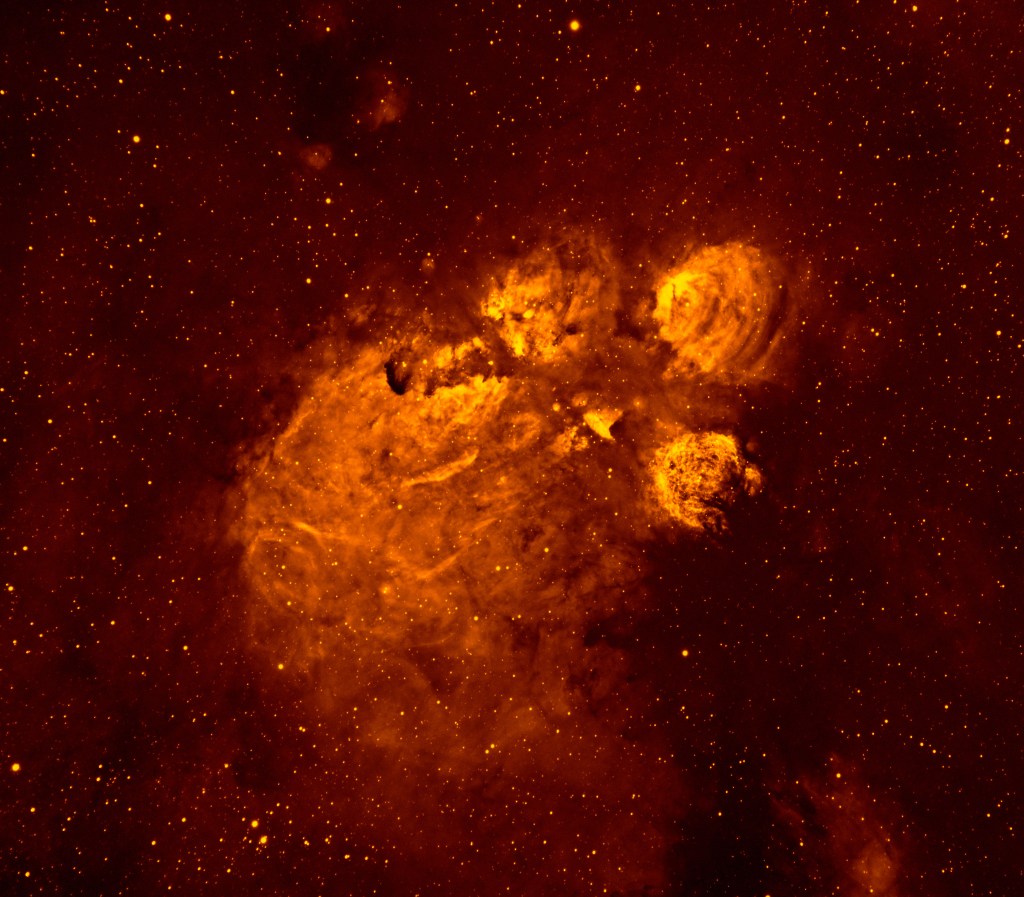
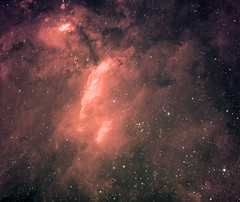
Fire in the Cat’s Paw Nebula

Deep H-alpha image of the Cat’s Paw Nebula (NGC 6334) in Scorpius obtained from my backyard, 15 km from Sydney’s city centre.

This image combines 40 frames I got during some few nights during late September and early October 2020 using the ZWO ASI1600MM Pro and the H-alpha Baader 3.5nm ultra-narrow filter.

All frames had an exposition time of 900s (15 minutes), hence this image combines a total of 10 hours of telescope time!

Telescope: Skywatcher Black Diamond 80, f=600mm (f/7.5)

Equipment: I used the ZWO ASIAir to control the camera, the mount (Skywatcher AZ-EQ6) and the guiding system (ASI120MM + Orion 50mm finderscope). The H-alpha filter was in the ZWO filter drawer.

Processing: Data processed with Siril software. FITS converted on TIFF using NASA’s Fits Liberator considering a logarithmic function. Color / saturation / levels / contrast / smart sharpen with Photoshop.

For this image I decided to give some false colour instead of just the greyscale image, I used Photoshop to get the kind of “fire” aspect to the gas in the nebulae.

I would love to get some data in broad-band filters to get the colours, but I’m afraid this will have to wait till next year, as Scorpius is already a bit too low over the western horizon, and some palm tress block the view from my backyard.

Full resolution image in my Flickr.

Credit: Ángel R. López-Sánchez (AAO-MQ).

Webinar: “A (very brief) introduction to Astrophotography”

The other day I uploaded to my YouTube channel the full recording of the webinar “A (very brief) introduction to Astrophotography“, that I gave on the 3rd October 2020 for the online events for “StarFest 2020”, Siding Spring Observatory, NSW, Australia.

The abstract of the talk is:

The sky is open to everybody. Thanks to the advance of the technology, amateur astronomers are obtaining outstanding images of the sky, even from their backyards, using DSLR cameras and small telescopes. In this webinar I provided a very broad introduction to the basics of Astrophotography, from the best settings for getting the images using DSLRs and telescopes to how to process the data.

Please, note that I couldn’t go in deep in almost any aspect of Astrophotography, just providing some very global ideas, enumerating the techniques, providing some key tricks (focusing, stacking images, use RAW) and show some of my best astrophotos.

I want to thank Brad Tucker (RSAA, ANU) for the invitation to give this webinar, also thanks for being the MC for this.

Credit: Ángel R. López-Sánchez (AAO-MQ).

Image

Helix Nebula in H-alpha from Sydney

Deep H-alpha image of the Helix Nebula obtained from my backyard, 15 km from Sydney’s city centre.

This image combines the best 40 frames of the 82 frames I got the nights of 24-30 August, 7, 12 and 15 September 2020 using the ZWO ASI1600MM Pro and the H-alpha Baader 3.5nm ultra-narrow filter.

All frames had an exposition time of 900s (15 minutes), hence this image combines a total of 10 hours of telescope time!

Telescope: Skywatcher Black Diamond 80, f=600mm (f/7.5)

Equipment: I used the ZWO ASIAir to control the camera, the mount (Skywatcher AZ-EQ6) and the guiding system (ASI120MM + Orion 50mm finderscope). The H-alpha filter was in the ZWO filter drawer.

Processing: Data processed with Siril software. FITS converted on TIFF using NASA’s Fits Liberator considering a logarithmic function. Color / saturation / levels / contrast / smart sharpen with Photoshop.

I hope to get soon some data in broad-band filters to get the colours!

Full resolution image in my Flickr.

Credit: Ángel R. López-Sánchez (AAO-MQ).