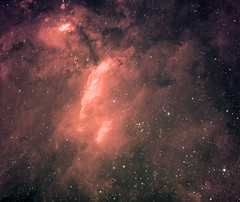
Diffuse gas and dust in the heart of the Carina Nebula. The bright star is Eta Carinae, a massive double star at the end of its live that will soon explode as a supernova. The “Keyhole” is the dark cloud in the centre of the image.
Image obtained as part of the “ABC Stargazing Live” events at Siding Spring Observatory (NSW, Australia), 4 – 6 April 2017.
Data taken on 3rd April 2017 using the CACTI camera in 2dF at the 3.9m Anglo-Australian Telescope. Color image using B (12 x 60s, blue) + [O III] (12 x 60 s, green) + Hα (12 x 60 s, red) filters.
More sizes and high-resolution image in my Flickr.
Credit: Ángel R. López-Sánchez (Australian Astronomical Observatory and Macquarie University), Steve Lee, Robert Patterson & Robert Dean (AAO), Night assistant at the AAT: Wiston Campbell (AAO).
Milky Way, Large Magellanic Cloud, and Anglo-Australian Telescope. Combination of. 6 frames, each of 30 seconds, CANON EOS 5D Mark III, 16mm, f/2.8, ISO 1600. Thursday 2 March 2017. The dome was illuminated in one of the frames by a car leaving the building.
More sizes and high-resolution image in my Flickr.
Last Thursday 24th November I conducted an outreach exercise while supporting astronomical observations at the Anglo-Australian Telescope (AAT). Using the Australian Astronomical Observatory (AAO) Twitter account I asked people to chose one of 4 given object located in the Large Magellanic Cloud (LMC) to be observed at the telescope with the new CACTI camera while we were changing gratings of the scientific instrument, the spectrograph AAOmega. I’ve called the experiment “LMC Little Gems using CACTI”.
We got 193 votes, thank you to all of you who voted and also shared the post! It was quite exciting, particularly the last 30 minutes when, thanks to some of the best science communicators in Spain (and friends), we got +50 votes!
I must say my favorite was NGC 1949, but NGC 2018 was also a nice choice.
And the final color image of the object you chose to observe at the 3.9m Anglo-Australian Telescope is:
NGC 2018, a supernova remnant in the LMC Data taken on 24 November 2016 as part of the AAO Outreach Exercise “Large Magellanic Cloud Little Gems with CACTI”. CACTI camera in 2dF @ 3.9m Anglo-Australian Telescope. Color image using B (6 x 10s, blue) + [O III] (6 x 60 s, green) + Ha (8 x 60 s, red) filters. A high resolution image can be obtained here. Credit: Ángel R. López-Sánchez (Australian Astronomical Observatory / Macquarie University) & Steve Lee, Robert Patterson & Robert Dean (AAO) Night assistant at the AAT: Steve Lee (AAO).
I’ve doing a bit of searching to get some extra information about this object. Indeed, the Large Magellanic Cloud has a high star-formation activity, meaning that star-cluster, star-forming nebula but also supernova remnants are all around the place. However, SIMBAD defines NGC 2018 as Association of Stars, and few references to this object to be a supernova remnant are found (e.g., here).
But looking at the image I can say that this definitively is a supernova remnant, yes, with an associated star cluster too (very probably, the sisters of the massive star that exploded as supernova). How? Well, do you see the filament structure seen in the green colour, that traces the [O III] emission? That is related to a supernova explosion, these features are usually not found in star-forming regions… unless you have a recent supernova explosion, as it is this case!
Thank you very much to all that participated on this outreach exercise! I really hope I can organize another experiment like this sooner than later!
Today, Thursday 24th November I’m the scheduled support astronomer at the Anglo-Australian Telescope (AAT). It is a “2dF+AAOmega service night”, meaning that I’ll be observing “service programs”, that is, science projects that require less than 6 hours in total to be completed, using the 2dF+AAOmega instruments at the 3.9m AAT.
Additionally, I’ve requested additional ~30 minutes to try to use the new CACTI camera to get a new, nice outreach image of an interesting object. As I did last May I’m asking the public to please provide feedback and help us to decide.
What do you want the AAT observes tonight?
For today’s observations I have chosen 4 objects located in the Large Magellanic Cloud (LMC), that is why I’ve called the experiment “LMC Little Gems using CACTI”.
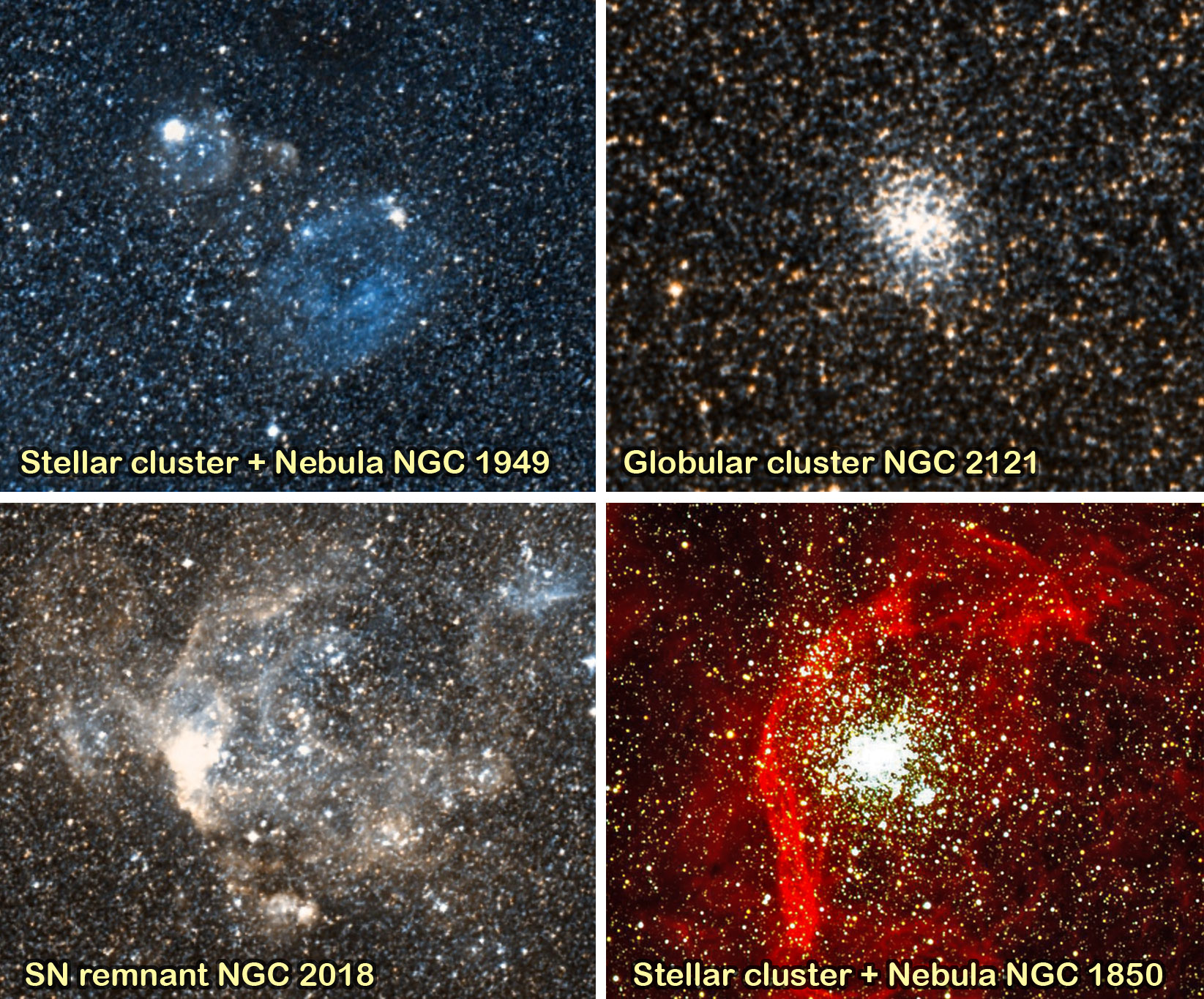
The chosen 4 objects are these:
1. Stellar cluster + Nebula NGC 1949
2. Globular cluster NGC 2121
3. Supernova remnant NGC 2018
4. Stellar cluster + Nebula NGC 1850
Objects chosen for the “LMC Little Gems with CACTI” Outreach Exercise at the AAT. From top left to bottom right they are: 1. Stellar cluster + Nebula NGC 1949, 2. Globular cluster NGC 2121, 3. SN remnant NGC 2018, 4. Stellar cluster + Nebula NGC 1850. Credit of the images: Digital Sky Survey, except for the image of NGC 1850, credited to ESO (image obtained using the FORS1 instrument at the VLT).
I chose objects in the LMC because this region of the sky can be observed during all night this time of the year.
In addition, getting these data for outreach purposes will not interfere too much with the scientific observations, as we need to change the configuration of the instrument (the gratings of the AAOmega spectrograph) and, while the night assistant is doing that, I will be taking the data of the object chosen by the public for this outreach exercise.
So, what do you think? What do you want the AAT observes tonight?
Assuming the weather is good and we don’t have any technical problems, I should have a new, nice outreach image obtained with CACTI at the AAT by tomorrow, Friday 25th November. Stay tuned!
After a very intense trip to Spain during July to September, I’m finally back to Australia, just in time to participate in the amazing StarFest 2016 in Coonabarabran, the “Astronomical Capital of Australia”, where Siding Spring Observatory is located.
First, on Friday 30th September we enjoyed the “Science in the Pub” event. I was part of the panel with Elisabete da Cunha (ANU), Fred Watson (AAO), Brad Moore (iTelescope) and David Malin (AAO). We talked about how astronomical images are taken and how to get the colours in Astronomy, with a lot of fun facts (thanks Fred!) about “what our eyes and brain try to see”.
“Science in the Pub” event in Coonabarabran (NSW, Australia) during StarFest 2016, Friday 30th September 2016. Participants are (from left to right): Ángel López-Sánchez (AAO/MQU), Elisabete da Cunha (ANU), Fred Watson (AAO), Brad Moore (iTelescope) and David Malin (AAO). High resolution version here. Photo credit: Steve Chapman (AAO).
Selfie Elisabete da Cunha and me took just moments before starting the “Science in the Pub” event in Coonabarabran (NSW, Australia) during StarFest 2016, Friday 30th September 2016. High resolution version here. Photo credit: Steve Chapman (AAO).
Me and the gift I received after the “Science in the Pub” event in Coonabarabran (NSW, Australia) during StarFest 2016, Friday 30th September 2016. High resolution version here. Photo credit: Steve Chapman (AAO).
On Saturday October 1st was the “Siding Spring Observatory Open Day”. Besides the bad weather, we had plenty of visitors of all ages, from kids to students to elders, all interested about Astronomy and Space. As usual I couldn’t stop talking to everyone, but I also took some photos. As I was jet-lagged (it was just 36 hours after I landed on Sydney) I was very early at the AAT and took some few photos with all ready to go!
The Anglo-Australian Telescope (AAT) is ready to start StarFest 2016!. Photo taken on Saturday 1 October 2016 during Siding Spring Observatory Open Day, part of StarFest 2016, in Coonabarabran (NSW, Australia). High resolution version here. Photo credit: Ángel R. López-Sánchez (AAO/MQ).
A lot of visitors at the Anglo-Australian Telescope during StarFest 2016 in Coonabarabran (NSW, Australia). Photo taken on Saturday 1 October 2016 during Siding Spring Observatory Open Day, part of StarFest 2016, in Coonabarabran (NSW, Australia). High resolution version here. Photo credit: Ángel R. López-Sánchez (AAO/MQ).
Doug Gray (AAO) explains how the AAT works to visitors of StarFest 2016. Photo taken on Saturday 1 October 2016 during Siding Spring Observatory Open Day, part of StarFest 2016, in Coonabarabran (NSW, Australia). High resolution version here. Photo credit: Ángel R. López-Sánchez (AAO/MQ).
A wonderful local orchestra was playing famous themes inside the AAT dome during the StarFest 2016. Photo taken on Saturday 1 October 2016 during Siding Spring Observatory Open Day, part of StarFest 2016, in Coonabarabran (NSW, Australia). High resolution version here. Photo credit: Ángel R. López-Sánchez (AAO/MQ).
However, it was particularly exciting to have a local orchestra playing in the dome! I don’t know who had the idea but was great, so I hope they do it again in the future. I couldn’t help myself and took this video of the orchestra playing two very famous themes: Star Wars and Indiana Jones.
A local orchestra plays the Star Wars & Indiana Jones themes inside the dome of the 3.9m Anglo-Australian Telescope (AAT) at Siding Spring Observatory near Coonabarabran (NSW, Australia) during StarFest 2016. Saturday 1 October 2016. Video credit: Ángel R. López-Sánchez (AAO/MQ).
I really enjoyed this day, and I’m looking forward participating again in StarFest 2017!


![NGC 2018 - Supernova remnant in the LMC Data taken on 24 November 2016 as part of the AAO Outreach Exercise “Large Magellanic Cloud Little Gems with CACTI”. CACTI camera in 2dF @ 3.9m Anglo-Australian Telescope. Color image using B (6 x 10s, blue) + [O III] (6 x 60 s, green) + Ha (8 x 60 s, red) filters. Credit: Ángel R. López-Sánchez (Australian Astronomical Observatory / Macquarie University) & Steve Lee, Robert Patterson & Robert Dean (AAO) Night assistant at the AAT: Steve Lee (AAO).](https://angelrls.com/wp-content/uploads/2016/11/ngc2018_bo3ha_lamina.jpg)






 A/Prof. Ángel R. López-Sánchez