Tag Archives: AAO

Kathryn’s Wheel: A ring of fireworks around a nearby galactic collision

Story based on the news release about Kathryn’s Wheel I prepared for the Australian Astronomical Observatory webpage.

The majority of the galaxies in the Universe can be classified into two well-distinguished classes: spiral galaxies (as our own Milky Way Galaxy) or elliptical galaxies. Spiral galaxies have on-going star-formation activity, possess a lot of young, blue stars, and are rich in gas and dust. However elliptical galaxies are just made up of old stars, with no signs of star formation, gas and dust. Besides these two large galaxy classes, some galaxies are found to have irregular or disturbed morphologies. That is certainly the case of many dwarf galaxies. A disturbed morphology is typically indicating a galaxy that has experienced an interaction with a nearby companion object. Indeed, all galaxies are experiencing interactions and mergers with other galaxies during their life time: the theory currently accepted about how galaxies grow and evolve naturally explains the building of spiral galaxies as mergers of dwarf galaxies, and the birth of an elliptical galaxy after the merger of two spiral galaxies. This will actually be the final destiny of our Milky Way, when it is colliding and merging with the Andromeda galaxy in around 4.5 billions years from now.

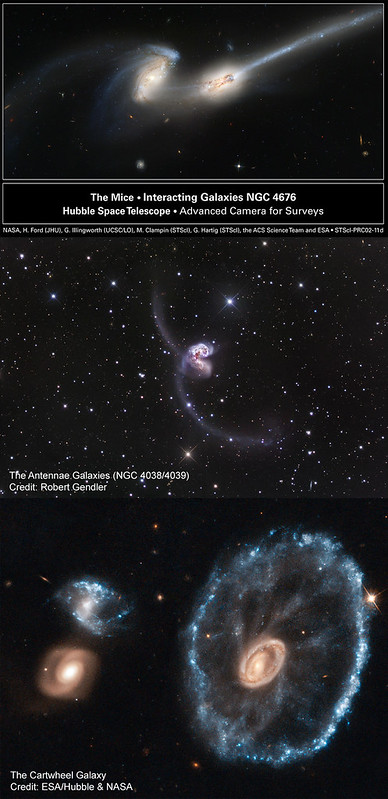
When galaxies collide, stars and gas are pulled out from them by gravity, and long tails of material stripped from the parent galaxies are formed. Famous galaxies in interaction developing these long “tidal tails” are the Mice Galaxies (NGC 4676) and the Antennae Galaxies (NGC 4038/4039). Very rarely, the geometry of the galaxy encounter is such that a small galaxy passes through the centre of a spiral galaxy creating a collisional ring galaxy. The ring structure is created by a powerful shock wave that sweeps up gas and dust, triggering the formation of new stars as the shock wave moves outwards. The most famous ring galaxy is the Cartwheel (ESO 350-40) galaxy, which is located at 500 million light-years away in the Southern constellation of the Sculptor. However complete ring galaxies are extremely rare in the Universe, only 20 of these objects are known.


Images of the interacting galaxies The Mice (NGC 4676), the Antennae Galaxies (NGC 4038/4039), and the Cartwheel (ESO 350-40) galaxy. Credit: The Mice: NASA, H. Ford (JHU), G. Illingworth (UCSC/LO), M.Clampin (STScI), G. Hartig (STScI), the ACS Science Team, and ESA, Antennae Galaxies: Robert Gendler, The Cartwheel: ESA/Hubble & NASA.

An international team of astronomers led by Prof. Quentin Parker (The University of Hong Kong / Australian Astronomical Observatory) has discovered a nearby ring galaxy which in some ways is similar to the Cartwheel galaxy but 40 times closer. The system was discovered as part of the observations of the AAO/UK Schmidt Telescope (UKST) Survey for Galactic H-alpha emission. Completed in late 2003, this survey used the 1.2m UKST at Siding Spring Observatory (NSW, Australia) to get wide-field photographic data of the Southern Galactic Plane and the Magellanic Clouds using a H-alpha filter. This special filter is able to trace the gaseous hydrogen (and not the stellar emission) within galaxies, allowing astronomers to detect the ionized gas from nebulae. The survey films were scanned by the SuperCosmos measuring machine at the Royal Observatory, Edinburgh (UK), to provide the online digital atlas “SuperCOSMOS H-alpha Survey” (SHS). When using this survey to search for new, undiscovered planetary nebulae (dying stars which often show ring morphologies in nebular emission) in the Milky Way, the team realised that a very peculiar of these structures was actually found around a nearby galaxy, ESO 179-13, located in the Ara (the Altar) constellation. The reason why this magnificent collisional ring structure has been unknown by astronomers is that it is located behind a dense star field (this area of the sky is very close to the Galactic plane, where the majority of the Milky Way stars are located) and very close to a bright foreground star.

Discovery images of the “Kathryn’s Wheel” using the data obtained at the 1.2m UKST by the “SuperCOSMOS H-alpha Survey” (SHS). The left panel (SR) shows the red image tracing mainly the stars. The three main components of the system are labelled. The central panel shows the image using the H-alpha filter (Hα), which sees both the diffuse ionized gas and the stars. The right panel (Hα-SR) shows the continuum-substracted image of the system, revealing for the very first time the intense collisional star-forming ring. Image credit: Quentin Parker / the research team.

The discovery SHS images of the system reveal 3 main structures (A, B and C) plus tens of H-alpha emitting knots making the ring. Component A is the remnant of the main galaxy, the collisional ring is centered on it. Component A does not possess ionized gas (that is, it does not have star-formation at the moment). On the other hand, component B seems to be the irregular, dwarf galaxy (“the bullet”) that impacted with the main galaxy. Component B does possess a clumpy and intense H-alpha emission.

Astronomers have dubbed this ring galaxy as “Kathryn’s Wheel” in honour of the wife of one of the discoverers, Prof. Albert Zijlstra, (University of Manchester, UK). Kathryn’s Wheel lies at a distance of 30 million light years away, and therefore it is an ideal target for detailed studies aiming to understand how these rare collisional ring galaxies are formed, the physics behind these structures, and their role in galaxy evolution. Interestingly, the collisional ring is not very massive: its mass is only a few thousand million Suns. This is less than ~1% of the Milky Way mass, indicating that ring galaxies can be formed around small galaxies, something that was not considered so far.

(Left) Colour image of the collision, made by combining data obtained at the Cerro-Tololo InterAmerican Observatory (CTIO) 4-metre telescope in Chile. The H-alpha image is shown in red and reveals the star-forming ring around the galaxy ESO 179-13, that has been dubbed “Kathryn’s Wheel”. Image credit: Ivan Bojicic / the research team. (Right) Image showing only the pure H-alpha emission of the system highlighting just the areas of active star formation. For clarity any remaining stellar residuals have been removed. Image credit: Quentin Parker / the research team.

Furthermore, the galaxy possesses a lot of diffuse, neutral hydrogen in its surroundings. This cold gas is the raw fuel that galaxies need to create new stars. Observations using the 64-m Parkes radiotelescope (“The Dish”, Parkes, NSW) as part of the “HI Parkes All-Sky Survey” (HIPASS) revealed that the amount of neutral gas around Kathryn’s Wheel is similar to the amount of mass found in stars in the system. Astronomers are unsure about from where this cold gas is coming from, although they suspect it mainly belonged to the main galaxy before the collision started. However, as the remnant of the galaxy (component A) does not have star-formation at the moment, it seems that the diffuse gas has been expelled from the centre of the system to the outskirts of the galaxy.

The results were published in MNRAS in August 2015.
MNRAS 452, 3759–3775 (2015) doi:10.1093/mnras/stv1432
Kathryn’s Wheel: a spectacular galaxy collision discovered in the Galactic neighbourhood
Authors: Quentin A. Parker, Albert A. Zijlstra, Milorad Stupar, Michelle Cluver, David J. Frew, George Bendo and Ivan Bojicic

Gas, star-formation and chemical enrichment in the spiral galaxy NGC 1512

How do galaxies grow and evolve? Galaxies are made of gas and stars, which interact in very complex ways: gas form stars, stars die and release chemical elements into the galaxy, some stars and gas can be lost from the galaxy, some gas and stars can be accreted from the intergalactic medium. The current accepted theory is that galaxies build their stellar component using their available gas while they increase their amount of chemical elements in the process. But how do they do this?

That is part of my current astrophysical research: how gas is processed inside galaxies? What is the chemical composition of the gas? How does star-formation happen in galaxies? How galaxies evolve? Today, 21st May 2015, the prestigious journal “Monthly Notices of the Royal Astronomical Society”, publishes my most recent scientific paper, that tries to provide some answers to these questions. This study has been performed with my friends and colleagues Tobias Westmeier (ICRAR), Baerbel Koribalski (CSIRO), and César Esteban (IAC, Spain). We present new, unique observations using the 2dF instrument at the 3.9m Anglo-Australian Telescope (AAT), in combination with radio data obtained with the Australian Telescope Compact Array (ATCA) radio-interferometer, to study how the gas in processed into stars and how much chemical enrichment has this gas experienced in a nearby galaxy, NGC 1512.

Deep images of the galaxy pair NGC 1512 and NGC 1510 using optical light (left) and ultraviolet light (right).Credit: Optical image: David Malin (AAO) using photographic plates obtained in 1975 using de 1.2m UK Schmidt Telescope (Siding Spring Observatory, Australia). UV image: GALEX satellite (NASA), image combining data in far-ultraviolet (blue) and near-ultraviolet (red) filters.

NGC 1512 and NGC 1510 is an interacting galaxy pair composed by a spiral galaxy (NGC 1512) and a Blue Compact Dwarf Galaxy (NGC 1510) located at 9.5 Mpc (=31 million light years). The system possesses hundreds of star-forming regions in the outer areas, as it was revealed using ultraviolet (UV) data provided by the GALEX satellite (NASA). Indeed, the UV-bright regions in the outskirts of NGC 1512 build an “eXtended UV disc” (XUV-disc), a feature that has been observed around the 15% of the nearby spiral galaxies. However these regions were firstly detected by famous astronomer David Malin (AAO) in 1975 (that is before I was born!) using photographic plates obtained with the 1.2m UK Schmidt Telescope (AAO), at Siding Spring Observatory (NSW, Australia).

The system has a lot of diffuse gas, as revealed by radio observations in the 21 cm HI line conducted at the Australian Telescope Compact Array (ATCA) as part of the “Local Volume HI Survey” (LVHIS) and presented by Koribalski & López-Sánchez (2009). The gas follows two long spiral structures up to more than 250 000 light years from the centre of NGC 1512. That is ~2.5 times the size of the Milky Way, but NGC 1512 is ~3 times smaller than our Galaxy! One of these structures has been somehow disrupted recently because of the interaction between NGC 1512 and NGC 1510, that it is estimated started around 400 million years ago.

Multiwavelength image of the NGC 1512 and NGC 1510 system combining optical and near-infrared data (light blue, yellow, orange), ultraviolet data from GALEX (dark blue), mid-infrared data from the Spitzer satellite (red) and radio data from the ATCA (green). The blue compact dwarf galaxy NGC 1510 is the bright point-like object located at the bottom right of the spiral galaxy NGC 1512.
Credit: Ángel R. López-Sánchez (AAO/MQ) & Baerbel Koribalski (CSIRO).

Our study presents new, deep spectroscopical observations of 136 genuine UV-bright knots in the NGC 1512/1510 system using the powerful multi-fibre instrument 2dF and the spectrograph AAOmega, installed at the 3.9m Anglo-Australian Telescope (AAT).

2dF/AAOmega is generally used by astronomers to observe simultaneously hundreds of individual stars in the Milky Way or hundreds of galaxies. Without considering observations in the Magellanic Clouds, it is the first time that 2dF/AAOmega is used to trace individual star-forming regions within the same galaxy, in some way forming a huge “Integral-Field Unit” (IFU) to observe all the important parts of the galaxy.

Two examples of the high-quality spectra obtained using the AAT. Top: spectrum of the BCDG NGC 1510. Bottom: spectrum of one of the brightest UV-bright regions in the system. The important emission lines are labelled.
Credit: Ángel R. López-Sánchez (AAO/MQ), Tobias Westmeier (ICRAR), César Esteban (IAC) & Baerbel Koribalski (CSIRO).


The AAT observations confirm that the majority of the UV-bright regions are star-forming regions. Some of the bright knots (those which are usually not coincident with the neutral gas) are actually background galaxies (i.e., objects much further than NGC 1512 and not physically related to it) showing strong star-formation activity. Observations also revealed a knot to be a very blue young star within our Galaxy.

Using the peak of the H-alpha emission, the AAT data allow to trace how the gas is moving in each of the observed UV-rich region (their “kinematics”), and compare with the movement of the diffuse gas as provided using the ATCA data. The two kinematics maps provide basically the same results, except for one region (black circle) that shows a very different behaviour. This object might be an independent, dwarf, low-luminosity galaxy (as seen from the H-alpha emission) that is in process of accretion into NGC 1512.

Map showing the velocity field of the galaxy pair NGC 1512 / NGC 1510 as determined using the H-alpha emission provided by the AAT data. This kinematic map is almost identical to that obtained from the neutras gas (HI) data using the ATCA, except for a particular region (noted by a black circle) that shows very different kinematics when comparing the maps.
Credit: Ángel R. López-Sánchez (AAO/MQ), Tobias Westmeier (ICRAR), César Esteban (IAC) & Baerbel Koribalski (CSIRO).

The H-alpha map shows how the gas is moving following the optical emission lines up to 250 000 light years from the centre of NGC 1512, that is 6.6 times the optical size of the galaxy. No other IFU map has been obtained before with such characteristics.

Using the emission lines detected in the optical spectra, which includes H I, [O II], [O III], [N II], [S II] lines (lines of hydrogen, oxygen, nitrogen and sulphur), we are able to trace the chemical composition -the “metallicity”, as in Astronomy all elements which are not hydrogen or helium as defined as “metals”- of the gas within this UV-bright regions. Only hydrogen and helium were created in the Big Bang. All the other elements have been formed inside the stars as a consequence of nuclear reactions or by the actions of the stars (e.g., supernovae). The new elements created by the stars are released into the interstellar medium of the galaxies when they die, and mix with the diffuse gas to form new stars, that now will have a richer chemical composition than the previous generation of stars. Hence, tracing the amount of metals (usually oxygen) within galaxies indicate how much the gas has been re-processed into stars.


Metallicity map of the NGC 1512 and NGC 1510 system, as given by the amount of oxygen in the star-forming regions (oxygen abundance, O/H). The colours indicate how much oxygen (blue: few, green: intermediate, red: many) each region has. Red diamonds indicate the central, metal rich regions of NGC 1512. Circles trace a long, undisturbed, metal-poor arm. Triangles and squares follow the other spiral arms, which is been broken and disturbed as a consequence of the interaction between NGC 1512 and NGC 1510 (blue star). The blue pentagon within the box in the bottom right corner represents the farthest region of the system, located at 250 000 light years from the centre.
Credit: Ángel R. López-Sánchez (AAO/MQ), Tobias Westmeier (ICRAR), César Esteban (IAC) & Baerbel Koribalski (CSIRO).


The “chemical composition map” or “metallicity map” of the system reveals that indeed the centre of NGC 1512 has a lot of metals (red diamonds in the figure), in a proportion similar to those found around the centre of our Milky Way galaxy. However the external areas show two different behaviours: regions located along one spiral arm (left in the map) have low amount of metals (blue circles), while regions located in other spiral arm (right) have a chemical composition which is intermediate between those found in the centre and in the other arm (green squares and green triangles). Furthermore, all regions along the extended “blue arm” show very similar metallicities, while the “green arm” also has some regions with low (blue) and high (orange and red) metallicities. The reason of this behaviour is that the gas along the “green arm” has been very recently enriched by star-formation activity, which was triggered by the interaction with the Blue Compact Dwarf galaxy NGC 1510 (blue star in the map).

When combining the available ultraviolet and radio data with the new AAT optical data it is possible to estimate the amount of chemical enrichment that the system has experienced. This analysis allows to conclude that the diffuse gas located in the external regions of NGC 1512 was already chemically rich before the interaction with NGC 1510 started about 400 million years ago. That is, the diffuse gas that NGC 1512 possesses in its outer regions is not pristine (formed in the Big Bang) but it has been already processed by previous generations of stars. The data suggest that the metals within the diffuse gas are not coming from the inner regions of the galaxy but very probably they have been accreted during the life of the galaxy either by absorbing low-mass, gas-rich galaxies or by accreting diffuse intergalactic gas that was previously enriched by metals lost by other galaxies.

In any case this result constrains our models of galaxy evolution. When used together, the analysis of the diffuse gas (as seen using radio telescopes) and the study of the metal distribution within galaxies (as given by optical telescopes) provide a very powerful tool to disentangle the nature and evolution of the galaxies we now observe in the Local Universe.

More information

Scientific Paper in MNRAS: “Ionized gas in the XUV disc of the NGC 1512/1510 system”. Á. R. López-Sánchez, T. Westmeier, C. Esteban, and B. S. Koribalski.“Ionized gas in the XUV disc of the NGC1512/1510 system”, 2015, MNRAS, 450, 3381. Published in Monthly Notices of the Royal Astronomical Society (MNRAS) through Oxford University Press.

AAO/CSIRO/ICRAR Press Release (AAO): Galaxy’s snacking habits revealed

AAO/CSIRO/ICRAR Press Release (ICRAR): Galaxy’s snacking habits revealed

Royal Astronomical Society (RAS) Press Release: Galaxy’s snacking habits revealed

Article in Phys.org: Galaxy’s snacking habits revealed

Article in EurekAlert!: Galaxy’s snacking habits revealed

Article in Press-News.org: Galaxy’s snacking habits revealed

Article in Open Science World: Galaxy’s snacking habits revealed

ATNF Daily Astronomy Picture on 21st May 2015.

New AAO video: Rainbow Fingerprints

Have you ever wondered how telescopes collect the light of the stars to be later analyzed by the astronomers? This new AAO video, entitled Rainbow Fingerprints shows how this is done at the Anglo-Australian Telescope (AAT). The video was produced by AAO Astronomer and Outreach Officer Amanda Bauer, and I have collaborated providing not only the sequences of the AAT outside and inside the dome (which were extracted from my timelapse A 2dF night at the AAT) but also providing comments during the production process.

Video “Rainbow Fingerprints” showing how the light of distant galaxies in collected by the Anglo-Australian Telescope and directed to the AAOmega spectrograph using optical fibres. More information in the AAO webpage Rainbow Fingerprints. Credit: AAO, movie produced by Amanda Bauer (AAO).

The light coming from distant galaxies is first collected using the primary mirror of the telescope, which has a diameter of 4 meters, and then it is sent using optical fibres (the 2dF system) to a dark room where the AAOmega spectrograph is located. This spectrograph, which is a series of special optics, separates the light into its rainbow spectrum, in a similar way a prism separates white light into a rainbow. The separated light is later focussed onto the CCD detector. Finally the video reveals the science quality spectra for two different types of galaxies, one spiral (top panel) and one elliptical (bottom panel), using actual data obtained with the AAT and the AAOmega spectrograph. The information codified in the rainbow fingerprint identifies each galaxy unambiguously: distance, star formation history, chemical composition, age, physical properties as the temperature or the density of the diffuse gas, and many more.

I hope you enjoy it!

The Anglo-Australian Telescope turns 40

On 16th October 1974, His Royal Highness the Prince of Wales formally opened the 3.9m Anglo-Australian Telescope (AAT, Siding Spring Observatory, NSW, Australia) for scientific operations. Hence the AAT (the telescope where I work) turned 40 last Thursday. We actually had some celebrations and events at the Australian Astronomical Observatory that day, including the release of this wonderful 8 min movie: Steve and the Stars,


The star of the show is Head Telescope Operator, Steve Lee, who has worked at the AAT for almost its entire 40 years of operation. Steve guides this video tour of working with the AAT, exploring how observational techniques have changed from the 1970s to today’s digital age, and the AAT’s exciting future pursuing more world-class discoveries. Famous astrophotographer David Malin co-stars the show. Some material taken from my astronomical time-lapses has been also used for this film.

After the public event for the “AAT 40th Anniversary Celebration” I couldn’t help myself and took this photo with all of us:

Photo taken at the end of the public event for the “AAT 40th Anniversary Celebration”, Thursday 16th Oct 2014. From left to right: Warrick Couch (AAO Director), Steve Lee (Head AAT Operators), Amanda Bauer (AAO Outreach Officer), David Malin (AAO famous astrophotographer) and Andrew Hopkins (Head of AAT Astro Science). Ah, yes, it is also me smiling as a little kid. Credit: Á.R.L.-S.

Happy 40th Birthday, AAT!

First “AAO Guerrilla Astronomy” event: partial solar eclipse on 29 April 2014 over Sydney Harbour

Last Tuesday 29th April the Earth, the Moon, and the Sun aligned to produce one of the most spectacular astronomical phenomena we can see: a solar eclipse. The 29th April solar eclipse was actually not a total eclipse (i.e., the disc of the Moon didn’t cover all the disc of the Sun) but an Annular eclipse. The annular phase could be only visible in Antarctica, but a partial solar eclipse was seen throughout Australia in the late afternoon. More information about this solar eclipse can be found in the NASA Eclipse Website managed by the astrophysicist Fred Espenak.

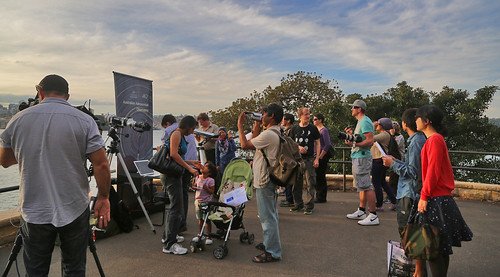
The Sun would be eclipsed by the Moon during the sunset, it was then a perfect opportunity to get some nice photos of the eclipsed Sun with some famous buildings such the Sydney Opera House or Sydney Harbour Bridge. With this excuse, but also with the idea of showing the wonders of Nature to the public, a group of astrophysicists working at Australian Astronomical Observatory (AAO) decided use this solar eclipse to organize our first “Guerrilla Astronomy” event (*). The aim of these activities is to set up amateur telescopes in a public area (a park or a shopping center) and explain to the public who is around what Astronomy is, what astronomers do, and what the “Australian Astronomical Observatory” is. More of these events are coming in the future, but this was our first “test” to see how we can organize and manage the activity.


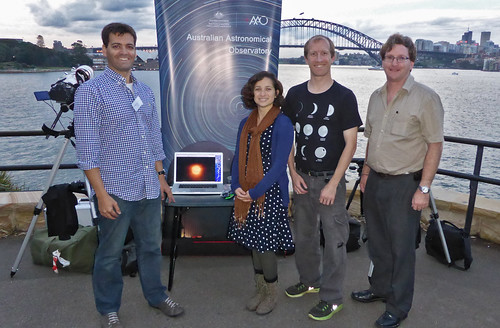
Participants to the first AAO “Guerrilla Astronomy” Event. From right to left, Stuart Ryder (AAO/AusGO), Kyler Kuehn (AAO), Paola Oliva-Altamiro (Swinburne/AAO) and Ángel R. López-Sánchez (AAO/MQ). The laptop shows the only good image we could get of the eclipse using my telescope. Mrs Macquarie Chair, Sydney Botanic Gardens / Domain, 29 Apr 2014.
Photo Credit: Stuart Ryder (AAO/AusGO).

Given the time and position of the Sun during the eclipse, we decided that a really nice spot to prepare our telescopes would be Mrs Macquarie Chair point, in the Domain, Sydney Botanic Gardens. From there a very dramatic view of the Sydney Opera House and the Sydney Harbour Bridge is seen. We first requested permission to do this to the authorities of the Domain, who were really nice and even allowed us to park by free. Actually, they also came along to see the eclipse and they liked our idea of organizing more “Guerrilla Astronomy” events there in the nearby future.


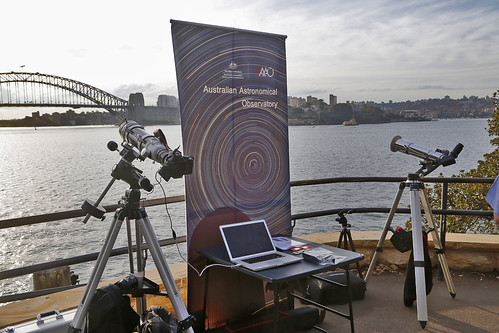
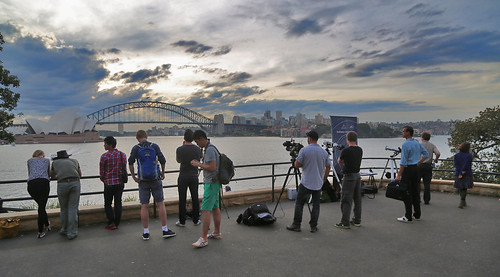
All set up for eclipse: two telescopes (Stuart’s at the right, mine at the left), the AAO banner, my laptop and camera to take photos through the telescope, the eclipse glasses and extra information about the eclipse to give to the visitors. Mrs Macquarie Chair, Sydney Botanic Gardens / Domain, 29 Apr 2014.
Photo Credit: Ángel R. López-Sánchez (AAO/MQ).

It was four of us, Stuart Ryder (AAO/AusGO), Kyler Kuehn (AAO), Paola Oliva-Altamiro (Swinburne/AAO) and myself, who participated in this first “Guerrilla Astronomy” event. Just to have everything ready on time, we were setting up telescopes, AAO banner and laptop around an hour before the beginning of the eclipse. The weather seemed very clear in the morning, but in the afternoon, as we feared, some clouds started to arrive from the west. We already knew this would be a killer… but we had to try!


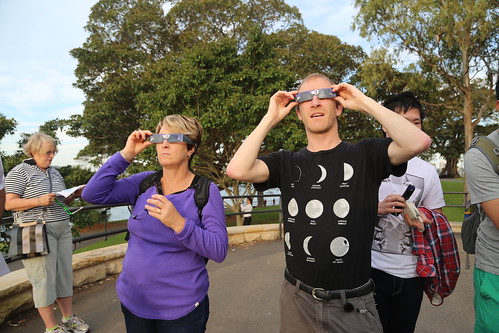
Kyler and visitor using the solar glasses. First AAO “Guerrilla Astronomy” Event: partial solar eclipse on 29 April 2014 over Sydney Harbour. Mrs Macquarie Chair, Sydney Botanic Gardens / Domain.
Photo Credit: Paola Oliva-Altamiro (Swinburne/AAO).


Little girl using the eclipse glasses. First AAO “Guerrilla Astronomy” Event: partial solar eclipse on 29 April 2014 over Sydney Harbour. Mrs Macquarie Chair, Sydney Botanic Gardens / Domain.
Photo Credit: Paola Oliva-Altamiro (Swinburne/AAO).


Visitors, but clouds please go away! First AAO “Guerrilla Astronomy” Event: partial solar eclipse on 29 April 2014 over Sydney Harbour. Mrs Macquarie Chair, Sydney Botanic Gardens / Domain.
Photo Credit: Paola Oliva-Altamiro (Swinburne/AAO).

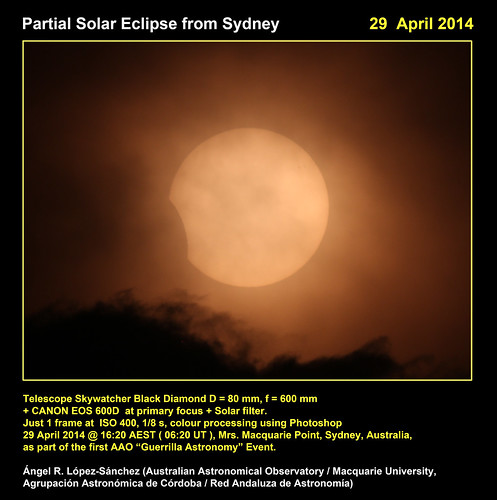
We actually were a bit lucky at the beginning, and hence we could see the Sun within thin clouds and follow the eclipse for 10 minutes. I even could take a nice image:


Partial Solar Eclipse from Sydney on 29 Apr 2014. Telescope Skywatcher Black Diamond D = 80 mm, f = 600 mm + CANON EOS 600D at primary focus + Solar filter. Just 1 frame at ISO 400, 1/8 s, colour processing using Photoshop. 29 April 2014 @ 16:20 AEST ( 06:20 UT ). First AAO “Guerrilla Astronomy” Event: partial solar eclipse on 29 April 2014 over Sydney Harbour. Mrs Macquarie Chair, Sydney Botanic Gardens / Domain.
Photo Credit: Ángel R. López-Sánchez (AAO/MQ).

After that, thick clouds arrived and this happened:

5-seconds timelapse video obtained combining 25 images taken with Telescope Skywatcher Black Diamond D = 80 mm, f = 600 mm + CANON EOS 600D at primary focus + Solar filter, at ISO 400, 1/8 s, showing how the clouds completly cover the eclipsed sun. 29 April 2014 @ 16:20 AEST ( 06:20 UT ). The direct link to the YouTube video is here.
Credit: Ángel R. López-Sánchez (AAO/MQ).

Once the Sun was completely covered by thick clouds we just waited and hoped for a little gap, but unfortunately this never happened and we didn’t see the Sun again that day.


Stuart and his telescope, Kyler and visitors, all hoping the clouds go away. First AAO “Guerrilla Astronomy” Event: partial solar eclipse on 29 April 2014 over Sydney Harbour. Mrs Macquarie Chair, Sydney Botanic Gardens / Domain.
Photo Credit: Paola Oliva-Altamiro (Swinburne/AAO).


The eclipsed sun is setting behind those think clouds. First AAO “Guerrilla Astronomy” Event: partial solar eclipse on 29 April 2014 over Sydney Harbour. Mrs Macquarie Chair, Sydney Botanic Gardens / Domain.
Photo Credit: Ángel R. López-Sánchez (AAO/MQ).

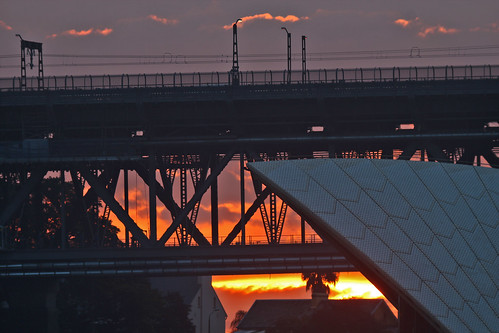
Well, it would have been really nice to see the eclipsed sun setting over the Sydney Harbour Bridge and sinking later close to the Sydney Opera House, I’m sure the images and time-lapse video would have been quite spectacular, but the best I got was this image:


An eclipsed sun should be setting around there… Imagen taken using a Telescope Skywatcher Black Diamond D = 80 mm, f = 600 mm + CANON EOS 600D at primary focus. First AAO “Guerrilla Astronomy” Event: partial solar eclipse on 29 April 2014 over Sydney Harbour. Mrs Macquarie Chair, Sydney Botanic Gardens / Domain.
Photo Credit: Ángel R. López-Sánchez (AAO/MQ).

In any case, all four AAO participants were very happy about how the event was and, as I said, we are expecting to repeat these “Guerrilla Astronomy” activities in the nearby future.

Next solar eclipse to touch Australia will be on 9 March 2016, but it will also be a partial eclipse only visible on the northern and western parts of the continent. The next total eclipse to be seen from Australia will happen on 20 April 2023 and it will just touch the coast of Western Australia. We have to wait until 22 July 2028 to see a total solar eclipse in Sydney. Actually, Sydney is almost exactly in the center of the totality.

More photos of this event can be found in this Flickr Album.

(*) Note that the word “Guerrilla” comes from Spanish, however the name didn’t come from me but from an idea my colleague Amanda Bauer (AAO Outreach Officer) had some months ago. As a native Spanish speaker I have to confess it is really hard to hear the pronunciation of “Guerrilla” following English phonemes as “Guerrilla Astronomy” sounds almost identical toGorilla Astronomy“. I would encourage to try to pronounce “Guerrilla” as it is said in Spanish (geˈri.ʝa) to be released of this confusion, but of course that is only my modest suggestion than can be completely ignored…