Tag Archives: astronomy

Image

Total Lunar Eclipse – 26 May 2021

Total Lunar Eclipse - 26 May 2021

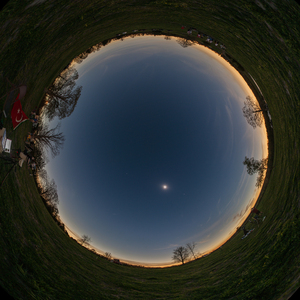
This image combines 50 x 1″ exposures, ISO 800, obtained with my CANON 5D Mark III attached at primary focus of my Skywatcher Black Diamond 80mm f600mm (F/7.5) during the Total Lunar Eclipse on Wednesday 26 May 2021, between 9:00pm and 9:04pm, Sydney local time.

The frames were manually aligned with Photoshop, then extracted as new frames to Lynkeos, that did the fine alignment. Drizzling x2 was also used. Then the combined image was taken to Photoshop, where the colour, highlights/shadows, and contrast were tuned. This got only the image of the eclipsed moon.

Additionally, I combined the full 266 x 1″ images I took during totality using Siril to get the stellar background.

They two combined frames (eclipsed moon + stars) were combined with Photoshop with a bit of extra tuning to get a nice background.

The image taken at 9:03pm was used as reference for the alignment.

All the data were taken during the 4 hours “ONLINE” event “Conversaciones astronómicas bajo la luna eclipsada” that I organised with the “Red Andaluza de Astronomía” (RAdA), “Agrupación Astronómica de Córdoba” (AAC), “Asociación de Lengua y Cultura Española” (ALCE) de Australia and the “Spanish Researchers in Australia-Pacific” (SRAP-IEAP), that was followed by many schools in Spain.

I also want to thank Alicia Lozano (RAdA), Héctor Socas-Navarro (Instituto de Astrofísica de Canarias), María Ribes (Universidad de Alicante) and Alberto Aparici (Instituto de Física Corpuscular de Valencia) for the conversation they had during the event while I was taking this images.

Full resolution image in My Flickr.

Credit: Ángel R. López-Sánchez (Australian Astronomical Optics, Macquarie University).

Pink SuperMoon (or not)

Pink SuperMoon (or not)

Image of the (not) Pink (you won’t see the difference) Super Moon obtained from our backyard in Sydney on Tuesday 27th April 2021, at 8:30pm local time.

This image combines 50 frames, 35ms each, obtained with a ZWO 1600MM-Pro at -20C, gain 100, using a ultra-narrow (3.5nm thick) H-alpha Baader filter.

The telescope used was a refractor Skywatcher Black Diamond 80mm, with a x0.75 focal reducer (effective focal length of 430mm) on a Skywatcher AZ-EQ6 Pro mount, everything controlled with the ZWO ASIAir.

The images (not corrected for darks or flatfield) were aligned and stacked using the Lynkeos software, also using the x2 Drizzle. The combined FITS image was then converted into TIF using Fits Liberator considering an Asinh scaling. Further adjustments with the contrast, shadows/highlights, and smart sharpening was performed in Photoshop.

Credit of the image: Luke López-Planells & Ángel R. López-Sánchez (AAO-MQ).

A high-resolution version of this image is available in MyFlickr.

Webinar: “A (very brief) introduction to Astrophotography”

The other day I uploaded to my YouTube channel the full recording of the webinar “A (very brief) introduction to Astrophotography“, that I gave on the 3rd October 2020 for the online events for “StarFest 2020”, Siding Spring Observatory, NSW, Australia.

The abstract of the talk is:

The sky is open to everybody. Thanks to the advance of the technology, amateur astronomers are obtaining outstanding images of the sky, even from their backyards, using DSLR cameras and small telescopes. In this webinar I provided a very broad introduction to the basics of Astrophotography, from the best settings for getting the images using DSLRs and telescopes to how to process the data.

Please, note that I couldn’t go in deep in almost any aspect of Astrophotography, just providing some very global ideas, enumerating the techniques, providing some key tricks (focusing, stacking images, use RAW) and show some of my best astrophotos.

I want to thank Brad Tucker (RSAA, ANU) for the invitation to give this webinar, also thanks for being the MC for this.

Credit: Ángel R. López-Sánchez (AAO-MQ).

A test of the Eagle Nebula from Sydney

A test of the Eagle Nebula from Sydney

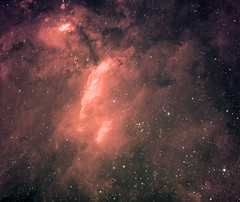
This is my first test image of the Eagle Nebula (M 16) using my amateur equipment from my backyard, 15 km North from Sydney’s city center, on 1st July 2020.

This image compiles 32 x 300s images (2 hours 40 minutes total integration time) obtained with my Skywatcher Black Diamond 80, an Orion X0.8 focal reducer (f/6), the ZWO ASI178MC camera and an OPTOLONG L-Pro filter.

I used the ZWO ASIAir to control the camera, the mount (Skywatcher AZ-EQ6) and the guiding system (ASI120MM + Orion 50mm finderscope).

Flats and darks included. Data processed with Siril software. Color / saturation / levels / contrast / smart sharpen with Photoshop.

Full resolution image in my Flickr.

Credit: Ángel R. López-Sánchez (AAO-MQ).

Video: Understanding the colours of nebulae

Today I’ve released in my YouTube Channel the very first video of a series that seeks to connect professional astrophysics with amateur astronomy and outreach. This video, is entitled “Understanding the colours of the nebulae“, or why square brackets are important when naming metallic transitions in nebulae.

Do you know how profesional astrophysicists and amateur astronomers get vibrant colour images of nebulae? In this video I provide insights of the Physics behind these images. I emphasise why the ionic transitions of metallic elements (i.e., any element that is not hydrogen or helium) in nebulae must be written with brackets, as they are not recombination lines but collisional excited lines, that is, a kind of forbidden lines that only appear in extreme low-density gases because of the collision of ions with free electrons in the gas.

The video includes my subtitles in both English and Spanish.

An extended article about the video will be added here soon.

I hope you like it! And remember: